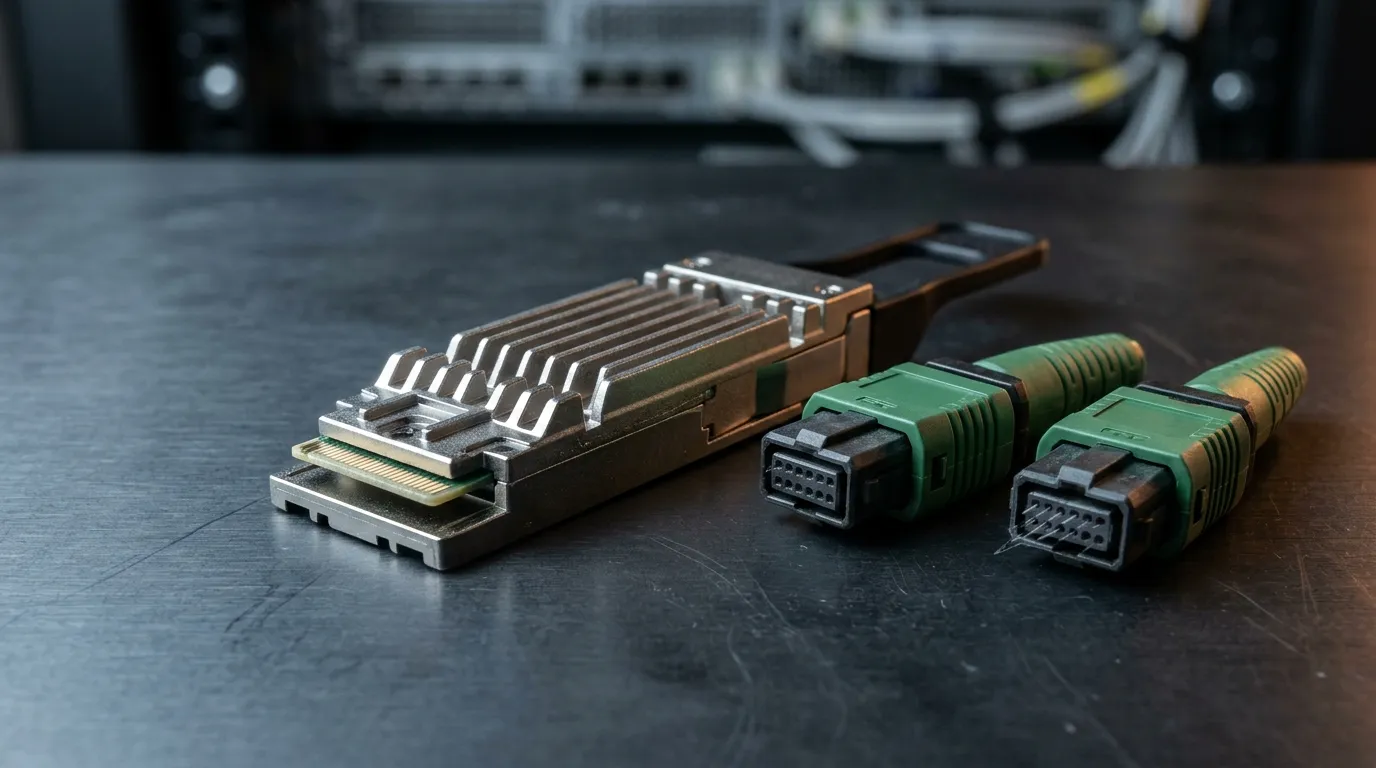
MPO Patch Cord Certification: Demand Proof
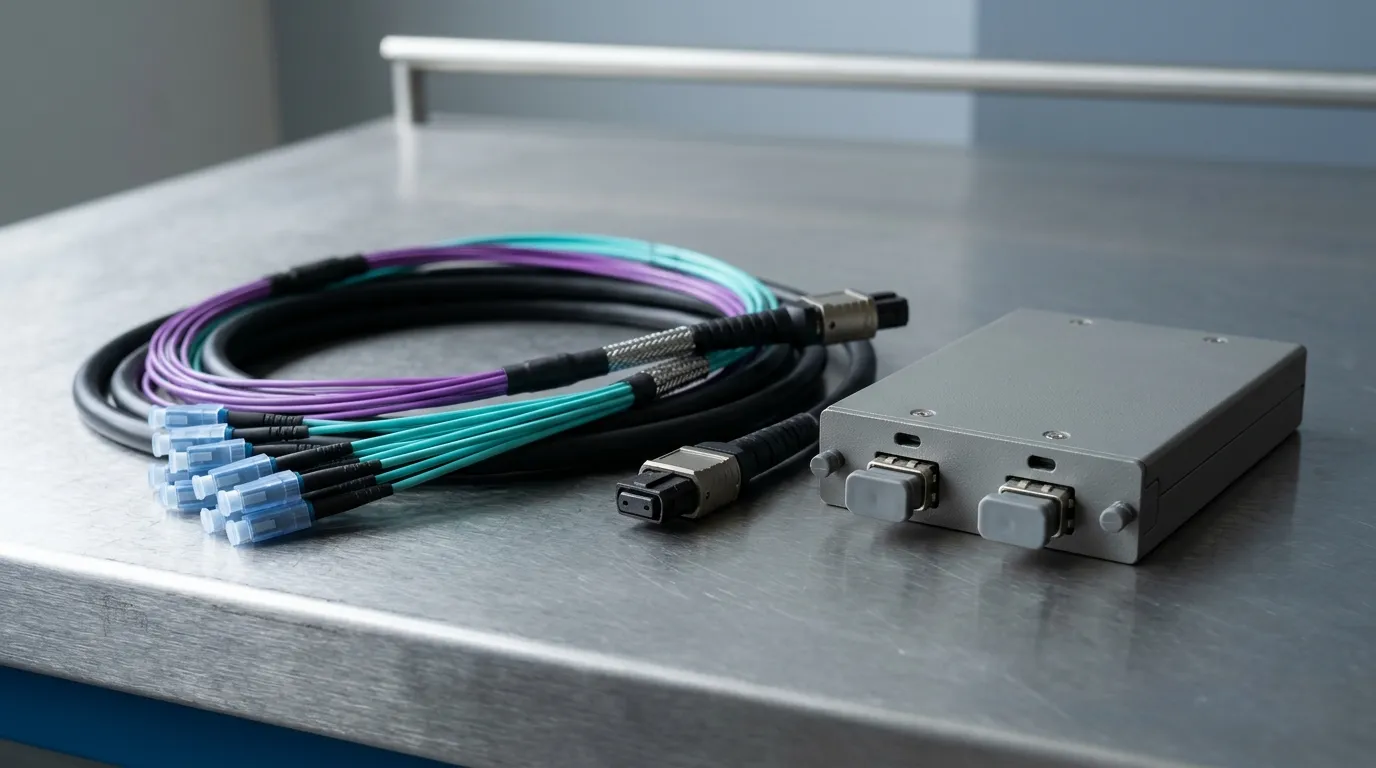
What a Certificate Has to Prove Before a Reel Ships
MPO patch cord certification questions arrive at the worst moment: the cords are built, the project is waiting, and someone forwards a folder of PDFs with the line "all certified". The folder usually contains an ISO 9001 certificate, a RoHS statement scanned on letterhead, a CE mark pictured on a bag, and something described as a UL certificate. Four documents, one sentence of reassurance, and no way to tell whether any of them is about the twelve-fiber assembly sitting in the crate.
The reason they do not add up is that those four documents answer four different questions, and MPO patch cord certification is not a badge — it is a chain from a legal instrument to a document type to a product identification that matches your part number. Break any link and the paperwork still looks complete. A certificate can be genuine, current, issued by a recognized body and still not cover the thing you bought.
That is what this page fixes. It walks the four regimes in the order a purchase order meets them, quotes the primary text behind each, and ends with the clause to put in the PO and the check to run at goods-in. It assumes the design is already settled — fiber count, polarity type, polish and loss grade. For that layer, the data center fiber cabling hub and the polarity guide are the right pages; this one starts where the design ends. And it does not replace the general framework: if you are still working out which European scheme applies to structured cabling at all, read the CE, RoHS and REACH guide for fiber cable first and come back.
Four Regimes, Four Documents, One Datasheet
Every MPO datasheet collapses four separate systems into one word — "certified". Separate them once and the folder becomes readable.
Regime | Legal basis | Document that exists | Who issues it | What it can cover |
|---|---|---|---|---|
RoHS | Directive 2011/65/EU, Annex II as amended | EU declaration of conformity, supported by technical documentation; a lab report is optional evidence | The manufacturer, self-declared | Substances in homogeneous materials |
CE marking | Regulation (EC) 765/2008 and the sector legislation providing for the mark | The same declaration of conformity, plus the mark on product or packaging | The manufacturer | Only the legislation named on the declaration |
CPR | Regulation (EU) 305/2011 with EN 50575 | Declaration of performance, test report, notified-body certificate | Manufacturer, with a notified body for higher classes | Cables for permanent installation in construction works |
UL | UL standards and the UL certification schemes | Listing record, or Recognized Component record — different marks — verifiable in UL Product iQ | UL Solutions | The product family and category named in the record |
Two things fall out of that table before any detail. First, three of the four rely on the same underlying act — the manufacturer declaring, then being ready to prove it. Second, only one of the four states a fire classification for permanent installation as its own subject — the CPR Euroclass — and it is not the one suppliers quote most often. In North America the same question is answered through the UL listing and the electrical code, which the UL section below comes back to.
The Construction Products Regulation is also the regime most often mis-applied to a patch cord, for a reason worth stating precisely: Article 2(1) of Regulation (EU) 305/2011 defines a construction product as one "produced and placed on the market for incorporation in a permanent manner in construction works or parts thereof". A patch cord plugs into a port. It is not incorporated in a permanent manner in anything, so a CPR declaration of performance is normally the wrong document for it — and when a supplier sends one for a patch cord, it is nearly always the declaration for the bulk cable the cord was made from.
RoHS: What the Directive Actually Says About a Cable
Start with the text, because the trade version of it is wrong in a way that matters at goods-in.
Directive 2011/65/EU Article 4(1) reads: Member States shall ensure that EEE placed on the market, including cables and spare parts for its repair, its reuse, updating of its functionalities or upgrading of its capacity, does not contain the substances listed in Annex II. Cables are named in the operative sentence. Whatever argument exists about whether a passive optical cord is "equipment" in the abstract, the directive's own drafting puts cable inside the restriction, and that is why every serious supplier declares.
The limits are the part buyers misread. Article 4(2) tolerates no more than the maximum concentration "by weight in homogeneous materials". Homogeneous, in the Commission's own guidance on the directive, means a material that cannot be mechanically disjointed into different materials — so the limit applies to the jacket compound, the housing plastic, the boot, the epoxy, each on its own, not to an average across the assembly. Annex II, as replaced by Delegated Directive (EU) 2015/863, lists ten substances: lead, mercury and hexavalent chromium at 0.1 %, cadmium at 0.01 %, PBB and PBDE at 0.1 %, and the four phthalates DEHP, BBP, DBP and DIBP at 0.1 %. The phthalate block is the one that catches older declarations: a certificate drawn up before that amendment covers six substances, and a plasticized compound is exactly where a phthalate would sit.
Now the part that decides what to ask for. RoHS is a self-declaration regime. Article 7(1) requires the manufacturer to draw up technical documentation and carry out internal production control following Module A of Annex II to Decision 768/2008/EC, then draw up the EU declaration of conformity and affix the CE marking. No notified body is involved, and no third-party test is legally required. Article 16(2) adds the comfort: materials tested or assessed in accordance with harmonised standards whose references are published in the Official Journal are presumed to comply.
So a "RoHS certificate" is not a legal instrument. It is either a declaration the manufacturer wrote, or a laboratory report on a sample. Both are useful; neither is what your compliance team actually files.
One more regime belongs in the same file and is routinely left out. REACH — Regulation (EC) No 1907/2006 — treats a patch cord as an article, and Article 33 places an information duty on whoever supplies it: where an article contains a Candidate List substance of very high concern above 0.1 % by weight, the recipient must receive enough information to use it safely, and at minimum the substance's name. A RoHS declaration answers none of that — different list, different threshold question, different duty — so a European file for a patch cord normally pairs the declaration of conformity with a dated SVHC statement. Where the threshold is exceeded, the notification route is ECHA's SCIP database, and that duty falls on the EU supplier or importer rather than on the non-EU factory.
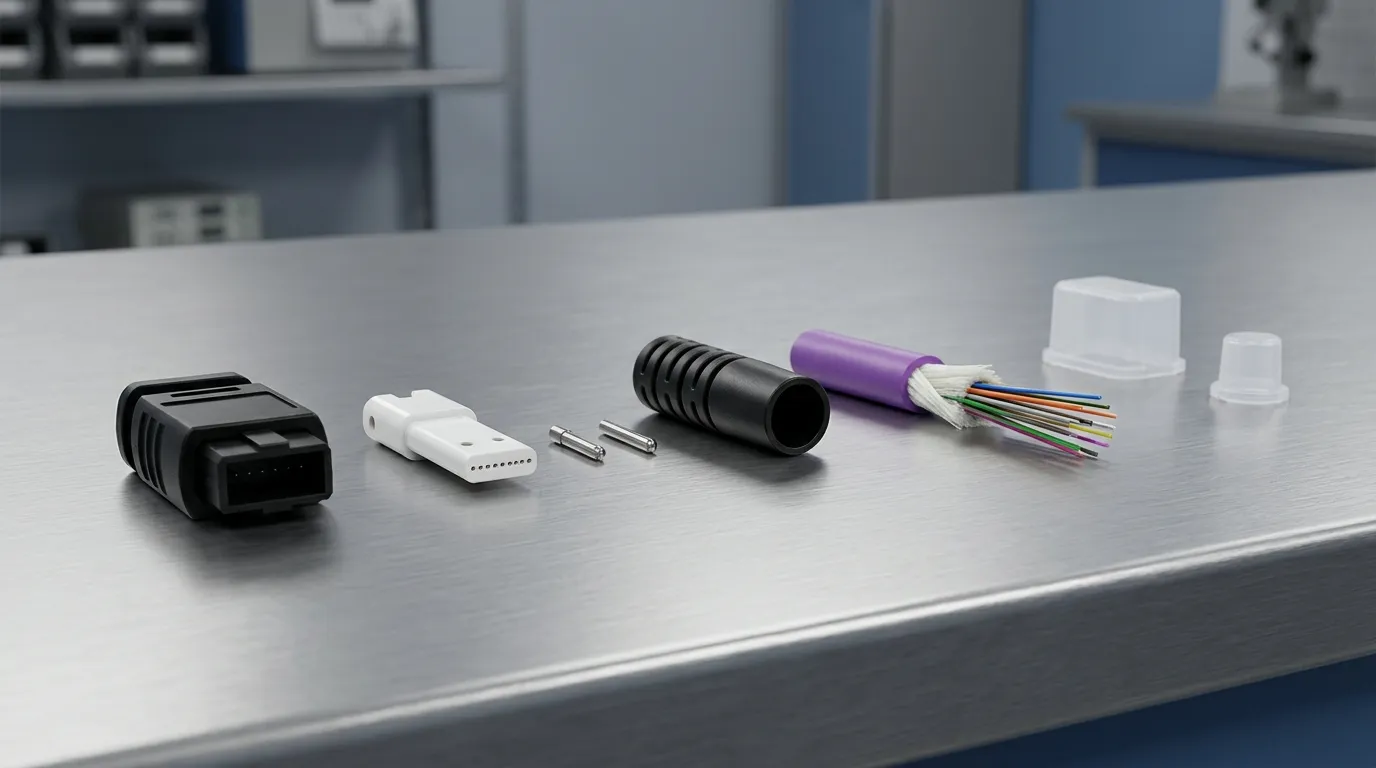
Why the limit is per material, not per assembly: a single MPO cord is a stack of separately-declared plastics, ceramics and metals, and each one carries its own declaration.
CE Marking: Name the Instrument, or Discount the Mark
A CE mark is not a quality mark and not a safety badge. It is a statement that a specific piece of Union legislation applies to the product and has been satisfied — which means the interesting question is always which one.
Regulation (EC) No 765/2008, Article 30(2), is explicit: the CE marking "shall be affixed only to products to which its affixing is provided for by specific Community harmonisation legislation, and shall not be affixed to any other product." The Commission's Blue Guide draws the conclusion in one line — a product may not be CE marked unless it is covered by legislation providing for its affixing — and then goes further: affixing the mark to a product that no such legislation covers "is considered to be deceiving", because users infer a conformity that was never assessed.
That is not a technicality to wave at a supplier; it is the question to ask. For a passive MPO patch cord, the honest answer is usually RoHS, and only RoHS: no low-voltage directive, no EMC directive, no machinery directive applies to a light guide. A supplier who can only say "CE certified" has told you nothing you can file. A supplier who says "CE marking under Directive 2011/65/EU, declaration of conformity available" has told you which instrument, which is the whole point.
The document behind the mark is the EU declaration of conformity, and its required shape is fixed by Decision No 768/2008/EC, Annex III. Eight elements:
- A unique identification of the product.
- Name and address of the manufacturer, or the authorised representative.
- The statement that the declaration is issued under the sole responsibility of the manufacturer.
- The object of the declaration — "identification of product allowing traceability", which the Annex says may include a photograph.
- The Union harmonisation legislation the product is declared against.
- References to the harmonised standards used, or to the specifications conformity is declared against.
- Where a notified body was involved, its name, number, the intervention and the certificate.
- Additional information, then signature, place, date, name and function.
Element 4 is where most real-world disputes live, and it is the reason this article keeps returning to part numbers. A declaration that identifies its object as "MPO patch cords" and nothing more has technically made a declaration about a category. Whether it covers the 16-fiber Base-16 cord on your PO is a separate question, and the answer depends on wording, not on the signature.
One more trap sits on the commercial side. If the entity placing the cord on the EU market is not the manufacturer — a trader, an importer, or your own brand — the Blue Guide is blunt that placing a product on the market under your own name or trademark makes you take over the manufacturer's responsibilities, including responsibility for conformity and for affixing the mark. Buyers who plan to relabel should read the OEM certification transfer mechanics before they sign, and treat the certificate question as a contract question.
UL: A Material Rating Is Not a Cable Class
UL language gets flattened in quotations more than any other, and the flat version is expensive. Three different things travel under the word "UL":
UL 94 is a materials test. The standard's own title is Tests for Flammability of Plastic Materials for Parts in Devices and Appliances — small-scale flame tests on standard specimens, producing classifications such as V-0, V-1, V-2, 5VA or HB. The UL 94 standard classifies materials, under controlled laboratory conditions, on a specimen; a V-0 rating belongs to a plastic compound at a stated thickness, not to a finished cord. When a datasheet says "connector housing: UL 94 V-0", it has told you the housing compound is self-extinguishing in a small flame test. It has not told you the assembly passed a cable fire test, and it is not a substitute for the cable class an inspector looks for in a plenum or a riser.
A UL certification record is product- and category-specific. UL's own guidance has buyers verify in Product iQ, whose search takes a keyword or one of the identifiers UL prints on the record: a file number, a category control number (CCN), or an assembly, design, system or construction number. The file number is a folder, not a warranty over everything a company makes: it belongs to a client within a category, and the scope is the product family the record names. A cord that is not listed under that CCN is not covered, however prominent the logo is on the website.
Two marks sit behind that record and they are not interchangeable. UL Listed applies to a finished product that UL has evaluated against a standard for its end use; UL Recognized Component applies to a component UL has evaluated for use inside another manufacturer's product. A housing, an adapter or a connector body can carry the Recognized Component mark while the assembled cord is not Listed at all, so a catalog line reading "UL Listed fiber optic cable" has to be read against the file number and the CCN rather than against the mark on the connector. For an MPO order, put the question in writing in that form — a Listed cord, or a Recognized Component inside it — and treat a component recognition as a materials-and-construction note rather than a cable class.
The mark itself carries an identifier. In the enhanced and smart mark variants, UL explains that a mark may carry a unique identifier or file number precisely so it can be traced in Product iQ, and confirms that "Certified" is a general term covering Listed and Classified. That is the check to run: photograph the mark at goods-in, read the identifier, search it, and confirm the CCN and the product family before you confirm the scope.
Where a US project is in play, the fire question is a different regime again — the code article decides what may be installed where, and the test standard decides how it is proven. Our guide to UL, NEC and NFPA cable fire ratings carries that chain in full. The point for an MPO order is narrower: a V-0 housing sentence and a UL file number are two different claims, and neither of them is a plenum or riser rating.
Test Report or Self-Declaration: Which One Did You Actually Get?
The legal document is the declaration. The test report is evidence that supports it. Suppliers routinely send the second and call it the first, so it is worth knowing what each can and cannot do.
A declaration — EU declaration of conformity for RoHS, declaration of performance for a CPR-covered cable — is the manufacturer's signed statement of responsibility. It exists without any laboratory, because Module A is internal production control. It is the document a market surveillance authority asks for first, and the manufacturer must keep it and the technical documentation for ten years after placing the product on the market.
A test report is a laboratory's record of an analysis it performed on a sample at a time. Its value depends entirely on three things being visible on the page: the method, the material identity of each sample, and the date.
Declaration of conformity | Test report | |
|---|---|---|
What it is | A signed statement of responsibility | A record of one analysis on one sample |
Who is accountable | The manufacturer, by signature | The laboratory, for the method it applied |
Required by RoHS | Yes, with technical documentation behind it | No — optional evidence |
What it proves | That the manufacturer claims conformity for the product it identifies | That specific samples met or failed a specific method on a specific date |
What it cannot show | That the claim is true | That the rest of the assembly, or a later lot, is covered |
Method matters most, because RoHS screening and RoHS confirmation are not the same evidence. IEC 62321-3-1 is a screening method — X-ray fluorescence on uniform materials, looking at lead, mercury, cadmium, total chromium, total bromine and more — and screening is designed to separate clear passes from cases that need chemistry. A report that says "XRF screening, no restricted elements detected" is a reasonable piece of assurance and a weak piece of proof, especially on a thin coating or a small part.
Material identity is the second test. A report that lists "cable, black" covers the jacket and nothing else. The housing, the boot, the ferrule, the epoxy and the metal guide pins are separate homogeneous materials, and if they are not on the sample list, they are not in the report. Ask for the sample list before the conclusion.
A third confusion sits next to these two and is worth naming, because supplier literature leans on it. The interface standards — IEC 61754-7 and TIA-604-5, the FOCIS documents — define the MPO connector so that parts from different makers mate. Telcordia GR-326 is a reliability qualification for connectors and jumper assemblies. Both are real and both matter, and neither is a conformity document for substances or for CE marking: they tell you the interface is standard and that a qualification regime exists, not that your assembly was built and tested under it. A datasheet that says "GR-326 compliant" without a lot-linked test record has named a framework, not produced evidence.
One honest caveat on the whole section: a supplier's in-house report is not worthless — a factory that tests every assembly for insertion loss and polarity and can show the record is a better bet than one that cannot — but performance records and substance records answer different questions, and neither one is a declaration of conformity.
Traceability: Tying the Document to the Part Number
Here is the failure that all of the above is designed to prevent. The certificate is real, the laboratory is real, the file number resolves, and the cord in the crate is still not the cord the certificate describes.
The link is the part number, and for an MPO assembly the part number is already a dense statement: fiber count, gender (pinned or unpinned), polarity type, polish (APC or UPC), fiber grade, jacket compound and length. Change any one of them and you have a different product, even if the description on the invoice reads the same. The fiber count alone splits the market into incompatible families — our 12, 16 and 24-fiber comparison covers that decision — and the polarity designation can flip a channel from working to dark without touching a single loss figure, which is why the MPO Type A, B and C guide maps it. Polarity is also one of the fields most often missing from a certificate's product identification.
Three checks close the gap:
- Scope wording against the PO line. The declaration's product identification must name the family your part number falls inside. "12 and 24 fiber" does not cover 8 or 16; "OM3 and OM4" does not cover OS2; "UPC" does not cover APC.
- A lot or date code on the reel, and on the record. A certificate has an issue date; a shipment has a manufacturing window. If the cord was built after a construction change — a new housing compound, a different ferrule supplier, a second assembly plant — the old declaration may still be valid for the old construction and silent about the new one. Article 7(1)(e) of the RoHS directive requires procedures to keep series production in conformity and to take account of changes in design or in the standards; that obligation is what a date code lets you audit.
- The factory, not just the brand. Certificates attach to legal entities and, for management systems and listings, to sites. A cord assembled at a second facility under the same brand is a separate question, and the honest supplier answers it before you ask.
If the certificate cannot be tied to a part number and a lot, it is not evidence about your order. It is evidence about somebody's order.

Where the chain is tested: at goods-in, against the reel in front of you — part number, lot code and the mark on the assembly, checked against the document set.
Five Certificates That Don't Cover What You're Buying
Each of these is a real pattern, and each has one question that exposes it.
The bulk-cable certificate offered for an assembly. The document names optical fiber cable, tested as cable. Your product is a factory-terminated cord with connectors, a housing and a boot. Ask: which document covers the terminated assembly, and where is the ferrule and housing material declared?
The declaration whose scope stops short of your configuration. A family declaration written for 12-fiber UPC OM4 cords, presented against a 16-fiber APC single-mode line. Ask: does the product identification in element 4 actually contain this configuration, or does it contain a range that excludes it?
The ISO 9001 certificate doing duty as product conformity. A management-system certificate says a process is controlled. It says nothing about the substances in the jacket or the fire behavior of the compound. Ask: which product-conformity document sits underneath this, and who signed it?
The CE mark with no instrument behind it. Regulation 765/2008 does not allow the mark on a product no legislation covers, and the Blue Guide calls that use deceptive. Ask: under which directive is this marked, and can I see the declaration that names it?
The UL file that belongs to a different category. The file resolves, the company is real, the CCN covers something else — often cable rather than cordage, or a component rather than the assembly. Ask: which CCN covers this product, and does the model appear in that record?
Two more deserve a mention because they are cheap to check and expensive to miss: an expired management-system certificate, and a certificate held by a trader rather than the factory. Neither is fraud. Both mean the document in front of you is not the guarantee you assumed. The discipline of verifying a supplier certificate at source covers the mechanics; the certificate library shows what a complete document set looks like when it is organized by the question each file answers.
The PO Clause and the Goods-In Check
Most of these disputes disappear if the requirement is written in the language of the instruments rather than the language of the trade:
MPO/MTP patch cords shall be supplied with an EU declaration of conformity identifying the delivered product per Annex III of Decision No 768/2008/EC, stating the Union harmonisation legislation under which the CE marking is affixed, and covering the exact configuration ordered (fiber count, gender, polarity type, polish, fiber grade, jacket compound and length). Where a RoHS test report is provided it shall state the test method, the homogeneous materials sampled and the date of analysis. Where a UL claim is made, the manufacturer shall state the UL file number and category control number covering the delivered product. Each reel or bag shall carry a part number and a lot or date code matching the declaration. Submissions that do not identify the delivered configuration will be rejected at goods-in.
Then run four checks when the crate opens:
Check | What you are looking at | Reject if |
|---|---|---|
Part number match | PO line, carton marking, declaration element 4 | Any of the three disagrees on count, gender, polarity, polish or grade |
Instrument named | Declaration element 5 | The CE mark exists but no legislation is named |
Scope wording | Declaration element 4, UL record scope | The wording names a range that excludes your configuration |
Lot and date | Reel or bag marking against the record date | The shipment postdates a construction change with no updated declaration |
Two practical notes. The jacket question — LSZH, PVC or plenum-rated compound — is a materials decision with its own trade-offs and its own fire evidence, covered in the LSZH, PVC and plenum comparison; do not let it be settled by a V-0 sentence on a housing. And keep the document set with the project file, not with the purchasing file: the people who need it two years later are the ones doing a fire audit or a customer compliance review, and by then the sales contact has moved on.
FAQ
Does an MPO patch cord need a CPR declaration of performance?
Normally no. The Construction Products Regulation applies to products placed on the market for permanent incorporation in construction works, and a patch cord is plugged in, not incorporated. The cable it is made from may well be a CPR product; the cord is not. If you are handed a declaration of performance for a patch cord, ask which product it actually describes — in practice it is usually the bulk cable.
Is a RoHS certificate enough for a European customer?
A declaration is what the customer's compliance system files, and RoHS is self-declared, so a signed declaration of conformity is the primary document — not a third-party certificate. What makes it usable is that it identifies your configuration and states the directive and its amendment. A test report on top of that is evidence; a certificate with no declaration underneath is a commercial document.
Can a UL 94 V-0 housing be used in a plenum?
That is the wrong question to ask of a material rating. UL 94 V-0 describes how a plastic specimen behaves in a small flame test; plenum and riser requirements are set by the electrical code and proven by cable fire tests, not by a compound's V-0 classification. Use the code article and the listed cable rating for the installation question, and use V-0 as a materials note in the specification.
What if the supplier's declaration names a product family rather than our part number?
That is normal and acceptable — Annex III allows the object of the declaration to identify a product in a way that allows traceability, and most manufacturers declare families. What is not acceptable is a family whose stated range excludes the configuration you ordered. Read the range, not the title, and get the exclusion confirmed in writing if the wording is ambiguous.
Where TTI Fiber Fits
Most of this page is a checklist any buyer can run without a supplier, and that is deliberate — the checks are worth more than the promises. What a manufacturer controls is whether the document set arrives already tied to the part number.
TTI Fiber builds MPO/MTP patch cords, trunks, harnesses and cassettes in 8, 12 and 24 fiber configurations across OM3, OM4, OS2 and OM5, with Type A, B and C polarity and LSZH jackets, and tests every assembly for insertion loss and polarity before it ships. The document set travels with the shipment: the declaration identifies the delivered configuration rather than a category, and the factory answers the awkward questions — which homogeneous materials were sampled, whether a UL file covers the product family you are buying and where that record sits, what changed between lots — at quotation stage rather than at goods-in. If you have a PO clause you are trying to close, send it over; the useful conversation is not about the cord price, it is about which document proves which sentence.