TIA-942 Data Center Standard: Cabling Guide
What the TIA-942 Data Center Standard Actually Requires
Two engineers can both claim a new hall is "TIA-942 compliant" and be describing different documents. One means the 2024 revision. Another is working from a slide deck of the 2005 edition that still circulates as if it were current. A third has written "TIA-942 Tier III" into a tender — a phrase that mixes a rating scale with a certification scheme run by a different organisation.
The standard is narrower than any of that. ANSI/TIA-942 is the Telecommunications Infrastructure Standard for Data Centers: spaces, cabling topology, power, cooling, fire protection and physical security, written as minimum requirements for a facility rather than a product catalogue. Its current revision, TIA-942-C, "includes multiple changes impacting the telecommunications, power, cooling, architecture, fire protection, safety, and physical security" of data centers, per TIA's own standard page. Nowhere in it will you find a cable part number.
What you will find is three kinds of sentence, and the whole art of reading this standard is telling them apart. TIA-942-C is itself a paid document — sold through the Accuris standards store that TIA's standard page links to — so the levels below come from TIA's public white paper and from published change lists rather than from the clause text. Put the clause number in from the copy you hold; the level is what decides whether a supplier can be held to it.
- Required — the sentence obliges you. A minimum 800 mm cabinet width in the distribution areas is one.
- Recommended — the sentence describes good practice. "A minimum of two optical fibers for horizontal and backbone cabling" is this kind, and a supplier who treats it as mandatory is quoting to a stricter internal standard.
- Inherited — the sentence points at another standard. TIA-942 does not define cabling transmission performance; the TIA-568 family does. Connectors come from TIA-568.3, pathways from TIA-569, labelling from TIA-606. The TIA-568 parts and their limits are where the electrical and optical numbers live.
That distinction is why this guide exists: TIA-942's cabling half, read as a specification. It sits inside the wider data center fiber cabling hub covering MPO trunks, 400G migration and multimode selection, because the standard only makes sense once you know which media you are choosing between.
The Functional Areas That Decide Your Fiber Count
TIA-942 organises a data center as a hierarchical star built from named functional areas. Almost every cable quantity you order falls out of which areas exist and how far apart they sit.
Area | What sits there | Cabling role |
|---|---|---|
Entrance room | access provider demarcation, carrier equipment | interface between data center cabling and inter-building cable |
MDA — main distribution area | main cross-connect, core routers and switches | centre of the star; at least one is required |
IDA — intermediate distribution area | optional intermediate cross-connect | only in large or multi-floor halls |
HDA — horizontal distribution area | horizontal cross-connect, access switches | distribution point for horizontal cabling to the rows |
ZDA — zone distribution area | optional consolidation point, zone outlet | reconfiguration flexibility in-row; no active equipment, no cross-connect |
EDA — equipment distribution area | server and storage cabinets | where equipment outlets terminate |
The shape matters more than the names. Backbone cabling runs from the MDA to the entrance room, to any IDA and to each HDA; horizontal cabling runs from an HDA, through a ZDA if one is used, to the EDA. There is no horizontal cabling between HDAs, and none between EDAs in different groups. Backbone between HDAs exists only as an optional redundant path, never as the base topology — which is why a "cable everything to everything" backbone blows up the fiber count.
Two constraints do most of the work. The areas must be placed so no run exceeds the media limits: the copper horizontal channel is 100 m, made of a 90 m permanent link plus up to 10 m of cords, and the longer 300 m optical run exists only where HDAs are omitted and cable runs from the MDA straight to an EDA, as Belden's data center design guide sets out when summarising the TIA limits. That guide summarises the 2005 edition, so treat both distances the way you should treat the connection figures that follow: confirm them against the edition you are specifying. Optical fiber is the case the 100 m figure does not carry: 942-A removed the 100 m length limitation for fiber horizontal cabling and based fiber horizontal distances on the individual application's requirements, so a fiber horizontal is sized by the optic's reach rather than by a channel cap. The 300 m MDA-to-EDA run above is the only fiber distance that guide prints, so it needs the same edition check. Then there is capacity guidance: a 2006 overview of the original edition puts the HDA at 2,000 connections and one ZDA per run at 288 connections — check those against your own edition rather than quote them from memory.
If you know enterprise cabling, the MDA will look like an MDF — cousins, not synonyms. The MDF and IDF roles in a building come from a different standard, and writing "MDF" in a data center specification is the fastest way to get a bid that does not match the drawing. That 2006 overview is also why so much published material still describes the areas as they stood before three revisions.

The star is the specification: MDA in the centre, one hop to the HDA, one hop to the equipment row. Every direct MDA-to-EDA run you add is fiber that serves one row and nothing else.
What TIA-942-C Changed for Cabling
The C revision is the one to cite now, and its cabling changes are few enough to hold in your head — fortunate, because they are easy to misquote. Per TIA's 942-C white paper:
- 800 mm minimum cabinet width in the areas that house switches — MDA, IDA and HDA. A requirement, and the change most likely to invalidate a cabinet order placed from an old drawing.
- A recommended minimum of two optical fibers for horizontal and backbone cabling. Recommended, not required — and the fiber-count section below is about what happens when a specification elevates it.
- Any TIA-568.3-compliant optical connector is now permitted outside the equipment outlet. Distributors, cross-connects and entrance spaces are no longer restricted to LC and MPO. At the equipment outlet itself, LC and MPO remain the required types, as Data Center Frontier's change list records.
- Single-pair Ethernet is recognised for horizontal cabling — framed in the white paper for low-speed IoT sensors: up to 52 W and 10 Mb/s over one twisted pair, up to 1,000 m.
- Two Category 6A or higher runs minimum to a wireless access point where balanced twisted-pair is used. A requirement, and a routine tender omission.
C also moved several annexes from informative to normative, including the one on infrastructure rating — with the caveat that any rating system may be used. That caveat is load-bearing.
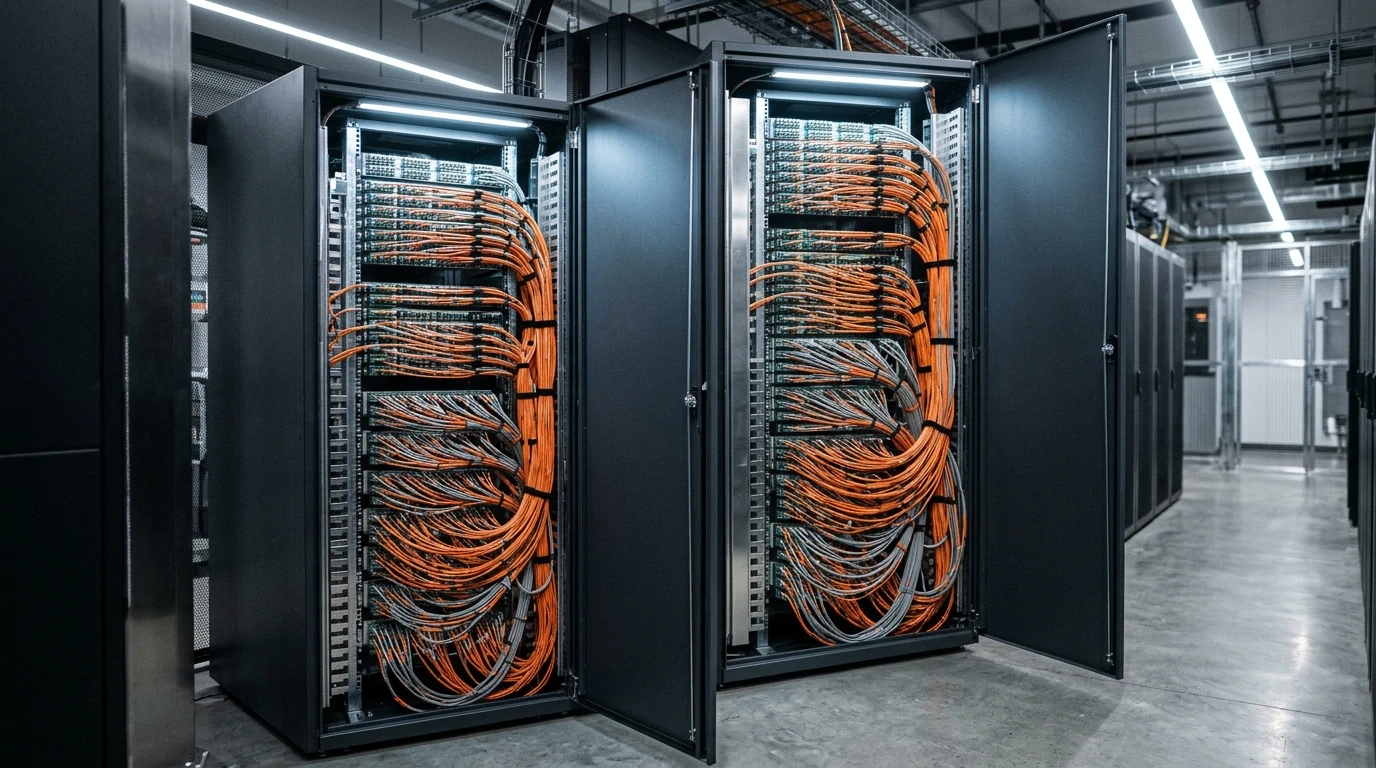
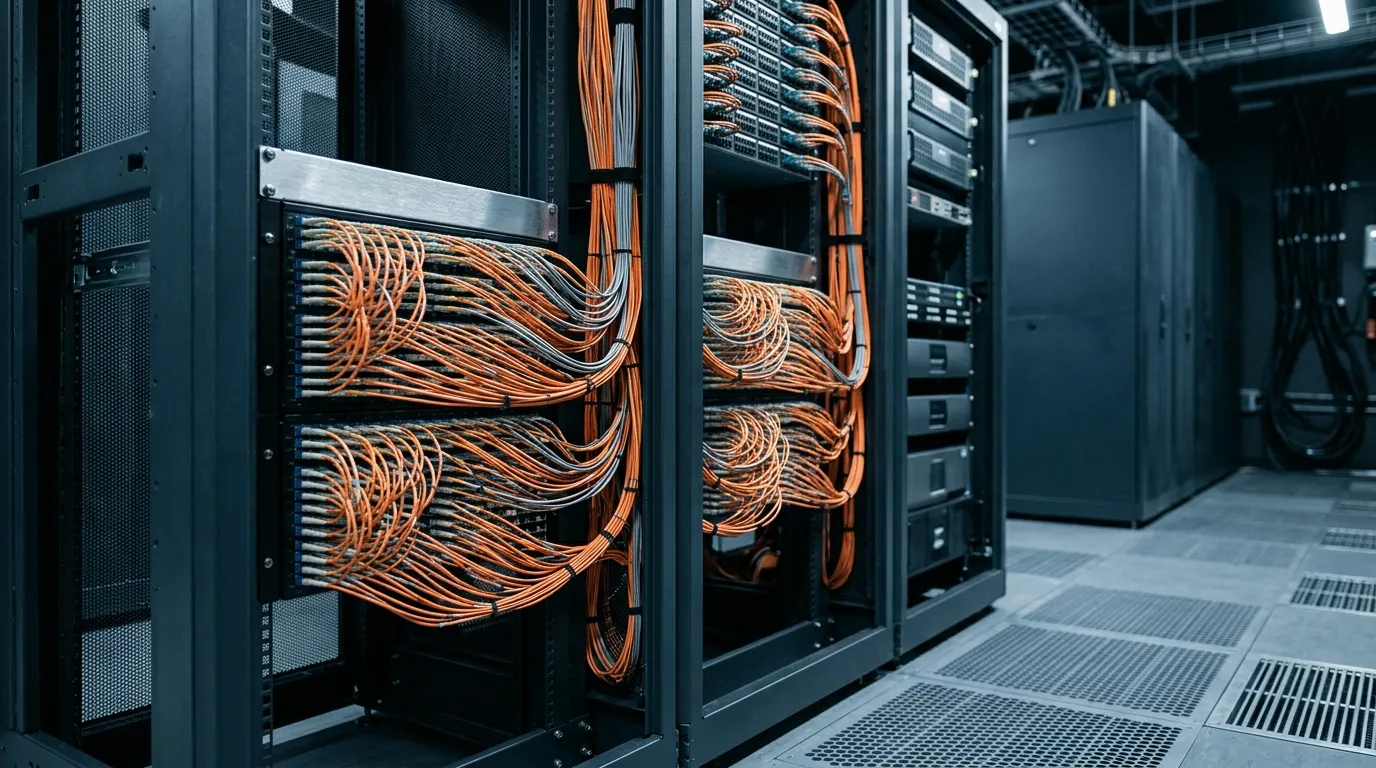
Cabinet width became a requirement in 942-C because a 600 mm cabinet cannot dress the fiber a dense switch row needs. The patch field is where that requirement is met or discovered too late.
What Each Edition Added, and Why Editions Keep Getting Mixed Up
ANSI requires a standard to be revised, affirmed or rescinded every five years, so TIA-942 has seen four published states plus an addendum:
Edition | Status | Cabling-relevant additions |
|---|---|---|
ANSI/TIA-942 | published 2005 | first data center infrastructure standard; functional areas, recognised media, availability tiers in an informative annex |
TIA-942-A | published 2012 | first revision; the edition that 942-B incorporates |
TIA-942-B | July 2017 | adds 16- and 32-fiber MPO array connectors (ANSI/TIA-604-18) and 24-fiber MPO (ANSI/TIA-604-5), allows Category 8, raises the Cat 6A recommendation to "Cat 6A or higher", adds OM5 wideband multimode |
TIA-942-B-1 | addendum, early 2022 | edge data center infrastructure |
TIA-942-C | published 2024 | absorbs B-1; 800 mm cabinets; two-fiber recommendation; connector flexibility outside the EO; single-pair Ethernet; 2 × Cat 6A to WAPs; rating annex made normative |
The B additions age a design fastest. A hall specified with 12-fiber MPO trunks and Cat 6A is not wrong — 942-B removed neither, and Cat 6A or higher remains the recommendation, with no published 942-C change list withdrawing it. What ages is the wording: a specification that names only MPO-12 and only Cat 6A puts the array-connector and OM5 options outside the table, where no supplier will price them. The MPO-12, MPO-16 and MPO-24 comparison is where that difference turns into a trunk schedule. The TIA Fiber Optics Tech Consortium keeps the edition-by-edition change list for 942-B when you need the wording rather than the summary.
Which is the practical problem with the topic: much of what ranks is slide decks and re-uploaded PDFs of the 2005 edition — a document that recommended Category 6 as the horizontal medium and treated fiber as the backbone option. They are not lying; they describe a superseded standard. When a specification quotes a TIA-942 figure without an edition letter, that is the first question to ask.
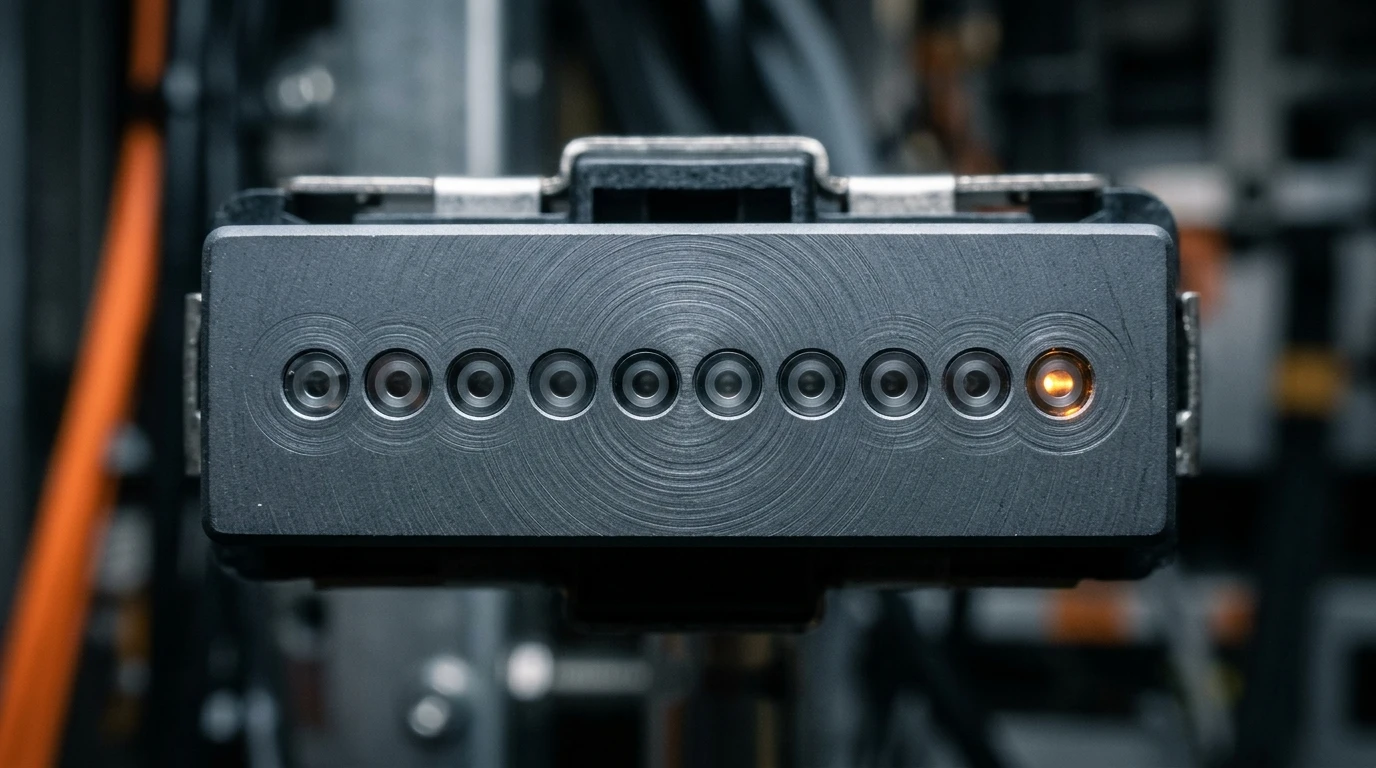
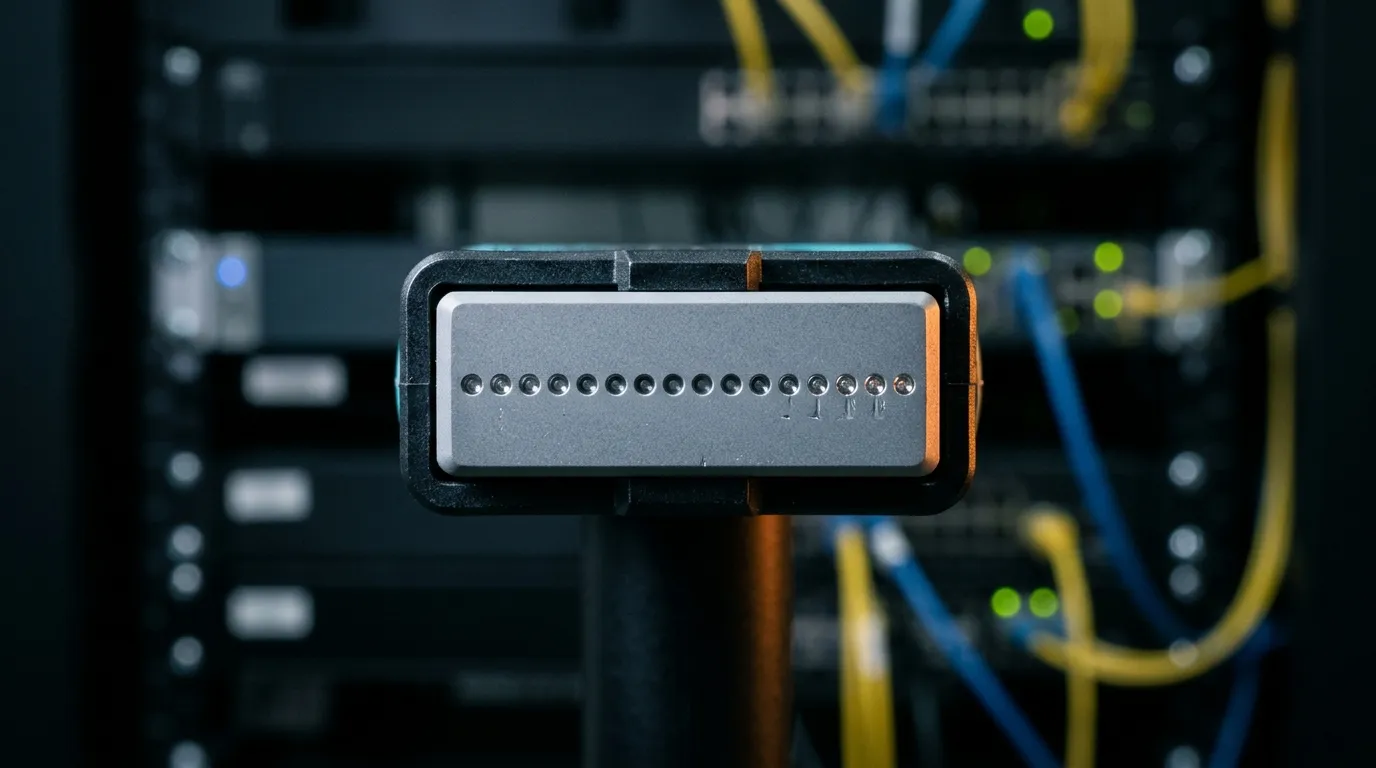
A dozen fibers in one ferrule — the array connector in its MPO-12 form. The 16- and 32-fiber versions 942-B added work on the same principle, and polarity is where all of them stop being an afterthought.
Two Fibers Is a Recommendation, Not a Design
Here is where obligation levels start costing money. The two-fiber sentence is a recommendation about the minimum count per horizontal and backbone run — not a statement that two fibers per link is sufficient, and silent on what a trunk should carry.
The optics decide that, and they decide it in lanes. A 400G SR4 link uses four lanes each direction — eight fibers, which is why it lands on an MPO-12 with four positions unused. A 400G SR8 link uses eight lanes each way: sixteen fibers, MPO-16. An 800G SR8 link is the same sixteen-fiber shape at double the per-lane rate. None of this is in TIA-942; the standard gives the floor, the transceiver datasheet gives the count.
So the specification carries two separate numbers, and they get conflated constantly:
- Fibers at the equipment outlet. LC duplex is still the required connector type at the EO, and two fibers per server port is normal — the case the recommendation is about.
- Fibers in each backbone and trunk. A port-count and optics question. Twenty leaf switches with 400G SR4 uplinks need twenty 8-fiber links plus sparing, not forty fibers in total.
Two consequences follow. A two-fiber horizontal is fine at the outlet and fatal in the trunk — the recommendation protects the first case and gets blamed for the second. And the connector flexibility 942-C introduced outside the EO is what makes a mixed plant practical: MPO trunks between areas, LC at the outlet, CS or SN at the cross-connect where density demands it. The MPO versus LC density trade-off is the next decision, and polarity the trap after it.
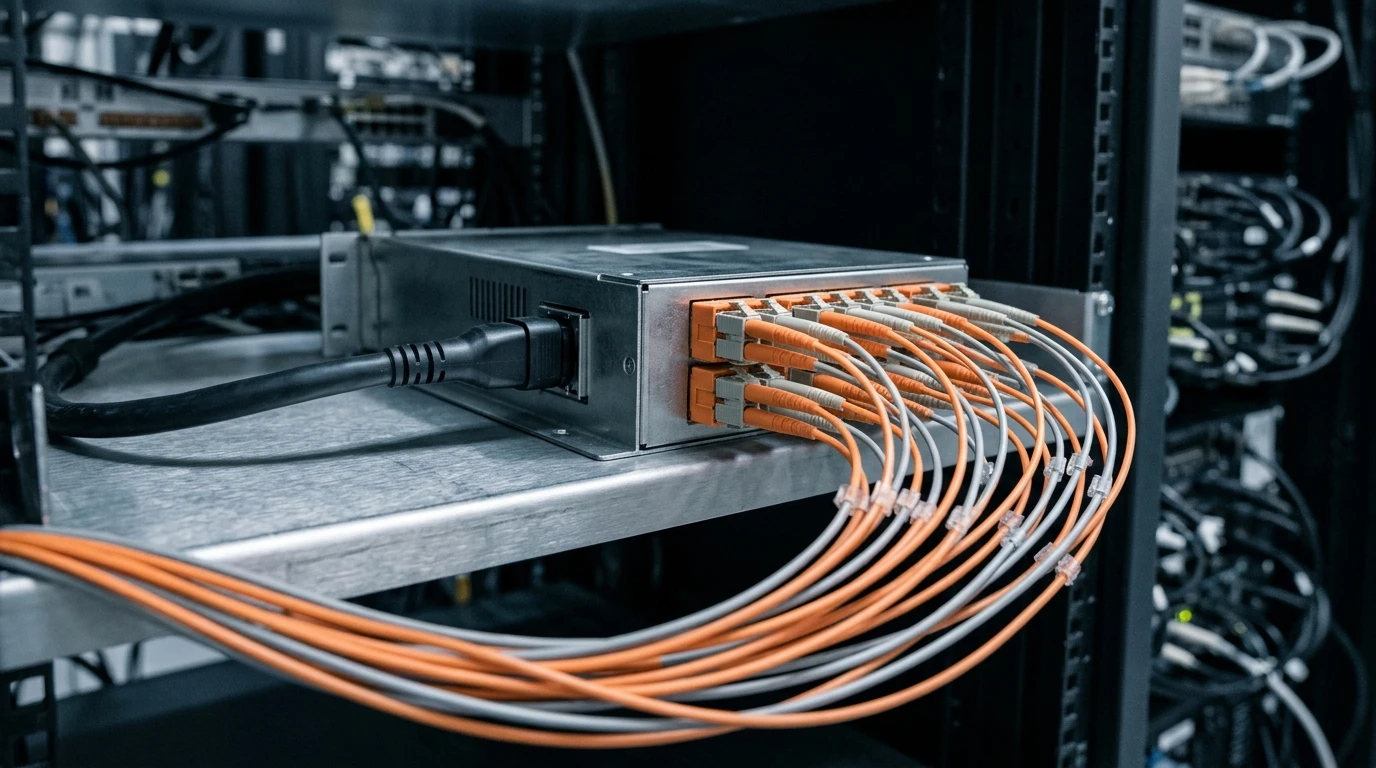
The trunk carries the fiber count the optics need; the cassette converts it to the LC pairs the outlet requires. That conversion point is where the two-fiber recommendation and the real lane count stop contradicting each other.
Rating, Tier, and What Certification Actually Certifies
"TIA-942 Tier III" is one of the most common phrases in data center procurement, and it names two schemes at once.
TIA-942 has a four-level rating — 1 Basic, 2 Redundant, 3 Concurrently Maintainable, 4 Fault Tolerant — which 942-C reworked "for more flexible and straightforward implementation". Conformity is verified by an independent programme: TIA's TIA-942 certification, a separate thing from the standard. TIA draws the line plainly in its own FAQ — the standard "provides the framework and requirements for designing and building data center infrastructure", while certification "provides independent verification that a facility meets the requirements of the standard".
The Uptime Institute's Tier I–IV is a different scheme run by a different organisation. It entered TIA-942's orbit historically: the 2005 edition carried availability tiers as an informative annex drawn from Uptime Institute material, complete with tier availability percentages and a note that the annex was informative. Informative means descriptive, not obligatory. When 942-C made the rating annex normative — with the rating tables in Annex D made binding if you use TIA's own rating system, as Data Center Frontier's change list records — it settled the question in the standard's own terms, while still allowing any rating system.
For a cabling buyer the consequence is small but worth stating: no rating level changes your fiber or copper performance requirements. A Rated 4 facility differs from Rated 2 in redundancy of paths and plant — dual diverse routes, separately protected distribution — not in whether a channel passes its loss budget. Rating belongs in the facility narrative; cable specification belongs in the cabling section. Mixing them produces a tender that asks a supplier to certify something they cannot see.
Turning the Standard into a Specification
The useful output is a table you can hand to a supplier: what the standard says, the obligation it carries, and the wording that makes it enforceable. There are no clause numbers in it — the clause text is behind TIA's paywall and the levels are read from its white paper and change lists, plus, for the fiber distance row, the modification list printed in the 942-A foreword — so supply the clause from the copy you hold.
What 942 says | Level | What to write |
|---|---|---|
Hierarchical star over MDA/IDA/HDA/ZDA/EDA, at least one MDA | required | "Topology per ANSI/TIA-942-C; MDA location and HDA count per drawing; no HDA-to-HDA cabling except where shown for redundancy" |
Cabinets in MDA/IDA/HDA at least 800 mm wide | required | "Cabinet width 800 mm minimum in MDA, IDA and HDA; 600 mm only in EDA" |
Horizontal channel, copper: 100 m (90 m permanent link + 10 m of cords) | required | "Maximum copper horizontal channel 100 m; any longer copper run re-homed or converted to a backbone leg" |
Horizontal distance, optical fiber | required, but no fixed maximum since 942-A — set by the application | "Fiber horizontal reach per the application and the optic selected, not a 100 m channel cap; 300 m only for MDA-to-EDA runs where HDAs are omitted — confirm against the edition you specify" |
At least 2 optical fibers for horizontal and backbone | recommended | "Two fibers per horizontal run is a floor; trunk fiber count per the optics schedule" |
LC and MPO at the equipment outlet; other TIA-568.3 connectors permitted elsewhere | required at the EO | "LC duplex at EO; MPO-12 or MPO-16 trunks between areas; connector types elsewhere per TIA-568.3" |
2 × Cat 6A or higher to wireless access points | required | "Two Cat 6A runs per WAP location, tested to the applicable TIA-568 channel class" |
Administration and labelling per TIA-606 | inherited | "Labelling to TIA-606; as-built schedule in the handover pack" |
Transmission performance per TIA-568 | inherited | "Channel performance per ANSI/TIA-568; test results per link, not per bundle" |
Two parts of the table deserve a note. The connector row is where the 942-C flexibility pays: one connector family at the outlet, another allowed at the cross-connect. The copper distance row is where geography quietly breaks a design — a hall whose MDA sits at one end and whose farthest row is 140 m away is not a 100 m copper horizontal design, whatever the drawing says, and the fix is usually an HDA rather than a longer cable.
The distance rows carry an extra caveat: the copper 100 m, the fiber 300 m and the 942-A removal are read from the sources named above — the removal from the 942-A foreword, the figures from a summary of the 2005 edition — not from clause text, so confirm them against your own edition before they reach a tender.
Fire rating is absent from the table because it is absent from TIA-942. Indoor cable in a plenum or riser space is governed by local electrical and building code, and in Europe by CPR class — a plenum versus LSZH versus PVC decision with a different authority behind it than the one this article is about.
Where the Standard Stops and Your Design Starts
TIA-942 defines a minimum; everything beyond it is a design decision, and three are being forced right now by rack density.
The first is media choice in the backbone. OM4 and OM5 carry 400G short-reach links to 100 m, which covers most MDA-to-HDA runs inside a hall; single-mode costs more per port today and removes the distance question permanently. The OS2, OM4 and OM5 comparison is the decision framework, and the honest answer depends on whether the building footprint is fixed.
The second is trunk sizing against port count, where AI clusters diverge from general compute. A cluster with hundreds of high-speed links per rack consumes trunk capacity a 2017-era design never provisioned — the pressure TIA's white paper describes when it notes links of "100, 200, or 400 Gigabit" at the rack level.
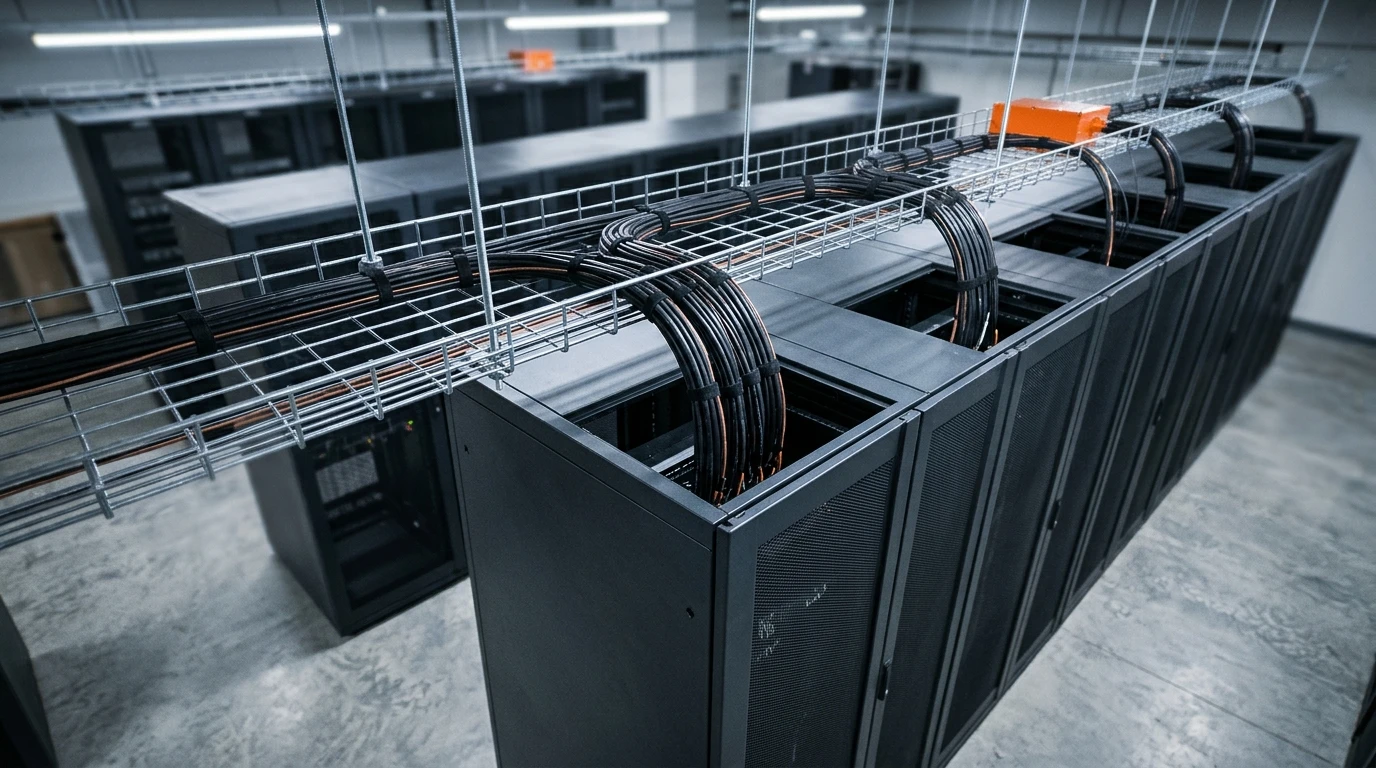
Pathways are the other half of the standard: TIA-569 governs the tray and the space it occupies, and a full tray caps fiber count long before the optics do.
The third is which standard you are citing. Outside North America the counterparts are ISO/IEC 24764 and, in Europe, EN 50173-5:2018, the data centre part of the EN 50173 series. ISO/IEC 24764:2010 specified generic cabling for data centres up to a 2,000 m distribution distance, and it is withdrawn — replaced by ISO/IEC 11801-5:2017. A tender naming 24764 in 2026 names a withdrawn document. That does not make TIA-942 wrong outside the US; it means "the global data center cabling standard" does more work than the facts support.
Where a supplier affects the outcome is narrow: the guaranteed numbers. Maximum insertion loss per mated pair, uniformity across the ports of a trunk, polarity consistency, and whether the test report names its measurement method. TTI Fiber manufactures MPO/MTP trunk assemblies and harnesses in the fiber counts these designs call for, and the useful conversation at quotation stage is not price per unit — it is which maximum each line will be held to, and which edition the drawing is checked against.
FAQ
Is TIA-942 the same as Uptime Institute Tier?
No. TIA-942 has its own four-level rating (1 Basic, 2 Redundant, 3 Concurrently Maintainable, 4 Fault Tolerant) and its own certification programme run by TIA. The Uptime Institute's Tier I–IV is a separate scheme from a separate organisation. The confusion is historical: the 2005 edition carried availability tiers in an informative annex based on Uptime Institute material, and that annex is where "TIA-942 Tier III" came from.
Is TIA-942-C mandatory?
Not by law. It is a voluntary consensus standard, and it binds when a contract, a tender, an insurer or an internal design standard cites it. What is effectively mandatory is naming the edition: a specification that says "TIA-942 compliant" without a revision letter is unenforceable, because a supplier can satisfy it with 2005 practice.
How many fibers does TIA-942 require per link?
It requires no number per link. It recommends a minimum of two optical fibers for horizontal and backbone cabling, and requires LC and MPO as connector types at the equipment outlet. The count comes from the optics: eight fibers for a four-lane 400G SR4 port set, sixteen for an eight-lane SR8 port. Size trunks from the port schedule, then check the result is at least the standard's floor.
What is the difference between TIA-942 and TIA-568?
TIA-942 is the data center infrastructure standard: spaces, topology, redundancy, and the requirements specific to a data center. TIA-568 is the building cabling standard that defines the cabling itself — media, channel performance, connectors, test limits. TIA-942 references TIA-568 rather than restating it, so a data center specification normally cites both, and a dispute about a failing link is almost always a TIA-568 question.