CPR Cable Classes: Euroclass Ratings Guide
What Are CPR Cable Classes — And Why They Matter for Your Project
In July 2017, a quiet regulatory shift changed how every cable permanently installed in an EU building is specified, sold, and verified. The Construction Products Regulation (EU) No. 305/2011 — universally shortened to CPR — became mandatory for all cables marketed within the European Economic Area. If a cable stays in the building after construction, it needs a CPR Euroclass.
The consequences of getting this wrong are not theoretical. A building inspector can flag non-compliant cable during a site visit. A tender can be disqualified because the submitted cable documentation shows Dca when the specification called for Cca-s1,d1,a1. A contractor who installs unclassified cable in a public building assumes liability that no insurer will touch.
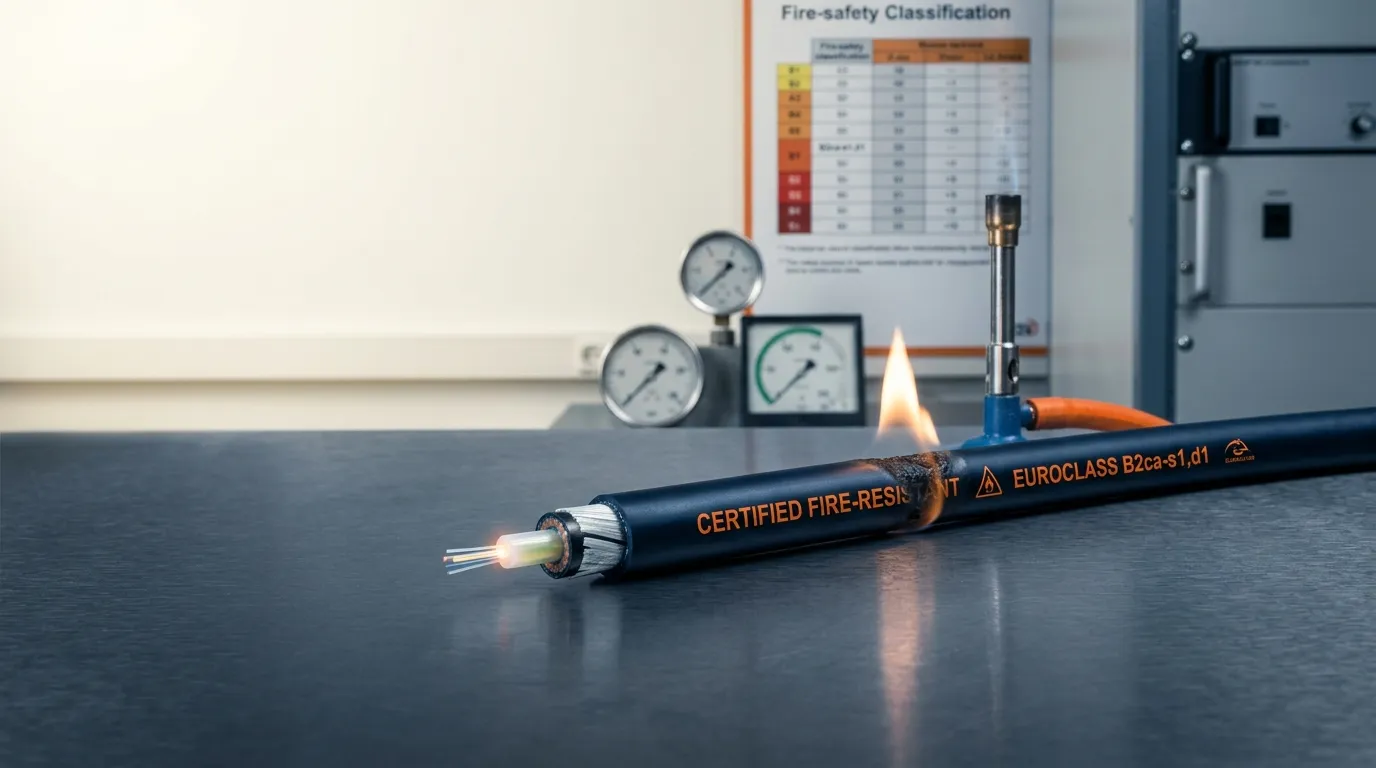
CPR exists because cables are fuel. In a fire, cable jackets burn, produce smoke, release acidic gases, and generate burning droplets that spread flames to lower floors. The Euroclass system quantifies all four behaviors — flame spread, heat release, smoke production, and flaming droplets — into a single alphanumeric code. Understanding that code is not a compliance checkbox exercise. It is the difference between a specification that protects people and one that only looks good on paper.
The European Commission's CPR overview and the Europacable industry guide provide the regulatory framework, but neither addresses fiber optic cables specifically — which is why we wrote this guide. This article is part of TTI Fiber's standards & certifications series, covering CPR, UL, CE, RoHS, and REACH compliance for fiber optic products. For related guidance on structured cabling design, see our enterprise structured cabling hub.
The Seven Euroclasses — A Complete Breakdown from Aca to Fca
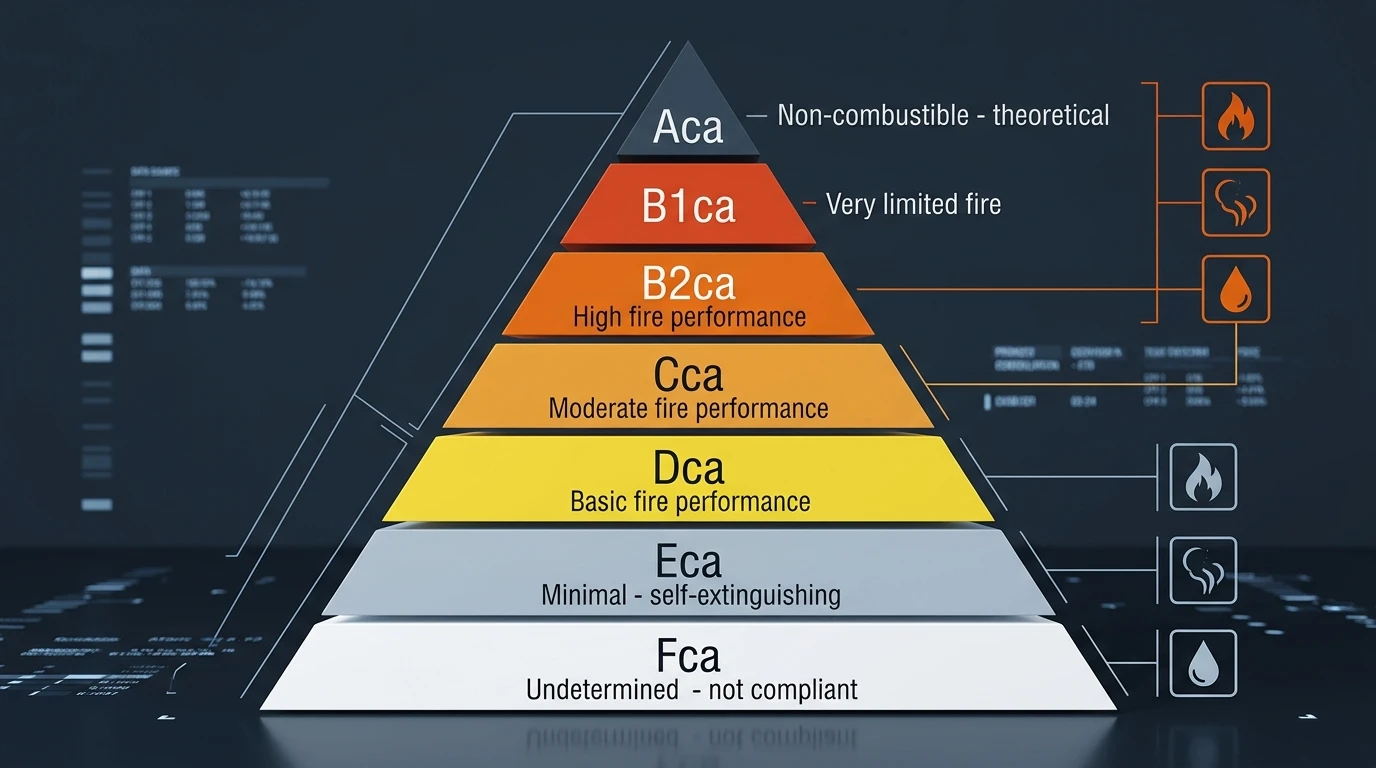
The harmonized standard EN 50575, which implements CPR for power, control, and communication cables, defines seven main classes. Five of them — B2ca through Fca — appear on actual cables you will encounter in a project specification. Aca and B1ca are defined in the standard but are rarely achieved by real cables; they represent the theoretical ceiling.
Every class is defined by a growing set of test criteria. The higher the class, the more tests the cable must pass, and the stricter the pass thresholds become.
Here are the seven classes, from most demanding to least:
Aca — Non-combustible (theoretical ceiling) Defined in EN 13501-6 but essentially unattainable for organic-insulated cables. No commercially available cable carries this class. It exists as a regulatory boundary, not a product category.
B1ca — Very limited fire contribution Requires the full EN 50399 test battery: flame spread (FS), total heat release (THR), and peak heat release rate (HRR). Thresholds are extremely tight — FS must not exceed 1.75 meters under the 30 kW burner, and THR must stay below 10 MJ. B1ca cables also pass EN 60332-1-2 (single-cable vertical flame test) and EN ISO 1716 (gross heat of combustion test, PCS ≤ 2.0 MJ/kg). These cables are rare even in safety-critical applications; the cost and material constraints push most specifications toward B2ca.
B2ca — High fire performance Same test suite as B1ca but with relaxed thresholds: FS ≤ 1.5 m, THR ≤ 15 MJ, and peak HRR ≤ 30 kW. B2ca is the highest class you will realistically see in commercial building specifications — hospitals, high-rise escape routes, and underground transport infrastructure typically call for B2ca-s1,d1,a1.
Cca — Moderate fire performance (the practical baseline for public buildings) Tested to EN 50399 with FS ≤ 2.0 m and THR ≤ 30 MJ, plus EN 60332-1-2. This is the minimum class required for many public buildings under national building codes. Germany's Model Building Regulation (MBO), for example, effectively requires Cca or better for escape and rescue routes.
Dca — Basic fire performance Tested to EN 50399 with FS ≤ 2.0 m and THR ≤ 70 MJ, plus EN 60332-1-2. Dca is common in standard commercial buildings, offices, and residential construction. It provides a baseline level of fire performance at a cost point that makes economic sense for non-critical areas.
Eca — Minimal fire performance (passes a single vertical flame test) Only tested to EN 60332-1-2. An Eca cable will self-extinguish when a flame is applied vertically to a single cable sample, but no data exists on how it behaves when multiple cables are burning simultaneously in a cable tray — which is how real fires propagate. Eca is the minimum class permitted for permanent installation in EU buildings. A cable that cannot pass EN 60332-1-2 is Fca — and it cannot carry a CE mark for construction use.
Fca — Undetermined performance Assigned to cables that either failed EN 60332-1-2 or were never tested. Fca cables cannot be legally installed as construction products in the EU. If your supplier offers "unclassified" or "CPR-exempt" cable for permanent building installation, it is almost certainly Fca — and it is non-compliant.
The practical reality: most cables on the market fall between Cca and Eca. Cca-s1,d1,a1 is the workhorse class for safety-conscious commercial projects, Dca covers standard commercial and multi-family residential, and Eca is the bare-minimum floor.
Beyond the Main Class — Smoke, Droplets, and Acidity (the s/d/a System)
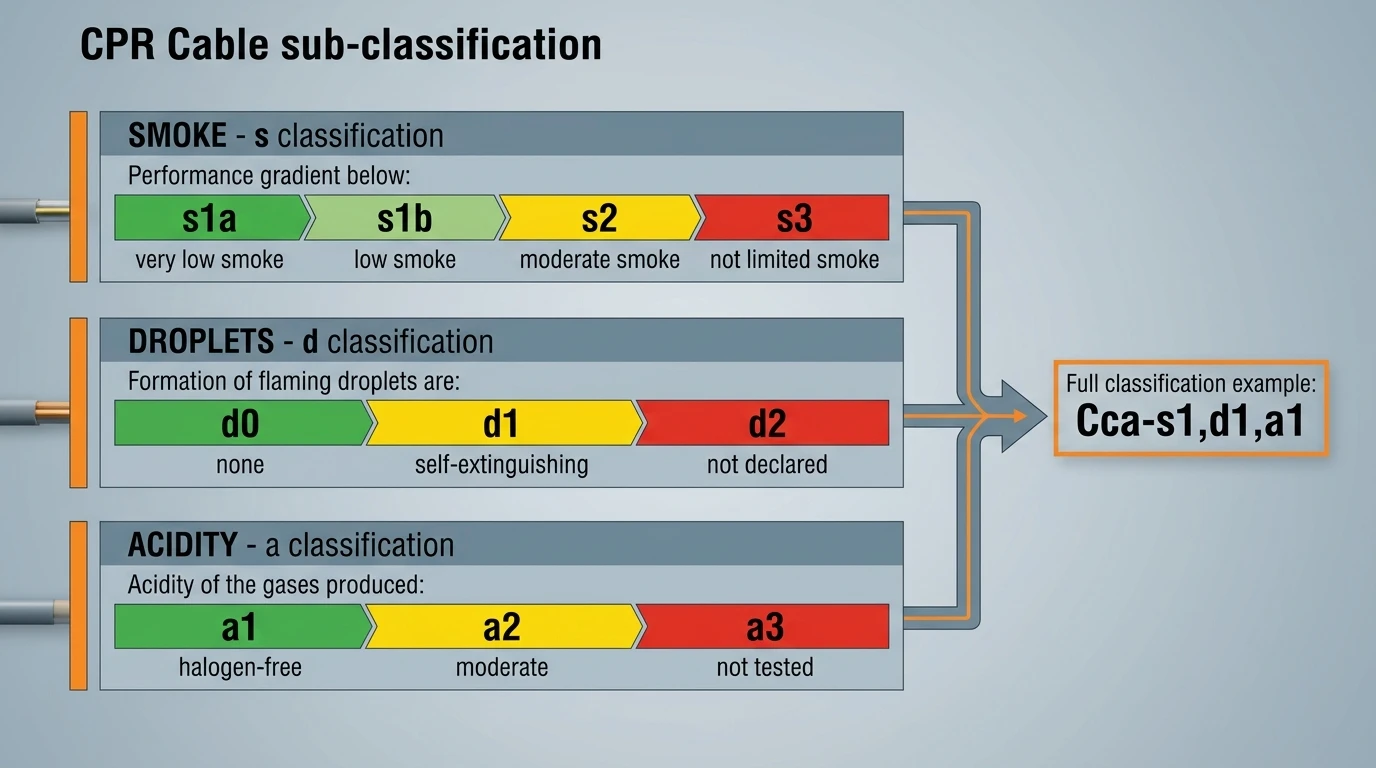
A class like "Cca" only tells part of the story. The suffixes after the main letter — s (smoke), d (droplets), and a (acidity) — describe what happens after the cable catches fire. They matter because most fire deaths are caused by smoke inhalation, not burns.
Smoke production (s1, s1a, s1b, s2, s3) Measured during EN 50399 testing using EN 61034-2 (smoke density in a 27 m³ chamber). The scale runs from s1 (very low smoke) to s3 (no performance limit). Sub-classifications s1a (TSP₆₀₀ ≤ 50 m², peak SPR ≤ 0.25 m²/s) and s1b (TSP₆₀₀ ≤ 400 m², peak SPR ≤ 1.5 m²/s) distinguish the cleanest cables from merely low-smoke ones. If you are specifying cable for a data center, hospital corridor, or underground station — anywhere visibility during evacuation determines survival — s1a or s1b is not optional.
Flaming droplets (d0, d1, d2) Measured during EN 50399. Burning droplets falling from a burning cable tray spread fire downward. d0 means no flaming droplets within 1,200 seconds. d1 allows flaming droplets but they must self-extinguish within 10 seconds. d2 means no performance declared. For vertical cable runs through risers and shafts, d0 or d1 is essential.
Acidity (a1, a2, a3) Measured separately via EN 60754-2 (acid gas emission, conductivity ≤ 2.5 µS/mm and pH ≥ 4.3 for a1). Acidic gases corrode electronics, destroy building structures, and cause respiratory damage. a1 cables use halogen-free materials and meet the strictest limits; a2 relaxes the conductivity threshold to ≤ 10 µS/mm; a3 is "not tested." For data centers, telecom exchanges, and any building with sensitive electronics, a1 is the standard choice.
A full CPR classification like "B2ca-s1,d1,a1" means: high fire performance, very low smoke, self-extinguishing droplets, and halogen-free construction. This is the gold standard for safety-critical installations — and it is the format you will see on compliant cable labeling.
How CPR Testing and Certification Actually Works
A cable's CPR class is not a manufacturer's claim — it is a laboratory test result backed by a legal chain of documentation. Understanding this chain helps you spot suppliers who overstate their compliance.
Step 1: Laboratory testing. A Notified Body — an independent testing laboratory accredited under the CPR framework — tests the cable to the relevant EN standards (EN 50399, EN 60332-1-2, EN 61034-2, EN 60754-2, and EN ISO 1716, depending on the target class). The manufacturer does not self-test.
Step 2: Declaration of Performance (DoP). Based on the test results, the manufacturer issues a DoP — a legally binding document that declares the achieved Euroclass. The DoP must be made publicly available (typically as a PDF on the manufacturer's website) and must reference the specific test reports and the Notified Body that performed them. A DoP is product-specific: a "Cca" DoP for 4-pair UTP cable does not cover the manufacturer's fiber optic patch cord, even if both use an LSZH jacket.
Step 3: CE marking. With a valid DoP, the manufacturer affixes the CE mark to the product label. The CE mark on a cable is not a general quality statement — it is a declaration that the cable meets the harmonized standard EN 50575, substantiated by the DoP behind it. A CE mark without a traceable DoP is legally meaningless.
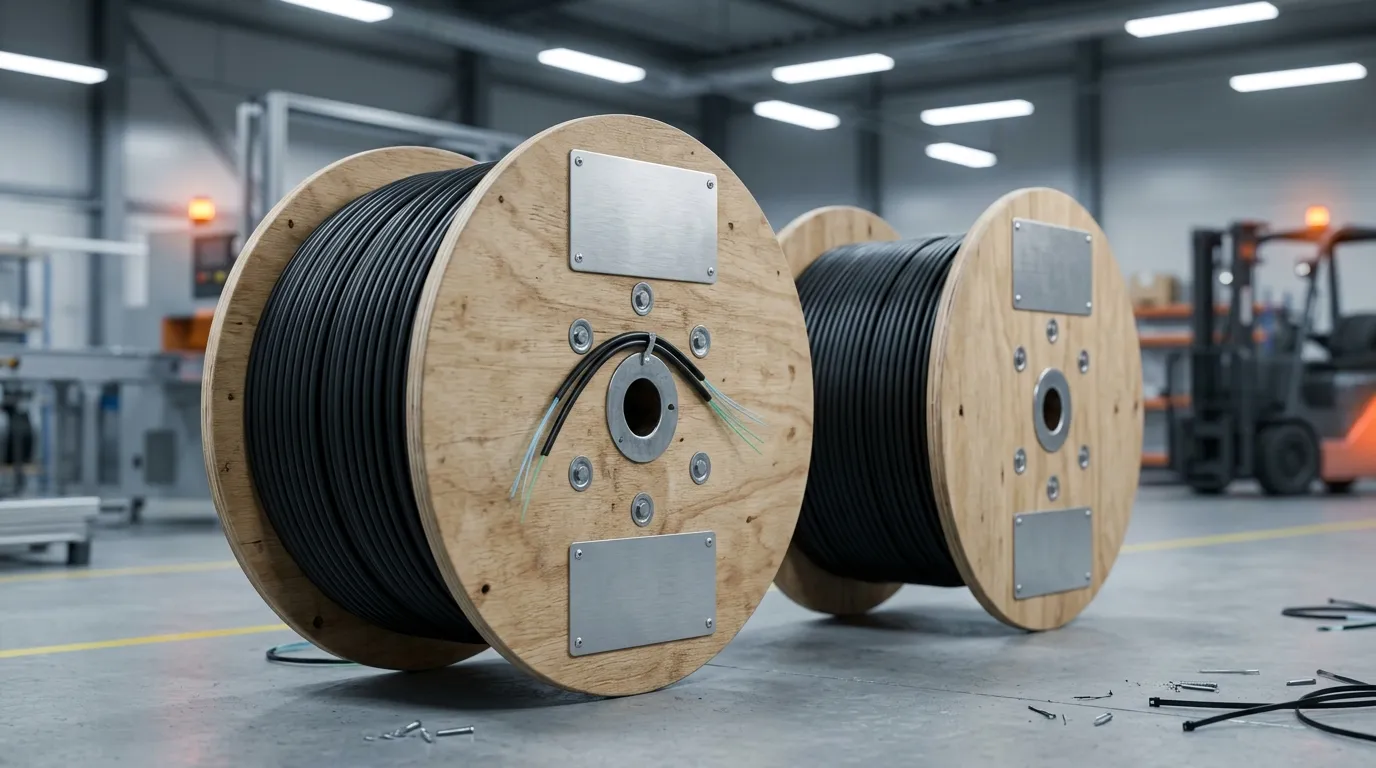
Step 4: Product labeling. CPR-compliant cable must carry three items on its outer packaging and/or the cable jacket itself: (a) the CPR class, written in full (e.g., "Cca-s1,d1,a1"), (b) the CE mark, and (c) the DoP reference number. If a cable reel shows only "LSZH" or "halogen-free" without a CPR class, it is not CPR-certified — those are material descriptors, not fire performance classifications.
Which CPR Class Do You Need? A Decision Framework by Building Type
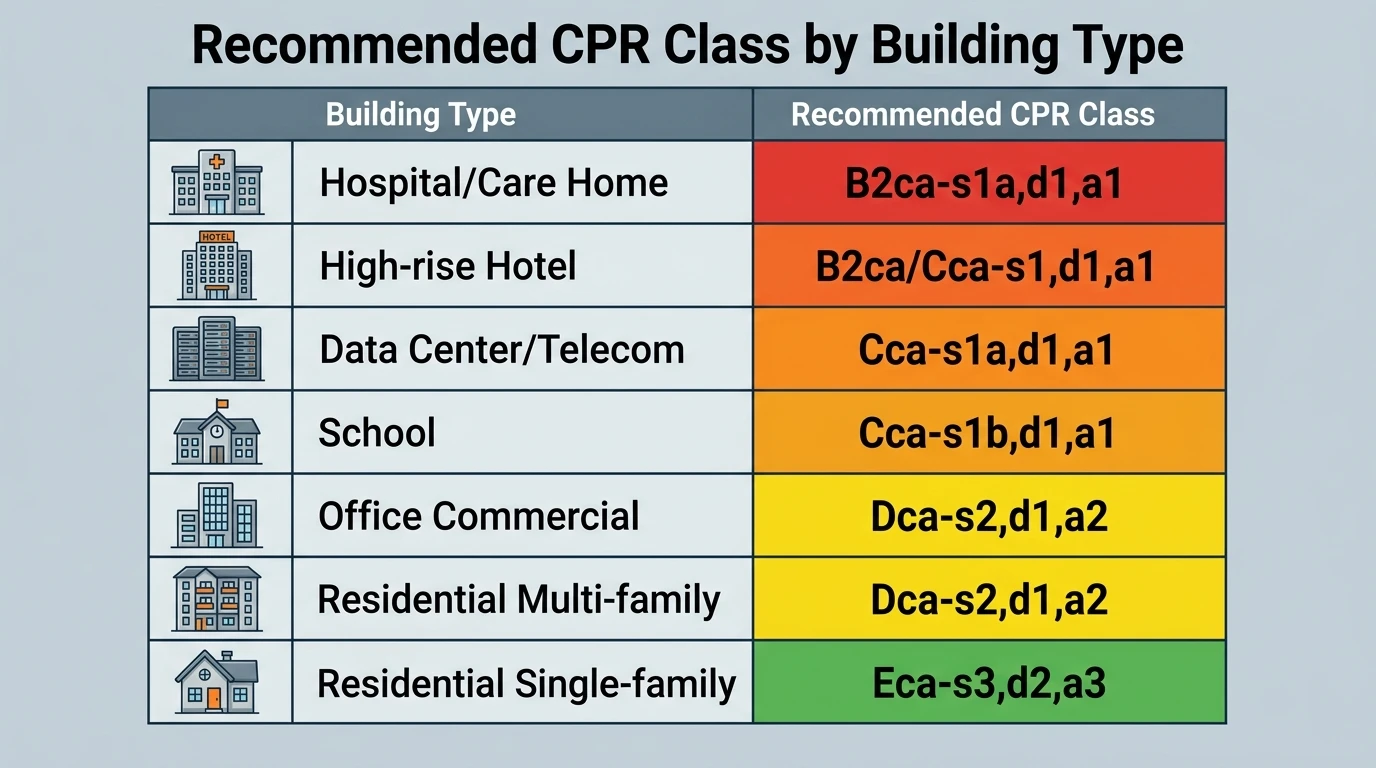
National building codes across the EU set minimum CPR requirements, but they vary by country and by building category. The European Commission has deliberately not mandated a single uniform requirement — each member state integrates CPR into its own building regulations. What follows is a practical framework based on common regulatory patterns and industry best practice:
Building Type | Recommended Minimum Class | Typical Sub-Classification | Rationale |
|---|---|---|---|
Hospitals, care homes, prisons | B2ca | s1a, d1, a1 | Evacuation is slow and vulnerable; smoke control is life-critical |
High-rise residential (>30 m), hotels | B2ca or Cca | s1a/s1b, d1, a1 | Vertical fire spread risk; large occupant populations |
Data centers, telecom exchanges | Cca | s1a/s1b, d1, a1 | Equipment protection (acid gas corrosion); high-density cabling. See our data center cabling guide for structured cabling best practices. |
Schools, universities | Cca | s1b, d1, a1 | Children and young adults; assembly occupancy |
Airports, rail stations, tunnels | B2ca | s1a, d0, a1 | Underground/confined spaces; mass evacuation |
Offices (standard commercial) | Dca | s2, d1, a2 | Lower occupancy density; manageable evacuation times |
Multi-family residential (<30 m) | Dca | s2, d1, a2 | Standard risk profile |
Single-family residential | Eca | s3, d2, a3 | Low occupancy; short evacuation distances |
Industrial / warehouse (non-hazardous) | Eca | s3, d2, a3 | Low occupancy; open spaces |
National variations to be aware of: Germany's MBO effectively requires Cca or better for escape routes. The UK's BS 7671 (18th Edition) references CPR under wiring regulations but has not adopted application-specific minimums — the government has explicitly stated it will not prescribe "which class per building type," leaving it to specifiers and insurers. France's NF C 32-070 ties CPR classes to specific building categories. Always check the national annex applicable to your project location.
CPR for Fiber Optic Cables — What Makes This Different
Every CPR guide you will find online — including the ones ranking in Google's top five — talks exclusively about copper cables. But EN 50575 covers "power, control and communication cables," which includes fiber optic cables permanently installed in buildings. If you are running a fiber backbone through a riser shaft, a horizontal fiber run in a ceiling plenum, or a fiber patch cord that stays in the building after construction, CPR applies.
How fiber optic CPR differs from copper cable CPR:
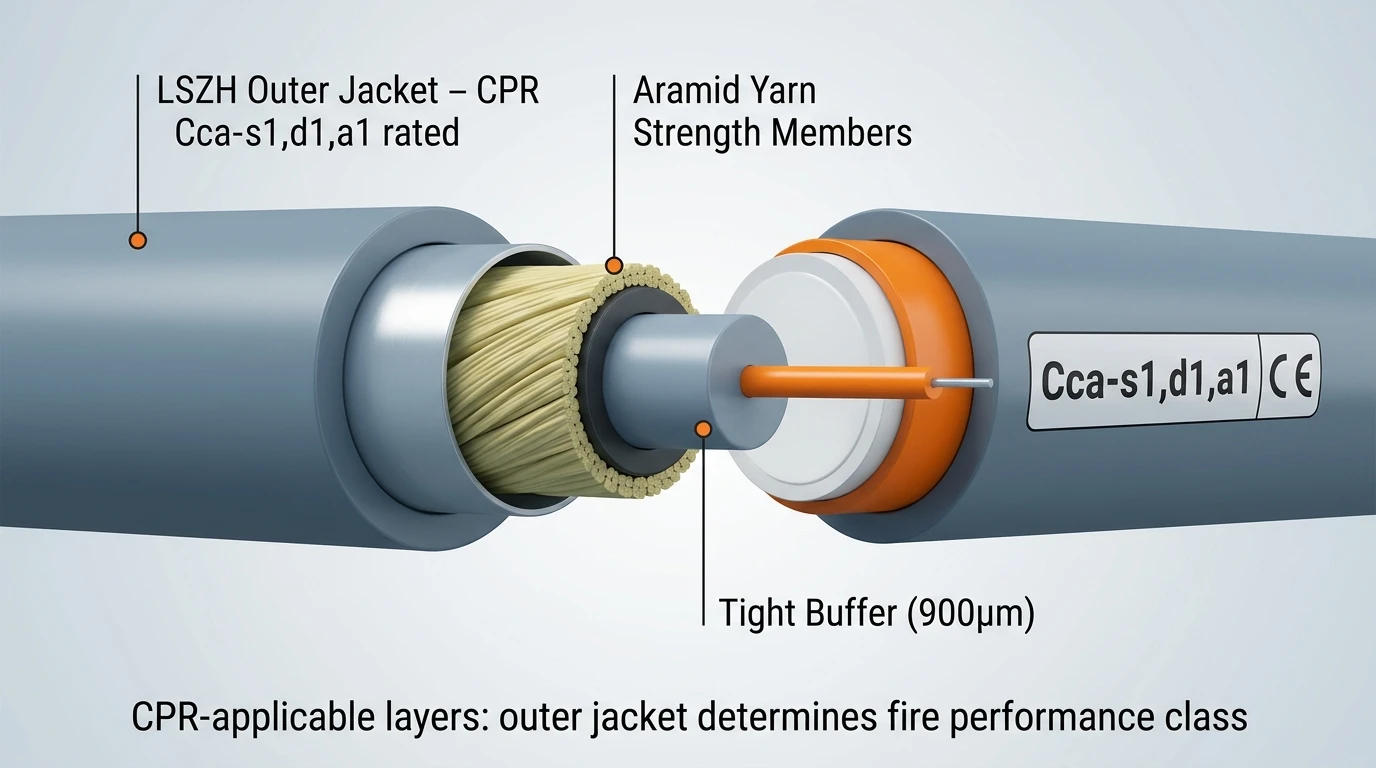
1. Jacket material is the key variable. A fiber cable's fire performance is almost entirely determined by its outer jacket. Copper cables have additional variables — insulation on individual conductors, shielding layers, fillers — but a tight-buffered fiber cable inside an LSZH (Low Smoke Zero Halogen) jacket is relatively straightforward to classify. For a deeper look at fiber cable construction, see our fiber optics basics section. Most indoor fiber cables achieve Cca or Dca with s1/a1 sub-classifications when jacketed with proper LSZH compounds.
2. The "data cable" loophole doesn't apply. Some suppliers have historically marketed fiber patch cords as "telecommunications equipment" rather than "construction products" to avoid CPR. Regulators increasingly reject this interpretation. A fiber cable permanently installed in a building's structured cabling system — even a patch cord connecting a switch to a patch panel — is a construction product. Pre-terminated MTP/MPO trunk cables, backbone fiber, and horizontal distribution fiber are unambiguously covered.
3. LSZH ≠ CPR-compliant. This is the most common confusion. "LSZH jacket" is a material claim; "Cca-s1,d1,a1" is a test-proven fire performance classification. An LSZH-jacketed fiber cable that has not been tested to EN 50399 and does not have a DoP is not CPR-certified. The LSZH material gives it the potential to achieve s1 and a1 ratings — but without testing, the classification does not exist.
4. Outdoor-to-indoor transitions need attention. A fiber cable that runs from an outside wall entry point to an indoor distribution frame is permanently installed in the building. If the outdoor-rated jacket (typically PE) is carried indoors beyond the minimum penetration length, the cable may require a CPR class for the indoor portion. Some manufacturers solve this by factory-terminating an outdoor cable to an indoor cable at a demarcation box, keeping the CPR obligation on the indoor segment.
For specifiers: when requesting fiber optic cable for an EU building project, ask the manufacturer for (a) the specific CPR class, (b) the DoP reference number, and (c) whether the class applies to the complete cable assembly or only the jacket material. A supplier who cannot produce a DoP for their fiber optic cables within one business day is either not testing to CPR or not selling into the EU market with compliant products.
CPR vs. Non-EU Fire Standards — A Quick Cross-Reference
Since this query targets English-speaking readers, many of whom operate in non-EU markets, here is how CPR maps (approximately) to fire standards you may be more familiar with:
CPR Class | Closest US/Canada Equivalent | Notes |
|---|---|---|
B2ca-s1,d1,a1 | NFPA 262 (plenum, CMP/OFNP) | NFPA 262 is a Steiner tunnel test; criteria differ but both represent the highest fire performance tier |
Cca-s1,d1,a1 | UL 1666 (riser, CMR/OFNR) + LSZH | UL 1666 is a vertical riser test; LSZH requirement for s1/a1 adds smoke/toxicity criteria not tested by UL 1666 alone |
Dca | UL 1581 VW-1 (general purpose, CMG/OFNG) | VW-1 is a single-cable vertical flame test similar in spirit to EN 60332-1-2 |
Eca | UL 1581 VW-1 (minimal) | Both represent the floor — self-extinguishing single cable, no burn propagation data |
For the Chinese market: GB 31247-2014 classifies cables into A, B1, B2, and B3 grades with similar flame spread/smoke/droplet criteria. B1 under GB 31247 roughly corresponds to B2ca/Cca under CPR, but the test methods differ enough that direct equivalency cannot be assumed.
Bottom line: CPR is an EU regulatory framework with its own test methods. North American and Asian standards test different things differently. When specifying for an EU project, only a CPR Euroclass issued by a Notified Body counts — no amount of NFPA or UL certification substitutes.
2024 Regulatory Update — What Changed Under Delegated Regulation 2024/1681
In 2024, the European Commission adopted Delegated Regulation 2024/1681, updating the system of Assessment and Verification of Constancy of Performance (AVCP) for cables. The key practical change for specifiers: cable manufacturers must now use AVCP System 1+ for B2ca and Cca class cables, which requires continuous factory production control audited by a Notified Body — not just initial type testing. This closes a gap where a manufacturer could test once, obtain a class, and then never retest, even if production processes or materials changed over time.
For procurement: a "Cca" DoP issued before 2024 under the old AVCP system may still be valid, but any cable manufactured after the regulation's effective date must comply with System 1+. When evaluating a supplier's CPR documentation, check the DoP's issue date and the AVCP system referenced. A new DoP under System 1+ is a stronger compliance signal than a pre-2024 DoP under System 1 or 3.
How to Verify a Supplier's CPR Claims (Before You Buy)
Walk through these four checks before accepting a supplier's CPR compliance at face value:
- Request the DoP. A legitimate manufacturer will provide the DoP as a PDF within hours. If they hesitate, say it's "confidential," or offer a generic "certificate of compliance" instead, pause the order. A DoP is legally required to be public — there is no such thing as a confidential DoP.
- Check the DoP against the product. The DoP names a specific product or product family. A DoP for "UTP Cat6A cable" does not cover fiber optic patch cords, even from the same manufacturer. Match the product description exactly.
- Look for the Notified Body's four-digit identification number. Every legitimate DoP lists the Notified Body that performed the testing and factory audit. You can verify that the Notified Body is accredited under the CPR framework through the European Commission's NANDO database.
- Inspect the cable labeling on delivery. The CPR class, CE mark, and DoP reference number must appear on the cable packaging. If the labeling is missing, the cable is not compliant — regardless of what the DoP says.
A manufacturer that passes all four checks on the first request is operating transparently. One that stalls, redirects, or provides partial documentation is either disorganized or evading compliance — and neither is acceptable for a building project where non-compliant cable can trigger a stop-work order.
All cables permanently installed in EU buildings need a CPR class. The system breaks cleanly into three decisions:
- The main class (Eca → B2ca/B1ca) tells you how the cable performs in fire — from basic self-extinguishing behavior to rigorously low flame spread and heat release.
- The sub-classifications (s/d/a) tell you about smoke, burning droplets, and acid gas — the factors that determine survival conditions during evacuation and equipment damage after a fire.
- The documentation chain (test report → DoP → CE mark → label) is the only proof that any of the above is real.
Fiber optic cables are covered by the same framework and deserve the same scrutiny. If your next EU project includes a fiber backbone, horizontal distribution, or patch cords in permanent installation, include a CPR class in the cable specification and verify it before accepting delivery. A compliant DoP takes one email to request. A non-compliant installation takes months and far more money to remediate.
TTI Fiber manufactures fiber optic cables, patch cords, and connectivity solutions with CPR-compliant LSZH jacketing. For DoP documentation or to discuss CPR class requirements for your next project, contact our engineering team.