Fiber Optic Cable Certificate Library
What a Fiber Optic Cable Certificate Library Actually Contains
Ask three fiber optic cable suppliers for their certifications and you get three different folders. One sends a single ISO 9001 PDF. Another sends forty scanned certificates with names like CPR, CE, RoHS, REACH and SGS. The third sends a zip file and a promise that everything is "fully certified." What none of them sends is a fiber optic cable certificate library — an organized answer to the only question that matters: which document protects this order, in this market, for this product.
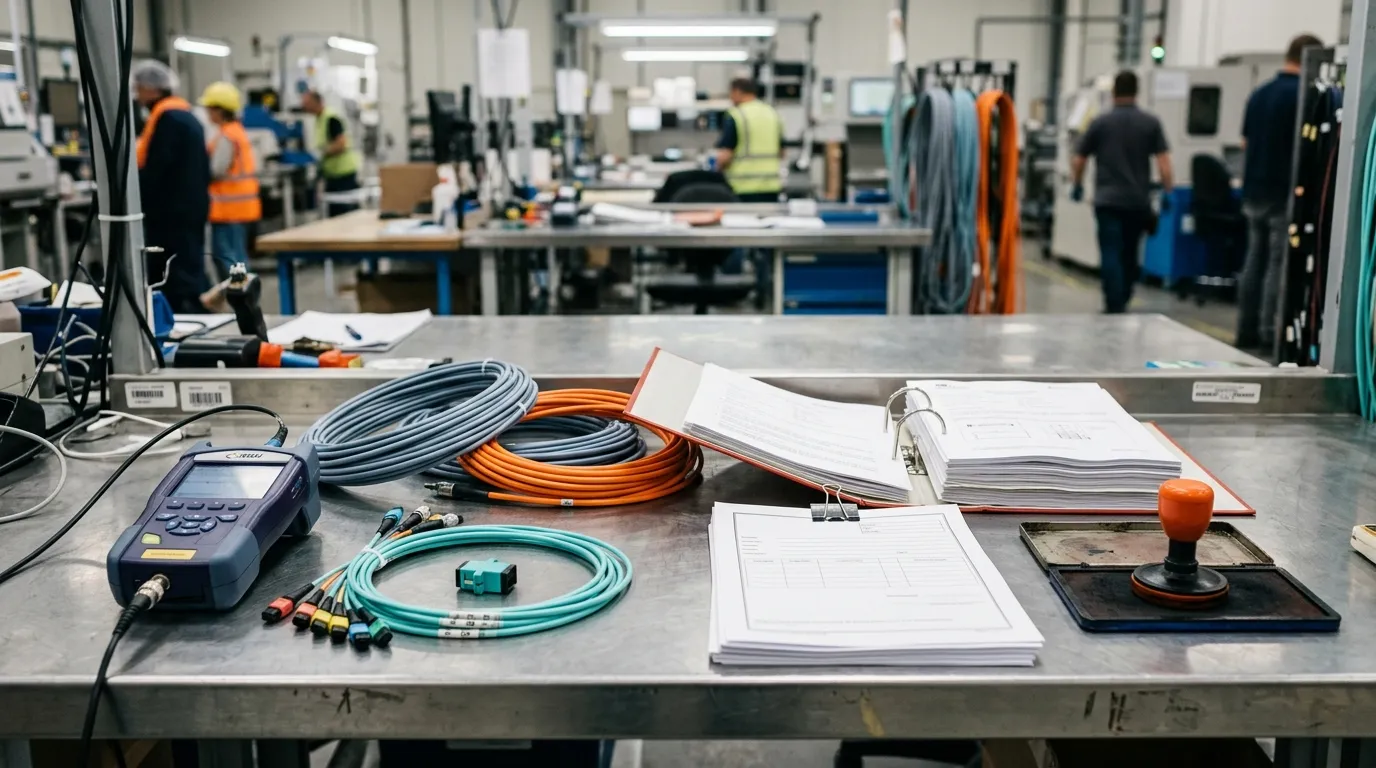
A fiber optic cable certificate library is the complete, organized set of compliance documents a manufacturer maintains for its cable, patch cord and passive component range: product regulation declarations (CPR, UL, CE), material and substance declarations (RoHS, REACH), management system certificates (ISO 9001, ISO 14001), and the performance test reports behind the datasheet numbers (IEC and TIA methods). The library matters not because it is large but because each document answers a different question, and because a buyer can verify most of them independently.
The five questions a certificate library has to answer, and the document that answers each one:
What you need to know | Document that answers it | Who issues it |
|---|---|---|
May this cable be sold and permanently installed in this market? | CPR Declaration of Performance (EU building cable), UL listing (North America) | Manufacturer, based on testing by a notified body; UL or another NRTL |
Is the declared performance true for the product I ordered? | Type test / performance test report (IEC, TIA or UL test methods) | Accredited test laboratory |
Are the materials free of restricted substances? | RoHS declaration and test report, REACH SVHC statement, certificate of conformity (CoC) | Manufacturer; accredited laboratory for reports |
Can this factory repeatedly make what it just made? | ISO 9001 (quality) and ISO 14001 (environment) certificates | An accredited certification body |
Has an independent body verified production, not just a sample? | Certificate of constancy of performance (CoCP) for higher CPR fire classes | Notified body |
The documents that carry the most weight in a purchase file are also the ones a manufacturer writes itself — the declaration of performance behind a CE mark, and the RoHS and REACH statements. That is the part most buyers miss: a CE mark is a self-declaration, not a certificate issued by an authority, and a RoHS statement is a claim until a test report backs it.
The document that matters is the one whose scope names the product you are buying. Everything else in the folder is context.
The rest of this article is the working version of that idea: which certification applies to which product and market, how to read the document when it arrives, and how to verify it before you wire a deposit. If you want the regulatory background underneath all of it, our fiber optic standards and certifications hub collects the deep dives on CPR, UL, CE and RoHS; this page is the index you keep open while you qualify a supplier.
Which Certifications Apply to Fiber Optic Cable and Patch Cords
Certification requirements follow two variables, not one: the market the goods land in, and the product family. A bulk outdoor cable and a 12-fiber MPO trunk assembly rarely need the same paperwork, even from the same factory.
Product family | European Union | North America | Both markets |
|---|---|---|---|
Indoor / in-building cable (riser, plenum, LSZH) | CPR declaration of performance with an EN 50575 Euroclass, CE mark | UL listing with an NEC fire rating (OFNR, OFNP) | RoHS, REACH, IEC 60794 / IEC 61300 test reports |
Outdoor / OSP cable | CE mark; CPR applies where the cable is permanently installed in a building | UL listing where the cable terminates inside a building | RoHS, REACH, IEC 60794 mechanical and environmental test reports |
Patch cords, pigtails, MPO/MTP assemblies | CE; RoHS and REACH declarations | UL listing when the assembly is required to be listed; TIA-568 performance compliance | Insertion loss / return loss test reports per assembly, end-face inspection (IEC 61300-3-35) |
Connectors, adapters, splitters, passive components | CE; RoHS and REACH declarations | UL listing for the component where applicable | IEC 61754 interface compliance, IEC 61300 test methods |
Two entries on that table are worth reading twice, because they are where purchase orders go wrong.
Fire performance is a building-code requirement, not a quality preference. Inside the EU, a cable permanently installed in a building has to carry a CPR reaction-to-fire classification; inside the US, cable in a plenum air-handling space has to be listed for that use. The same physical cable can be over-specified (expensive) or non-compliant (failed inspection) depending only on where it is installed.
Patch cord certification is assembly-level, not just cable-level. A buyer who receives a CPR or UL document for a bulk cable has verified the cable, not the finished patch cord that ships with a factory-terminated connector. That distinction is exactly what MPO/MTP projects trip over.
CPR and EN 50575: The Certificate EU Building Projects Ask For
When a European project specification demands "CE certification" for cable, what it usually means in practice is a declaration under the Construction Products Regulation. Regulation (EU) No 305/2011 requires a manufacturer to draw up a Declaration of Performance (DoP) for a construction product and to CE-mark it on that basis — and for cables, the European Commission's CPR pages describe how the system works.
For cable, the harmonised standard that turns the CPR into a testable requirement is EN 50575. It defines reaction-to-fire Euroclasses (Aca through Fca, with additional classifications for smoke production, flaming droplets and acidity) that are declared for cables intended for use in construction works. The DoP is the document that carries the classification: if your specification says Cca-s1b,d1,a1 and the DoP says Dca-s2,d2, the cable is not non-compliant in the abstract — it is non-compliant for your project, and no amount of ISO paperwork changes that. Our CPR Euroclass guide walks through the classes themselves; the indoor vs outdoor CPR rating comparison covers the version of the question that matters when one cable is used in two environments.
Which document settles the question depends on the market and the specification, not on the supplier's preference:
Your situation | The document that decides it | What has to match |
|---|---|---|
An EU construction project that specifies a Euroclass | CPR declaration of performance | The declared Euroclass string against the specification; the AVCP system applied; the notified body number |
An EU project that asks only for "CE cable" | The same DoP | Insist on the DoP itself — a CE mark alone states no performance |
A North American installation with a code fire-rating requirement | UL listing for the applicable product category | File number, product category and the rating the code requires |
One cable going into an EU project and a North American project | Two independent document sets | Neither the DoP nor the UL listing substitutes for the other |
One structural point about CPR documents: unlike an ISO certificate, a DoP is not issued to the manufacturer by a third party. The assessment and verification system behind it is fixed by fire class: Commission Decision 2011/284/EU set the assignment for cables — it is the mapping now carried in the harmonised standard EN 50575, whose system definitions point back to Annex V of the CPR — and it puts cables declared Aca, B1ca, B2ca or Cca in system 1+, in which a notified body carries out the initial type testing, audits factory production control and keeps up surveillance; cables declared Dca or Eca fall under system 3 (initial type testing by a notified test laboratory, with no ongoing notified-body surveillance) and Fca under system 4, where the manufacturer tests and declares alone. The consequence for your document pack is concrete: for the higher fire classes there should be a certificate of constancy of performance issued by the notified body in addition to the DoP. The DoP itself names the system applied and the notified body's number, and those two fields, not the logo, are what a project engineer should check.
Two further points about timing. First, the reaction-to-fire classification on the DoP is what has to satisfy the project specification; a supplier offering a different Euroclass can be perfectly compliant and still wrong for your job. Second, the regulation itself has changed: Regulation (EU) 2024/3110 has replaced Regulation (EU) No 305/2011 — it applies from 8 January 2026 and repeals the old regulation from the same date — while harmonised standards such as EN 50575 that were in force on 8 January 2026 remain valid under the old regulation until the Commission withdraws them. Two consequences follow for your document pack. The DoP-based documents described above are still what you will be handed for cable today, because the provisions of the old regulation that cover levels of performance and assessment and verification of constancy of performance stay in force until 8 January 2040. And the recast merges performance and conformity into one document, the declaration of performance and conformity, which is the name to expect as products move onto the new harmonised technical specifications.
UL Listings and North American Fire Ratings: What a File Number Proves
In North America the fire question is answered by listing, and listing is a real third-party record — which makes it the easiest of all these documents to check. Cable and patch cord ratings you will see on specifications include OFNR (riser), OFNP (plenum), OFCR and OFCP; they are referenced by the National Electrical Code, NFPA 70, and enforced by inspectors, not by buyers.
A UL listing for optical fiber cable is documented by a file number (the familiar E-number), which resolves to a company and a product category in UL's certification directory. UL's certification services are the body of record for those marks, and a listing entry will name the product types it covers.
That last sentence is the whole verification: the listing must cover the product family you are buying and the company you are contracting with. Three failures recur.
- The file number resolves to a different legal entity. Listings do not transfer with a distribution agreement or a rebrand.
- The listing covers a different construction or rating than the one on the purchase order — a riser-listed cable quoted against a plenum specification is a mismatch, not a paperwork slip.
- The product carries a UL mark but no resolving file number is ever produced, or the supplier offers an unrelated "test report" instead.
For the code side — which rating is required where, and how the NEC treats optical fiber cable — our UL, NFPA and NEC cable fire ratings article goes through the ratings in detail. In the certificate library itself, the UL document is the one North American buyers should be able to verify in public records within minutes.
CE, RoHS and REACH: The Declarations Behind the Marks
These three letters get used as if they were the same kind of evidence, and they are not.
CE marking is the manufacturer's declaration that a product meets the EU directives that apply to it. There is no central EU register of CE certificates and no authority that issues one; the European Commission's CE marking pages state the obligation and the manufacturer's responsibility plainly. The document to request is the Declaration of Conformity (DoC): it names the manufacturer (and, for non-EU manufacturers, the authorized EU representative), the product identification, the directives applied, the harmonised standards used, and the date and signatory.
RoHS — Directive 2011/65/EU — restricts hazardous substances in electrical and electronic equipment, and the European Commission's RoHS pages summarise the current restricted list and the exemption regime. Because the directive's legal scope is written around electrical and electronic equipment, the RoHS position for a passive fiber optic cable is argued from its role in the equipment it serves, and suppliers therefore issue declarations for the full product line. Treat that as reason to read the paperwork, not to skip it: ask for a test report from an accredited laboratory, citing the batch, and ask the supplier to state which product types the declaration is intended to cover rather than accepting a company-level compliance statement.
REACH — Regulation (EC) No 1907/2006 — governs chemical substances in the EU and operates the candidate list of substances of very high concern, which the European Commission's REACH pages maintain in overview. In practice, what a cable buyer needs is an SVHC declaration: a statement of which candidate-list substances, if any, are present above the applicable threshold in the article being supplied, kept current as the list grows. A declaration that has not changed in five years is not evidence of stability; it is evidence that nobody is checking.
The three documents differ in kind, and the table below is the short version of why they cannot substitute for one another:
Mark or claim | Legal nature | Document to request | Where it can be verified |
|---|---|---|---|
CE mark | Manufacturer's self-declaration | Declaration of Conformity, with directives and standards | Nowhere centrally — verify the directives and standards it cites |
RoHS | Legal restriction on substances | RoHS declaration + laboratory test report per batch | Laboratory report number and accreditor |
REACH | Legal restriction and information duty | SVHC declaration, dated and updated | Inside the supplier's own substance data; compare against the current candidate list |
Our CE, RoHS and REACH compliance guide covers the same three regimes from the project side, including the documents a European distributor has to hold.
ISO 9001 and IEC/TIA Test Compliance: Process Evidence vs Product Proof
The most common confusion in a certificate library is between a certificate that describes a factory and a report that describes a product.
ISO 9001 certifies a quality management system. It is issued by a certification body that is itself accredited by a national accreditation body, which is why the searchable global register, IAF CertSearch, is the right place to look up a certificate number, and why ISO's own explanation of the 9000 family is careful to describe it as a management-system standard. A valid ISO 9001:2015 certificate tells you the supplier has a documented, audited process for design, production and inspection. It tells you nothing about whether the specific cable in the container was tested, or which fire class it holds. Buyers who treat ISO 9001 as product compliance are one inspection away from finding out the difference.
Test compliance with IEC and TIA standards is the product side of that divide. Optical fiber cable, connector interfaces and test methods are standardized by IEC, whose 60794 (cable), 61300 (test procedures and measurement) and 61754 (connector interfaces) series appear on almost every serious datasheet; structured cabling performance and component requirements are standardized by the Telecommunications Industry Association, whose TIA-568 and TIA-604 series cover cabling and connector interoperability — our TIA-568 structured cabling overview covers that family in more depth. Compliance here means a test report that names the standard, the method, the sample and the measured values.
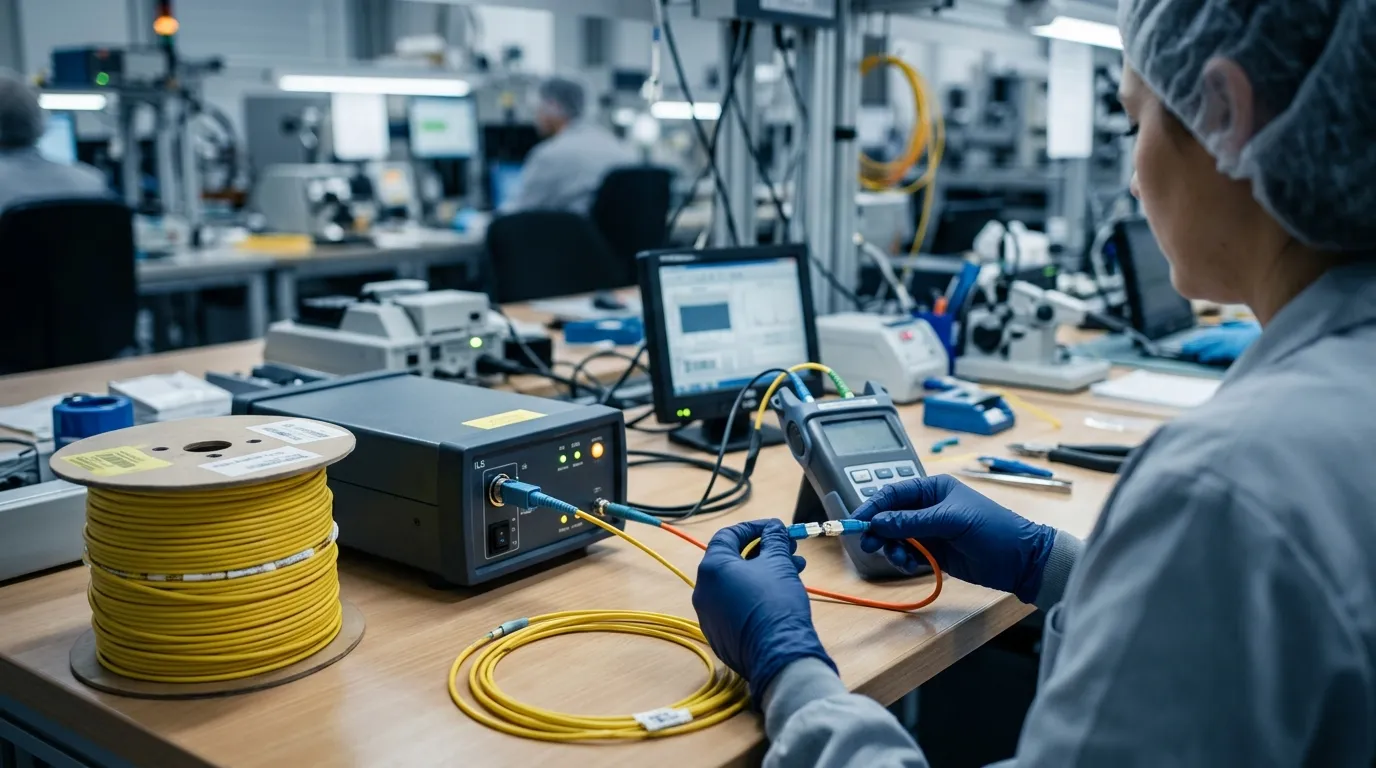
That report is where a fiber optic test report earns its place in the library, and it is the document that answers the buyer's most practical question: not "is this factory good?" but "does this assembly measure what the datasheet says?" For patch cords sold as a fiber optic cable product line, the numbers to expect are insertion loss and return loss per mated pair, plus an end-face geometry/inspection result for the connector.
How to Read a Certificate Document
Certificates from different schemes look different, but they share a skeleton. Reading them in the same order every time turns a stack of PDFs into eight checkable fields.
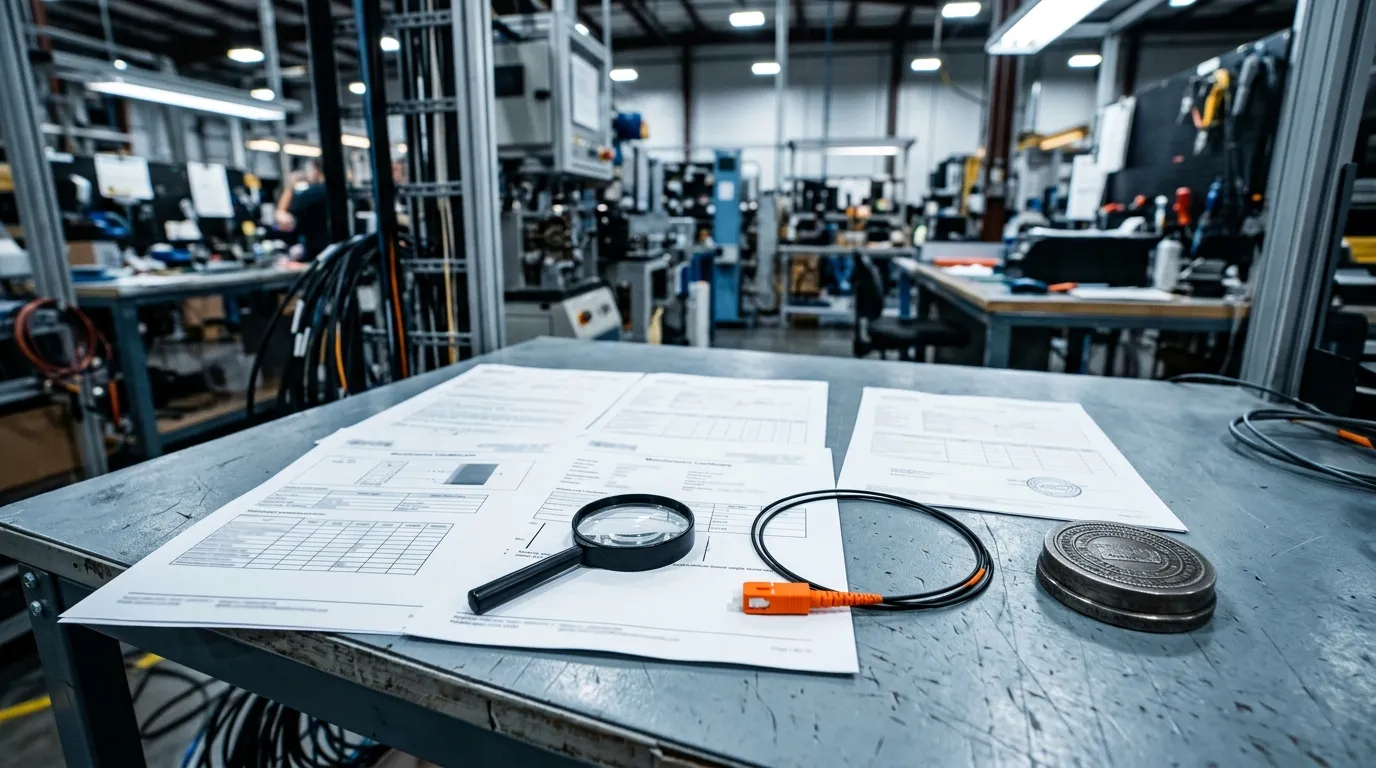
- Certificate or file number. If a document has no number, or a decorative one ("No. 001"), you cannot verify it, and the conversation should stop there until the supplier produces a real one.
- The legal entity. The name must be the company you are contracting with, not a trading name, a sister factory or a group parent. Certificates are address-specific and site-specific; a document for a different production site is a different supplier.
- The issuing body, and its accreditation mark. For ISO certificates, look for the accreditation body's mark (ANAB, UKAS, CNAS and their peers). For CPR, look for the notified body number. For UL, look for the file number rather than the logo.
- The standard, with version and year. "ISO 9001" is incomplete; ISO 9001:2015 is a document you can check. The same applies to a DoP that cites an older test standard.
- The scope. This is the field that decides whether the certificate is relevant to your order. A scope reading "trading of optical components" does not evidence manufacturing; a scope covering cable and pigtails may not cover the MPO assembly you asked about.
- The product or model list. Where the document enumerates covered products or types — a UL listing entry, a type test report, a DoP — read it against your purchase order line by line.
- Issue date, expiry date, surveillance cycle. ISO certificates run on a three-year cycle with surveillance audits; an expiry date that extends every year without a new audit is a sign that the document has been edited rather than issued.
- For a CPR declaration of performance specifically: the Euroclass and the notified body. The classification string (for example Cca-s1b,d1,a1) must match the project specification, and the notified body reference must be a body authorized for cable.
A certificate that passes those eight checks is a document you can defend in an audit. One that fails any of them is a document to send back with the specific field named — which is a faster conversation than rejecting the whole folder.
How to Verify a Supplier's Certificate Before You Order
Verification is not an opinion about the supplier; it is a lookup, and different documents have different lookups. This is the workflow to run on the file set (not the sales deck) before a purchase order goes out.
Document in your pack | Where the independent record lives | What has to match |
|---|---|---|
ISO 9001 / ISO 14001 certificate | IAF CertSearch or the issuing certification body's own database | Certificate number, legal entity, scope, validity dates |
UL listing | UL's certification directory | File number, company, product category and rating |
CPR declaration of performance | The notified body referenced on the DoP; the Commission's register of notified bodies | Euroclass, the assessment and verification of constancy of performance (AVCP) system applied, and the notified body number for that product area |
RoHS / REACH test report or declaration | The accredited laboratory named on the report | Report number, methods, model and batch or date codes |
Performance test report (IL / RL / end face) | The laboratory that issued it, and your supplier's own records | Standard cited, sample identity, measured values, lot |
- List every number. Certificate numbers, UL file numbers, DoP identifiers, test report numbers, notified body numbers. Numbers are the only fields that can be checked against an independent record.
- Run the ISO certificates through the register. Search the certificate number in IAF CertSearch or the issuing certification body's own database. Confirm the entity, the scope and the validity dates match the PDF in front of you.
- Run the UL listing through UL's directory. The file number must resolve to your supplier's legal entity and to the product category you are sourcing. Ask the supplier to send the directory entry themselves — a listed manufacturer can do it in one click, and a supplier selling someone else's listing cannot.
- Check the CPR paperwork against the notified body and the specification. The Euroclass on the DoP must satisfy the project, and the notified body referenced must be authorized for the relevant product area in the European Commission's register of notified bodies.
- Trace the test reports to your batch, not just to the model. A report that names the model but not the batch is evidence about a sample, not about your shipment; the useful version also carries the date codes or lot references that let you tie it to the goods.
- Ask what happens when something changes. Materials, compounds and factories change; a change-notification clause in the supply agreement is what keeps a verified library valid next year.
- Re-verify on a cycle. Annual re-checks, plus a re-check whenever the supplier announces a process or material change, are cheap compared with discovering an expired certificate during an acceptance inspection.
Two adjacent cases are worth knowing about because they generate most of the arguments. The first is OEM and private-label supply: when a buyer's brand goes on the product, the question of whose certificate covers which party is answered by contract as much as by document — our OEM certification transfer article deals with that structure directly. The second is the sourcing conversation itself, which is easier when you arrive with a specific document checklist; our supplier certificate verification guide is the companion piece to this one, and covers the database-level checks certificate type by certificate type.
A statement is not evidence. Ask for the report behind the statement, and for the lot it covers.
A Certificate Request Checklist for Your Next RFQ
Paste this into the RFQ, or into the email that follows the quote. Every line is a document, not an assurance.
- Certificate copies with numbers visible — not logo pages or a marketing page.
- Declaration of Conformity for CE-marked products, naming directives, harmonised standards, the signatory and the EU authorized representative where applicable.
- Declaration of Performance for any cable permanently installed in a building, with the Euroclass and the notified body number.
- UL file number and the directory entry for any listed cable, patch cord or assembly.
- RoHS test report from an accredited laboratory, with report number, methods and the batch or date codes it covers.
- REACH SVHC declaration, dated, with a stated update cycle against the current candidate list.
- ISO 9001 (and ISO 14001) certificate numbers and the issuing certification body, so you can run the register check yourself.
- Performance test reports per assembly type for patch cords and MPO/MTP trunks — insertion loss, return loss, end-face inspection — traceable to the lot.
- Audit access and change notification: the right to inspect or commission a third-party inspection, plus a written commitment to notify you when a material, process or certificate changes.
Suppliers who maintain a real certificate library answer this list in one message. Suppliers who treat certification as marketing answer the first three items and go quiet on the rest, and that silence is itself the verification result.
Inside TTI Fiber's Certification Library
The same table applies to the certificates a manufacturer publishes. TTI Fiber maintains and publishes its certification library for fiber optic cable, patch cords, pigtails, connectors, adapters and splitters, and it is structured the way the sections above suggest: management system certificates with checkable numbers, EU product regulation compliance, and third-party verification.
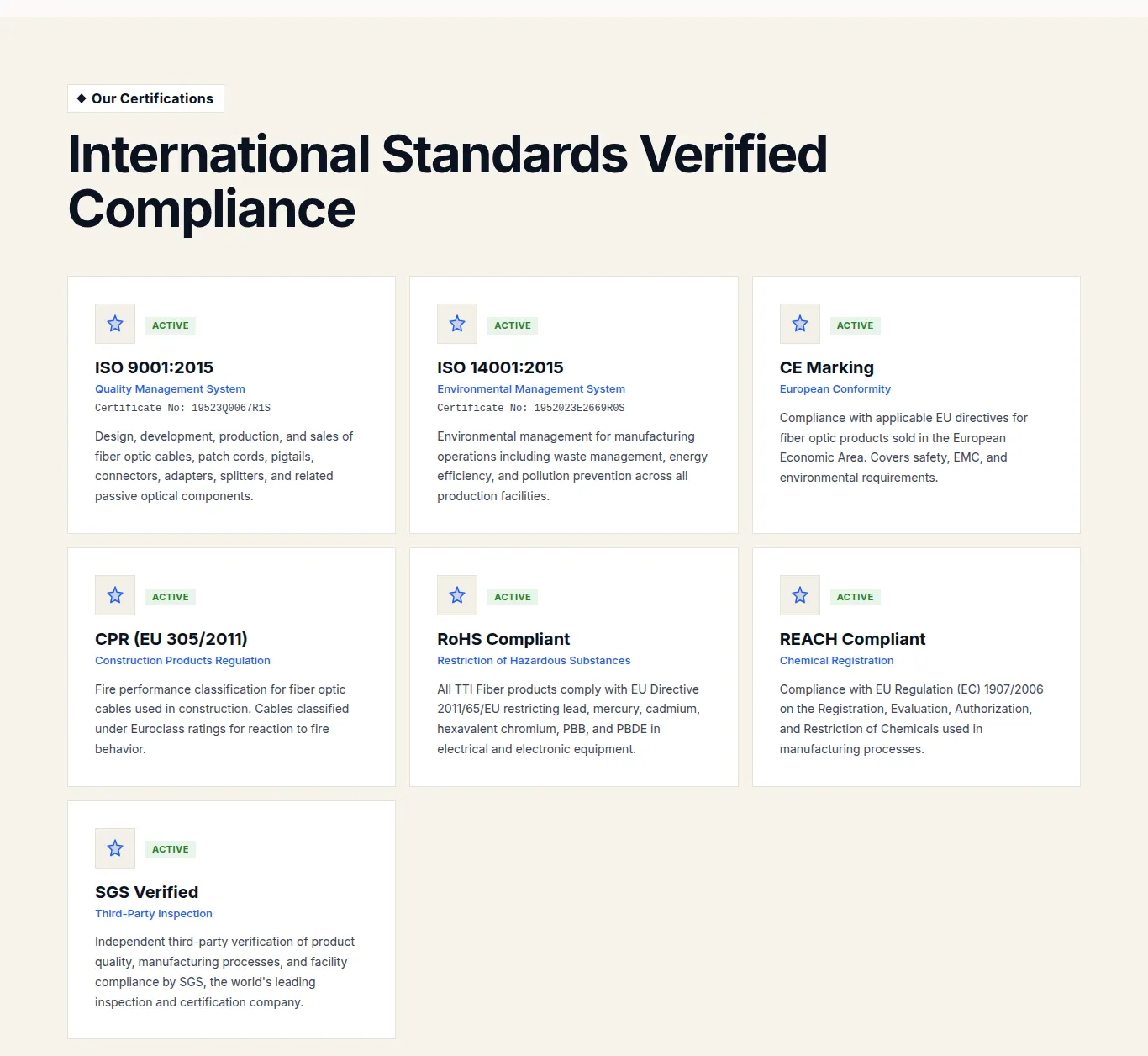
The published entries, as they stand on the TTI Fiber certifications page:
- ISO 9001:2015 — quality management system, certificate no. 19523Q0067R1S, scoped to design, development, production and sales of fiber optic cables, patch cords, pigtails, connectors, adapters, splitters and related passive optical components.
- ISO 14001:2015 — environmental management system, certificate no. 1952023E2669R0S.
- CE marking and CPR (EU 305/2011) — EU product compliance for fiber optic products sold in the EEA, with fire performance classification for cables used in construction declared under Euroclass ratings.
- RoHS (Directive 2011/65/EU) and REACH (Regulation (EC) 1907/2006) compliance across the product range.
- SGS third-party verification of product quality, manufacturing processes and facility compliance.
- Manufacturing and testing against IEC 61754, IEC 61300, IEC 60794, TIA-568 and TIA-604 series specifications, with every patch cord, cable and splitter individually tested for insertion loss, return loss and end-face geometry before dispatch, and batch-level traceability from raw material to finished goods.
Two limits belong next to that list, because a library that claims everything verifies nothing. ISO 9001 and ISO 14001 are management-system certificates and should be read as such; the product-level evidence is the CPR classification, the CE declarations and the test reports. And a certificate library is only as current as its last audit — the numbers above are worth looking up in the registers described in the previous section, and we expect buyers to do exactly that.
FAQ: Fiber Optic Cable Certification Questions Buyers Ask
Do fiber optic cables need CE marking? Where they fall under an EU directive that requires it — and a cable permanently installed in a building falls under the CPR, which carries CE marking with a declaration of performance. The marking is a manufacturer's declaration, so the DoC and DoP are the documents that carry the substance.
Do patch cords need UL listing? Not universally. A listing is required where the installation code, the project specification or the buyer's own compliance program demands it — most often for cables and assemblies installed in plenum or riser spaces. The check is the same either way: a file number that resolves to your supplier and your product family.
How long is an ISO 9001 certificate valid? The standard cycle is three years, with surveillance audits in between. A certificate that shows no surveillance history is incomplete documentation regardless of the expiry date printed on it.
What is the difference between a certificate of conformity and a declaration of conformity? A certificate of conformity for fiber optic cable is issued on the basis of testing or assessment and names the standard it conforms to; a CE declaration of conformity is the manufacturer's own statement of which directives and standards apply. Both are useful; only one of them is independent of the manufacturer.
Can I rely on the supplier's datasheet instead of the certificates? The datasheet is a claim; the test report is the evidence behind it. For loss figures and end-face results, ask for the report that produced the number and for the lot it covers.
How often should a certificate library be checked? Annually at minimum, and again whenever the supplier changes materials, compounds, processes or production sites. The register lookups take minutes; the recall or the failed inspection they prevent does not.
What to Do With This Page
Send the nine-item checklist to your supplier today, and ask for the certificate numbers before the quote is finalised. Two things happen: either your supplier's certificate library stands up, in which case you have a documented basis for the approval and a faster path through customs and acceptance; or it does not, and you have found that out while the order is still yours to place.
A working certificate library is not the thickest one. It is the one where every document has a number you can look up, a scope that matches the goods, and a date that has not quietly gone stale. If you are sourcing assemblies rather than bulk cable, our MPO/MTP patch cords and other terminated cable assemblies ship with the per-assembly insertion loss, return loss and end-face test reports described in the checklist above, and our team will send the declarations behind any quotation.
This article is a procurement reference on certification documents, not legal or regulatory advice. Compliance obligations depend on the specific product, market and installation, and the governing texts — the CPR, RoHS and REACH regulations and the applicable standards — are the authoritative sources.