OEM Certification Transfer for Fiber Cable
If you buy fiber optic cable from a factory and sell it under your own brand, you have probably assumed the supplier's certifications come with it. They do not — not automatically. A CE mark, a CPR Declaration of Performance, a UL listing, an ISO 9001 certificate: each one is attached to a specific legal entity (and, for listing marks and management-system certificates, a specific site) and a specific product type. Buying cable transfers ownership of the cable. It transfers none of that by itself. OEM certification transfer, in other words, is a paperwork and rights exercise — not a property transfer.
What actually moves in an OEM deal is what your contract says may move: the right to use technical documentation, documents re-issued under the correct name, and authorized coverage of listing marks. Get that arrangement wrong and the gap shows up in the worst places — a customs hold, a failed building inspection, a customer's compliance audit that names you, not the factory. This guide walks through which fiber optic cable certifications can follow your brand, which ones never do, and the exact documents and checks to close before you sign an OEM agreement. For the full framework behind each scheme — CPR, UL, CE and RoHS — start with our fiber optic standards and certifications hub, then come back for the transfer mechanics.
OEM certification transfer: why the phrase misleads buyers
The phrase makes a certificate sound like a document you can hand over with the goods, like a test sheet in the drum. It is closer to a license: it belongs to whoever the issuing scheme names, and using it under another name without authorization is either a contractual failure or a legal one.
What OEM buyers assume | What actually happens |
|---|---|
"The factory is CE and CPR certified, so our brand is covered." | CE and CPR documents must name the correct economic operator. When your brand appears on the product in the EU, the obligations can shift to you — or you must operate strictly as importer or distributor on the factory's documentation. |
"We have the factory's ISO 9001 certificate, so we can show it to customers." | An ISO 9001 certificate is issued to one legal entity at one site. It says nothing about your company, and it cannot be transferred to you in a supply deal. |
"The UL listing follows the product." | A UL or ETL listing is held by the company named in the file. If your name will appear on the product, the file must cover that arrangement, or the mark on your cable is not backed by any listing. |
"We can use the factory's test reports for our own declaration." | Test reports belong to whoever commissioned them. Using them in documents issued under your name requires the right to do so — a clause in your agreement, not an assumption. |
"Certification transfer" also means three different things in practice, and mixing them up is where deals go wrong:
- Formal transfer between entities — a listing or certificate moving from one legal entity to another, usually in an acquisition or ownership change, under rules set by the scheme (for example, UL's transfer process, or the certification-body transfer rules managed by the IAF). This is rare and does not happen because you signed a supply agreement.
- Rights granted by contract — the factory licenses you to use its technical file, re-issues documents in the agreed name, or arranges private-label coverage of its listing marks. This is the normal engine of OEM business.
- Documents re-issued under the right name — a Declaration of Performance or Declaration of Conformity that names you as the manufacturer because you have the product made under your own name or trademark.
Most white-label fiber cable deals run on numbers 2 and 3. The work is making sure the paperwork, the product, and the commercial roles line up — and proving it before the money moves.
Which fiber optic cable certifications can follow your brand
Not all schemes behave the same way. Sorting them into three families makes the rules legible: declaration-based schemes, substance rules, and third-party listing marks.
Certification | Scheme type | What can move to your brand | What stays with the factory |
|---|---|---|---|
CPR / CE (EU, EN 50575) | Manufacturer's declaration | A new Declaration of Performance can name you as manufacturer if you have the product made under your own name or trademark and hold the technical documentation | The underlying reaction-to-fire test programme and its notified-body relationship are tied to the declared product type — you declare the same product type, not a new one |
RoHS / REACH (EU) | Substance rules along the supply chain | Information duties flow to you as recipient and onward to your customers; data (SVHC declarations, SCIP details) is obtainable from the factory | No "certificate" exists to transfer — obligations attach to each economic operator, and importer duties land on whoever imports under their own name |
UL / ETL (North America, ETL by Intertek) | Third-party listing | Authorized or private-label coverage so your brand can appear on a listed product; a formal listing transfer in an ownership change | The listing file and its holder identity; the mark is only covered for parties and products the file names |
ISO 9001 / 14001 | Management system audit | Nothing — it certifies the factory's own system | The entire certificate: entity, site, audit trail |
Test reports | Technical evidence | Use rights, if your agreement grants them and the report scope covers your exact product | Ownership and the laboratory's duty of care to whoever commissioned the test |
CPR and CE documents can be re-issued for your brand — with conditions. The Construction Products Regulation governs the CE marking of most fiber optic cable installed permanently in buildings, through EN 50575 and the Euroclass system. The operative document is the Declaration of Performance, and its legal basis is Regulation (EU) No 305/2011. Note the regulation is being replaced in stages: the recast Regulation (EU) 2024/3110 has applied since 2026-01-08, but EN 50575 products still issue DoPs under the 305/2011 route during the transition, so before signing or reviewing a DoP confirm which path currently applies to your product. A DoP names the manufacturer and the declared product type. If your company commissions the cable, markets it under your own name or trademark, and holds the rights to the technical documentation, you can be that manufacturer — with the duties that come with the title. What you cannot do is keep the factory's DoP unchanged while your name goes on the drum. For the details of Euroclass codes and what each one means for your project, see our CPR cable classes guide.
RoHS and REACH have no certificate to transfer — but they have duties that follow you. Both schemes are substance rules that run along the supply chain rather than attaching to a product brand. REACH is the EU's chemicals regulation; its official text and the European Commission's REACH explainer describe the core pattern: information about substances in articles flows from supplier to recipient. If you import the white-label article into the EU under your own name, you become the importer for REACH purposes — which means SVHC communication duties under REACH Article 33 and, where the article contains a Candidate List substance above the 0.1% w/w threshold, SCIP database notification duties under the Waste Framework Directive (operated by ECHA) sit with you as the first EU supplier or your chain. The factory's data feeds those duties; it does not extinguish them. The practical buyer's reading: obtain a dated SVHC declaration that covers the article you are actually buying, and confirm who carries the SCIP obligation in your arrangement. If the EU framework side of this is new, our CE, RoHS and REACH compliance guide walks through the schemes themselves in buyer language.
UL and ETL listings are held, not inherited. A UL listing is a third-party certification issued to a named company — the certificate holder — for listed products manufactured at listed sites. Fiber optic cable sold into North American plenum and riser spaces is specified by its NEC rating (OFNP, OFNR, OFCP and the rest), and those ratings only mean something when the mark on the cable is backed by a live listing file. If your brand name will appear on a UL-marked product, the listing must cover that arrangement. In practice that is a private-label or authorized-use agreement with the certificate holder, or a formal listing transfer if your company is acquiring the holder's business. Selling a rebranded cable under a mark whose file names only the factory is mark misuse — and it voids exactly the protection you thought you had. UL's own guidance on using the UL mark is the place to understand the boundary.

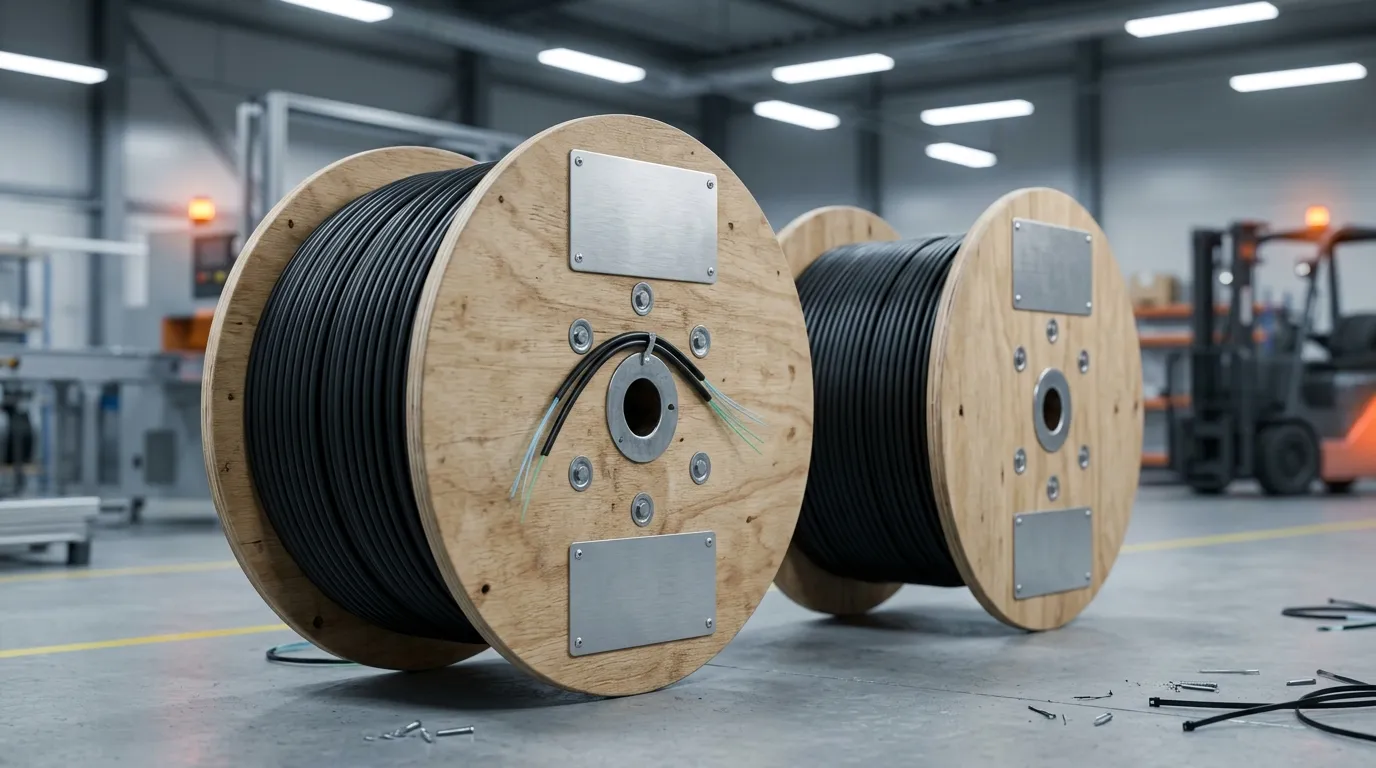
Figure: a white-label reel only inherits the compliance story if the documents behind it are re-issued or authorized for the name on the label.
What never transfers: the three things OEM buyers overestimate
Three items come up in nearly every OEM negotiation as if they were negotiable. They are not.
1. The factory's ISO 9001 (or ISO 14001) certificate. Management-system certificates are issued to a single legal entity at a single site after an audit of that organization's processes. They certify the factory's quality management, which is genuinely useful information about your supplier — and genuinely useless as evidence about your company. When your customer asks whether you hold ISO 9001, a scan of the factory's certificate answers the wrong question. If your contract with the end customer requires you to hold the standard, you need your own certification audit; no clause in an OEM agreement can manufacture that.
2. The identity behind a UL or ETL listing. The certificate holder, the file number, and the listed sites are facts recorded by the certification body. A supply agreement can authorize your use of a listed product under agreed terms; it cannot rewrite who the listing belongs to. This is why the directory lookup in the audit section below is non-negotiable: it shows you, from the certification body itself, whose name the file actually carries.
3. Ownership of test data and the notified-body relationship. Reaction-to-fire testing under the CPR runs through an assessment and verification of constancy of performance (AVCP) programme tied to the declared product type — the Euroclass on your DoP is not a self-declared label, it is the output of a physical test programme with a paper trail. Test reports are owned by whoever commissioned them. If you become the manufacturer on a DoP, you need the right to use that underlying technical documentation, which means a contractual grant from the factory — or commissioning your own testing. Relatedly, whoever is the manufacturer carries the retention duty for the DoP and its technical file for ten years after the product is placed on the market under Article 11 of the CPR. That obligation does not expire when your relationship with the factory does.
The legal manufacturer question: whose name goes on the DoP
The single most consequential decision in a white-label deal is also the one buyers delegate last: who is the manufacturer of record for the EU market. The European Commission's Blue Guide — its official handbook on implementing EU product rules — explains the general logic: the manufacturer is the natural or legal person who places the product on the market under its own name or trademark, and that person carries the conformity obligations. The Commission's CE marking overview and its Construction Products Regulation page describe the same structure from the mark side. The practical consequence for OEM buyers: the moment your brand name is on a cable you placed on the EU market, you may already be the manufacturer that EU rules hold responsible — whether or not anyone updated the paperwork.
In practice white-label programs run on one of two operating models, and the paperwork must match the model:
Model A: your company is the manufacturer | Model B: the factory is the manufacturer | |
|---|---|---|
Who is named on the DoP / DoC | Your company | The factory |
What you need | Rights to the technical file (contract), declared product type, notified-body references, ten-year retention capacity | Verified documentation from the factory, importer/distributor duties under your control |
Who carries conformity liability | You | The factory — with your own obligations as the operator who placed the goods |
Typical fit | You commission a dedicated product line under your brand | You distribute an existing, unchanged product range |
Both models are legitimate. What is never legitimate is a hybrid where the paperwork says one thing and the labels say another — your brand on the drum, the factory's name alone in the file, and nobody able to say which operator answers for the product. Decide the model per market before you sign the PO, and write the decision into the agreement. If the boundary is not obvious for your specific arrangement — it often is not — have a compliance advisor confirm it. Nothing in this guide replaces that step.

Figure: the fire class behind a DoP comes from a physical test programme tied to a declared product type — it cannot be invented on a datasheet when you rebrand.
A five-step process for moving certifications into an OEM agreement
Treat certification transfer as a workstream inside the deal, with the same discipline as tooling or lead times.
Step 1. Map every certificate claim to a document and a holder. Before negotiations, list the certifications your customers will ask for — CPR Euroclass, CE, RoHS, REACH/SVHC, UL or ETL, ISO 9001. Include the cabling-performance standards your tenders cite — ANSI/TIA and ISO/IEC channel specifications are common in structured cabling projects — and note the commercial terms attached to the quoted product type, such as MOQ and lead time, because a re-issued certificate must describe the same product the price was quoted on. For each item, write down the document that proves it, the legal entity named on it, and its date or validity. This map is your baseline: it tells you what actually exists behind the supplier's marketing page. Most supplier claims collapse or survive at this step.
Step 2. Decide the operating model per market. Using the two models above, decide who is the manufacturer of record for each market you serve — the EU (CPR/CE), North America (UL/ETL), and any other region with its own rules. The model can differ by market: many OEM buyers are the manufacturer for their home EU market and rely on the factory's UL file for North American sales under a coverage arrangement. Write the decision down; it drives every document request that follows.
Step 3. Contract the rights. Your agreement needs clauses for: the right to use the technical documentation behind any DoP or declaration issued in your name; the obligation to re-issue documents within a defined period after order confirmation; private-label or authorized-use coverage for UL/ETL marks; ownership and license terms for the factory's test reports; and a change-notification clause so you are told — in writing — before the factory alters a product formulation, a production site, or a certificate that your documents depend on. If a clause is absent, assume the right does not exist.
Step 4. Get the documents in your name and verify them. After the contract is signed and before the first shipment, collect the re-issued documents and check each one mechanically: the name on the DoP, the declared product type against the cable you ordered, the notified body reference, the UL directory entry, the SVHC declaration's scope and date. Section 7 below is the ten-minute routine for this. Do not accept "the factory's certificates cover it" as a substitute — the whole point of the re-issue is that your name, not a generic claim, is on the file.
Step 5. Re-verify on every batch and every trigger. Certificates and listings have validity periods, and the EU substance lists update twice a year. Re-request SVHC declarations on the update cycle, confirm UL directory entries are still live before each major order, and treat any supplier change — new factory site, changed jacket formulation, new test laboratory, new certificate number — as a trigger to rerun steps 1 through 4. An OEM agreement is not a one-time transfer; it is a standing verification relationship.
Documents to collect before you sign a white-label cable order
Collect these with the quotation, and check the name field on every one of them. If the document does not say who it belongs to, it is not evidence.
Document | Name that should appear | Field to check |
|---|---|---|
CPR Declaration of Performance (DoP) | The manufacturer for the EU model you chose | Product type, Euroclass, notified body reference, issue date |
CE Declaration of Conformity (DoC) | The manufacturer or its authorised representative | Directives cited, standards, signatory |
REACH / SVHC declaration | Your company as recipient (and your customers onward) | That it covers the branded article you buy, not just "patch cords" in general; date vs the latest candidate list update |
SCIP notification data | The importer or producer of the article | Which entity files it in your arrangement |
UL / ETL directory entry | The certificate holder | File number, listed product category, listed sites, live status |
Test reports | The commissioning party and the tested product | Report number, laboratory, scope (exact cable type), date |
Certificate of Compliance (CoC) | The issuing manufacturer | Whether it restates real underlying reports or papers over them |
OEM supply agreement | Both parties | Technical-file licence, re-issue obligation, private-label coverage, change notification |

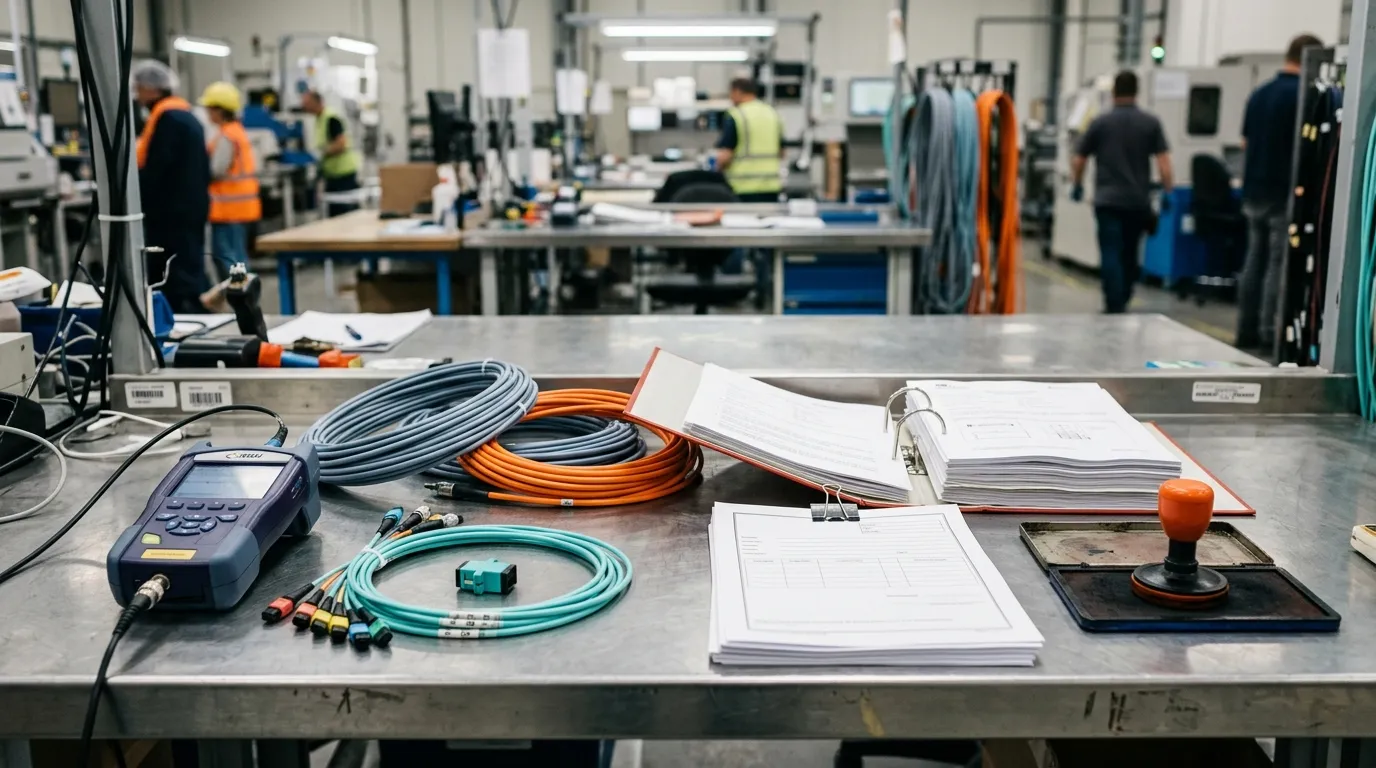
Figure: document review is a procurement step — for white-label deals the name on each document matters as much as its validity.
How to audit a supplier's certification transfer claims
Ten minutes per supplier, four checks, all against primary sources rather than the supplier's own folder.
Check 1: look the listing up yourself. For UL and ETL, search the certification body's own directory — UL's Online Certifications Directory is the authoritative lookup. Search by the file number or company name the supplier gave you, and confirm: the entry is live, the product category matches what you are buying, and the holder is who the supplier says it is. A mark without a directory entry is decoration.
Check 2: read the DoP like a spec sheet. Match the declared product type and Euroclass to the cable you ordered — type, construction, and print must line up. A DoP for "patch cords" cannot back bulk indoor cable, and a Dca declaration cannot serve a project that demands Cca. This is the same discipline covered in depth in our guide to verifying supplier certificates.
Check 3: chase the test evidence. Every test report should carry a report number, a laboratory name, a scope that names your cable type, and a date. If the supplier cannot produce the underlying report behind a declaration, the declaration is an opinion.
Check 4: test the name logic. Ask directly: "Which entity will be named on the DoP if we brand this cable? Which entity holds the UL file? Will our SVHC declaration cover the article under our name?" Hesitation on any of the three is the answer you needed before you signed.
Red flags are easy to spot once you look: certificate numbers that predate the product range, "certified" claims with no directory entry, DoPs that name a different company than the one invoicing you, and SVHC declarations dated before the most recent substance-list update.
FAQ: certification transfer questions OEM buyers ask
What does "certification transfer" actually mean when I white-label cable? It means one of three things: a formal transfer of a listing or certificate between legal entities (rare, usually ownership-driven), rights granted to you by contract (technical file use, private-label coverage), or documents re-issued in your name because you are the manufacturer of record. Most OEM deals run on the last two, and all three need to be explicit in writing.
Can a supplier's ISO 9001 certificate cover my company? No. An ISO 9001 certificate is issued to one legal entity at one site and certifies that entity's quality management system. It is useful evidence about the factory and useless as evidence about your company. If a customer requires ISO 9001 from you, you need your own certification.
Can we put our brand on a UL-listed cable? Yes, when the listing covers the arrangement — typically via private-label or authorized-use coverage with the certificate holder, or a formal transfer if you acquire the holder's business. The directory entry will show whose name the file carries; if yours is not in it, the mark on your product is not backed by that file.
Do we need our own CPR DoP if the factory already has one? If your company is the manufacturer of record for the EU — because you market the cable under your own name or trademark — then yes: the DoP and its technical file belong to you, and you need contractual rights to the underlying documentation. If the factory remains the manufacturer and you operate as importer or distributor, their DoP travels with the product and your obligations are those of the importer. Before you commit to either route, confirm which CPR path currently applies to your product — the original Regulation (EU) No 305/2011 is being phased out in favour of the recast Regulation (EU) 2024/3110 (applying since 2026-01-08), and EN 50575 products still issue DoPs under the 305/2011 route during the transition.
How long does a certification transfer take, and what does it cost? It depends entirely on the scheme and the starting point. Re-issuing a DoP for an existing, tested product type can be a matter of weeks once the technical-file rights are in place; adding your brand to a UL file follows the certification body's own process and timeline; commissioning new testing for a genuinely new product type is measured in months and real money. The cheapest and fastest path is always the same: verify what exists before you sign, so the transfer is paperwork rather than re-testing.
The eight-point checklist before you order white-label fiber cable
- Map every certificate your customers will ask for to a document and a named holder.
- Decide — in writing — who the manufacturer of record is for each market you serve.
- Put the technical-file licence, re-issue obligation, and private-label coverage into the agreement.
- Require documents re-issued in your name, not the factory's folder.
- Verify each one against a primary source: UL directory, DoP fields, report numbers, SVHC scope.
- Confirm who carries the SCIP obligation when an SVHC threshold is met.
- Set a re-verification rhythm: twice-yearly substance-list updates, live listing checks per order, and every supplier change as a full re-run.
- Keep the compliance file for the ten-year horizon the CPR sets for the DoP and its technical documentation.
None of this is exotic — it is the difference between buying cable and buying a brand story. Suppliers who serve OEM buyers routinely handle it: TTI Fiber, for example, publishes its compliance portfolio openly — CE marking, CPR under Regulation (EU) 305/2011 (with EN 50575 products still on the 305/2011 route during the transition to the recast Regulation (EU) 2024/3110) with Euroclass classification, RoHS and REACH declarations across the product line, plus ISO 9001 and ISO 14001 management systems and third-party inspection — documented on its certifications page, and its indoor fiber optic cable range ships with the compliance file behind it. Use that set as your benchmark: any factory you are qualifying for a white-label program should be able to show you the same documents, in the names your arrangement requires, on request.
This guide is provided for general information and does not constitute legal advice. Certification and conformity rules — especially who counts as the manufacturer under EU product legislation — are interpreted continuously and vary with your exact commercial arrangement and target markets. Always verify requirements against the official texts on EUR-Lex, the European Commission's guidance, and the certification body's own rules, and confirm the operator model for your specific deal with a qualified compliance advisor before signing.