CE RoHS REACH Compliance for Fiber Cables
If you buy fiber optic cable for European projects, CE RoHS REACH compliance is not paperwork — one customs hold or one failed building inspection will cost more than the entire order. Yet most buyers can't say which of the four acronyms on a supplier's datasheet — CE, RoHS, REACH, CPR — actually applies to the cable they're buying, or which documents prove it. That gap is where projects stall.
CE, RoHS, and REACH compliance are three separate EU legal requirements. CE marking is the manufacturer's declaration that a product meets the EU legislation applicable to it; RoHS restricts ten hazardous substances in electrical and electronic equipment; REACH regulates chemicals across virtually every article sold in the EU, including cable materials. A fourth scheme, the Construction Products Regulation (CPR), is the one that governs the CE marking of most fiber optic cables installed in buildings.
This guide is written from a buyer's seat: what each regulation demands from fiber optic products, which documents you should request before you place an order, and how to fold compliance into your procurement process without turning it into a legal project. For the full framework of fiber optic standards — CPR, UL, CE and RoHS — start with our fiber optic standards and certifications hub, then come back for the buying specifics.
CE RoHS REACH Compliance: What Each One Actually Means
The three frameworks are often discussed together because they all sit at the EU border, but they are different kinds of obligations with different legal bases, different scopes, and different documents.
Framework | Legal basis | What it applies to | Core obligation | Key document |
|---|---|---|---|---|
CE marking | Various EU directives/regulations | Products covered by CE legislation (EEE, machinery, construction products, …) | Product meets every applicable EU requirement before market placement | Declaration of Conformity (DoC) + Technical File |
RoHS | Directive 2011/65/EU | Electrical and electronic equipment (EEE) | Ten restricted substances stay below concentration limits at the homogeneous-material level | RoHS test report / declaration, part of DoC |
REACH | Regulation (EC) No 1907/2006 | Substances, mixtures, and articles — effectively all goods | SVHC communication and notification, compliance with restrictions and authorisations | SVHC declaration, SCIP notification data |

Two shared facts keep these connected in practice. First, the European Chemicals Agency (ECHA) manages the substance lists for both RoHS and REACH, so updates to one often echo in the other. Second, non-compliance carries the same shape of consequences everywhere: fines, product recalls, customs detention, and loss of market access. The question is never whether compliance matters — it's which documents you can actually check before you pay.
Which EU regulations apply to fiber optic cables
Not every rule applies to every cable. Mapping the regulation to the product is the first step, and it's where most of the confusion lives.
REACH applies to your cable. Always. A fiber optic cable is an "article" under REACH — an object with a shape that determines its function. The jacket compounds, loose tubes, strength members, fillers, and colorants are all in scope. The obligations that matter to a buyer are the SVHC communication duty and the restrictions in Annex XVII, detailed in the REACH section below.
RoHS applies to the equipment around your cable, and in practice to the cable itself. The legal scope of Directive 2011/65/EU is electrical and electronic equipment. A bare cable drum is not EEE; but pre-terminated assemblies, patch cords, and cables sold as part of an EEE product are treated as covered in practice, and EU distributors and integrators routinely require RoHS declarations for everything with copper or a connector on it. Almost every serious cable manufacturer declares RoHS compliance for its full product line — which is why "RoHS compliant" is printed on nearly every fiber cable datasheet you will ever see.
The CE marking on a fiber optic cable usually means CPR, not LVD or EMC. Passive fiber optic cable carries no voltage, so the Low Voltage Directive does not apply, and it is not "apparatus" under the EMC Directive. The CE framework that does reach cable is the Construction Products Regulation: cables placed on the market for permanent installation in buildings and civil works fall under EN 50575, the harmonised standard for the reaction-to-fire performance of power, control and communication cables. That is the mechanism behind the CE mark and the fire classification printed on indoor cable drums. If you buy active equipment instead — media converters, switches, optical transceivers — then the classic LVD/EMC/RoHS CE marking stack does apply to that equipment.
CPR is the requirement most fiber buyers miss. Regulation (EU) No 305/2011 requires a Declaration of Performance and CE marking for construction products covered by a harmonised standard. Communication cables, optical fiber included, are covered by EN 50575 when they are intended for fixed installation in construction works. The next section covers what that means for the cable itself.
The practical reading for a buyer: REACH documentation for every fiber product, RoHS documentation for assemblies and EEE-connected products, and CPR documentation (DoP + fire class) for any cable going into a building.
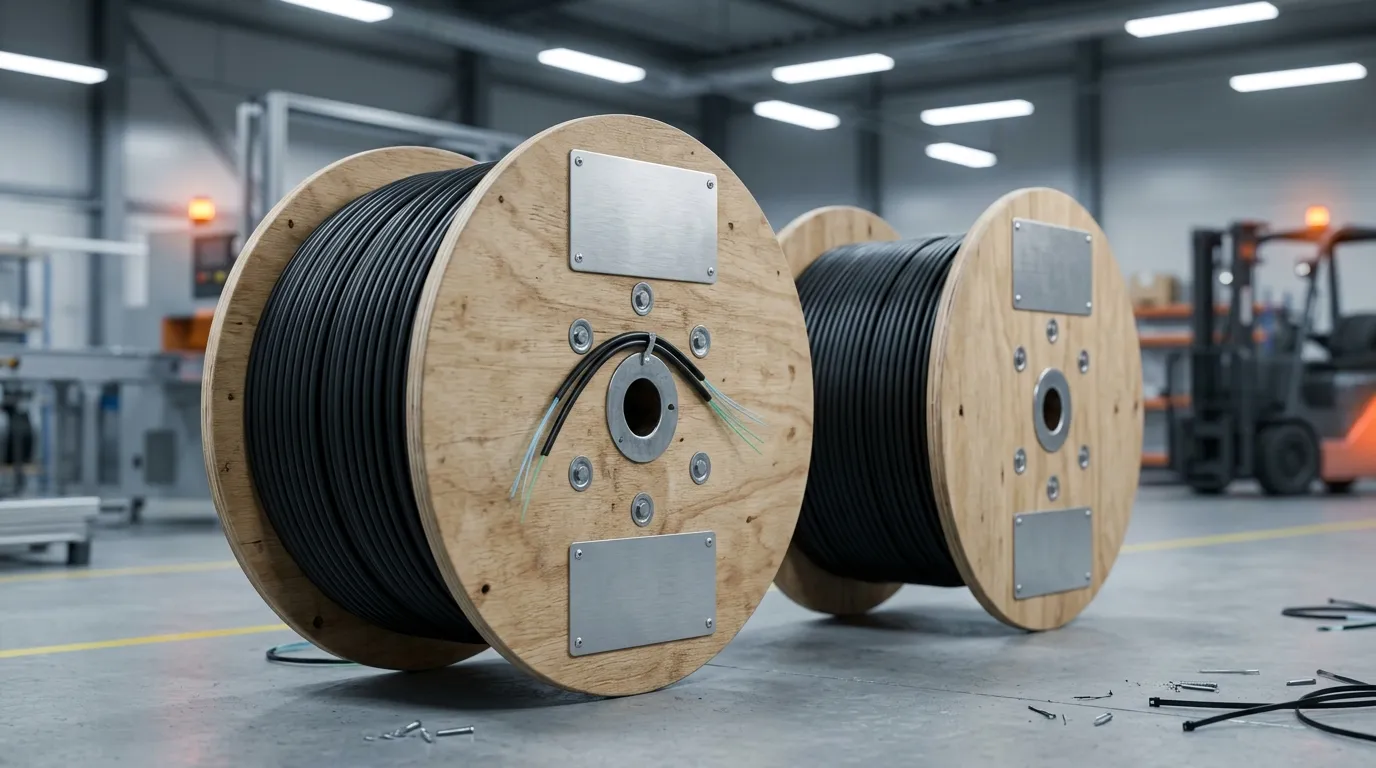
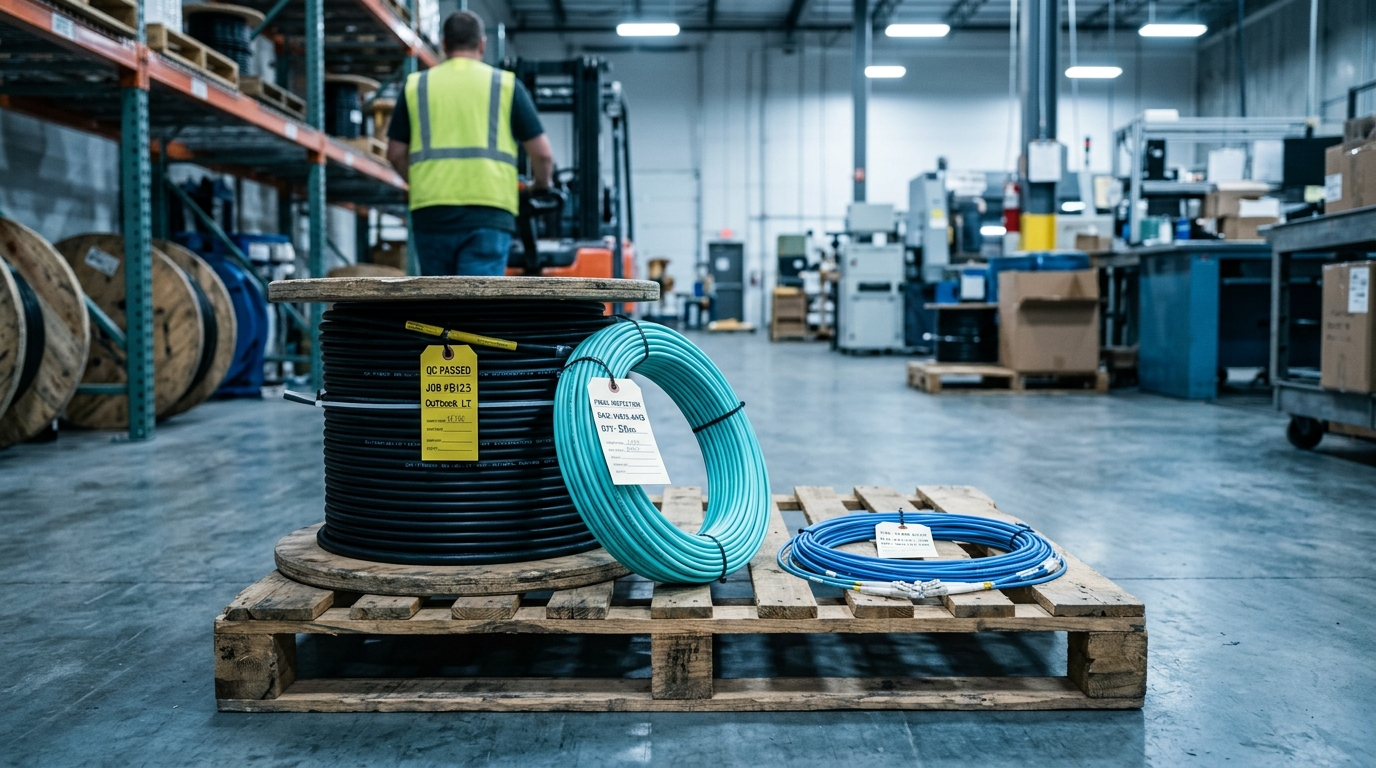
Figure: the same supplier can ship outdoor reels, indoor coils, and pre-terminated assemblies — each with a different compliance stack.
RoHS for fiber optics: ten substances, homogeneous materials, and test evidence
Directive 2011/65/EU — the RoHS recast, in force since 2013 — restricts ten substances in EEE and its components. The directive text on EUR-Lex is the authoritative reference, and the European Commission's CE marking overview explains where RoHS sits inside the wider CE system. The limits are measured per homogeneous material, which is the industry's way of saying "per uniform substance layer", not per product.
Substance | Limit |
|---|---|
Lead (Pb) | 0.1% (1000 ppm) |
Mercury (Hg) | 0.1% (1000 ppm) |
Cadmium (Cd) | 0.01% (100 ppm) |
Hexavalent chromium (Cr VI) | 0.1% (1000 ppm) |
Polybrominated biphenyls (PBB) | 0.1% (1000 ppm) |
Polybrominated diphenyl ethers (PBDE) | 0.1% (1000 ppm) |
Bis(2-ethylhexyl) phthalate (DEHP) | 0.1% (1000 ppm) |
Benzyl butyl phthalate (BBP) | 0.1% (1000 ppm) |
Dibutyl phthalate (DBP) | 0.1% (1000 ppm) |
Diisobutyl phthalate (DIBP) | 0.1% (1000 ppm) |
The homogeneous-material rule is why a cable must be checked layer by layer. A cable is not one material: the outer jacket, the loose tubes, the strength members, and the fiber coating are separate homogeneous materials, and any one of them can put the product over the limit even when the cable as a whole looks clean. This is also where soldered or plasticised subcomponents in pre-terminated assemblies most often fail.
Two practical points matter to buyers. First, exemptions. Annexes III and IV of the directive permit some restricted substances in specific technical applications where no substitute exists, and these exemptions are amended regularly by delegated directives. A compliant supplier can tell you which exemptions its products rely on — a supplier that cannot usually does not have a compliance program at all. Second, evidence. The authoritative test method family is IEC 62321, and a credible RoHS file contains either a test report from an accredited laboratory covering the actual product, or a full material declaration from the material supplier. A one-page "RoHS compliant" stamp on a datasheet, without a report number, a lab name, or a date, is marketing, not compliance.
The declaration that ties RoHS into the CE system is the same Declaration of Conformity you see on the electrical side: RoHS conformity feeds the technical documentation that supports CE marking for EEE. For cable itself, the CE-relevant document is the CPR Declaration of Performance, covered below.
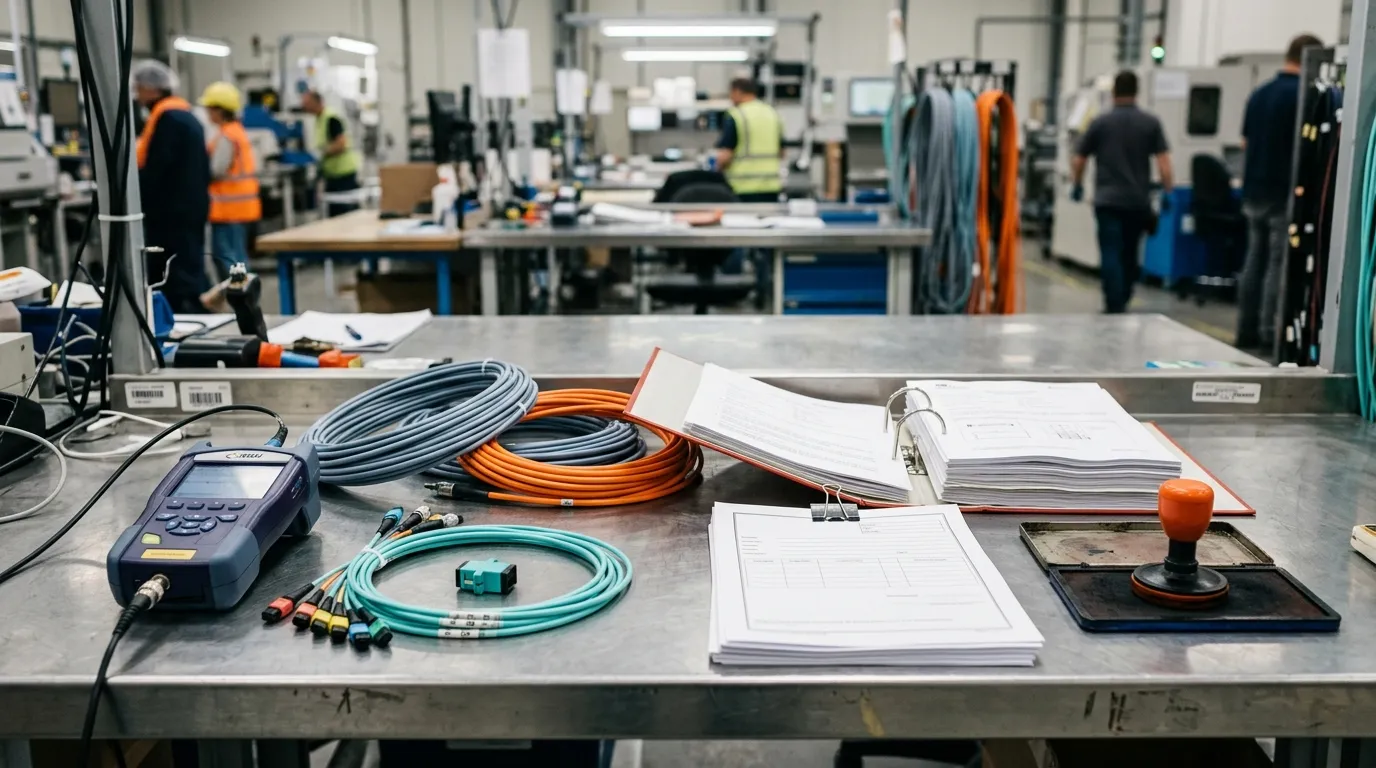
Figure: RoHS evidence starts in the lab — a test report names the lab, the method, and the batch, which is what makes it verifiable.
REACH for fiber optics: SVHCs, SCIP, and what 0.1% means for your cable
Regulation (EC) No 1907/2006 — Registration, Evaluation, Authorisation and Restriction of Chemicals — is the EU's horizontal chemicals law, published in full on EUR-Lex, with the Commission's own explainer on its REACH page. For a cable buyer, three parts of REACH matter.
The SVHC Candidate List. ECHA publishes a Candidate List of Substances of Very High Concern (SVHCs) — carcinogenic, mutagenic, reprotoxic, persistent or bioaccumulative substances — and updates it twice a year. The list never shrinks: entries are added, never removed. It stood at 233 substances in January 2023 and has grown in every update since, so always check ECHA's live list for the current count. The obligation that reaches you as a buyer: when an article contains an SVHC above 0.1% by weight, suppliers must provide the information to you on request, and you pass it on to your customers in turn.
The 0.1% threshold is per article, not per shipment. REACH applies the 0.1% weight-for-weight limit to each article individually. A cable drum is a bundle of many articles — jacket, tubes, strength members, connectors — and each is evaluated on its own. A small component high in an SVHC (a plasticised connector body, a colorant in the jacket) can trip the threshold even though the overall cable weight is overwhelmingly glass and silica. When your supplier sends an SVHC declaration, it should be based on article-level material data, not a guess at the drum weight.
SCIP notification. Since January 2021, articles containing an SVHC above 0.1% w/w must be notified to ECHA's SCIP database by the importer or producer, under Article 9 of the Waste Framework Directive. In practice this means your supplier's compliance system either confirms every article is below the threshold, or it holds SCIP registration data for the ones that are not. Ask which of the two is true.
A smaller set of use-specific restrictions sits in Annex XVII of REACH and can catch cable materials — phthalates and cadmium restrictions in plasticised parts are the recurring ones. Rather than auditing Annex XVII yourself, make the supplier's declaration cover it, and check that declaration against the product you are actually buying.
One more thing to track: the regulation itself is being revised. The European Commission is still working on a REACH revision — no adopted proposal or in-force date yet. Watch the European Commission's REACH revision announcement rather than relying on a third party to tell you, which matters for the two-updates-a-year rhythm of your supplier declarations.
CPR: the compliance requirement most fiber buyers miss
The Construction Products Regulation (EU) No 305/2011 is the piece of EU law that puts a CE mark on fiber optic cable — and it is the one absent from most general CE/RoHS/REACH guides. The regulation text is on EUR-Lex. For cables installed permanently in buildings, CPR is not optional: it is the market access rule.

The mechanism works like this. EN 50575, the harmonised standard for power, control and communication cables, classifies cable reaction to fire under EN 13501-6 into Euroclasses from A${}{ca}$ (best) down to F${}{ca}$. The class is expressed as a code such as Dca-s2,d1,a1 or Cca-s3,d1,a2, where the suffixes cover smoke production (s1-s3), flaming droplets (d0-d2), and acidity (a1-a3). The manufacturer tests the cable through a notified body, issues a Declaration of Performance (DoP), and affixes the CE mark with the declared class.
Figure: the Euroclass on a cable drum — Dca, Cca, or better — is produced by a physical fire test, not by a datasheet template.
What this means for you as a buyer:
- The fire class is a specification, not a detail. EU member states set minimum classes in their national building regulations, and projects commonly require Cca or Dca for communication cables depending on the country and the building type. Confirm the class required in your project country before you ask for quotes — a Dca cable specified for a building that demands Cca will fail inspection even though it is perfectly good cable.
- The DoP is the document that matters. It names the product type, the declared class, the notified body, and the regulation. No DoP, no CPR compliance, whatever the datasheet says.
- Verify the class against the cable, not the family. The DoP is per product type; a supplier's "CPR-compliant" claim must resolve to the specific cable you are buying. For the class-by-class breakdown, see our CPR cable classes guide, and for choosing between indoor and outdoor builds, our indoor vs outdoor CPR cable ratings guide. Outdoor backbone cable has its own CPR considerations, covered in our outdoor fiber cable CPR rating guide.
The European Commission's Construction Products Regulation page is the authoritative overview, and the regulation text itself is on EUR-Lex.
CE, RoHS, and REACH compliance documents to request from a cable supplier
The paperwork is where compliance becomes checkable. Request these documents with the quotation, not after the order:

- CPR Declaration of Performance (DoP) — for any cable going into a building. Check the Euroclass, the product type, and the notified body number.
- CE Declaration of Conformity (DoC) — for CE-marked products, including active equipment. Check the directives cited, the harmonised standards, and the signatory.
- RoHS test report or full material declaration — check the lab, the report number, the batch or product covered, and the date. IEC 62321 methods are the benchmark.
- REACH / SVHC declaration — a dated statement that the articles supplied contain no SVHC above 0.1% w/w, or an itemised list where they do.
- SCIP registration data — for any article where SVHCs exceed the threshold, the importer needs this to complete its own notification.
- Certificate of Compliance (CoC) — many suppliers issue a combined letter covering CE, RoHS and REACH in one document. It is convenient, but it is only as good as the underlying reports it summarises.
On every document, check four fields: the issuing party (is it a notified body, an accredited lab, or the manufacturer itself?), a traceable number, the scope (does it name the product you are buying?), and a date or validity period. Documentation that predates the current SVHC list update, or a scope that says "patch cords" while you are buying bulk outdoor cable, is a red flag even when the document itself is genuine.
One caution: a certificate PDF is not proof of compliance. Certificates can be edited, numbers can be borrowed, and validity dates extended in image editors. We have written a separate, practical guide on how to verify supplier certificates — registry checks for UL, CE, CPR, RoHS and ISO — and the ten-minute routines there turn the document list above into a verification workflow. A supplier that hesitates on any of these six documents is telling you something before you ever sign a PO.
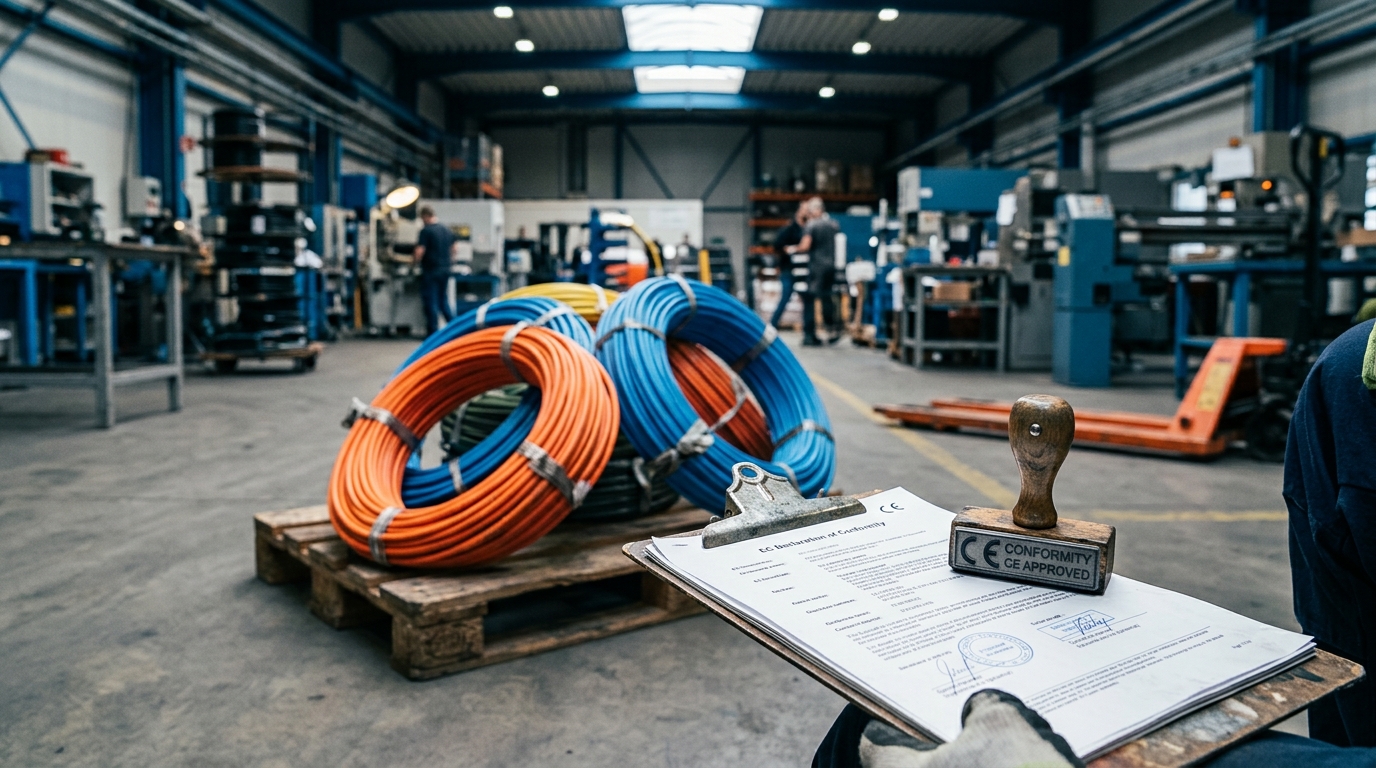
Figure: document review is a procurement step with its own checklist — issuing party, number, scope, and dates on every sheet.
How to build compliance into your cable procurement process
Documents are only useful if they arrive before the money moves. Fold compliance into the process in four steps.
1. Write the requirement into the RFQ. A single clause changes the game. For example: "The supplier shall provide, with the quotation: (a) a Declaration of Performance under Regulation (EU) 305/2011 for cables for fixed installation, declaring the fire class required by this project; (b) a Declaration of Conformity for CE-marked products; (c) RoHS declarations or test reports per Directive 2011/65/EU; and (d) a REACH SVHC declaration per Regulation (EC) 1907/2006 covering every article supplied, including SCIP data where SVHC content exceeds 0.1% w/w." Once the clause is in the RFQ, suppliers self-select, and you are comparing compliant offers instead of policing one.
2. Run a supplier questionnaire before qualification. Ask for certificate numbers, issuing bodies, expiry dates, test laboratories, and batch traceability. This is a five-minute email that filters out the suppliers whose compliance folder is a folder of scans.
3. Check documents against the delivered product. On receipt, match the cable printing and labels to the DoP and declarations — product type, class, and manufacturer name must line up. Keep the documentation for at least ten years alongside the technical file: under Article 11(7) of the Construction Products Regulation, the manufacturer must retain the conformity technical documentation for ten years (the DoP and the file behind it), and an audit can arrive years after the project closes.
4. Re-check on a schedule. The SVHC Candidate List updates twice a year, so a declaration that was accurate in January can be out of date in July. For long-running supply relationships, re-request SVHC declarations on the update cycle, and always re-request them when a product batch or formulation changes.
The consequences of skipping this are not abstract: customs can detain a shipment at the border, market surveillance authorities can order products off the market, and if a non-compliant cable fails a building inspection, the distributor and the installer carry part of that liability regardless of what the datasheet claimed. Compliance verification is cheaper than any of those outcomes.
US vs EU: UL, California RoHS, and cross-market buying
Buyers serving both the EU and North America run two different compliance stacks, and the acronyms do not transfer.
The US has no federal RoHS. California's RoHS (SB 20/50) restricts substances in certain covered electronic devices sold in California, which is narrower than the EU directive and generally does not reach cable. What US buyers actually specify for cable is the UL listing: UL 1651 covers optical fiber cable, and the OFNP/OFNR/OFCP/OFCR plenum and riser ratings are referenced by the National Electrical Code for cable run through air handling and riser spaces. UL is a voluntary, third-party safety certification — a cable without it can still be sold in the US, but it cannot be legally installed in the spaces that require it.
The CE and CPR obligations have no US counterpart, and the UL listing has no EU counterpart. A cable CE-marked under CPR for a German project tells you nothing about its NEC compliance in a US plenum, and vice versa. If you qualify the same supplier for both markets, ask for both stacks explicitly: CPR DoP and CE documentation for the EU side, UL file number and listing category for the US side, and RoHS/REACH declarations for both.
FAQ: CE / RoHS / REACH compliance questions buyers actually ask
Is RoHS compliance required in the US? No federal RoHS exists. California's SB 20/50 restricts four heavy metals (lead, mercury, cadmium, and hexavalent chromium) in certain covered electronic devices sold in California, but it does not generally cover cable. US cable buyers rely on UL listings for fire safety and on customer-specified RoHS declarations for substance control.
Is there going to be a REACH revision in 2026? A revision is coming, but not yet in force — the Commission is still working on the revised text and no proposal has been adopted yet. Track the Commission's announcements for the actual dates rather than planning around a fixed 2026 timeline.
What does "CE and RoHS compliant" mean? It means the product meets the EU legislation applicable to it (CE) and stays below the ten-substance RoHS limits in its homogeneous materials. For fiber optic cable, "CE compliant" in practice most often refers to the CPR marking under EN 50575.
Does a fiber optic cable need a CE mark? Only when EU legislation requires it for that product. Cables for fixed installation in construction works need the CPR CE marking; passive cable does not need the LVD or EMC CE marking, because it carries no voltage and is not apparatus.
What is the difference between a certificate and a declaration? A certificate is issued by a third party — a notified body, an accredited laboratory, a certification body — and carries its own number and scope. A declaration is the manufacturer's own statement, signed under its own responsibility. CE, CPR (DoP), and REACH SVHC communication are all declaration-based; RoHS test reports and UL listings are certificate-based. Both are checkable, but against different databases.
A five-point checklist for compliant fiber optic cable sourcing
Before you compare prices on your next EU project, close these five points:
- Map the rules to the product. REACH documentation for every cable; RoHS for assemblies and EEE; CPR (DoP + fire class) for any cable installed in a building.
- Fix the fire class as a spec. Confirm the Euroclass your project country requires — commonly Cca or Dca — and put it in the RFQ.
- Request the six documents with the quotation: DoP, DoC, RoHS test report, SVHC declaration, SCIP data, and a CoC.
- Verify, don't collect. Check issuing party, number, scope, and dates on every document — the routines in our supplier certificate verification guide (linked in the documents section above) take under ten minutes each.
- Keep records and re-check on schedule. Retain the compliance file for the ten-year horizon CPR Article 11(7) sets for the DoP and its technical documentation, and re-request SVHC declarations on ECHA's twice-yearly update cycle.
As a worked example of what compliant sourcing looks like: TTI Fiber publishes its compliance portfolio openly — CE marking, CPR (EU 305/2011) with Euroclass classification, RoHS (Directive 2011/65/EU) and REACH (Regulation (EC) 1907/2006) compliance across the product line, ISO 9001 and ISO 14001 management systems, and SGS third-party inspection — all documented on its certifications page. If you are qualifying suppliers for an EU project, start there: any supplier you are comparing should be able to produce the same set of documents on request. And if you would rather source from a manufacturer that provides them upfront, our indoor fiber optic cable range ships with the full compliance file.
This guide is provided for general information and does not constitute legal advice. Regulations are amended and interpreted continuously — always verify requirements against the official texts on EUR-Lex and the European Commission's guidance, and confirm the fire classes and substance lists that apply to your specific product and project with a qualified compliance advisor.