MPO-12 vs MPO-16 vs MPO-24: The Complete Guide to Fiber Count
MPO-12 vs MPO-16 vs MPO-24: The Complete Guide to Fiber Count
Ask which multi-fiber connector to spec — MPO-12, MPO-16, or MPO-24 — and the honest answer is another question: "What Ethernet speed are you wiring, and how much of it per rack unit?" The number in the name is a fiber count, but what it really encodes is a generation of parallel optics. Get the count wrong and you either strand a third of your fibers dark, or you buy density you can't terminate.
Here's the whole decision in one breath, and it's the only sentence most people need:
MPO-12 is the universal incumbent for 40G/100G links (it uses 8 of its 12 fibers). MPO-16 is purpose-built for 400G and 800G, where 8 transmit + 8 receive fibers fill all 16 with zero waste. MPO-24 packs two rows of 12 for high-density backbone trunks. Match the connector to the transceiver, not to a habit — and know that MPO-16 will not mate with an MPO-12.
That's the answer. The rest of this guide is for when "it depends" isn't good enough: the clean three-way spec table, the transceiver map that actually decides it, the base-8/12/16 system underneath, and the two things every competing article skips — the pinned/unpinned rule and the MPO-16 keying trap that quietly breaks channels on the loading dock.
The 30-second answer: MPO-12 vs 16 vs 24 at a glance
Before the deep dive, here's the entire comparison in one table. If you only read one thing, read this.
MPO-12 | MPO-16 | MPO-24 | |
|---|---|---|---|
Fiber count | 12 | 16 | 24 |
Ferrule layout | Single row of 12 | Single row of 16 | Two rows of 12 |
Cabling system | Base-12 | Base-16 | Base-12 (high-density) |
Built for | 40G / 100G-SR4 | 400G / 800G-SR8 | High-density 100G+ trunks |
Fibers actually used | 8 of 12 (SR4) | 16 of 16 (SR8) | 20 of 24 (SR10) → trunking |
Breaks out to | 6× LC duplex | 8× LC duplex | 12× LC duplex / 2× MPO-12 |
Mates with MPO-12? | — | No (different key) | No (physically) |
Relative insertion loss | Baseline | Baseline (single-row) | Slightly higher (dual-row) |
Ecosystem maturity | Universal | Emerging | Mature, niche |
Three patterns fall out immediately. MPO-12 is the safe default and has the deepest ecosystem. MPO-16 exists for one reason — it fills every fiber at 400G/800G — and it is not backward-compatible with 12. MPO-24 is a density tool, not a speed tool: it carries more fibers in the same footprint, but each is still an ordinary duplex or parallel lane. Now let's unpack why.
Why fiber count exists in the first place
An MPO connector is a single ferrule that holds a row (or two) of fibers precisely aligned so one push mates all of them at once. MPO stands for Multi-fiber Push-On. You'll also see MTP®, which is not a different connector — it's US Conec's branded, tighter-tolerance version of the MPO, with a removable housing and a floating ferrule for better mechanical performance. MTP mates with standard MPO; the difference is build quality, not interface. Throughout this guide, everything said about MPO applies to MTP.
The fibers themselves sit in a rectangular MT ferrule. How many you can line up — and in how many rows — is what the fiber count describes:
- Single-row ferrules hold 4, 8, 12, or 16 fibers in one line.
- Dual-row ferrules stack two rows to reach 24 (2×12) — or 32 (2×16) and beyond.
That single-vs-dual-row distinction is the physical root of the whole comparison, and it's the part most guides blur into "24 is just denser." It isn't just denser — it's a structurally different ferrule with a second row of fibers that has to be polished and aligned to the same tolerance as the first.
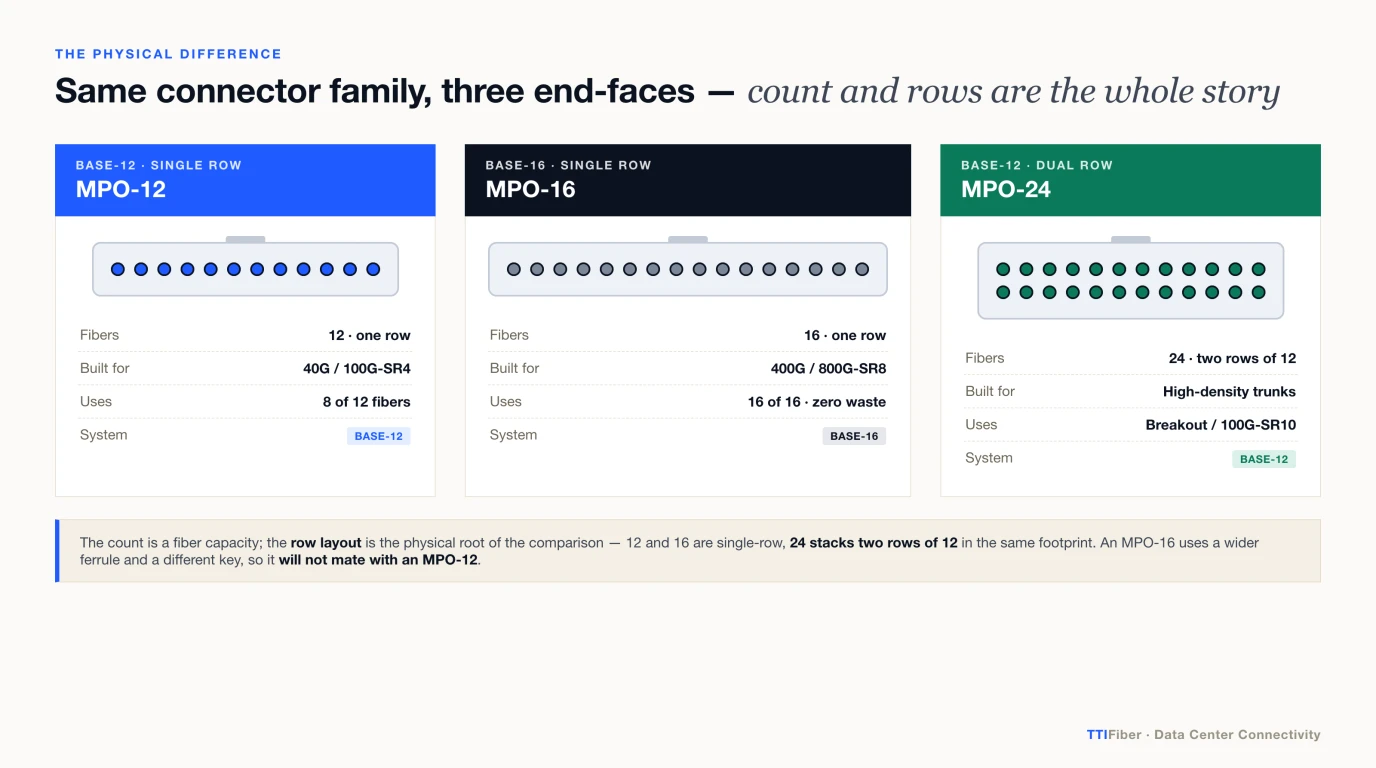
The reason multiple counts exist at all is parallel optics. A 10G link needs one fiber to transmit and one to receive — an LC duplex handles it. But 40G and above split the signal across several lanes running in parallel, and each lane needs its own fiber. Suddenly you need 8, 16, or more fibers arriving in one connector, in a known order. That's the job MPO was invented for. And it's where the infamous "wasted fiber" problem is born — which brings us to the incumbent.
MPO-12: the universal incumbent
MPO-12 is the connector you'll meet first and most often. Twelve fibers, single row, and an ecosystem — cassettes, trunks, breakouts, adapters — that no other count can match. It anchors the base-12 cabling system that dominated the 40G and 100G era.
Here's the catch that shaped everything after it. The workhorse transceivers — 40GBASE-SR4 in a QSFP+ module and 100GBASE-SR4 in a QSFP28 — are 4-lane optics: four fibers transmit, four receive, for 8 fibers used out of 12. The middle four sit dark. Across a large deployment, that's a third of your installed glass doing nothing — the "fiber waste" you'll see cited everywhere, and the reason the industry eventually engineered its way around base-12.
None of that makes MPO-12 a bad choice. For most 40G/100G links it remains the pragmatic default: cheapest per port, universally stocked, and trivially broken out to 6× LC duplex for connecting to duplex switch ports. It runs on multimode OM3/OM4 for short reaches and single-mode OS2 for longer ones — and if you're weighing the glass grade, our guides on the difference between OM1, OM2, OM3 and OM4 and the OM3 vs OM4 decision cover that fork. TTI Fiber builds MPO-12 in both grades — MPO/UPC OM3 and MPO/UPC OM4 patch cords — factory-tested for insertion and return loss on every cord.
MPO-16: built for 400G and 800G
MPO-16 answers the base-12 waste problem head-on. Sixteen fibers, still a single row, defined under TIA-604-18 (FOCIS 18). It exists for one specific era: 400G and 800G parallel optics.
Do the math that makes it click. 400GBASE-SR8 is an 8-lane transceiver: 8 fibers transmit, 8 receive — 16 fibers, every one of them working. No dark fibers, no stranded glass. That's the payoff MPO-12 could never give an 8-lane optic, and it's why 400G/800G switching hardware — housed in high-density QSFP-DD and OSFP module cages — increasingly terminates directly into 16-fiber MPO. Push further and 800GBASE-SR8 rides that same 16-fiber footprint as eight 100G lanes each way, and a single MPO-16 can break out to 8× 100G links for spine-leaf fan-out.
Now the trap that costs people a truck roll. An MPO-16 will not mate with an MPO-12. It uses a wider ferrule and a different offset key, so the two are mechanically incompatible — you cannot plug a 16-fiber cord into a 12-fiber adapter, and there is no "adapter" that reconciles the fiber counts. This is the single most expensive misunderstanding in the whole topic, and almost no comparison article states it plainly: choosing MPO-16 means committing your panels, cassettes, and trunks to base-16 end to end. Plan the whole channel around it, or don't start.
One honest note on availability: MPO-16 is newer and its ecosystem is thinner than MPO-12's. If your 400G roadmap is real, it's the right connector; if it's speculative, you may be buying ahead of your supply chain.
MPO-24: the density play
MPO-24 is where the ferrule gets a second story. Twenty-four fibers arranged as two rows of 12 — the same connector footprint as an MPO-12, twice the fibers. It's a density tool, and understanding that is the key to using it well.
Historically, MPO-24 carried 100GBASE-SR10, a 10-lane optic that used 20 of its 24 fibers. That application is largely legacy now. Today MPO-24 earns its place as a high-density backbone trunk: run one 24-fiber MPO between racks and break it out to 2× MPO-12 or 12× LC duplex at the ends. In a spine-leaf fabric where cross-sectional fiber count is the constraint, halving your connector count per trunk is real estate you get back on the patch panel.
The dual-row structure carries two caveats worth pricing in. First, insertion loss tends to run slightly higher than a single-row connector, because there are more fibers and two rows to align and polish to spec — which matters when you're stacking loss across a multi-connector channel. Second, cleaning and inspection are less forgiving: 24 end-faces in two rows are harder to keep contaminant-free than 12 in one. Neither is disqualifying; both are reasons to insist on factory-tested, low-loss assemblies rather than field-terminated guesswork. TTI Fiber's MPO 24-fiber patch cords and MTP trunk cables are built and tested for exactly this backbone role.
Match the connector to the transceiver
Fiber count is abstract; the transceiver on your switch port is not. This is the table that actually decides which MPO you buy — read across from the speed you're deploying.
Ethernet speed | Transceiver | Fibers used | Native MPO |
|---|---|---|---|
40G | 40GBASE-SR4 | 8 | MPO-12 (8 of 12) |
100G | 100GBASE-SR4 | 8 | MPO-12 (8 of 12) |
100G | 100GBASE-SR10 | 20 | MPO-24 (20 of 24) |
200G | 200GBASE-SR4 | 8 | MPO-12 (8 of 12) |
400G | 400GBASE-SR8 | 16 | MPO-16 (16 of 16) |
400G | 400GBASE-SR4.2 | 8 | MPO-12 (BiDi/SWDM) |
800G | 800GBASE-SR8 | 16 | MPO-16 (16 of 16) |
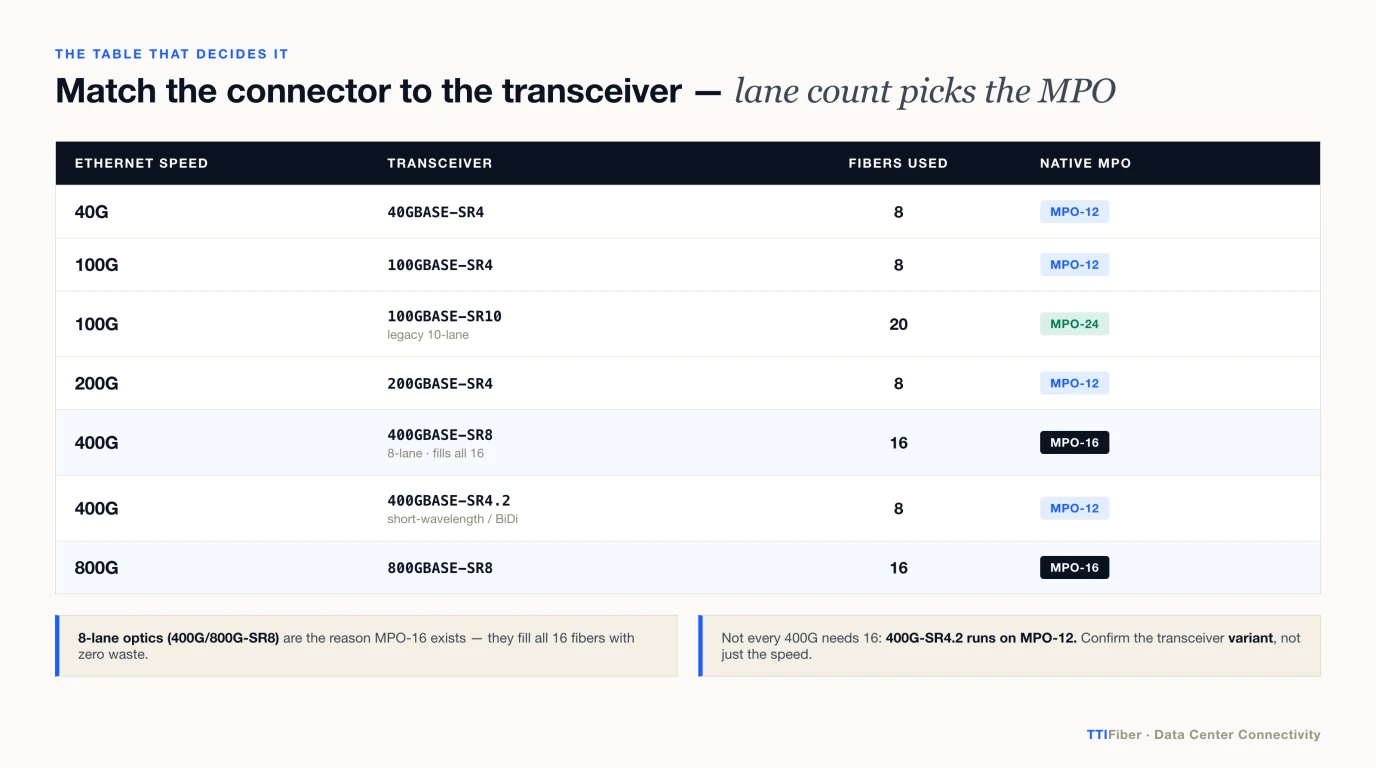
Two things to notice. First, 8-lane optics (400G/800G-SR8) are the reason MPO-16 exists — they're the only mainstream transceivers that fill 16 fibers exactly. Second, not every 400G path needs MPO-16: 400GBASE-SR4.2 uses short-wavelength multiplexing to squeeze 400G onto 8 fibers, so it runs on MPO-12. If your 400G optics are SR4.2 rather than SR8, base-12 still works. Always confirm the transceiver variant, not just the headline speed. And remember these are short-reach (SR) optics — the actual distance you get still depends on the fiber grade, which is why how far OM4 multimode fiber can transmit is a separate question from which connector carries it.
The system behind the connector: base-8 vs base-12 vs base-16
Step back from the connector and you're really choosing a cabling system — the fiber-count "base" that your trunks, cassettes, and breakouts all have to agree on. There are three, and each solves the waste problem differently.
- Base-12 is the legacy standard: 12-fiber increments (MPO-12, MPO-24 as 2×12, MPO-72). Deepest ecosystem, but it strands 4 fibers on every 8-lane SR4 link.
- Base-8 was engineered to kill that waste. Everything comes in 8-fiber increments (MPO-8, and MPO-16/24/32 built as 2×8, 3×8, 4×8), so an 8-fiber SR4 link uses 100% of the fibers and breaks out cleanly to 4× duplex. If your plant is mostly 40/100G-SR4 and duplex breakout, base-8 is the efficiency play.
- Base-16 is the newest, built around the 16-fiber connector so a single MPO-16 carries a whole 400G-SR8 link with nothing wasted. It's the forward-looking system for 400G/800G fabrics.
The practical takeaway: the three connectors are avatars of three systems, and systems don't mix casually. A base-16 trunk needs base-16 cassettes and 16-fiber optics; a base-12 MPO-24 breaks out to base-12 MPO-12s. Migration is a channel-level decision, not a per-cord one — which is exactly why the connector you standardize on today constrains the speeds you can reach tomorrow. For the higher-speed multimode context, see where OM4 and OM5 fiber cables earn their place in these fabrics.
The rules nobody explains: pinned vs unpinned & polarity
Two things trip up MPO orders more than any spec sheet, and — remarkably — none of the top-ranking guides spell them out. Get these wrong and the connectors physically won't mate or the link goes dark, regardless of fiber count.
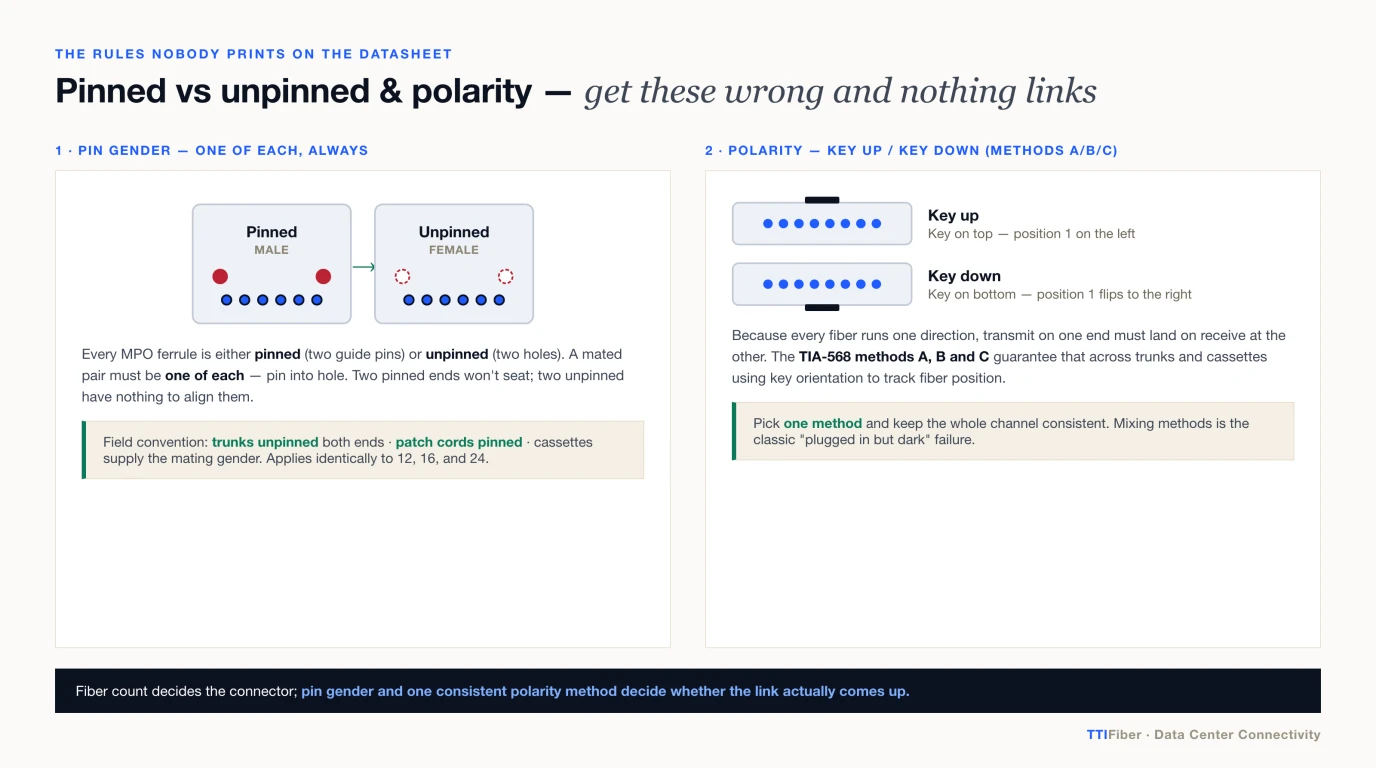
Pinned (male) vs unpinned (female). Every MPO ferrule either has two guide pins (pinned/male) or two holes for them (unpinned/female). A mated pair must be one of each — pin into hole. Two pinned ends won't seat; two unpinned ends have nothing to align them. The field convention: trunk cables are typically unpinned on both ends, patch cords are pinned, and cassettes/adapters provide the mating gender. When you order, you specify the gender of each end — it's not optional, and it applies identically to MPO-12, 16, and 24.
Polarity (Method A / B / C). Because every fiber transmits in one direction, a parallel link only works if transmit on one end lands on receive at the other. The TIA-568 polarity methods — A, B, and C — are three schemes for guaranteeing that across trunks and cassettes, using key-up/key-down connector orientation to track fiber position. You don't have to memorize the wiring; you do have to pick one method and keep the whole channel consistent. Mixing polarity methods is the classic "everything's plugged in but nothing links" failure.
Insertion loss and the standards behind MPO
As fiber count rises, your loss budget gets tighter. More fibers and, for MPO-24, a second row mean more opportunities for insertion loss to creep in, and every connector pair in a channel spends part of your budget. This is why low-loss (often marketed "Elite") grade assemblies matter more at 16 and 24 fibers than at 12 — and why a factory insertion-loss and return-loss test on every cord isn't a luxury, it's how you know the link will close its power budget before you're on a ladder at 2 a.m.
One end-face detail rides alongside pin gender on the order form: polish type. Multimode MPO uses a flat UPC polish, while single-mode MPO uses an angled APC polish that deflects back-reflections away from the source for far better return loss. The two don't intermate, so single-mode channels are specified APC end to end — another parameter that has to be consistent across the whole link, independent of whether you chose 12, 16, or 24 fibers.
The interfaces are governed by real standards, worth naming for the engineers who have to defend a spec:
- IEC 61754-7 defines the MPO connector interface family (including the 16- and 24-fiber variants).
- TIA-604-5 (FOCIS 5) covers the 12- and 24-fiber MPO; TIA-604-18 (FOCIS 18) covers the 16-fiber MPO.
- TIA-568 defines the base-8/base-12 polarity methods and structured-cabling framework.
- IEEE 802.3 defines the Ethernet variants (40G-SR4, 100G-SR4/SR10, 400G-SR8, 800G-SR8) whose lane counts drive every choice above.
You won't cite these in a hallway conversation, but they're why an MPO-16 from one vendor mates with a cassette from another — the interface is standardized even when the marketing isn't.
How to choose: the decision framework
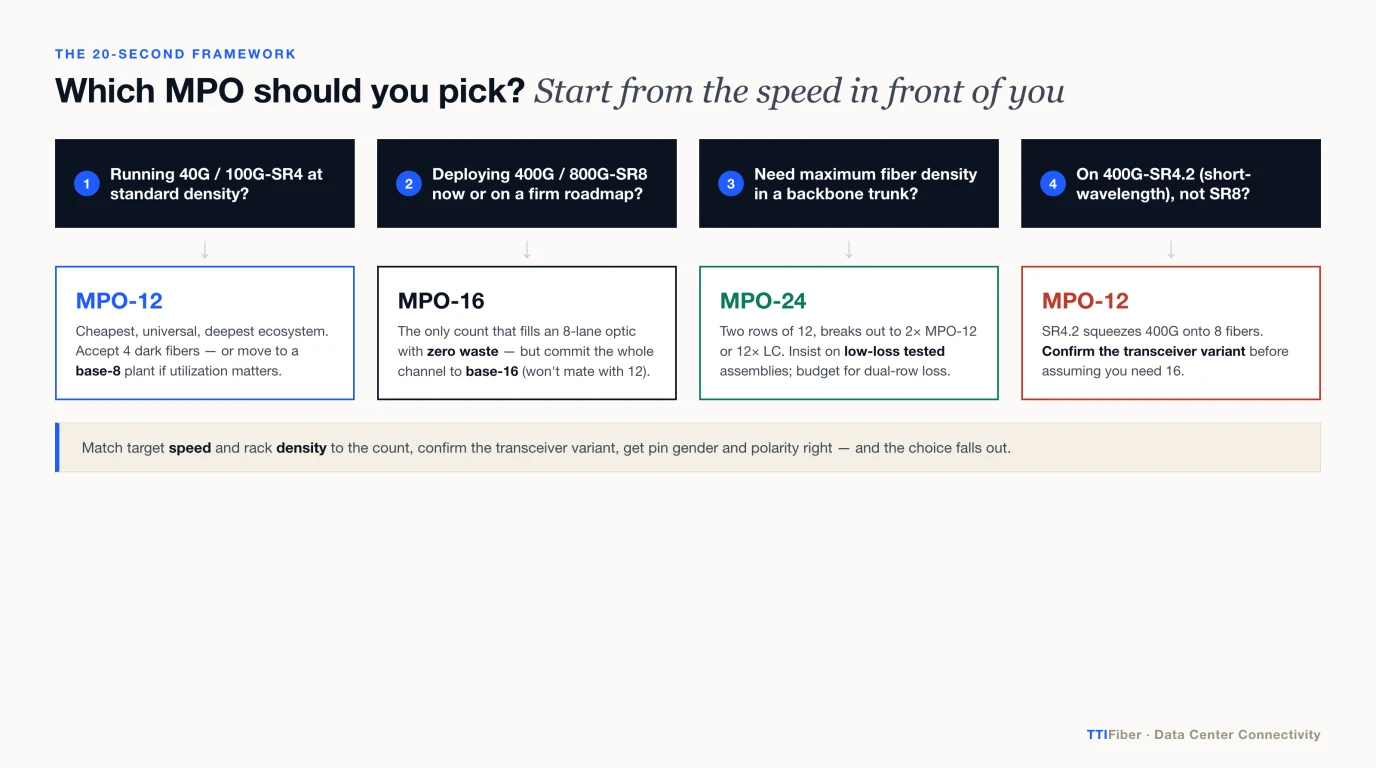
Strip away the detail and the decision is fast. Match the connector to the speed and density in front of you:
- Running 40G or 100G-SR4, standard density? → MPO-12. Cheapest, universal, deepest ecosystem. Accept the 4 dark fibers or move to a base-8 plant if utilization matters.
- Deploying 400G or 800G-SR8 now or on a firm roadmap? → MPO-16. It's the only count that fills an 8-lane optic with zero waste — but commit the whole channel to base-16.
- Need maximum fiber density in a backbone trunk, breaking out to 12s or LC? → MPO-24. Buy the density, insist on low-loss tested assemblies, and budget for the dual-row loss.
- On 400G-SR4.2 (short-wavelength) rather than SR8? → MPO-12 still works — confirm the transceiver variant before you assume you need 16.
Whichever count you land on, the connector only performs if the assembly is built and tested to spec — pins on the right ends, one consistent polarity method, and a measured loss figure you can trust. That's the part TTI Fiber controls: MPO/MTP patch cords, trunks, and breakout assemblies manufactured in base-12 and 24-fiber configurations, 100% factory-tested for insertion and return loss, with pin gender and polarity built to your channel — not left to chance in the field.
Frequently asked questions
What is the difference between MPO-12 and MPO-24? MPO-12 holds 12 fibers in a single row; MPO-24 holds 24 in two rows of 12, in the same connector footprint. MPO-12 is the universal choice for 40G/100G-SR4 (using 8 of its 12 fibers); MPO-24 is a density tool for high-fiber-count backbone trunks that break out to 2× MPO-12 or 12× LC duplex. MPO-24 typically carries slightly higher insertion loss because of its dual-row ferrule.
What is the difference between MPO-16 and MPO-24? They solve different problems. MPO-16 is a single-row, 16-fiber connector purpose-built for 400G/800G-SR8, where 8 transmit + 8 receive fibers fill it exactly. MPO-24 is a dual-row, 24-fiber connector for trunk density, historically used for 100G-SR10. Choose 16 for zero-waste 400G/800G links; choose 24 for maximum fiber density in a backbone.
Can you mix MPO-12 and MPO-16? No. MPO-16 uses a wider ferrule and a different offset key, so it will not physically mate with an MPO-12 adapter or cord, and there is no adapter that reconciles the two fiber counts. Choosing MPO-16 commits the entire channel — panels, cassettes, and trunks — to base-16.
What is MPO-16 used for? MPO-16 is used for 400G and 800G parallel-optic links. 400GBASE-SR8 and 800GBASE-SR8 are 8-lane transceivers that need 8 transmit and 8 receive fibers — exactly 16 — so a single MPO-16 carries the whole link with no dark fibers. It's increasingly the native connector on high-speed data center switches.
Is MPO-24 obsolete? No, but its role has shifted. Its original 100GBASE-SR10 application is largely legacy, yet MPO-24 remains widely used as a high-density backbone trunk that breaks out to lower-count connectors. It is not the connector you terminate a modern 400G-SR8 optic into — that's MPO-16 — but it's very much alive for density-driven trunking.
How many fibers can an MPO connector hold? Common MPO fiber counts are 8, 12, 16, and 24, with higher-density variants at 32, 48, and 72 fibers using multi-row ferrules. The count you choose should follow the transceiver lane count and your cabling system's base (8, 12, or 16), not simply the highest number available.
The bottom line
MPO-12, MPO-16, and MPO-24 aren't three grades of the same thing — they're three answers to three different questions. MPO-12 wires the 40G/100G world and does it everywhere, at the cost of a few dark fibers. MPO-16 exists for 400G/800G, where its 16 fibers fill an 8-lane optic perfectly — as long as you commit the whole channel to base-16, because it won't mate with a 12. MPO-24 is density in a bottle: two rows of 12 for backbone trunks, with a small loss penalty you manage by buying tested, low-loss assemblies.
Map your target speed and rack density against those three, confirm the transceiver variant, get the pin gender and polarity right, and the choice falls out. When you're ready to source it, explore TTI Fiber's factory-tested MPO and MTP patch cords, trunks, and breakout assemblies — built to the fiber count, loss grade, and polarity your channel actually needs.