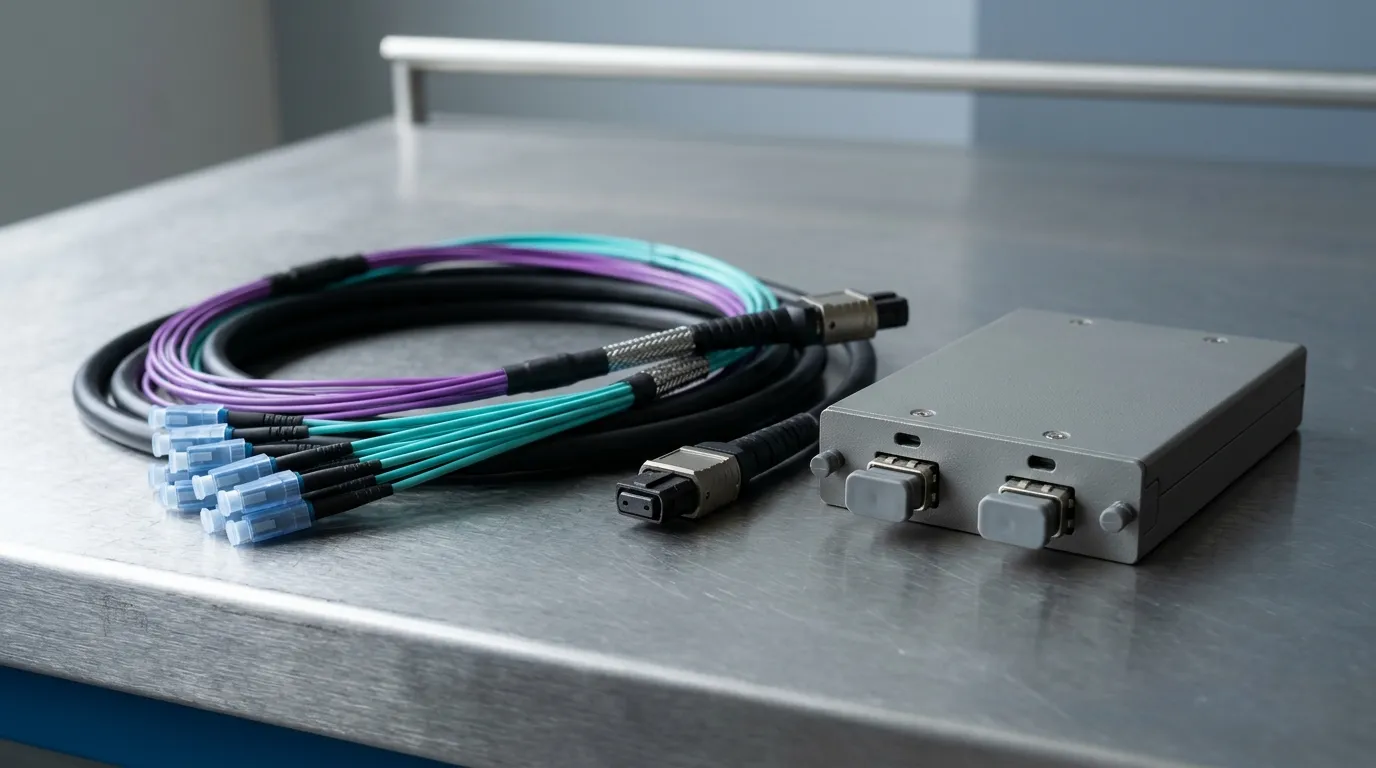
Custom Fiber Cables: OEM MPO Cord Guide
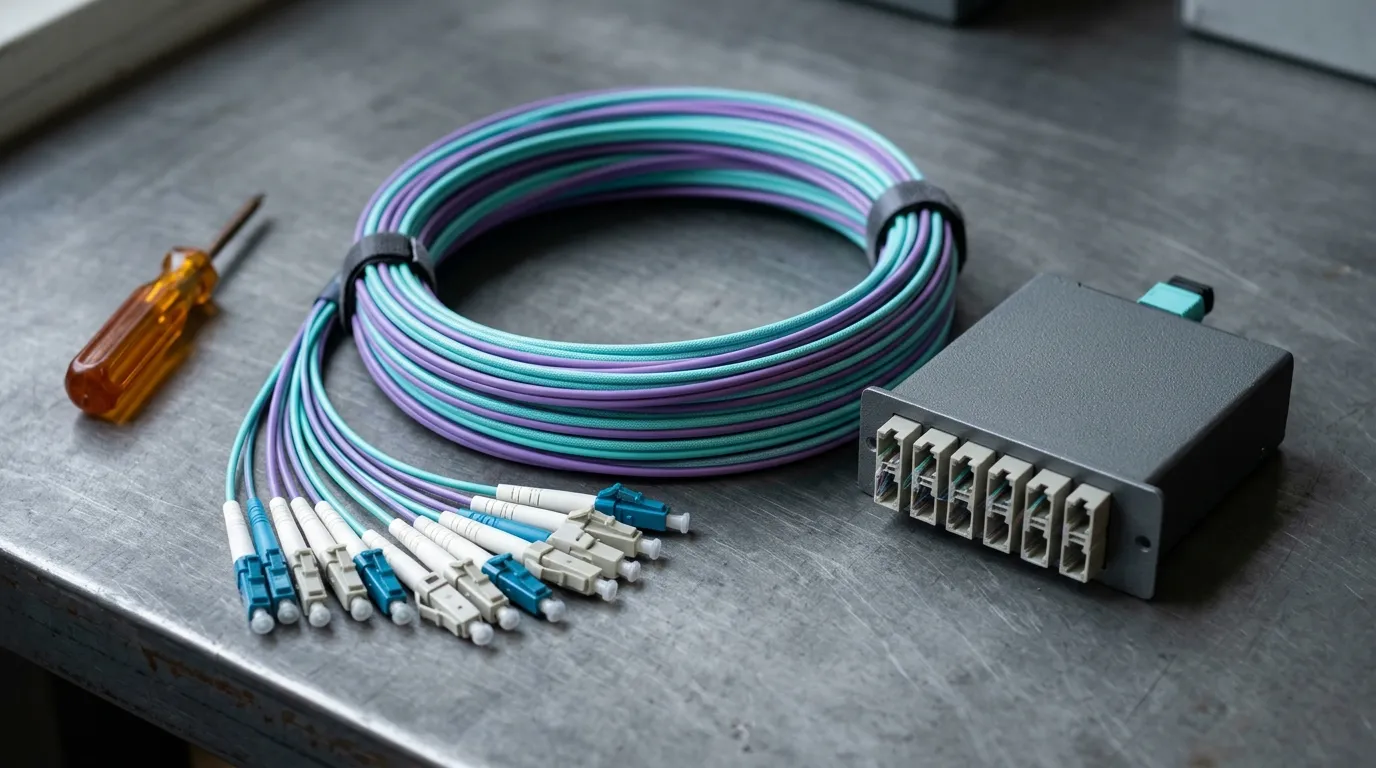
The purchase order says 500 MPO patch cords, your part number, your label. The quote comes back well under the incumbent's, and the specification attached to it reads: MPO-12, OM4, LSZH, 3 m, tested. Six weeks later the cartons arrive. The labels are correct, the loss figures are on a sheet, and the first link you build fails at 400G because two of the twelve fibers arrive crossed.
Nothing in that story is a lie. The factory built exactly what the document described. The problem is that the document described a cord, and an order for custom fiber cables is really a description of a system: ferrule, polarity, pinning, grade, test method, label, lot code. Leave one of those out and the supplier is still fully compliant — and you own the gap.
This page is the working document behind that order. It covers the nine specs worth writing down before any quote is comparable, the acceptance test that settles the argument later, and the parts of a white-label program no catalog page mentions. If the architecture underneath is still open — lane counts, fiber type, whether you run MPO or LC at all, which the MPO vs LC density trade-off settles — start with the data center fiber cabling hub that this page sits under, then come back. Everything here assumes the design is settled and you are now buying it.
Why "Custom Fiber Cables" Is Two Different Purchases
Search the phrase and you land on configurators: pick a connector, pick a length, pick a jacket, see a price. That model is genuinely good at what it does — one-off cords for a lab, a retrofit, a single rack that needs a 7 m run nobody stocks. It is a bad model for a product line you intend to sell under your own brand, and the two purchases need different documents.
One-off custom cord | OEM / white-label program | |
|---|---|---|
Quantity | 1–50, priced per unit | Bands, priced per band |
Spec owner | Supplier's catalog options | Your written specification |
Identity | Supplier's part number | Your part number, your label |
Repeatability | Best effort; next order may differ | Same drawing, same test, same report |
Acceptance | You test the one you got | Sampling plan agreed in advance |
Document set | Packing slip + test sheet | Drawing, DoP/DoC as applicable, test report per lot, traceability |
The difference matters because custom fiber optic cables bought as hardware are judged once, while a program is judged on the fifth delivery. The questions that decide the fifth delivery — is the ferrule the same supplier, is the polarity convention still Type B, does the label carry a lot code — are almost never asked at the sample stage unless you ask them.
Where the two models meet is the cord itself. A duplex LC jumper and a 24-fiber trunk are the same manufacturing problem at different scale — the patch cord types overview maps the family — and the sequence is identical: strip, cleave, terminate, polish, inspect, test, label. What changes with fiber count is how much a single error costs, because an MPO concentrates twelve or twenty-four chances to be wrong into one connector body. That concentration is why the next section is a list of decisions rather than a list of options. If you are buying a handful of cords for one rack rather than launching a range, the specification table and the acceptance test are the parts that pay for themselves — skip the sections on lot codes, banding and first articles.
The Nine Specs That Have to Be Locked Before a Factory Quotes
Every MPO datasheet you will receive compresses these nine into four lines. Separate them once and the quotes become comparable. The last column is the one buyers miss: each decision quietly closes doors on the ones after it.
# | Decision | What goes in writing | What it silently locks |
|---|---|---|---|
1 | Fiber count and ferrule | 8F / 12F / 16F / 24F, rows, and the optic it serves | Which transceiver ports the cord can reach at all |
2 | Connector type and sex | LC / SC / FC / ST duplex, or MPO male (pinned) / female (unpinned), stated per end | Which adapters, cassettes and ports will mate |
3 | Polarity type | Type A / B / C, and the method letter for the whole link | Key orientation, adapter type, and the transition modules |
4 | Fiber type | OS2, OM3, OM4, OM5; core and jacket color | Reach, lane rate, and the whole loss budget |
5 | End-face / polish | PC, UPC or APC, and the mating face | Whether it can be mated to what is already in the rack |
6 | Loss grade and test method | Max IL per mated pair, min RL, reference method | How the dispute at goods-in gets settled |
7 | Cable and jacket | Cordage construction, jacket material, fire rating | Bend radius, routing path, and the tender response |
8 | Length and tolerance | Nominal length, measurement method, tolerance | Rack fit, slack management, and price |
9 | Identity | Part number, label content, packaging, lot coding | Whether the goods are yours in an audit |
Most OEM problems with custom MPO patch cords trace back to one of those nine being described with a word instead of a value — "low loss" instead of a dB figure, "Type B" without saying which end is pinned, "3 m" without saying whether that is the cord or the breakout legs.
Fiber Count and Ferrule: How 12, 16 or 24 Fibers Change the Cord
The MPO interface is standardized, which is why cords from different factories mate. The ferrule is a rectangular body roughly 6.4 mm by 2.5 mm with two guide pins of about 0.7 mm doing the alignment, and the standard splits it by how many rows of fibers it holds: one row for up to 12 fibers, two rows for 16 and 24. That split is codified in the current interface documents, where the single-row and two-row variants sit in separate parts: IEC 61754-7-1:2014 covers the one-row family and IEC 61754-7-2:2017 covers the two-row one, and each abstract says the same thing about the old document — it is the pair together, not either part alone, that cancels and replaces the third edition of IEC 61754-7 published in 2008.
Why this matters to a buyer rather than an engineer: the ferrule geometry is chosen by the optic, not by preference. An 8-lane 400G or 800G module on an MPO-16 port uses all sixteen fibers — eight transmit, eight receive — so it needs the two-row, 16-fiber ferrule; a 4-lane 400G module on an MPO-12 port uses eight of the twelve positions, which is where the half-populated ferrule comes from; a Base-24 port needs the 24-fiber layout; a 12-fiber trunk is a single row. Order the wrong row count and the cord is not "slightly off" — it does not carry the channels the module expects, and no amount of polishing fixes it. Check the transceiver datasheet for the port type before you write the line, not after.
Sixteen-fiber is a real port count and a real ferrule, but it is not a build every factory keeps on the shelf — it is specified per optic rather than stocked alongside 8, 12 and 24. If your lane plan lands there, treat 16F as a drawing-specific item: ask for availability and lead time against the drawing before anyone promises a date.
There is a second-order effect that costs more than the mistake itself. Once you fix the ferrule, you fix the breakout: a 24-fiber trunk fanned to LC duplex gives you twelve duplex pairs, a 12-fiber trunk gives six, and the harness leg count in your bill of materials follows. If your design has mixed 8- and 12-fiber modules on the same trunk, the transition happens somewhere — in a cassette, in a harness, or in a cord you have to specify twice. The 12 vs 16 vs 24-fiber comparison walks the layouts; here the point is narrower. The ferrule decision propagates down the whole bill of materials, so make it once and write it into the drawing.
For 400G and 800G deployments the ferrule choice arrives as part of a wider link plan — lane count, reach, trunk or direct attach — which the 400G fiber cabling guide covers; this page only adds the reminder that whatever the plan says, it has to come back out as a row count and a fiber count on the purchase order.
Polarity Is a Link Decision the Cord Inherits
Polarity is where most white-label MPO programs lose money quietly, because a polarity error usually passes a continuity test and fails a real link. Two cords can both be "MPO-12 OM4 APC, tested" and still be wired differently.
The array polarity methods have been standard for years: Type A straight (key-up to key-down), Type B crossover (key-up to key-up), Type C pairs reversed. The revision that matters for anyone writing a specification today is ANSI/TIA-568.3-E: the TIA release notice records it as released on 29 September 2022 and as folding the previous 568.3-D addendum into the base document. Two of its changes matter to a purchase order. It adds two further transition variants, Type U1 and Type U2, aimed at MPO-to-duplex applications, and it revises the guidance on connector pinning to support a shift toward end-to-end array systems — both spelled out in Siemon's summary of the revision. If your supplier's datasheet still cites 568.3-D as current, that is a small but useful signal about how fresh their documentation is.
Three things follow for the order, and they are the three that get missed:
Polarity belongs to the link, not the cord. A Type B trunk is correct only in a link whose modules and adapters were chosen for Method B. Buy the trunk first and the modules later and you will discover the mismatch at commissioning, when the fix is new modules rather than a new trunk. Write the method letter next to every cord on the order, not just the trunk.
Pinning is a separate field from polarity, and it is not cosmetic. MPO plugs come male (with guide pins) and female (without). The pairing rule is male-to-female at every mating, so a trunk with male ends at both sides needs female ports on both cassettes. TIA-568.3-E's revised pinning guidance exists because the industry is moving toward end-to-end array systems where the pin is expected in a predictable place. Practically: state the sex at each end explicitly — "male at A, female at B" — rather than letting the factory infer it from a part number.
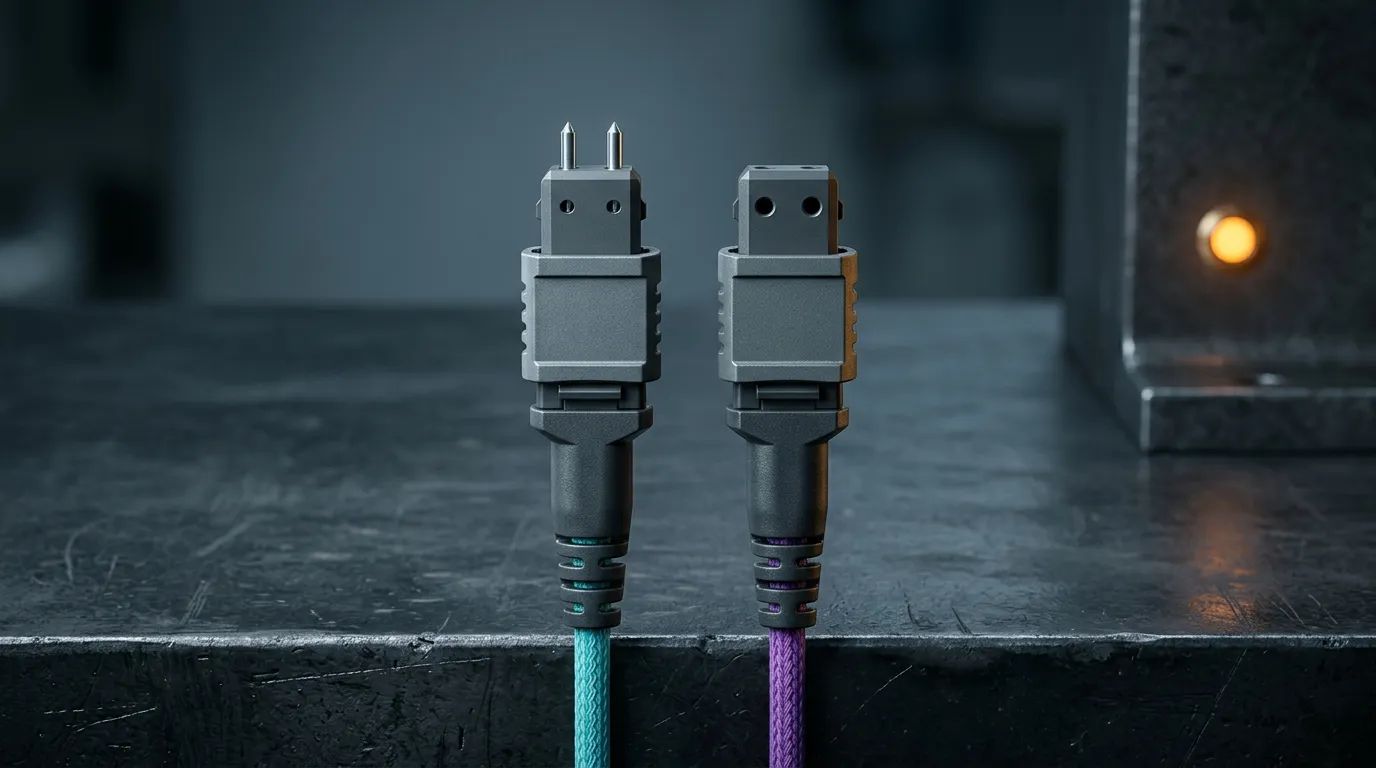
Figure: the same connector body, two different parts — pins in or pins out is a purchase-order field, not a detail.
Interoperability is not the same as standardization. The MPO interface is standardized so that plugs mate; the FOCIS 5 intermateability standard (TIA-604-5) exists precisely to pin down which plugs mate with which, and TIA's release notice for FOCIS 5 notes that the current revision was harmonized with IEC 61754-7. That harmonization is why a cord from one factory works in another factory's cassette. It is also why "MTP" and "MPO" appear interchangeably in quotes: MTP is a commercial designation for a connector built to the same interface, not a different standard. Accept either name; do not accept a drawing that omits sex and key orientation.
The full method-by-method walk-through, including the key-orientation diagrams, is in the MPO polarity Type A, B and C guide. Read it before the RFQ, not after the failed link test.
Grade, Loss and the Measurement Method Behind the Number
"Low loss" is a marketing word. A loss figure is only meaningful with three things attached: a value, a method, and a wavelength.
Start with the method, because it decides what your number even means. Attenuation of a mated connector pair is measured under IEC 61300-3-4, currently the 2023 fourth edition. The standard's own scope is narrow in a way buyers find surprising: it covers attenuation measurement, and it explicitly does not apply to random-mate attenuation — the statistical case where you plug one cord into an unknown partner — which is handled by the 3-34 and 3-45 documents instead. That distinction is not academic. A factory quoting "0.20 dB max" against a single-mate measurement and a customer expecting random-mate performance are describing two different populations of numbers, and neither party is lying. Write both: "max IL per mated pair, per IEC 61300-3-4, measured at 850 and 1300 nm" and, if your application involves mating into unknown cassettes, "random-mate data per IEC 61300-3-34 available on request".
Second, the grade. Connector performance is expressed through grades and performance categories, and the two get conflated constantly. IEC 61753-1 is the document that defines the service environments — Category C for controlled environments, OP and OP+ for outdoor plant, Category I for industrial — and the tests and severities behind each. Those categories are also the current edition's own change history: the 2018 edition plus its 2020 amendment replaced categories U and O with OP and OP+, and added Category I. When a supplier says "meets IEC 61753-1", the useful follow-up is which category, because a cord qualified for a controlled data hall and a cord qualified for a cabinet on a substation are not the same product.
That is the category half, and it says nothing about loss. The grade half is a different pair of documents, and it is the one a "low loss" claim is actually judged against. IEC 61755-1 defines the letter grades for single-mode interfaces on a random-mate basis: the figure has to be met by at least 97% of randomly mated channels, and it carries a mean limit as well.
Attenuation grade — IEC 61755-1, random mate at 1310 nm | 97th-percentile IL | Mean IL |
|---|---|---|
B | ≤ 0.25 dB | ≤ 0.12 dB |
C | ≤ 0.50 dB | ≤ 0.25 dB |
D | ≤ 1.00 dB | ≤ 0.50 dB |
Grade A is marked reserved for future application in the standard, which is why the real conversation is B versus C.
For an MPO the grade is only half of it, and this is the half a buyer can use. IEC 61755-3-31:2015, the interface standard for the angled rectangular ferrule, works out in its Annex A what a per-channel grade means when twelve channels share one body: Grade B is ≤ 0.25 dB for more than 97% of channels, and yet on the standard's own theoretical worst-case model — a completely random core alignment distribution — only about 72% of 12-fiber connectors hold all twelve channels inside 0.25 dB. Relax the per-channel figure to 0.35 dB and that theoretical connector-level yield rises to about 93%. "Grade B" therefore describes channels, not connectors — two suppliers can both say it and still hand you different odds. That document covers single-mode angled ferrules of up to twelve fibers only, so on a multimode cord, ask which document the number was measured against.
Then there is the premises-cabling ceiling, which is a different number doing a different job. ANSI/TIA-568.3-E budgets a standard-grade mated pair at 0.75 dB and a reference-grade-to-standard-grade pair at 0.50 dB, as Fluke Networks summarises the limits. That 0.75 dB is a maximum an installed link has to survive, not a target for a quote — a cord that only just meets it will blow a 400G budget, which is why the grade you ask for and the cabling limit you design to are two separate lines on the RFQ.
Third, the arithmetic that decides whether the grade is good enough. A worked example, using figures your own datasheet will confirm rather than ours: a 300 m OM4 run at the 3.0 dB/km attenuation the fiber datasheet quotes for 850 nm contributes 0.9 dB; two mated MPO pairs at 0.35 dB each contribute 0.7 dB; total 1.6 dB before any splice, cassette or patch panel. Compare that against the link budget in the optics datasheet and you have the maximum IL you can accept per pair — a number, not a word. Everything above that figure is either a different grade or a different design.
One more field that belongs on the order and rarely is: return loss, with the polish it depends on. An APC end face and a UPC end face cannot be mated to each other without damage and reflection problems, so the polish line and the RL line have to agree with whatever is already installed. If the rack is UPC and the new cords are APC, the acceptance test will pass and the link still misbehaves. The APC vs UPC comparison covers the geometry; the purchasing rule is simply that polish is a mating constraint, not a cosmetic option.
Jacket, Rating and the CPR Question
Cordage decisions look like the simplest part of the order and generate the strangest tender responses. Three separate things get mixed into the word "jacket".
Material is the polymer: LSZH (low smoke zero halogen) is the usual choice for inside-plant cords in enclosed spaces, PVC appears where cost dominates, and the choice interacts with the fire rating rather than replacing it. Fire rating is the North American language — OFNR for riser, OFNP for plenum — and it applies to the cable the cord is built from, which is why a cord's rating is inherited, not invented. Reaction to fire is the European language, expressed as a Euroclass under EN 50575 for cables. A supplier can give you all three; none of them is a substitute for the others.
Then there is the question that arrives in almost every European tender: do the patch cords need a CPR Declaration of Performance? Usually the honest answer is no, and the reason is in the regulation's own definition. The Construction Products Regulation, Regulation (EU) No 305/2011, governs products placed on the market for incorporation in a permanent manner in construction works. A factory-terminated cord plugged between two transceivers is not incorporated in the works; the permanently installed cable behind the panel is. So a tender asking for a cord-level DoP is normally asking for the wrong document, and what it should be asking for is the reaction-to-fire class of the cordage, plus the cord's own test report. Member states do not all read that boundary the same way for work-area and patch cords either, so confirm the local interpretation before you rely on the exemption.
This is worth stating carefully rather than triumphantly, because tenders are contracts and not physics. If the customer's specification demands a document, the commercial answer may still be to supply it — but you should know whether you are supplying a compliance document or a comfort document, and price accordingly. The supplier who cannot explain the difference is the one who will send you a DoP for a cable you did not buy.
Two substance regimes apply to the cord itself regardless of CPR, and they follow the goods rather than the brand. RoHS limits ten substances in homogeneous materials under Directive 2011/65/EU as amended — the ten includes the four phthalates added by Delegated Directive (EU) 2015/863. REACH runs alongside it: under Article 33, a supplier of an article containing a Candidate List substance above 0.1% by weight must give the recipient enough information for safe use. Both are duties that attach to whoever places the goods on the market — which is the subject of the label and liability section below, and the reason a white-label buyer needs declarations addressed to them, not photocopies addressed to the factory's other customer.
End Face: What "100% Tested" Should Mean
Every factory says 100% tested. What that phrase covers is the difference between a quality claim and a quality system, and it is checkable in one question: tested for what, judged against which criteria, and recorded where?
End-face condition is judged against IEC 61300-3-35, the visual inspection standard, currently the 2022 third edition. Its scope is narrower than people assume and its limits are explicit. Inspection covers the fiber zones and, for rectangular ferrules like MPO, the whole contact area rather than just the two zones on the fiber; it sets the minimum criteria a microscope has to meet to be compliant; and — the sentence worth reading twice — visual inspection is in addition to and does not replace measurement of attenuation, return loss and end-face geometry. The same standard says a connector cannot be rejected on a failed visual inspection alone; optical performance decides.
That is the correct framing for your purchase order. A 12-fiber MPO has twelve end faces inside one ferrule, so a single scratch or a particle in zone A is a channel-level defect that an insertion-loss sweep may or may not catch, depending on which channel degrades. Ask for both: end-face inspection to IEC 61300-3-35 with pass/fail per fiber recorded, and attenuation per fiber to IEC 61300-3-4. The first tells you the connector is clean and undamaged; the second tells you it works. Neither substitutes for the other, and a supplier who offers only one of them is offering half a test.
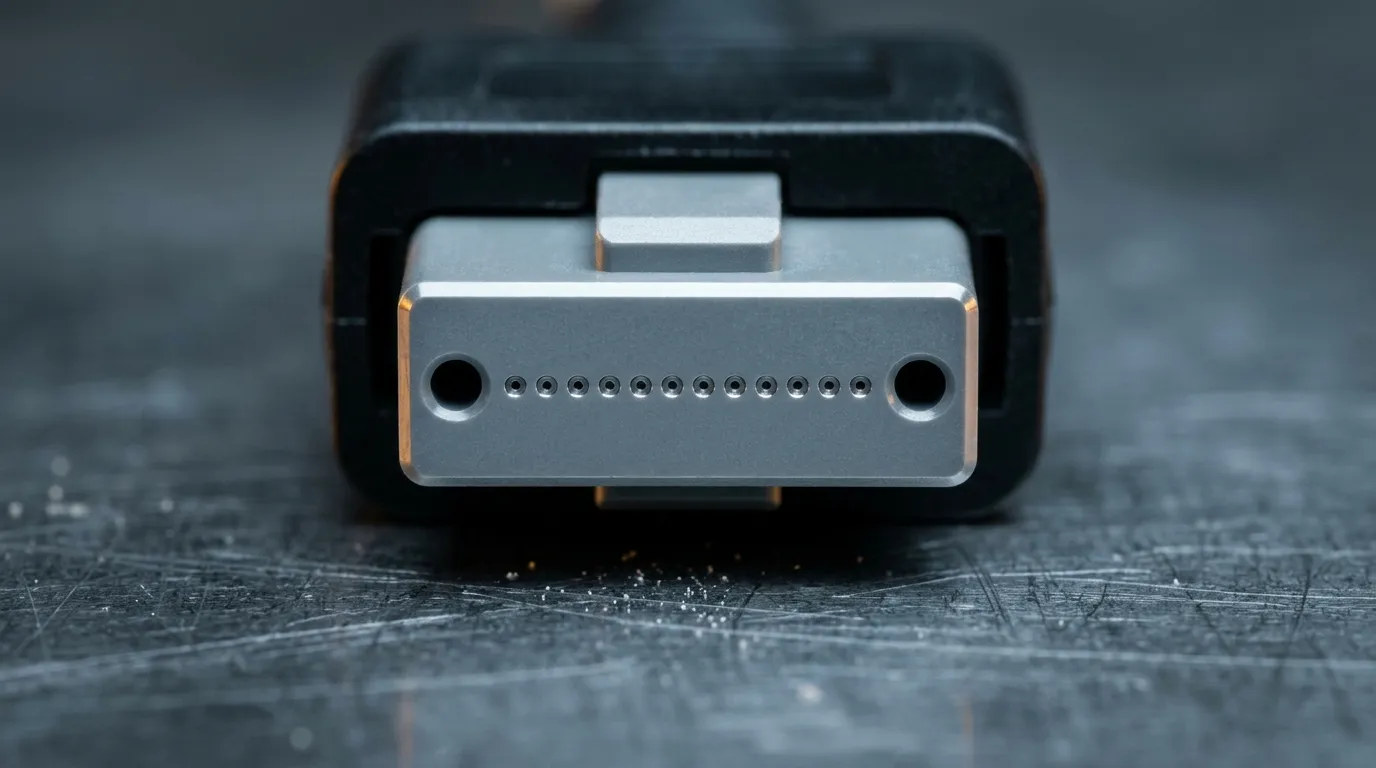
Figure: a 12-fiber ferrule puts twelve end faces — and twelve acceptance decisions — inside one connector body.
What to demand in the report, in plain terms: per-fiber attenuation at both wavelengths, return loss, the pass/fail criteria the numbers were judged against, the test equipment identification, the date, the lot or serial reference, and the standard invoked. A report with numbers but no criteria cannot prove anything, because there is nothing to fail.
Sample, First Article, Then Volume
The cheapest risk control in a white-label program is a first article that costs almost nothing: one cord, built to the drawing, measured, and signed off before the tool is set for volume.
Treat the sample as an acceptance rehearsal rather than a preview. Measure it yourself, on your meter, against the same criteria you will apply at goods-in — because the point is not to confirm the factory can make one good cord, it is to confirm that your document and their process agree about what "good" means. Disagreements found here cost a phone call; the same disagreements found after 5,000 cords cost a rework decision.
Three items belong in the first-article sign-off and are routinely skipped:
- The drawing, red-lined. Not the datasheet — the drawing, with connector type, ferrule and fiber type, sex, polarity letter, polish, jacket, length and label fields visible. This is the artefact you will re-order against.
- The retained sample. A sealed, labelled unit kept by both sides, so a future dispute has a physical reference rather than a photograph.
- The label and packaging, physically. Labels are where white-label programs break, and a photographed mock-up hides the details that matter (see below).
Length deserves its own line at this stage. "3 m" is not a specification until it says whether the measurement runs ferrule face to ferrule face or includes the fan-out legs, whether the tolerance is ±50 mm or ±5%, and how it is measured — laid flat, under tension, or with the breakouts extended. On a harness with 1 m legs, the difference between the two readings is a rack that closes and a rack that does not.
Your Label, Your Part Number, Your Liability
This is the section that separates an OEM order from a bulk purchase, and the one with legal weight behind it.
The label is a legal statement, not decoration. In EU practice, a company that places a product on the market under its own name or trademark takes on the manufacturer's obligations for the legislation that product falls under — the technical documentation, the declaration, and the responsibility for conformity. The European Commission's Guide to the implementation of product rules (the Blue Guide, 2022 edition) sets that out, including the point that a distributor or importer branding a product as its own is treated as the manufacturer. Practically, your name on the bag changes who answers the customs question and who signs the declaration. The mechanics of moving documents into your name — what can be re-issued, what stays with the factory, what has to be authorized — are covered in the OEM certification transfer guide; the trap where the certificate is genuine but does not name your part number is covered in MPO patch cord certification.
CE marking follows the same logic, and it is the obligation white-label buyers ask about last. Where the goods fall under legislation that requires a CE mark — CPR when a cord is sold as a construction product, for instance — the mark is affixed by the manufacturer of record, and the Blue Guide says a distributor or importer that places goods on the market under its own name "takes over the manufacturer's responsibilities", which include "the responsibility for the conformity of the product and the affixing of the CE marking". The same guidance says the underlying technical documentation and test reports need not be in your name, but you do have to be in possession of them. That is the practical half of the own-brand decision: your name on the DoC, the factory's test evidence in your folder, and a PO clause that obliges them to hand it over.
The part number is your specification in compressed form. Build one that encodes eight of the nine decisions, and put the decode table in the drawing. One string that carries them: MPO12-OM4-APC-B-MF-30000-LSZH-R1. Read left to right, that is the ferrule and fiber count (MPO-12), the fiber type (OM4), the polish (APC), the polarity method (Type B), the sex at each end (male at A, female at B), the length (30 m, encoded in millimeters as 30000 — state the unit in the drawing or you will eventually argue about it), the jacket (LSZH), and the revision (R1). Eight decisions in eight segments, one line short enough to print on a label — the ninth, loss grade and test method, stays on the drawing rather than in the string, which is exactly why the drawing travels with every PO.
The revision suffix is the field most programs omit and later need, because when the ferrule supplier changes you want the new goods distinguishable from the old without opening a carton. Give the suffix a meaning in writing at the same time: when R1 becomes R2, the supplier returns the drawing with the change marked, states what else moved with it — ferrule source, test regime, jacket compound — and confirms in one sentence whether the two revisions are interchangeable in a link. A revision number with no change note is a decoration.
A manufacturer already running OEM programs will usually have a part-number convention you can adopt rather than invent. The MPO/MTP assembly range is a fair example of what to look for in a partner here: 8, 12 and 24-fiber configurations across OS2, OM3, OM4 and OM5, Type A, B and C polarity, and 100% insertion-loss and polarity testing with a report shipped per assembly. Those are the fields your part number has to decode, and the test regime is what your acceptance criteria will be compared against.
Packaging is a specification too. Bag or reel, individual or bulk, desiccant or not, carton marking, and whether the outer box carries your part number or the factory's. Two orders can be identical in every technical respect and differ entirely in whether a warehouse can receive them. White label fiber optic cables are, in the end, judged by the carton as much as by the cord.
A label worth specifying carries: your part number and description, fiber count and type, length, polarity letter, lot or date code, your PO reference, a scannable code, and country of origin where your market requires it. That list doubles as your audit trail — the lot code is what makes a recall, a complaint or a customer query traceable back to a build, and it is the one field that cannot be reconstructed after the fact. The declarations you collect along the way belong in one searchable place rather than a shared folder named after the project — organized the way a certificate library is, so someone else can use it when you are not in the room.
Standards and EU-law references on this page were checked against the editions current in November 2026; where a document has been superseded since, the edition named here is the one the requirement was read from.
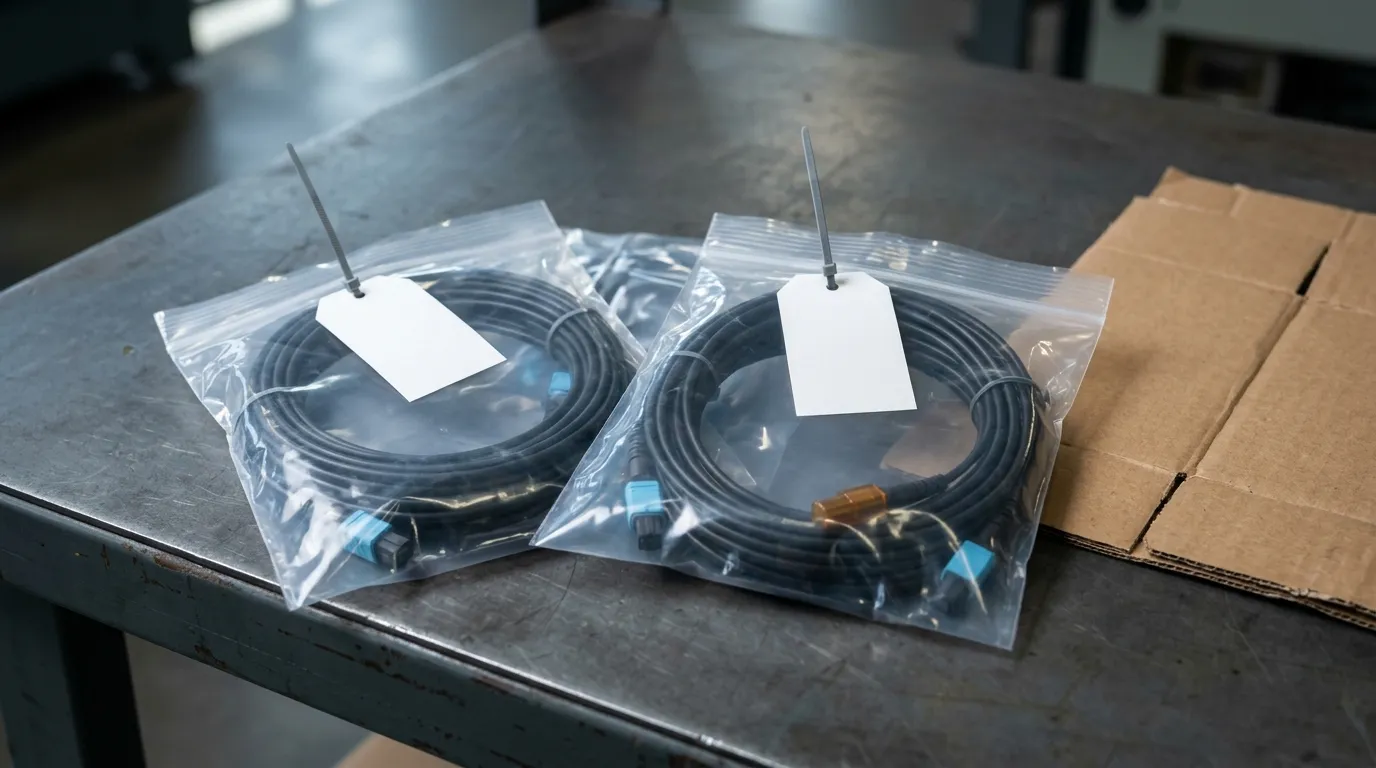
Figure: the three deliverables a white-label order actually specifies — the cord, what it is called, and how it arrives.
MOQ, Lead Time and What Actually Moves the Price
Price conversations about custom fiber cables go badly because buyers compare unit prices across incomparable scopes. Four things drive an MPO cord's cost, and only one of them is the cord.
Connector and ferrule quality. A low-loss ferrule with tight geometry costs more than a standard one, and the difference is per connector, not per order — a 24-fiber cord carries two of them. If your quote is materially cheaper than the others on identical loss figures, the two most likely explanations are a different ferrule grade or a different test regime.
Test time. This is the line procurement teams underweight. A cord with 100% attenuation and end-face inspection has minutes of labor in it; 5,000 cords is a schedule, not a unit cost. A supplier who quotes a low price for "100% tested" without saying what the test covers has either automated it or narrowed it, and it is worth asking which.
Volume banding and MOQ. In this category a minimum order is often set by material purchasing rather than by capacity — a full ferrule reel, a complete jacketing run — so ask which constraint applies to your part. The price step between bands is not uniform either: the drop happens where you cross one of those boundaries, and the steps on either side of it are smaller than the step across it. Ask for the band structure rather than a single MOQ number, and ask what the next band's price would be — it is information the supplier already has.
Lead time composition. Ordered honestly, it breaks into component availability, production queue, test, and packing. Only the production queue responds to negotiation; component availability is a market fact and test is arithmetic. A quote that gives one lead-time number without the breakdown cannot be managed, and it is the first thing to slip when a ferrule reel is late.
None of this produces a price you can compare in a table without the specification attached. Which is the argument for the next section.
The RFQ Pack: Ten Lines That Make Quotes Comparable
Send the same ten lines to every supplier and the custom cable assembly quote stops being an opinion.
# | Line | What good looks like |
|---|---|---|
1 | Drawing | One PDF per part number, revision-controlled, dimensions in mm |
2 | Ferrule and fiber count | Family, rows, fiber count, and the optic it serves |
3 | Fiber type | OS2/OM3/OM4/OM5, core size, jacket color |
4 | Connector type, polish, sex | LC/SC/FC/ST duplex or MPO; PC/UPC/APC; male/female stated per end |
5 | Polarity | Type A/B/C plus the method letter for the link |
6 | Loss and test | Max IL per mated pair, min RL, method (IEC 61300-3-4), wavelengths |
7 | Cordage and jacket | Construction, material, fire rating or Euroclass |
8 | Length and tolerance | Nominal, measurement definition, tolerance |
9 | Identity | Part number, label fields, packaging, lot coding |
10 | Commercials | Volume bands, Incoterm, lead time broken down, sample cost and schedule |
Two lines deserve a note. Line 6 should name the method as well as the number, because that is what makes two suppliers' figures comparable; and line 10 should ask for the band table, not a single price, because a single price hides the volume boundaries that decide your reorder economics.
What a good response looks like: the drawing returned with your fields filled in and any disagreement flagged, not a catalog page with a highlighted row. A supplier who returns your drawing with a comment on it is doing the work. A supplier who returns their own datasheet is quoting a different product.
Goods-In: Three Checks and the Documents to Keep
The last control point is the one you own entirely. Three checks, in this order, catch nearly everything.
Paper first. Does the test report reference your part number and your lot code, state the criteria, and cover the fibers you received? A report with the right numbers and the wrong part number is not evidence about your goods — it is evidence about someone else's.
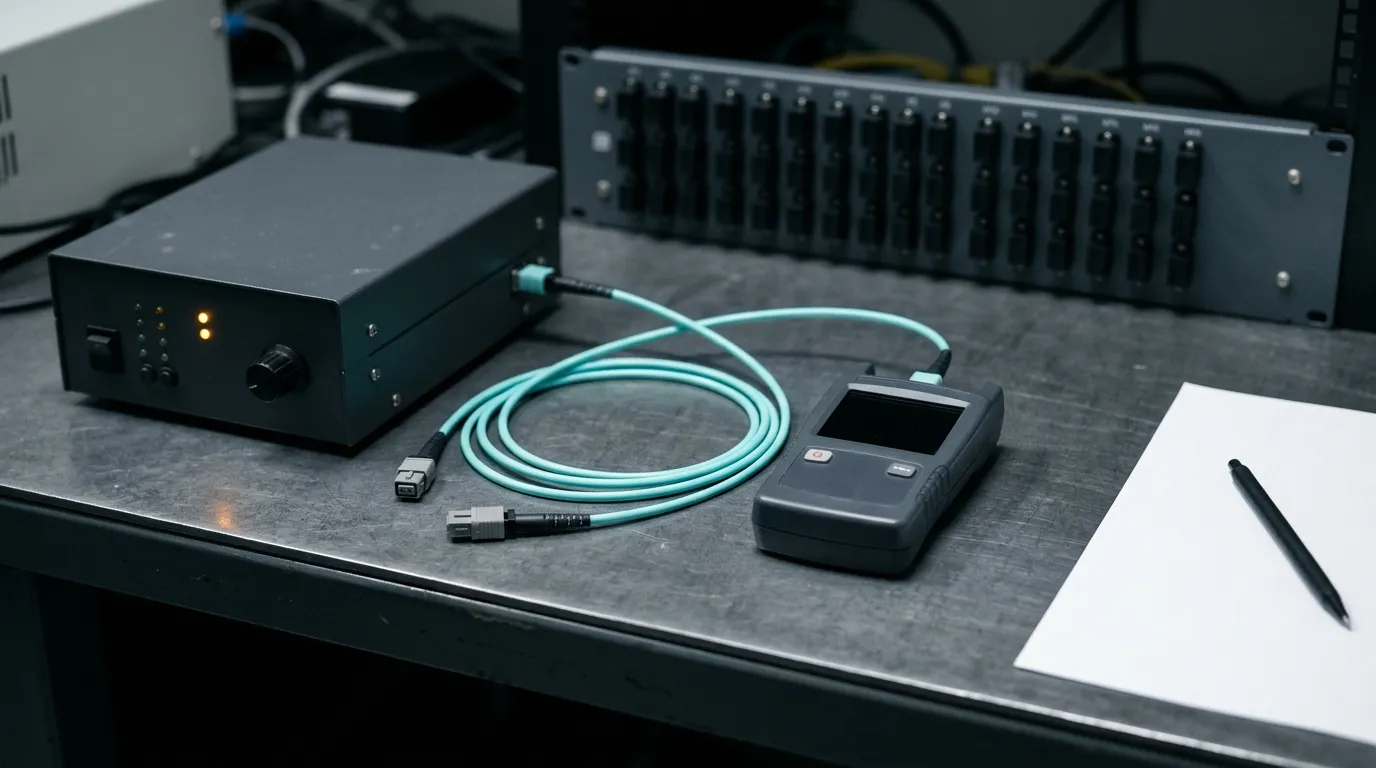
Figure: the minimum goods-in rig — a stable source, a calibrated meter, and a reference cord you already trust.
Then the sample. Pull units per your sampling plan and measure attenuation per fiber, not per cord. A cord-level average can pass while one channel sits outside the budget — and with twelve or twenty-four channels, one bad lane is enough to fail a 400G link. Record per-fiber values against the criteria on the drawing.
If you do not have a sampling plan yet, one you can actually write down looks like this. Review the test report on 100% of the assemblies in the lot — it ships per cord, so the paper costs nothing — then re-measure a sample: ISO 2859-1:2026 at general inspection level II, with an AQL of 0.65 or 1.0 on the optical measurement, is common industry practice for assemblies like these and a defensible starting point — the standard defines the scheme, the choice of AQL is the buyer's — and the lot-accept rule that comes with it — accept on the plan's acceptance number, reject on the rejection number — is what makes a lot refusable at all. Two things need to be fixed in the order rather than discovered later: that a single channel outside the per-fiber limit counts as a defect, because a cord-level average hides exactly the failure you are sampling for; and that the first three lots are re-tested in full while the process is unproven. Treat the whole thing as a negotiable default and not as a claim about any factory's practice — agree the inspection level, the AQL and the acceptance number in writing, then put them in the purchase order where the argument will happen.
Then the physical. Label content against the specification, length against the tolerance, sex and key orientation against the drawing, packaging against the requirement. This is also when you photograph the carton marking and the label, because those photographs are what a future dispute will be argued with.
Keep four documents per delivery: the drawing revision in force, the test report, the declaration(s) covering the goods under your name, and the lot code record. Between them they answer the four questions that arrive later — what was specified, what was measured, who declared it, and which build it was.
Questions Buyers Ask Before the PO
Can I get a small quantity of custom fiber cables first, before committing to a band?
Yes, and you should — but buy the sample against the same drawing and the same test criteria as the volume order, or the sample proves nothing about the volume. Expect to pay a unit price at sample quantity that is not representative; the sample's job is to validate the document, not the price.
Can I supply my own fiber or connectors?
Sometimes, and usually not worth it on MPO. The ferrule and the termination process are where the yield lives, and a factory working with unfamiliar components carries the risk into your price. If you do supply material, the drawing has to say who owns the yield loss — that clause decides more arguments than the specification does.
Can the label say "made in" my country?
Origin marking follows rules of origin, not the label design. Putting your brand on the product does not change where it was made, and a label asserting otherwise is a customs problem rather than a branding one. Get the origin statement from the supplier in writing and mark accordingly.
What happens if the loss is out of spec at goods-in?
Whatever your purchase order says. This is exactly why the acceptance criteria, the sampling plan and the measurement method belong in the order rather than in an email thread — with them, the conversation is about facts; without them, it is about whose meter is right.
Where to Start
Nine specifications, one drawing, one sample, one acceptance test — the nine lines plus the commercial line make the ten-line RFQ. That is the whole apparatus, and it is smaller than the spreadsheet most buyers build to compare quotes without it.
If you are at the beginning rather than the middle, work backwards: settle the fiber count and ferrule from the optics, settle polarity from the link, then write the remaining seven lines around them. The hub page for this cluster — the data center fiber cabling section — carries the architecture-level guides that feed those first two decisions, and the MPO guides linked above cover the mechanics. That RFQ is the document that turns a price into a commitment, and any factory building MPO assemblies to order will recognize it immediately. TTI Fiber runs those programs with OEM branding and custom fiber counts; if you would rather start from a drawing than from a catalog page, send the ten lines and ask for the drawing back red-lined before anyone discusses price.