APC vs UPC: Fiber Connector Polish Explained
APC vs UPC: The Fiber Connector Polish Difference That Decides Your Network
APC and UPC are not two kinds of connector. They are two ways of polishing the end of the same fiber — and that tiny difference in how the glass is finished decides how much light bounces straight back toward your laser. Get it wrong on a PON with an RF video overlay and you don't just lose a fraction of a decibel; you can smear a whole cable-TV channel with reflection noise.
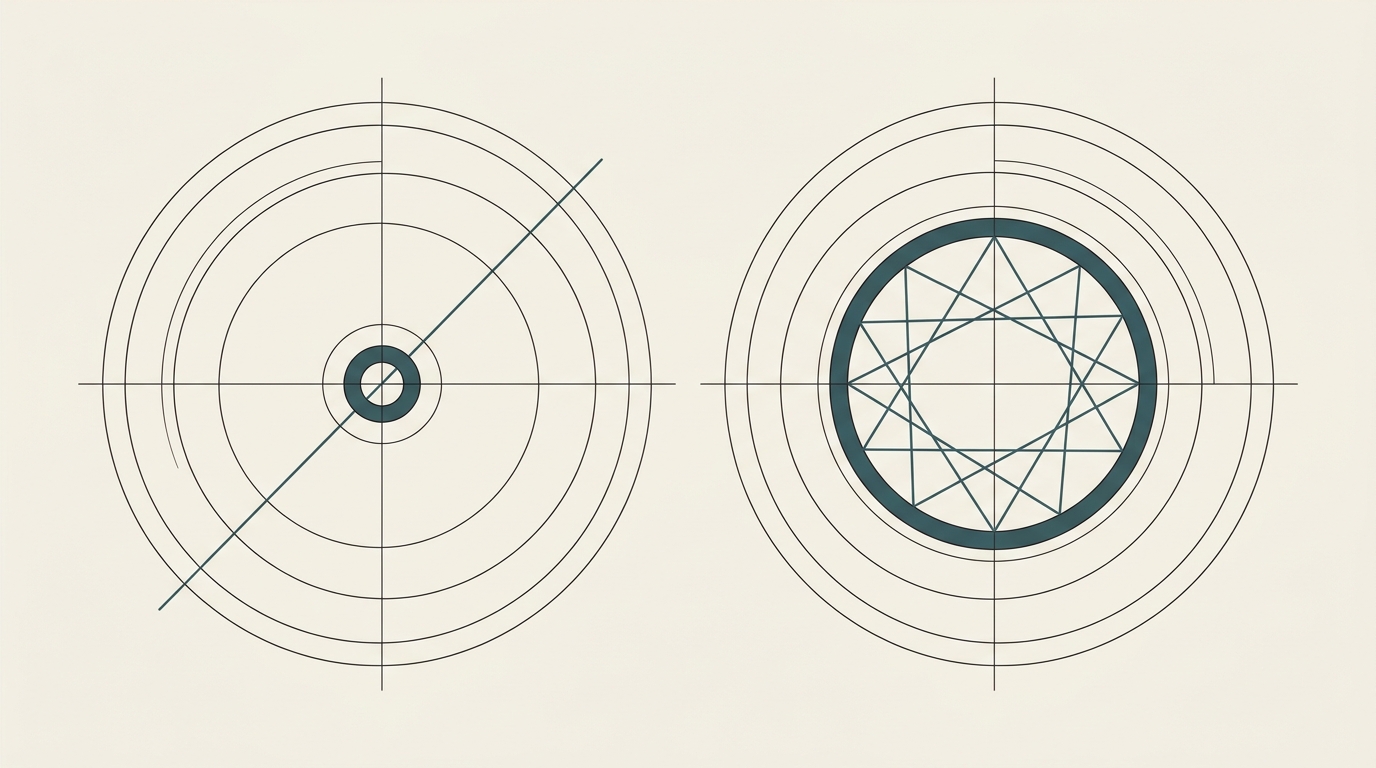
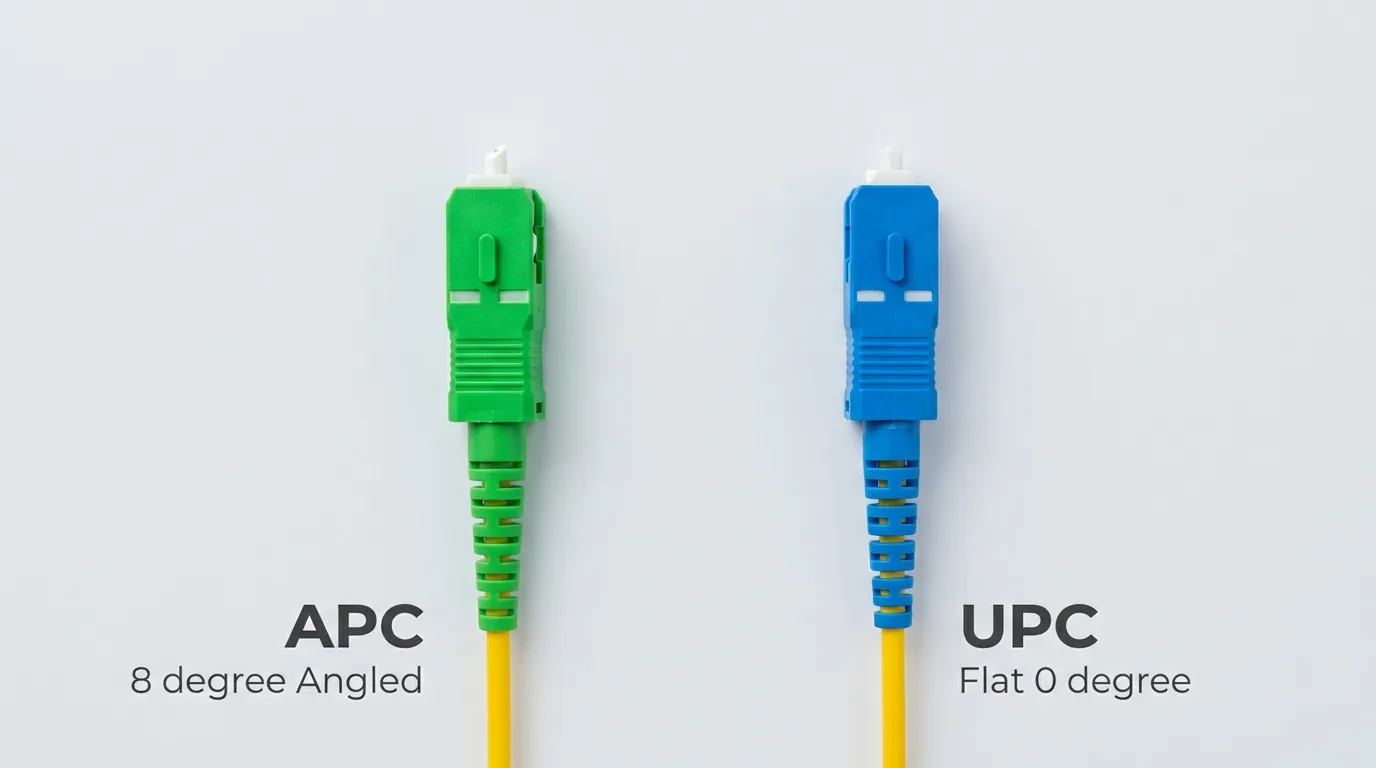
The choice comes down to one number most buyer's guides never print: return loss. A UPC endface is polished flat and square to the fiber axis. An APC endface is polished at a deliberate 8° angle. That angle is the entire reason APC exists, and it is why the two are colored differently, mated in different adapters, and — critically — must never be plugged into each other.
This guide compares APC vs UPC the way an FTTH, PON, or data-center engineer actually has to decide between them: by endface geometry, real return-loss and insertion-loss figures, color coding, deployment fit, and the compatibility rule that saves ferrules from being destroyed.
APC vs UPC at a Glance
Attribute | UPC (Ultra Physical Contact) | APC (Angled Physical Contact) |
|---|---|---|
Endface polish | Flat / domed, 0° (square to fiber axis) | Angled 8° |
Connector color (single-mode) | Blue | Green |
Return loss (back reflection) | ≥ 50 dB (typical 50–55 dB) | ≥ 60 dB (typical 60–65 dB) |
Insertion loss | ≤ 0.3 dB | ≤ 0.3 dB |
Reflection behavior | Reflects light straight back up the core | Reflects light out into the cladding, away from the source |
Best for | Enterprise LAN, data centers, most Ethernet, OTDR, general single-mode | FTTH/PON, RF video / RFoG, CATV, WDM, any reflection-sensitive link |
Relative cost | Lower | Slightly higher (precision angled polish) |
Fiber type | Single-mode (and multimode, as PC/UPC) | Single-mode almost exclusively |
Mate with the other type? | No — never mate APC to UPC | No — never mate APC to UPC |
One-line rule: if reflected light will hurt the system — analog/RF video, GPON overlays, coherent or high-count PON — use APC (green). Otherwise UPC (blue) is cheaper, easier to terminate, and perfectly adequate.
What APC and UPC Actually Mean
Both terms describe the polish geometry of the ferrule endface — the finish on the ceramic ferrule tip where two fibers physically touch inside an adapter. They sit in a family of three physical-contact polishes:
- PC (Physical Contact): the original curved/domed polish that forces the two fiber cores to touch, eliminating the air gap. Return loss around 40 dB. Largely superseded.
- UPC (Ultra Physical Contact): an extra-fine, more tightly controlled version of the same flat, square (0°) dome. Better surface finish pushes return loss to ~50 dB. This is today's default for straight-polished single-mode.
- APC (Angled Physical Contact): the same fine polish, but the whole endface is ground at an 8° angle relative to the perpendicular. That angle is what separates it from everything above.
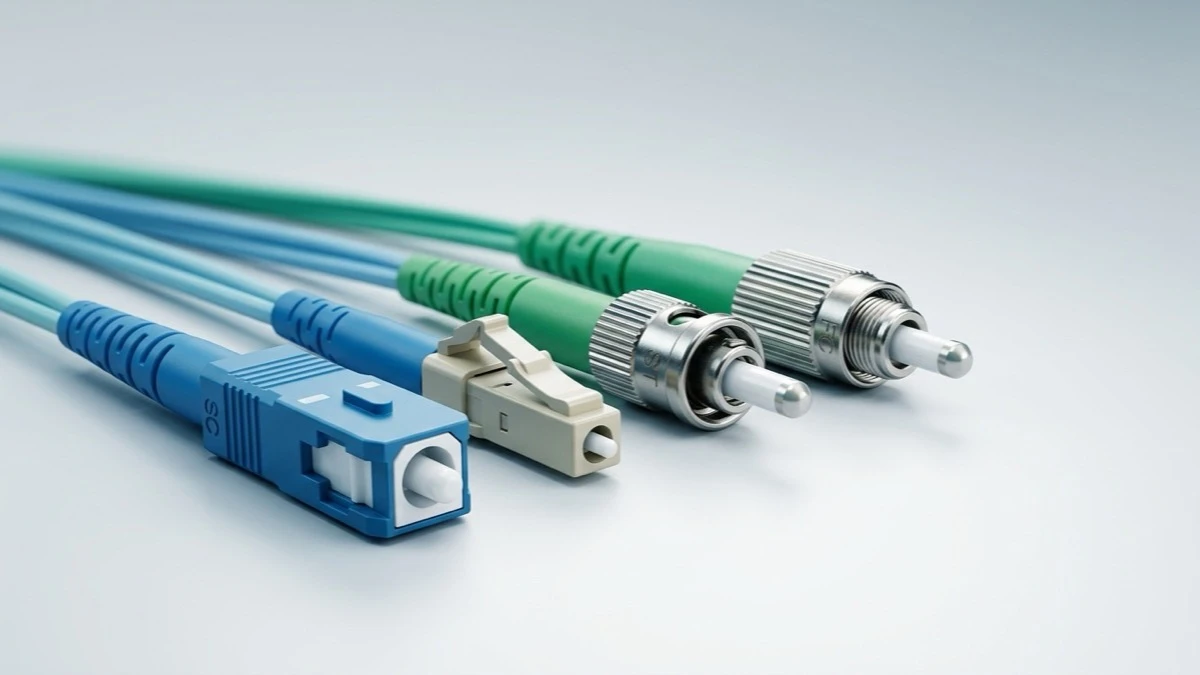
The key thing to internalize: APC and UPC are polish types, not connector types. Any connector body — SC, LC, FC, ST, even MPO/MTP — can be finished as either. That is why you order a "SC/APC" or "SC/UPC" patch cord: the first part is the connector form factor, the second is the polish. "LC/APC" and "LC/UPC" work the same way.
The Physics: Why the 8° Angle Exists
Every time light passes from glass into a tiny air gap and back — at any connector interface — a small fraction reflects. This Fresnel reflection is about 4% (roughly −14 dB) at a bare glass-air boundary. Physical-contact polishing removes most of that air gap by pressing the cores together, but no mated pair is perfect, and reflections still occur.
Here is where the geometry matters:
- On a UPC endface, the surface is square to the fiber. Any reflected light travels straight back down the core, directly toward the transmitter. That returning light is what return-loss numbers measure.
- On an APC endface, the surface is tilted 8°. Reflected light leaves at roughly twice the polish angle (~16°) relative to the core — steep enough that it escapes into the cladding and is lost from the guided mode instead of racing back to the laser.
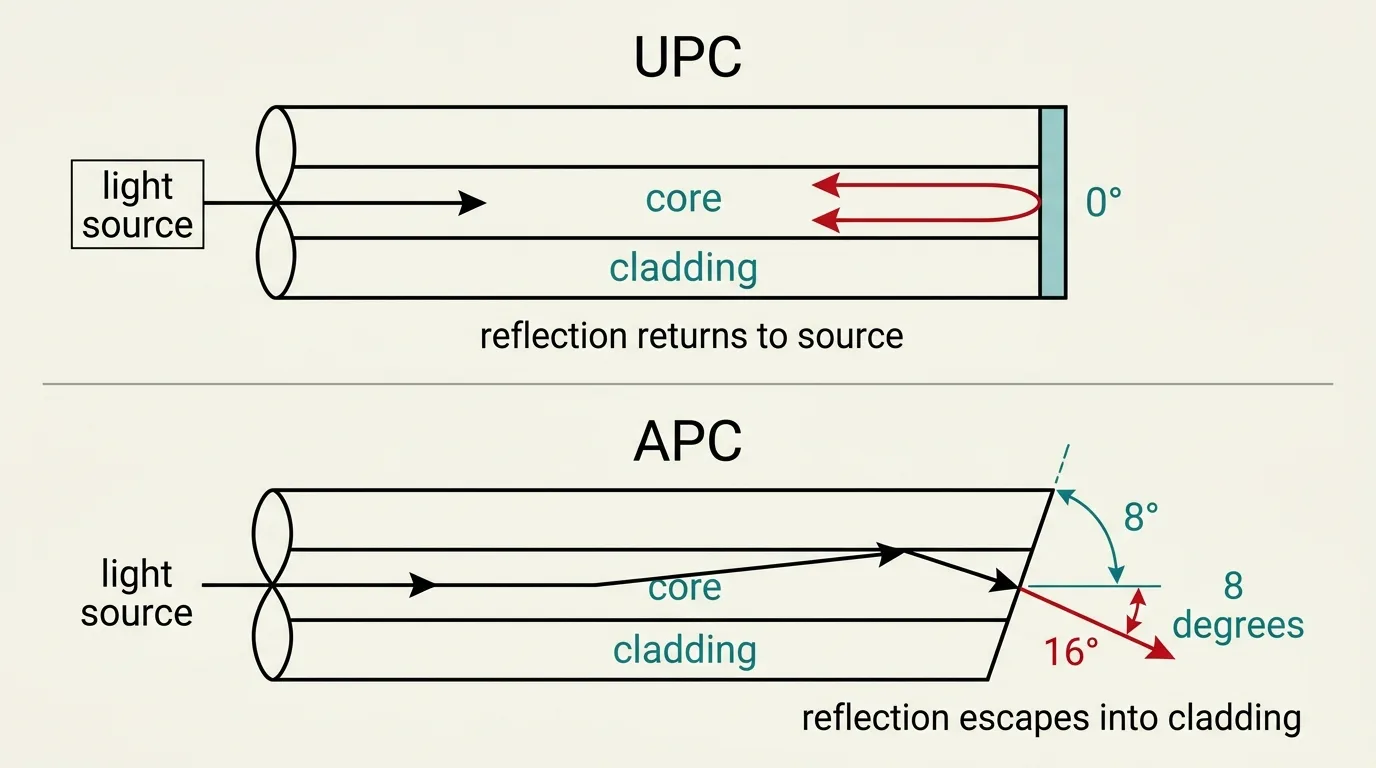
That is the whole trick. The angle doesn't reduce how much light reflects — it changes where the reflection goes. On APC, it goes somewhere harmless.
Why back reflection is worth engineering around: strong reflections destabilize laser sources (especially the DFB lasers used in analog and PON systems), raise the noise floor, and in analog/RF-modulated video create visible distortion. High return loss is a direct requirement in passive optical networks carrying broadcast video, which is exactly why the industry standardized on APC there.
Return Loss and Insertion Loss: The Numbers
These are the two specs that separate APC from UPC in practice. Return loss is where they diverge; insertion loss is where they're nearly identical.
Spec | PC | UPC | APC | What it means |
|---|---|---|---|---|
Return loss (higher = better) | ~40 dB | ≥ 50 dB | ≥ 60 dB | How much reflected light comes back. APC returns ~1/10th as much as UPC. |
Insertion loss (lower = better) | ≤ 0.3 dB | ≤ 0.3 dB | ≤ 0.3 dB | How much signal is lost through the mated pair. Effectively a tie. |
Two points engineers miss:
- Return loss is logarithmic. Going from 50 dB (UPC) to 60 dB (APC) is a 10× reduction in reflected power, not a 20% one. On reflection-sensitive links that order-of-magnitude is the whole point.
- Insertion loss is a wash. A well-made APC and a well-made UPC both land at ≤ 0.3 dB per mated pair — often ≤ 0.2 dB. APC's angle demands tighter manufacturing tolerance to hit that number (the two angled ferrules must be rotationally aligned by the connector key), which is part of why APC costs a little more, but the finished insertion-loss spec is comparable. If a data sheet shows APC with materially worse insertion loss, that's a manufacturing-quality signal, not an inherent property of the polish.
For the underlying definitions and measurement conventions, see the industry reference on the optical fiber connector.
What APC Costs vs UPC (and Why)
Almost every comparison online waves this away as "APC is slightly more expensive." Here is the real answer from the production side: in our experience as a manufacturer, an APC assembly typically carries roughly a 10–20% unit-price premium over an otherwise identical UPC one (exact delta varies by connector type, volume, and supplier). On a single patch cord that's cents to a couple of dollars; across a full PON build of thousands of drops it's a line item worth understanding.
The premium is not a markup — it's manufacturing reality:
- An extra, tighter polishing step. Grinding a controlled 8.0° angle (industry tolerance is typically ±0.2°) is more demanding than a flat polish and uses angled polishing films and fixtures.
- Rotational alignment. Two angled ferrules only mate cleanly if their angles are keyed to line up. The connector key and ferrule must be assembled to a tighter rotational tolerance, or insertion loss suffers.
- Lower yield. More endfaces fail interferometer inspection (apex offset, angle error, fiber height), so more units are reworked or scrapped — which shows up in the price.
That's also why buying APC from a manufacturer that actually controls the polish matters more than for UPC: the angle tolerance and rotational alignment are where cheap APC quietly loses its return-loss advantage.
From the Factory Floor: What "Good" APC and UPC Look Like
A polish spec on paper only holds up if it survives handling and inspection. Two practical checks separate a reliable connector from a marginal one:
- Endface inspection (IEC 61300-3-35). Every endface should be inspected under a fiberscope and graded for scratches and defects in the core and cladding zones before it's mated. A speck of dirt on the core is the most common cause of a "bad" connector in the field — and it hits UPC and APC equally. Inspect and clean before every connection.
- Reliability testing (Telcordia GR-326-CORE). Quality single-mode assemblies are qualified against GR-326 for insertion loss, return loss, and mechanical/environmental endurance. Asking a supplier for GR-326 data is the fastest way to tell a real manufacturer from a re-labeler.
This is the manufacturer angle worth trusting on: return-loss numbers are only as good as the polish tolerance and inspection discipline behind them.
Green vs Blue: How to Identify APC and UPC at a Glance
The color code is a hard industry convention on single-mode connectors and adapters — it exists precisely so nobody mates the wrong pair:
- Green = APC (single-mode, angled).
- Blue = UPC (single-mode, flat).
- Beige / black / aqua = multimode (always PC/UPC, never angled).
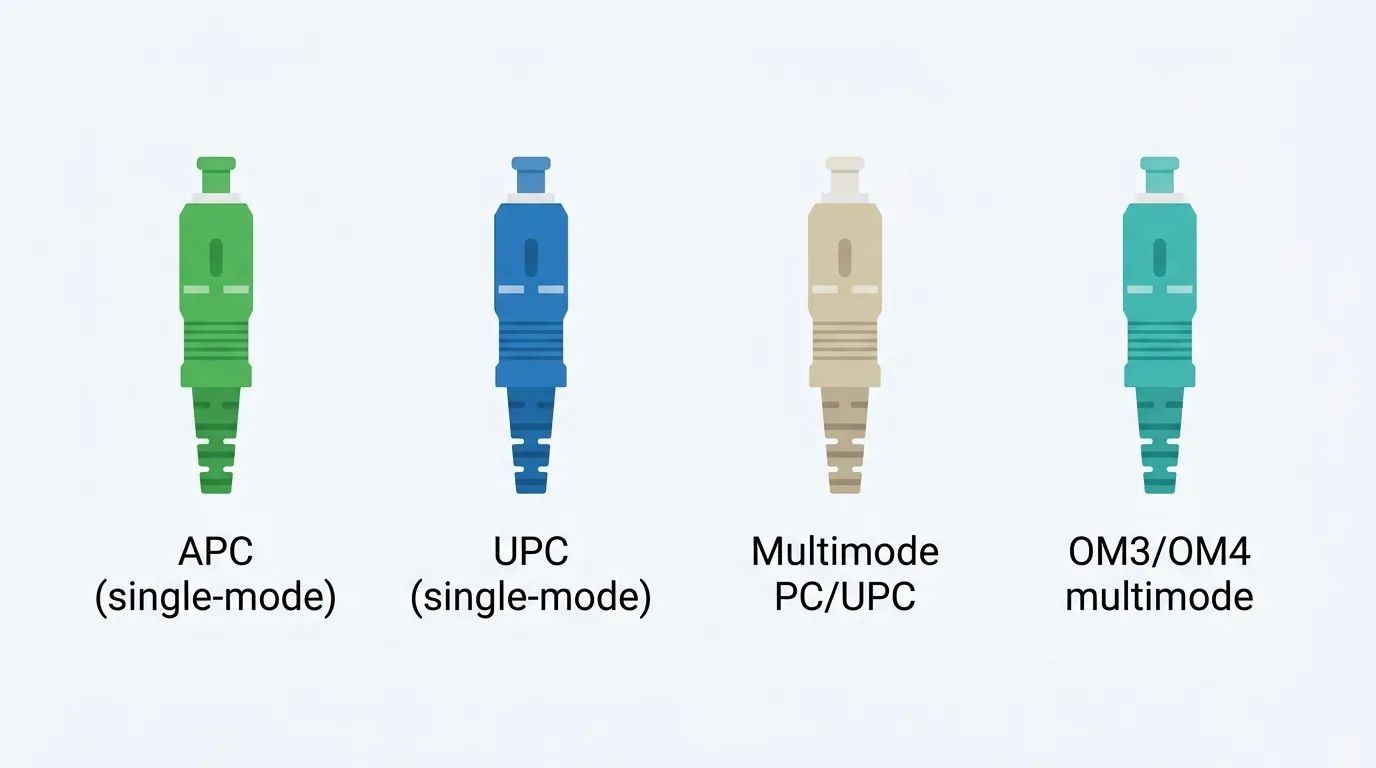
The color lives on the connector boot/housing and the matching adapter. A green adapter is keyed for APC; a blue one for UPC. If a green connector won't seat cleanly in a blue adapter, that mismatch is the color code doing its job — stop before you force it.
Quick field check: boot is green → it's APC → it belongs on a PON/CATV/video-overlay link. Boot is blue → it's UPC → enterprise, data center, general single-mode.
When to Use APC vs UPC: The Decision Matrix
This is the section that actually resolves "apc or upc for ftth" and "which is better apc or upc." Neither is universally better — they solve different problems.
Deployment | Use | Why |
|---|---|---|
FTTH / GPON / XGS-PON with RF video overlay (RFoG) | APC | Analog/broadcast video is destroyed by back reflection; high return loss is mandatory. |
Standard GPON / EPON access (no RF overlay) | APC (typical) | PON operators standardize on APC end-to-end for reflection margin and consistency. |
CATV / HFC / any analog-modulated optics | APC | Same reflection-sensitivity as RFoG. |
DWDM / long-haul / coherent single-mode | APC | High-bit-rate and reflection-sensitive sources benefit from the extra margin. |
Enterprise LAN backbone (single-mode) | UPC | Digital links tolerate UPC-level reflection; cheaper and simpler. |
Data center single-mode (100G/400G, MPO trunks) | UPC (or APC per spec) | Most DC single-mode is UPC; some 400G/coherent and PON-in-DC designs call APC — follow the transceiver spec. |
Multimode (OM3/OM4, LAN, DC) | UPC / PC | Multimode doesn't use APC; reflection isn't the limiting factor. |
Test & measurement (OTDR, patch leads) | Match the network | Use the same polish as the system under test to avoid a reflective event at the connection. |
The heuristic: reflection-sensitive or analog/PON → APC. Digital, enterprise, cost-driven → UPC. When a network operator or transceiver data sheet specifies a polish, that spec wins over any rule of thumb.
TTIFiber manufactures both polishes across the full connector range — SC/APC and LC/APC for PON and access, UPC patch cords and pigtails for enterprise and data center, and single-mode MPO/APC trunks for high-density builds — so the deployment decides the part, not what happens to be in stock.
Can You Mix APC and UPC? (Read This Before You Force a Connector)
No. Never mate an APC connector to a UPC connector. This is the single most common — and most damaging — field mistake with these connectors.
Here's what happens if you do:
- A physical air gap. One endface is flat, the other is angled at 8°. They cannot make full physical contact, so an air gap forms. Insertion loss shoots up (often several dB), and the link may not pass at all.
- Reflection returns anyway. The air gap reintroduces the Fresnel reflection APC was designed to avoid — return loss collapses.
- Permanent damage. Forcing an angled ferrule against a flat one under spring load can scratch, crack, or chip the polished endfaces. Now both connectors are ruined, not just the link.
The color code (green vs blue) and keyed adapters exist to physically block this — but people defeat them by forcing a connector or using the wrong adapter.
If you genuinely need to bridge an APC domain to a UPC domain (for example, a PON drop meeting enterprise equipment), the correct part is a hybrid APC-to-UPC patch cord — APC on one end, UPC on the other, terminated and tested as a matched assembly — such as a SC/APC-to-LC/APC or hybrid single-mode jumper. Never improvise the transition inside an adapter.
SC/APC vs SC/UPC, LC/APC vs LC/UPC
Because the polish is independent of the connector body, the same rules apply to every form factor:
- SC/APC vs SC/UPC — identical SC housing; SC/APC is the green PON/access standard (the SC/APC combination is the classic FTTH drop connector), SC/UPC the blue enterprise/legacy choice.
- LC/APC vs LC/UPC — the small-form-factor equivalent; LC/UPC dominates data-center and high-density single-mode, LC/APC appears in reflection-sensitive and newer PON builds.
- FC/APC vs FC/UPC — common in test equipment and metrology, where FC/APC is preferred for its low back reflection.
In every case: match the polish to the network, and never cross APC with UPC across a mated pair — regardless of whether both ends are SC, LC, or FC.
Frequently Asked Questions
What do APC and UPC stand for in fiber? APC = Angled Physical Contact; UPC = Ultra Physical Contact. Both describe how the fiber/ferrule endface is polished. UPC is polished flat (0°) with an ultra-fine finish; APC is polished at an 8° angle.
Why are APC connectors green? Green is the industry color code for single-mode APC, used on both connectors and adapters so they can't be accidentally mated to blue UPC parts. Blue signals single-mode UPC.
Is APC better than UPC? Not universally. APC has far lower back reflection (return loss ≥ 60 dB vs ≥ 50 dB), which matters for PON, RF video, and reflection-sensitive links. For general enterprise and data-center use, UPC performs fine and costs less. "Better" depends entirely on the application.
Do I need APC or UPC for my ONT or modem? Follow the operator's spec — most GPON/FTTH deployments use APC (green), so a fiber drop into an ONT is very often SC/APC. If the equipment port and the patch cord are both green, you're matched; if one is green and one is blue, stop and get the correct polish.
Can APC connect to UPC? Physically it can be forced, but you should never do it: you get high insertion loss, poor return loss, and a real risk of permanently damaging both endfaces. Use a hybrid APC/UPC patch cord to bridge the two.
Is there APC for multimode? In practice, no. Multimode connectors are polished PC/UPC. Back reflection isn't the limiting factor in multimode links, so the angled polish isn't used.
The Bottom Line
APC vs UPC is a return-loss decision wearing two colors. The 8° angle on an APC (green) endface steers reflected light into the cladding, delivering ~60 dB return loss for PON, RF video, and any link where back reflection is the enemy. A UPC (blue) flat polish is cheaper and simpler, hits ~50 dB return loss, and is the right call for enterprise LAN, data centers, and most digital single-mode. Insertion loss is a tie. And whatever you choose, keep the two apart at every mated pair.
TTIFiber produces both polishes in-house across patch cords, pigtails, connectors, and adapters — factory-terminated and interferometer-tested to the return-loss and insertion-loss grades above. If you're speccing a PON, access, or data-center build and want the correct APC or UPC assemblies (including hybrid and custom polish), talk to our engineering team about your link budget.