OS2 vs OM4 vs OM5: Choosing Data Center Fiber That Outlives Your Optics
OS2 vs OM4 vs OM5: Choosing Data Center Fiber That Outlives Your Optics
The transceivers you plug in this year will be gone in five. The fiber you pull this year will still be in the tray in 2040.
That asymmetry is the whole reason "OS2 vs OM4 vs OM5" is a hard question. Nobody is really asking which glass has the best spec sheet — they're asking which one still has transceivers available for it when the row gets refreshed to 800G, and then to whatever comes after. Get that wrong and the cost isn't the cable. It's re-pulling a fabric through occupied trays while the room is live.
Most comparison pages won't help you with that. They reprint the same six-row table — core size, jacket color, bandwidth, "typical distance" — and stop exactly where the decision starts. So this guide starts from the standards instead: every published IEEE 802.3 optical application, the reach each one gets on each medium, and what that pattern tells you about which fiber to put in the ground.
One finding drives most of the conclusions, and you can check it yourself in the next few minutes: OM5 gets more reach than OM4 in exactly one of the twenty-two published multimode Ethernet applications.
OS2 vs OM4 vs OM5: the short answer
OS2 | OM4 | OM5 | |
|---|---|---|---|
Core | 9 µm single-mode | 50 µm multimode | 50 µm multimode |
Best at | Everything over ~100 m, and every future speed | Cheapest complete link under ~100 m | The same links as OM4, plus SWDM |
400G reach | 500 m (DR4) → 10 km (LR8) | 100 m (SR4/SR8) | 100 m, or 150 m with SR4.2 |
800G reach | 500 m (DR8) → 2 km (DR8-2) | 100 m (SR8), 50 m (VR8) | Identical to OM4 |
Reach trend per generation | Flat | Shrinking | Shrinking |
Where the money goes | Optics + connector discipline | Optics + more of them | Fiber premium you rarely cash in |
Specify it when | The plant must survive 2+ optics generations, or any link exceeds 100 m | Links are short, dense, and you're buying VCSEL optics anyway | You already run SWDM, or you have a real population of 100–150 m links |
If you want the decision in one sentence: OS2 for anything that has to last or reach, OM4 for short links where VCSEL optics are what you're actually buying, and OM5 only when you can name the specific transceiver that will use its extra window.
The rest of this guide is the evidence for that, in the order an engineer would want to audit it.
Three media, three cost structures
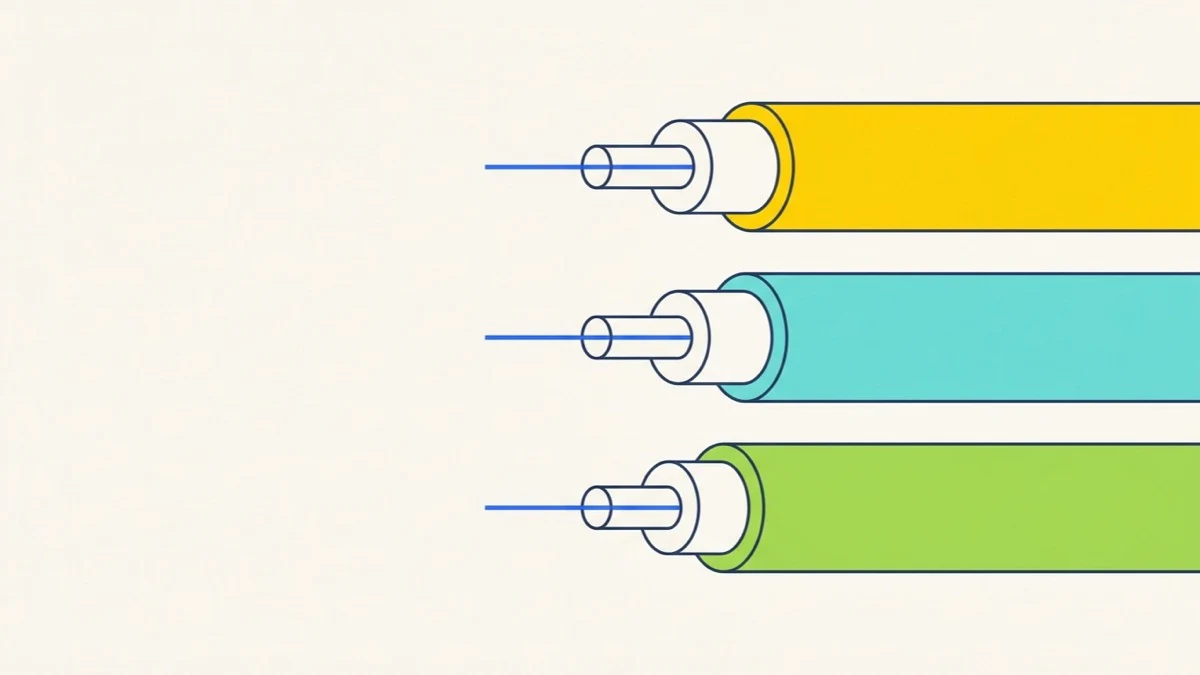
The three are not three grades of the same thing. Two of them are the same glass with different bandwidth guarantees; the third is a different transmission regime entirely.
OS2 is 9/125 µm single-mode fiber built to ITU-T G.652.D, attenuating at roughly 0.4 dB/km at 1310 and 1550 nm. Light travels one path, so there is no modal dispersion to run out of — reach is limited by attenuation and by the optics' link budget, not by the fiber's bandwidth. That's why single-mode reach barely moves as line rates climb.
OM4 is 50/125 µm laser-optimized multimode with 4700 MHz·km effective modal bandwidth at 850 nm. Many modes travel many paths, they arrive at slightly different times, and that spreading is what caps distance. Every time the industry doubles the line rate, the pulses get shorter and the same modal spread eats a larger fraction of them — so reach shrinks.
OM5 is the same 50 µm core, the same 4700 MHz·km at 850 nm, plus a second guarantee: 2470 MHz·km at 953 nm. That's the entire technical difference. TIA approved it as ANSI/TIA-492AAAE in June 2016 under the name wideband multimode fiber (Cabling Installation & Maintenance), specifically so short-wavelength division multiplexing could put four wavelengths down one pair instead of one.
So OM4 and OM5 are backward-compatible siblings — an OM5 link runs every OM4 application at OM4's numbers — and OS2 is a different animal. If you're still deciding between multimode grades rather than between multimode and single-mode, our OM3 vs OM4 comparison covers that fork in detail.
The spec sheet is where most comparisons stop. It's also where they stop being useful, because none of these numbers tell you what you can actually plug in.
The reach table nobody puts in one place
Ethernet reach isn't a property of fiber. It's a property of a specific optical application — 400GBASE-SR4.2, 800GBASE-DR8 — defined in IEEE 802.3 and published, per application, by the TIA Fiber Optics Technical Consortium. Below are nineteen of the twenty-two published multimode applications. The three left out are Gigabit-era (1000BASE-SX, 1000BASE-LX, 10GBASE-LX4), where OM4 and OM5 are also identical — 1000BASE-SX runs 1,100 m on both.
Application | OM3 | OM4 | OM5 |
|---|---|---|---|
10GBASE-SR | 300 m | 400 m | 400 m |
25GBASE-SR | 70 m | 100 m | 100 m |
40GBASE-SR4 | 100 m | 150 m | 150 m |
50GBASE-SR | 70 m | 100 m | 100 m |
100GBASE-SR4 | 70 m | 100 m | 100 m |
100GBASE-SR10 | 100 m | 150 m | 150 m |
100GBASE-SR2 | 70 m | 100 m | 100 m |
100GBASE-SR1 | 60 m | 100 m | 100 m |
100GBASE-VR1 | 30 m | 50 m | 50 m |
200GBASE-SR4 | 70 m | 100 m | 100 m |
200GBASE-SR2 | 60 m | 100 m | 100 m |
200GBASE-VR2 | 30 m | 50 m | 50 m |
400GBASE-SR8 | 70 m | 100 m | 100 m |
400GBASE-SR16 | 70 m | 100 m | 100 m |
400GBASE-SR4 | 60 m | 100 m | 100 m |
400GBASE-SR4.2 | 70 m | 100 m | 150 m |
400GBASE-VR4 | 30 m | 50 m | 50 m |
800GBASE-SR8 | 60 m | 100 m | 100 m |
800GBASE-VR8 | 30 m | 50 m | 50 m |
Read the OM4 and OM5 columns against each other. They are identical in eighteen of these nineteen rows, and in all three of the Gigabit-era applications not shown. Across the whole published set, OM5 out-reaches OM4 in exactly one application out of twenty-two.
Now the single-mode side — the short- and medium-reach applications that compete for the same links. (TIA lists 31 single-mode applications in total; most of the rest are long-haul variants no data hall needs.)
Application | Fiber | Reach | Defined in |
|---|---|---|---|
100GBASE-DR | OS2 | 500 m | 802.3cd-2018 |
400GBASE-DR4 | OS2 | 500 m | 802.3bs-2017 |
400GBASE-DR4-2 | OS2 | 2 km | 802.3df-2024 |
400GBASE-FR4 | OS2 | 2 km | 802.3cu-2021 |
400GBASE-LR4-6 | OS2 | 6 km | 802.3cu-2021 |
400GBASE-LR8 | OS2 | 10 km | 802.3bs-2017 |
800GBASE-DR8 | OS2 | 500 m | 802.3df-2024 |
800GBASE-DR8-2 | OS2 | 2 km | 802.3df-2024 |
Two patterns fall out immediately, and they're the two facts that should drive your design.
First, the OM5 premium buys nothing in twenty-one of the twenty-two multimode applications. Second, single-mode reach at 800G is the same 500 m it was at 100G, while multimode's best case dropped from 400 m to 100 m over the same span. For the multimode-side detail on where those numbers come from, we go deeper in how far OM4 multimode fiber can transmit.
OM5's advantage exists in exactly one application
The exception in that table is real, and it deserves a fair hearing before it gets dismissed.
400GBASE-SR4.2 is the one application built to use OM5's second window. Defined in IEEE Std 802.3cm-2020, it sends two wavelengths — 850 and 910 nm — down each of four fiber pairs, eight fibers total on an MPO. Its published operating range is 70 m on OM3, 100 m on OM4 and 150 m on OM5 (TIA FOTC). That's a genuine 50% reach gain, on a real standardized application, and it exists because OM5 guarantees bandwidth at 953 nm that OM4 doesn't.
If your building has a meaningful population of 400G links between 100 and 150 m, and you intend to buy SR4.2 modules, OM5 is the correct answer and this article is not going to argue you out of it.
There's a second point in OM5's favor that the IEEE table structurally cannot show, and it should be on the record. OM5 was designed for SWDM4, which is a multi-source agreement rather than an IEEE application — so it never appears in the tables above no matter how widely it ships. On SWDM4 the gap is real: 100G-SWDM4 runs 75 m on OM3, 100 m on OM4 and 150 m on OM5, a 50% gain on exactly the fiber OM5 was built for, and the 40G modules stretch further still. Anyone who tells you OM5 does nothing is only counting IEEE applications.
The catch is what happened next: SWDM4 stopped at 100G. There is no 400G or 800G SWDM4, so the one application family that fully exploits OM5's second window is now a generation behind the speeds being deployed. OM5's window didn't get wider — the traffic moved past it.
And the counter-case on the IEEE side is blunt. Leviton's Gary Bernstein, in Lightwave's 2017 survey of the OM5 debate: "The reach advantage of OM5 over OM4 is minimal," OM5 carries a cost premium while short-reach optics prices keep falling, and — the point that gets missed most — SWDM transmission can't be broken out into component lanes the way parallel fiber can. That interview predates 802.3cm, so it's fair to note it was written before SR4.2 existed; the breakout limitation it identifies hasn't changed at all. A 400G-SR8 or DR4 link on an 8- or 12-fiber MPO can be split into 4×100G to feed four switches. A wavelength-multiplexed link can't. In a leaf-spine fabric where breakout is how you get port economics, that limitation costs more than 50 m of reach is worth.
Our interest here should be on the table too: TTI Fiber's standard catalog runs OS2, OM3 and OM4, and OM5 trunks are build-to-order — so this verdict is one we have a commercial reason to reach. It's also the verdict the standards support, which is why the tables above are the argument and our catalog isn't.
So the honest scoring on OM5 is: technically legitimate, standardized, backward compatible with every OM4 application, genuinely better on SWDM4, and applicable to a slice of links narrow enough that most data centers never hit it. If you want the affirmative case for where each multimode grade earns its keep, we lay it out in applications of OM4 and OM5 fiber cables.
Multimode reach shrinks every generation. Your cable plant doesn't.
Line the multimode table up by generation and the trend is not subtle:
- 10GBASE-SR on OM4: 400 m
- 40GBASE-SR4 on OM4 (four 10G lanes): 150 m
- 100GBASE-SR4 on OM4 (four 25G lanes): 100 m
- 400GBASE-SR4 on OM4 (four 100G lanes): 100 m
- 800GBASE-VR8 on OM4: 50 m
Each doubling of lane rate shortens the pulse, and the same modal dispersion consumes more of it. There's no vendor conspiracy here — it's the physics of a 50 µm core, and it applies to OM5 identically.
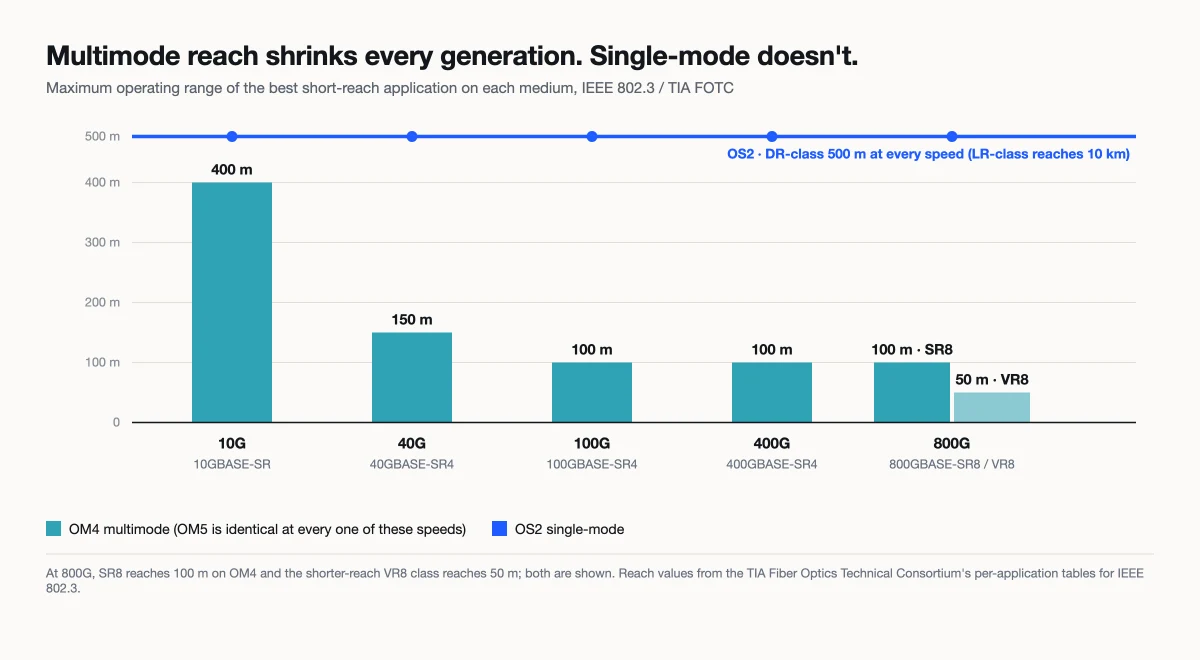
Single-mode over the same period: 500 m at 100GBASE-DR, 500 m at 400GBASE-DR4, 500 m at 800GBASE-DR8. Flat. When the industry wants more reach it adds a variant (DR4-2, FR4, LR4-6) rather than shortening the base one.
The next generation makes the divergence explicit, and it's worth reading the source documents rather than anyone's roadmap slide. The adopted objectives for IEEE P802.3dj — the 200 Gb/s-per-lane project covering 200G, 400G, 800G and 1.6T — list optical reach targets of 500 m, 2 km, 10 km, 20 km and 40 km. Every single one specifies SMF. The project contains no multimode objective at all.
Multimode at 200 Gb/s per lane was spun out into a separate task force, IEEE P802.3ds, whose objectives approved in November 2025 target 30 m and 50 m — at 200G, 400G, 800G and 1.6T alike. Put the two documents side by side and the next decade is already written down: single-mode is being specified out to 40 km, multimode is being specified to 50 m.
This is the part that turns a spec comparison into a design decision. A cable plant is a 10-to-15-year asset; optics turn over every 3–5. If you build a multimode plant sized to today's 100 m links, the same trays support 50 m links two generations from now. Whether that matters depends entirely on a number you can measure today: how many of your links are actually longer than 50 m?
In a single-row-of-racks deployment, almost none, and multimode is fine for a long time. Across a 2,000 m² hall with a spine at one end, plenty — and those are exactly the links that will need re-cabling.
Loss budget: where short links actually fail
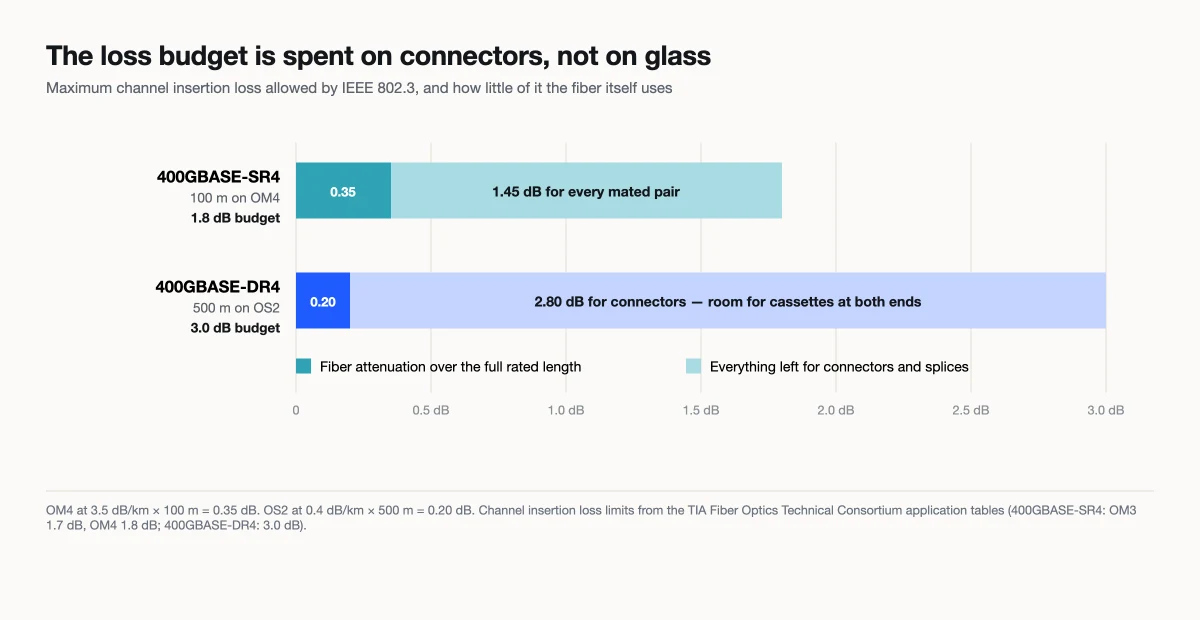
Reach tables assume a channel that meets its loss budget. In a data center — short links, lots of patching — the budget is spent on connectors, not glass, and this is where real deployments fail acceptance testing.
At 100 m of OM4, the fiber itself contributes at most about 0.35 dB. The published maximum channel insertion loss for 400GBASE-SR4 over OM4 is 1.8 dB (TIA FOTC) — so roughly 1.45 dB is left to be shared across every mated pair in the path. Two MPO cassettes and a pair of patch cords will use most of it. OM3 gets 1.7 dB, OM5 on SR4.2 gets 2.0 dB.
Single-mode short-reach is more forgiving on paper: 400GBASE-DR4 allows 3.0 dB of channel loss over its 500 m (TIA FOTC). More headroom, more patch points, more room for a structured design with cassettes at both ends.
Two traps hide in those numbers.
The OS1a trap. Not all single-mode is OS2. Inside-plant OS1a cable is specified at 1.0 dB/km at 1310 nm, against OS2's 0.4 dB/km (TIA FOTC). Run 400GBASE-DR4 over OS1a and TIA calculates the link tops out at 250 m instead of 500 m. Note what that figure is and isn't: IEEE doesn't specify an operating range for cabled fiber above 0.5 dB/km, so 250 m is TIA's planning calculation, not a published standard value. It's still the number to design to — and ordering "single-mode indoor cable" without naming the fiber class can halve your reach with nothing visibly wrong in the install.
Reflectance. Single-mode links at 1310 nm are reflectance-sensitive in a way multimode links are not, and short links are worse — the reflected light comes back to the laser before it has decayed. That's why serious single-mode data center plants use APC endfaces: an angled ferrule sends reflections into the cladding instead of back down the core. Our APC vs UPC comparison covers when the angled polish is worth the price difference. For the underlying arithmetic of what your link can afford, see what counts as a good dB loss.
Practical version: on multimode, count your connectors before you trust the reach table. On single-mode, specify the fiber class and the endface, or the reach table doesn't apply to you either.
What the link actually costs in 2026
The folk rule says single-mode optics cost three times what multimode optics cost. That rule was true, and it's the single most outdated input still driving media decisions.
Current third-party module pricing from FiberMall's May 2026 QSFP-DD price guide:
Module | Media | Third-party price |
|---|---|---|
400G SR8 | Multimode | $1,400 – $1,800 |
400G DR4 | Single-mode | ~$2,850 |
400G FR4 | Single-mode | $769 – $2,500 |
400G LR4 | Single-mode | $925 – $3,500 |
800G SR8 | Multimode | $3,500 – $5,000 |
800G DR8 | Single-mode | $4,000 – $6,000 |
At 400G the cheapest multimode module still beats the closest single-mode one — $1,400–1,800 for SR8 against roughly $2,850 for DR4, a spread of about 1.6–2×. At 800G that narrows to about 1.1–1.2×. And the ranges overlap: 400G FR4 starts at $769, below every SR8 quote in the table. Meanwhile the same guide lists the OEM price for that 400G SR8 at around $6,200 against $1,400–1,800 third-party. Your sourcing channel moves the per-port cost by roughly three and a half times; your media choice moves it by one to two. If a media decision is being justified on optics cost alone, that's the wrong variable to be optimizing.
Two more line items belong in the model. Fiber and connectivity are typically a small fraction of link cost at these speeds, so an OM5 premium over OM4 shows up as a rounding error next to the transceivers — which cuts both ways: it's cheap insurance if you'll use SR4.2, and dead weight if you won't. And power: HFCL puts 800G single-mode modules at 12–16 W per port against 16–20 W for multimode, which at thousands of ports is a cooling line item, not a footnote. (That's HFCL's figure, not a standards number — treat it as directional.)
Two things in multimode's favor never show up in a price table, and they're worth naming since they're why plenty of experienced teams still specify OM4 where OS2 would also work. Field termination and testing at 850 nm are more forgiving — cleanliness and reflectance discipline matter less than they do on single-mode, which shows up in labour hours and rework rather than in the BOM. And VCSELs are a mature, high-volume, physically simple light source. Neither advantage changes the reach arithmetic, but both belong in a total-cost conversation that a module price list can't capture.
Which means the decision comes back to geometry.
Choose by layer, not by preference
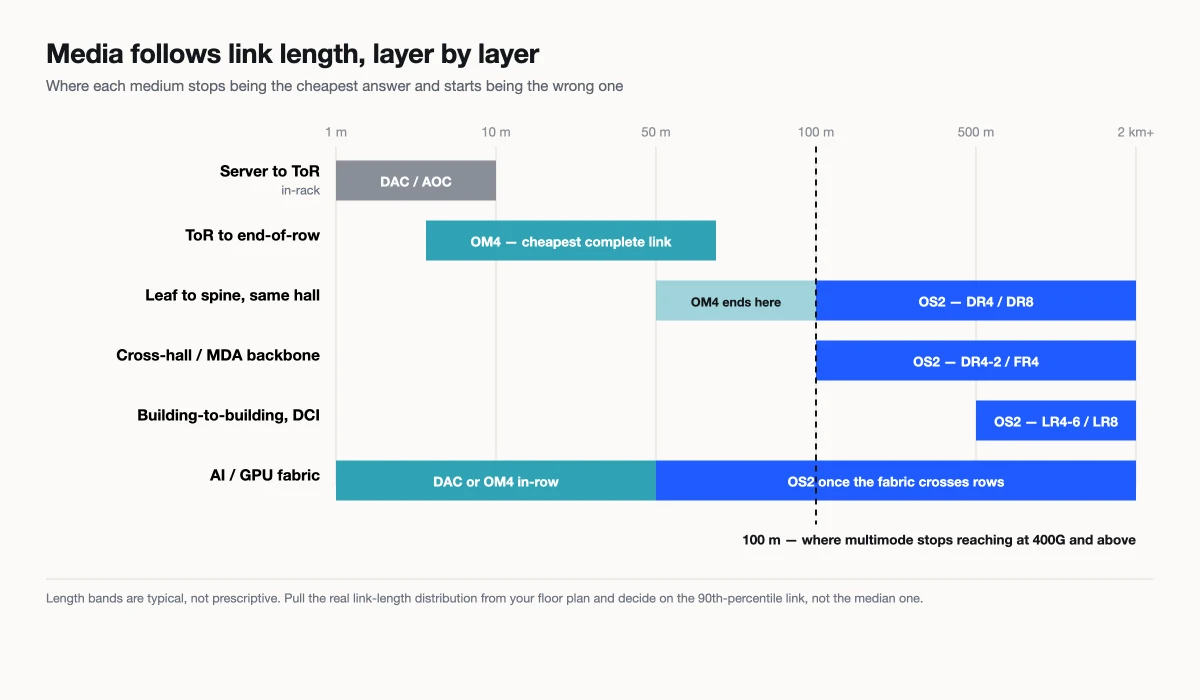
Media selection gets easy once you stop asking "which fiber is better" and start asking, layer by layer, how long the links are and how long they have to last.
Layer | Typical length | Specify | Why |
|---|---|---|---|
Server to ToR (in-rack) | 1–5 m | DAC/AOC, or OM4 | Below 30 m even VR-class optics work; copper is cheaper still |
ToR to end-of-row | 10–50 m | OM4 | Comfortably inside 800GBASE-VR8's 50 m; cheapest complete link |
Leaf to spine, same hall | 50–150 m | OS2 | Past 100 m, multimode needs SR4.2 + OM5 or it doesn't reach at 400G+ |
Cross-hall / MDA backbone | 150 m – 2 km | OS2 | No multimode application reaches; DR4/FR4 territory |
Building-to-building, DCI | 2 – 10 km+ | OS2 | LR4-6, LR8, coherent |
AI/GPU fabric, in-row | 3–50 m | OM4 or DAC | Short, extremely dense, cost-per-port dominated |
AI/GPU fabric, cross-row | 50 m+ | OS2 | Scale-out fabrics outgrow multimode reach quickly |
Two rules make this table portable to your site:
Measure before you choose. Pull the actual link-length distribution out of your floor plan, not the industry average. The decision hinges on the 90th percentile link, not the median one. HFCL notes the practical multimode/single-mode crossover has moved from around 100 m toward 40 m as speeds have climbed — worth knowing, but your building's geometry beats anyone's rule of thumb.
Hybrid is a legitimate answer. OM4 horizontal in the row, OS2 in the backbone is the mainstream design for a reason. Uniformity is a spares-and-training convenience, not an engineering requirement.
If you already have an OM3/OM4 plant
Most of these decisions are made in buildings that already contain fiber, which changes the question from "what's best" to "what do I add."
Mixing grades in a channel works, and performs to the worst fiber in it. Splice OM3 to OM4 and the channel behaves like OM3 — physically fine, but don't expect to buy back the difference. Mixing 50 µm and 62.5 µm cores in one channel is a different matter and creates real loss at the junction.
OM4 to OM5 is not an upgrade path worth ripping for. Since OM5 matches OM4 in every application except SR4.2, replacing working OM4 with OM5 buys you one transceiver option. Adding OM5 for a specific new SR4.2 deployment is defensible; wholesale replacement isn't.
Where OM4 is genuinely running out, add single-mode rather than more multimode. If the links that fail your reach check are the long ones, they're the ones that will fail again next generation. A parallel OS2 backbone alongside the existing OM4 horizontal is usually cheaper over ten years than re-pulling multimode twice.
Watch polarity when you extend. MPO trunks come in Type A/B/C polarity, and a plant extended with the wrong method produces links that test clean and pass no traffic.
Specifying it
Whichever way the geometry pushes you, the BOM is the same shape: trunks between distribution points, cassettes to break MPO out to LC, and cords at the equipment.
TTI Fiber builds that set in all three relevant media — MTP/MTP trunk cables in OS2, OM3 or OM4 from 12 to 72 fibers with A/B/C polarity and insertion loss of ≤0.35 dB (single-mode) or ≤0.30 dB (multimode), MPO/APC single-mode cords with ≥60 dB return loss for the reflectance-sensitive short single-mode links described above, and MPO/MTP cassettes at ≤0.35 dB per MPO interface. As flagged earlier, OM5 trunks are build-to-order rather than catalog stock.
Whatever you specify, ask for the per-connector insertion loss on the actual production units and check it against the budget in the loss-budget section above. On a 1.8 dB channel, catalog typicals and measured values are not the same number.
FAQ
Is OM5 better than OM4?
Only for 400GBASE-SR4.2, where it reaches 150 m instead of 100 m. In every other published IEEE application — 10G through 800G — OM5 and OM4 have identical operating ranges. OM5 is fully backward compatible, so it is never worse; it just usually isn't paid for.
What is the difference between OM4 and OS2?
Core size and everything that follows from it. OM4 is 50 µm multimode running 850 nm VCSELs, cheap optics, reach capped by modal dispersion and shrinking each generation. OS2 is 9 µm single-mode running 1310/1550 nm lasers, reach limited by attenuation, holding 500 m at 800G and extending to 10 km with LR-class optics.
Is OM5 backward compatible with OM4?
Yes. OM5 guarantees the same 4700 MHz·km effective modal bandwidth at 850 nm as OM4, so any OM4 application runs on OM5 at the same distance. You can patch OM5 into an OM4 channel; the channel just performs as OM4.
Which fiber should I use for 400G and 800G?
Under 100 m, OM4 with SR-class optics is the cheapest complete link. Over 100 m, OS2 with DR/FR-class optics is generally the only thing that reaches at all, and it will still reach at the next speed. At 800G the multimode ceiling is 100 m (SR8) or 50 m (VR8).
Is OS2 more expensive than OM4?
The cable usually isn't — single-mode glass is commonly cheaper per meter than laser-optimized multimode. Single-mode optics still cost more at the same generation, but by roughly 1.6–2× at 400G and 1.1–1.2× at 800G, not the 3× the old rule of thumb assumes — and the OEM-versus-third-party spread on the same module is larger than the gap between media.
Can I mix OM4 and OM5 in the same link?
Yes, and the link performs as OM4 — including on SR4.2, where an OM4 segment pulls the whole channel back to 100 m. Mixing is safe; it just doesn't deliver OM5's one advantage.
The bottom line
Choose media on the link-length distribution of the building you actually have, and on how many optics generations that plant has to survive.
If most of your links are short and you're buying VCSEL optics anyway, OM4 is still the cheapest complete link and will be for years. If your links run past 100 m, or the plant has to outlive two refreshes, OS2 is the only medium whose reach hasn't moved in three generations of Ethernet. And OM5 is a precise instrument for one application — worth specifying when you can name the SR4.2 modules that will use it, and hard to justify when you can't.
For the rest of the cabling decisions that follow from this one — MPO polarity, breakout, and the OM-grade fork — start from our data center cabling guides. If you're pricing a specific plant and want the loss numbers on real production units before you commit, talk to our engineering team with your link-length distribution in hand.