TIA-568 Standard Explained: Parts & Limits
If your specification says "cabling shall comply with TIA-568," it is pointing at a family of documents rather than one book — and the four numbers that drive most design decisions live in different parts of that family. TIA-568 is the ANSI-approved commercial building telecommunications cabling standard published by the Telecommunications Industry Association and developed by its TR-42 engineering committee. It is not a single document: the family splits by medium and by function, and the current commercial-building edition is ANSI/TIA-568.1-E, published in March 2020, with a March 2023 addendum that changes how wireless access points must be cabled. This guide maps the parts, the editions, and the limits — 90 m, 100 m, 55 m and 0.75 dB — onto the decisions you are actually making.
What TIA-568 Is, and Which Edition Is Current
TIA-568 covers the planning and installation of a structured cabling system in a commercial building, and TIA's own standard listing is the place to confirm the designation. Its structure is inherited from the generic cabling system described in TIA-568.0-E, and the performance numbers you specify come from two other parts of the same family: TIA-568.2-E for balanced twisted-pair copper — TIA released 568.2-E in November 2024, revising 568.2-D — and TIA-568.3-E for optical fiber. The commercial-building document itself was developed by the TIA TR-42.1 Premises Telecommunications Infrastructure Subcommittee and published in March 2020.
That date matters more than it looks. Two generations of projects are still being built from specifications that cite the 2009 (C) or 2015 (D) revision, and the requirements have moved. The 2020 edition of the commercial-building document added an environmental compatibility clause, reorganized the infrastructure clause to align with the generic document, and added a physical network security clause. Three years later, the March 2023 addendum (ANSI/TIA-568.1-E-1) went further: it recognized single twisted-pair cabling as a media type and set a floor of two Category 6A or higher cabling runs to every wireless access point. A Cat 5e drop to an access point is no longer a defensible design under the current edition, whatever the older drawings in the project folder show.
One thing to get straight before you quote the standard at a contractor: it is voluntary.
"The standards are voluntary. So, TIA is not the 'technical FDA' for example. There is no 'TIA jail' to go to if you break all the rules." — trueCABLE's technical explainer on the ANSI/TIA-568 series
Its force comes from being written into a tender, a contract, or a building code — which is exactly why the edition number in your document needs to be right. A supplier answering "we meet TIA-568" has told you almost nothing until you ask which part and which revision.
Why the Standard Answers to Three Different Names
Search a project archive and you will find the same standard under three designations: EIA/TIA-568, ANSI/TIA-568, and TIA-568. They are the same lineage after two changes of steward.
The first issue appeared in 1991 under the EIA/TIA prefix, when the Electronics Industries Alliance and the Telecommunications Industry Association published joint building-cabling standards. The document then received American National Standards Institute approval, adding the ANSI prefix, and the EIA eventually left the cabling field, leaving TIA as the publisher. The revision letters advanced with it: A in 1995, B in 2001, C in 2009, D in 2015, and the E generation in 2020 — Wikipedia's ANSI/TIA-568 entry tracks that sequence and cites the superseded editions against it.
Practically, all three prefixes still appear in live documents — "TIA 568", "TIA-568" and "ANSI/TIA-568" are used interchangeably in the same tender pack — and older texts routinely cite the longest form. Treat any "EIA/TIA-568-B" reference in a 2026 document as a signal that the specification has not been reviewed in two decades, and ask for the current edition in writing.
What Is Inside the TIA-568 Family
This is where most "what is TIA-568" answers stop short. The standard is partitioned so that each part owns one medium or one generic layer, and each part has its own revision letter — which is why "TIA-568-D" and "TIA-568.1-E" can both be correct in the same paragraph.
Part | What it governs | Edition seen in TIA's own documentation |
|---|---|---|
TIA-568.0 | Generic cabling system structure for customer premises | 568.0-E |
TIA-568.1 | Commercial building cabling: topology, subsystems, installation and transmission requirements | 568.1-E (March 2020), plus 568.1-E-1 (March 2023) |
TIA-568.2 | Performance and technical criteria for balanced twisted-pair (copper) cabling systems | 568.2-E (November 2024), revising 568.2-D |
TIA-568.3 | Performance and technical criteria for optical fiber cabling systems | 568.3-E |
TIA-568.5 | Single twisted-pair cabling, recognized as a media type by the 2023 addendum | 568.5 |
Two consequences follow from that table. First, a copper question and a fiber question have different answers inside the same standard — the loss budgets, the component specs and even the test methods come from different documents. Second, TIA-568 is not the whole picture for a project: spaces and pathways, administration and labeling, and grounding and bonding sit in adjacent documents in the same TIA cabling series, which we cover in the MDF and IDF distribution guide.
Edition History: What Changed From 568-B to the E Generation
If you have ever been handed a drawing set that cites 568-C and wondered what you are missing, this is the short version. The revision letters are not cosmetic — each generation changed what is recognized as a media type, and the E generation changed what is required at the endpoint.
Revision | Year | What a project manager needs from it |
|---|---|---|
Initial issue | 1991 | First joint EIA/TIA building cabling standard |
568-A | 1995 | Defined Categories 3, 4 and 5 for twisted-pair |
568-B | 2001 | The 90 m horizontal / 100 m channel framing most teams still quote |
568-C | 2009 | Major rewrite driven by fiber and higher-speed copper |
568-D | 2015 | Superseded C; the copper performance part settled at 568.2-D |
568-E | 2020 | Current generation: 568.0-E, 568.1-E, 568.3-E — with the copper part revised again as 568.2-E in November 2024 |
Inside the E generation, the changes that touch a bill of materials are the 2020 additions to the commercial-building document and the 2023 addendum. The 2020 edition reworked the infrastructure clause and introduced requirements for environmental compatibility and physical network security. The 2023 addendum changed the wireless access point rule and recognized single twisted-pair cabling.
The category list has moved as well. The current revision of the standard recognizes copper categories 5e (100 MHz), 6 (250 MHz), 6A (500 MHz) and 8 (2,000 MHz). Categories 7 and 7A were never officially recognized by TIA, so a "Cat 7" claim on a supplier datasheet is a marketing description rather than a TIA category.
How the Standard Organizes a Building Network
TIA-568 does not describe a product; it describes a shape. The cabling system is a hierarchical star: cabling subsystems branch out from central distribution points, so that any one link carries traffic for one area rather than acting as a shared path. The commercial-building document enumerates the pieces of that shape — entrance facilities, equipment rooms, telecommunications rooms and enclosures, backbone cabling, horizontal cabling, work area, coverage area, cabling installation requirements, grounding and bonding, pathways, firestopping and administration.
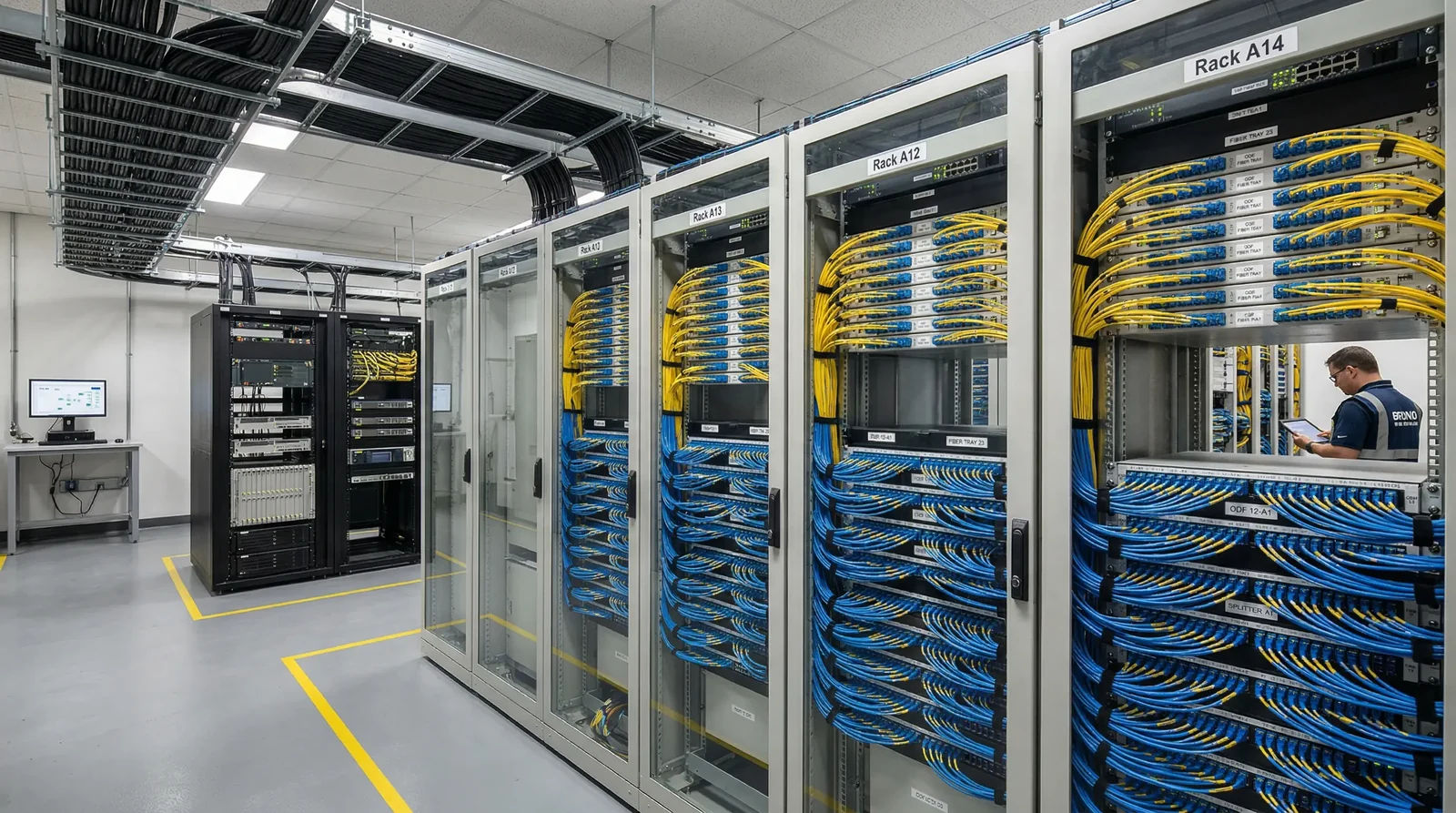
The endpoints matter as much as the rooms. A work area is where a horizontal run finishes — the outlet or consolidation point at the desk, plus the patch cords that join it to the device — and a patch panel is where the same run terminates at the telecommunications-room end, as the cross-connection point the installed length is measured to. Both ends sit inside the 100 m channel budget, which is why the standard treats patch cords as part of the channel rather than as an accessory.
The backbone side (the links between the entrance facility, the equipment room and each telecommunications room) and the horizontal side (the runs from a telecommunications room out to the work areas) are the two subsystems most projects argue about, and the standard splits them deliberately: the backbone can use almost any media over long distances, while horizontal cabling is bound by the length limit that copper imposes. That is why a building taller than a couple of floors ends up with fiber on the riser and copper on the floor. The enterprise structured cabling design hub collects the rest of that design sequence.
The single most quoted rule in TIA-568 sits on the horizontal side: a maximum of 90 m of installed horizontal twisted-pair cabling, with 100 m as the total length including patch cords. Wikipedia's Category 6 cable specification breaks that 100 m into its 90 m permanent link — the solid horizontal cable between two connection points — and the patch cords that finish the run. The superseded B revision went further, capping any single patch cord at 5 m. When someone tells you "copper reaches 100 meters," this is the rule they are simplifying: 10 meters of that budget belongs to the patch cords at both ends, and if you consume it, the installed link you are allowed to certify shrinks with it.
Copper Inside TIA-568: Categories and the Distance Rules
Copper is specified as 100-ohm balanced twisted-pair cabling terminated on 8-position modular connectors. Everything else in the copper part of the standard — the frequency rating, the pair twists, the shield options, the test limits — is there to keep that balanced transmission workable at the speeds you want. Category is the shorthand for how much bandwidth the cable and its connecting hardware can hold.
Category | Rated bandwidth | Where it fits today | 10GBASE-T distance |
|---|---|---|---|
Cat 5e | 100 MHz | Legacy horizontal cabling, voice and sub-gigabit links | Not supported |
Cat 6 | 250 MHz | Common horizontal cabling for gigabit access | Up to 55 m |
Cat 6A | 500 MHz | New horizontal cabling; the baseline the 2023 addendum assumes | Full 100 m channel |
Cat 8 | 2,000 MHz | Short links between switches and servers in a room | 24 m permanent link / 30 m channel at 25G and 40G; full 100 m channel at 10G and below |
Read that table as a set of traps rather than a shopping list. The Cat 6 figure is the one that catches projects: a Cat 6 cable carries 1 Gbps for the full 100 m, but 10GBASE-T over Cat 6 is limited to roughly 55 m, and Category 6A — with its tighter alien crosstalk specification — is what makes the full 100 m distance possible for 10-gigabit copper. Cat 8 goes the other way: Fluke Networks' Category 8 fact sheet records the same standard giving it 2,000 MHz of tested bandwidth while capping it at a 24 m permanent link and a 30 m channel — but those caps apply at the 25 and 40 Gigabit speeds the category was written for. The same cable carries 10GBASE-T and below over a full 100 m channel, so the short length limit only bites when you step up to 25G or 40G.
The installation rules are part of the compliance story, not housekeeping. trueCABLE's read-through of the standard's installation clauses is the most practical public summary of them: copper cabling destined for horizontal runs may use 22 to 24 AWG conductors, while patch cords may be 26 or 28 AWG. No more than 0.5 inch of untwist is permitted from the end of the jacket to the point of termination, and the recognized conductor color patterns are the T568A and T568B sequences — with the same pattern required at both ends of a segment. Bend radius is capped at four times the jacket diameter for unshielded cable and eight times for shielded construction. And the conductors themselves must be copper: copper-clad aluminum is not a permitted conductor under the electrical code, however the cable tests at the factory.
Fire performance is handled in the same breath as performance in most specifications, because a horizontal cable runs through ceilings and shafts that building codes control. Plenum-rated, riser-rated and low-smoke alternatives are not interchangeable, and how to choose between them is laid out in our jacket fire rating comparison.
Fiber Inside TIA-568: Loss, Bend Radius and Polarity
The optical fiber part of the standard is where cabling projects most often get their numbers wrong, because fiber budgets are built by addition and a single overstated connector value can consume the whole margin. The values below are the ones the fiber section of the standard sets as maxima, and the ones you should be testing against at handover; the Fiber Optic Association's summary of the fiber clauses is an accessible public reference for them.
Requirement | Limit | Notes |
|---|---|---|
Connector mating loss | 0.75 dB maximum | Applies to multimode at 850/1300 nm and singlemode at 1310/1550 nm |
Optical return loss | 20 dB multimode, 26 dB singlemode | 55 dB for analog CATV transport |
Splice loss | 0.3 dB maximum | Fusion or mechanical splices, multimode and singlemode |
Bend radius, premises cable | 10× cable outer diameter unloaded, 15× under rated tension | Horizontal cables of 2–4 fibers: 25 mm installed, 50 mm while pulling |
Connector interface | Any design with a FOCIS intermateability document | LC replaced SC as the worked example in later revisions |
The 0.75 dB connector maximum is deliberately generous, and it is worth understanding why before you copy it into a budget as your expected loss. It is set high enough to cover field-installable and array connectors, whose measured loss includes a splice, and high enough to cover the alignment tolerance of an MPO with a dozen fibers behind it. For design purposes, the Fiber Optic Association recommends budgeting under 0.3 dB for factory patch-cord connectors and under 0.5 dB for splice-on connectors. If your acceptance test shows a mated pair losing anywhere near the standard's ceiling, something in the termination is wrong, not merely compliant.
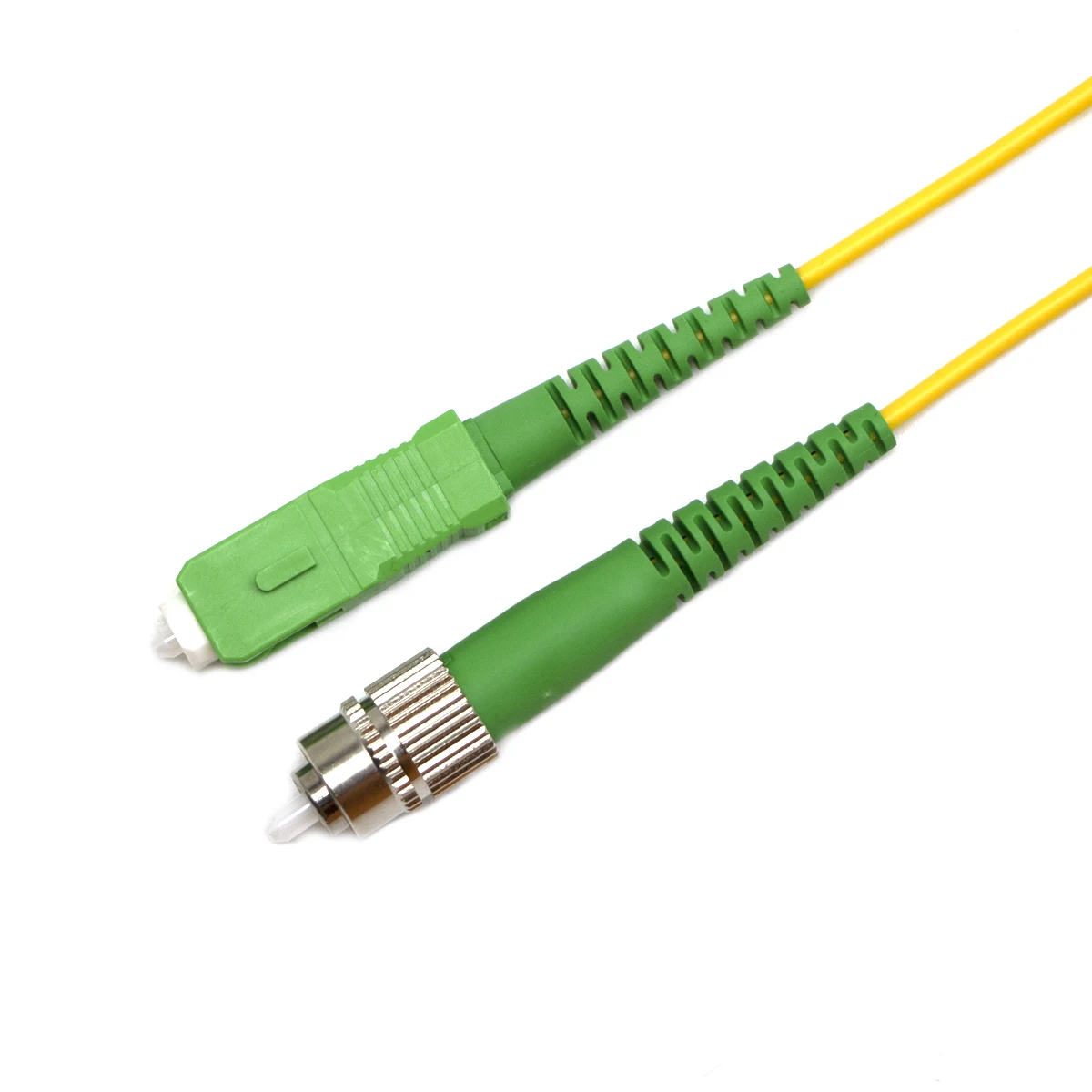
Color coding is part of the same document family and is not decorative: multimode connectors are aqua for OM3 and OM4 and lime green for OM5, while singlemode connectors are blue for UPC and green for angled physical contact. The older multimode designations — beige for OM1, black for OM2 — still describe the hardware you will find in service, but the current fiber edition moved them out of the body of the standard and into an annex of grandfathered specifications. Cabled fiber performance is specified per type and wavelength — at 850 nm the standard's tables allow 3.5 dB/km for 50/125 µm multimode with bandwidth of 500 MHz·km for OM2, 2,000 MHz·km for OM3 and 4,700 MHz·km for OM4.
Polarity is the part of the fiber document that surprises people who have not built an MPO link before. Duplex connectors are keyed and always wired as a crossover — position A on one end meets position B on the other — and for multi-fiber array connectors the standard defines several polarity methods, which the Fiber Optic Association describes as consuming roughly half the pages of the fiber document. If cassettes and trunk cables on the same link follow different methods, the link simply will not light up; the fix is at the design stage, not at commissioning.
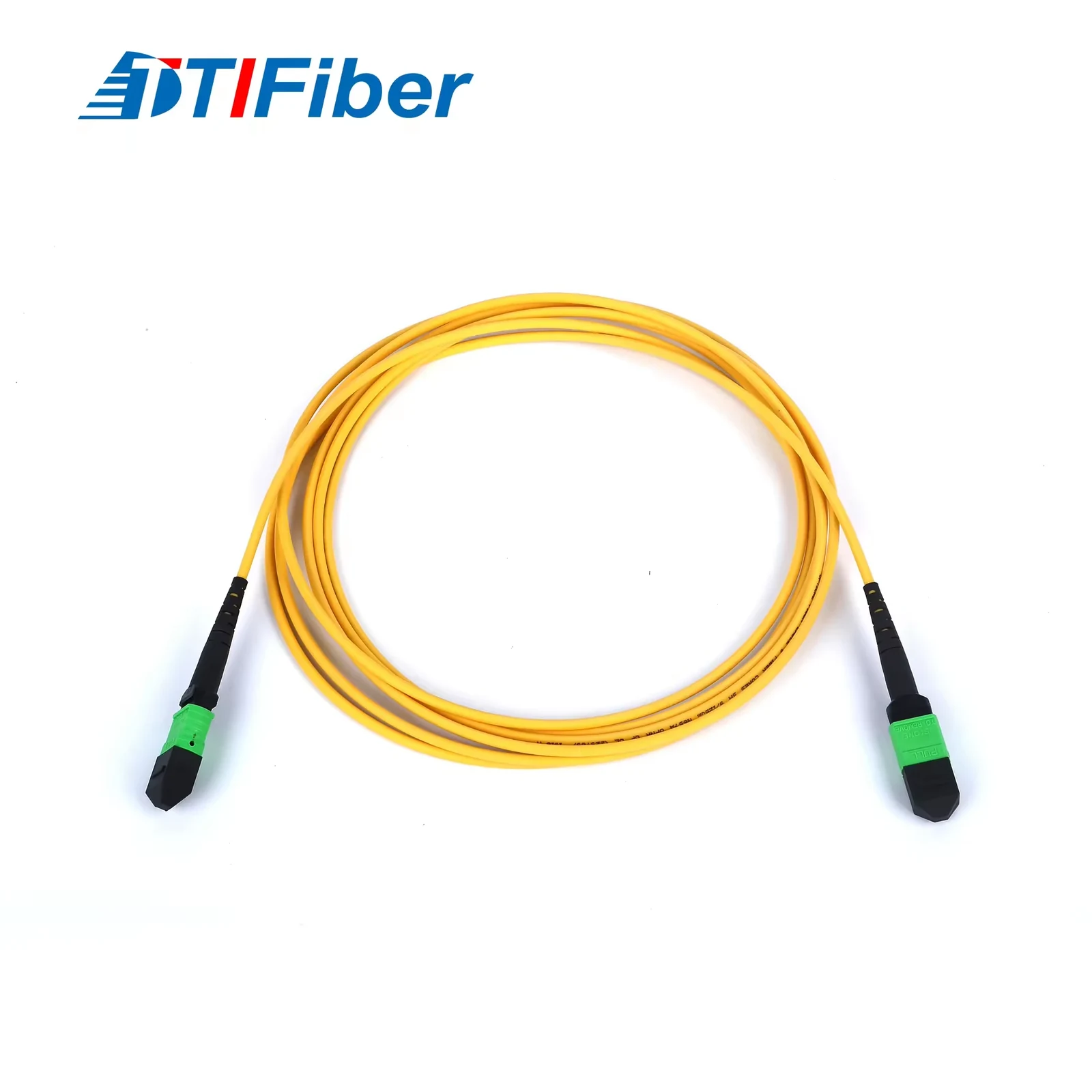
For a link that has to survive an OTDR and a loss budget audit, start with the budget: our fiber link loss budget walkthrough shows how the connector, splice and fiber contributions add up against a transceiver's tolerance.
T568A vs T568B: What the Standard Actually Says
Both T568A and T568B are recognized conductor color patterns under the copper part of the standard, and the direct answer to "which should I use" is that either will carry the same traffic at the same performance — the difference is the order in which two pairs land on the connector.
In T568A the green pair terminates on pins 1 and 2 and the orange pair on pins 3 and 6; in T568B the two are swapped. Every other pair goes to the same pins in both. Fluke Networks' comparison of the two wiring codes sets out the detail: T568A is the preferred pattern in the standard because it is backward compatible with both one-pair and two-pair USOC wiring, and wiring done under U.S. federal contracts is required to use it. T568B matches the older AT&T 258A color code and is the more widely used pattern in North American commercial work. What the standard enforces absolutely is consistency: a segment wired to one pattern at one end and the other at the far end is a fault, and the two schemes must never be mixed inside one network.
Where TIA-568 Sits Among Cabling Standards
TIA-568 is the North American cabling standard, and ISO/IEC 11801 is its international counterpart; the two are similar in structure but not identical, which is why a product tested to one is not automatically certified to the other. European projects add a regulation layer on top: the Construction Products Regulation assigns cable a fire-performance class, which is a legal requirement rather than an industry standard and follows different logic entirely. Our CPR class guide unpacks that system.
Inside the TIA family, TIA-568 sits alongside space and pathway standards, administration and labeling standards, grounding and bonding standards, and the data-center standard (TIA-942), which is why a data-center cabling specification cites several numbers at once. Vendor reference libraries such as CommScope's TIA standards page collect the same set in one place when you need to check a designation.
The practical point is that these are performance standards, not product certifications. Nobody inspects compliance into existence. What makes a cabling system "TIA-568 compliant" is that somebody tested it to the relevant part of the standard and recorded the result — which moves the question from the standard to the evidence.
What to Ask Your Supplier For
Ask for the revision, not the brand. Five questions separate a supplier who can support a specification from one who is answering with a catalog page.
Which part and which revision was the product tested to? For copper that means the performance part of the standard and the category; for fiber it means the fiber part and the fiber type. "Meets TIA-568" without a part number is not an answer.
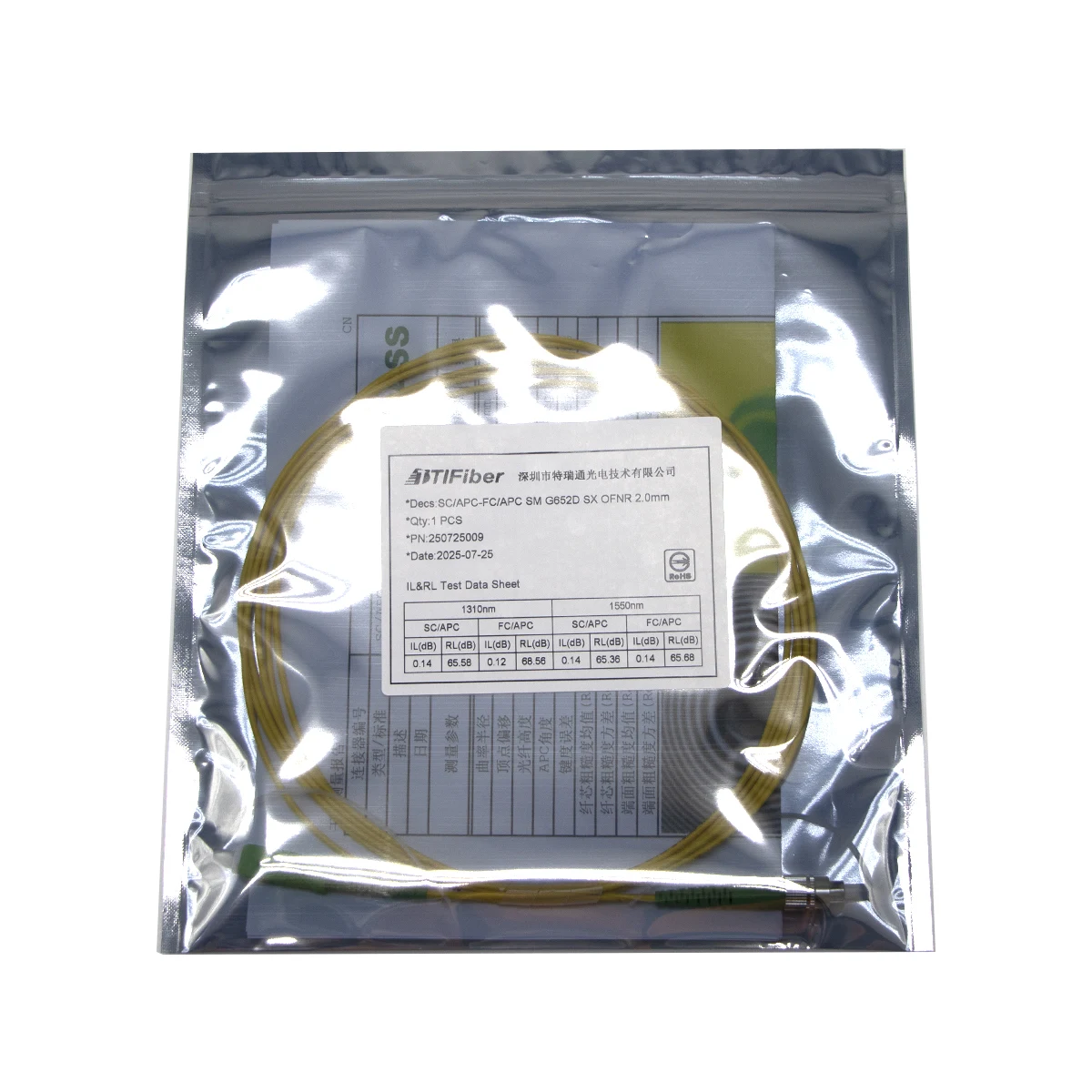
Can you give me per-unit test data? Insertion loss and return loss measured on the units you are shipping, not a typical-value table. Factory patch cords that ship with their own measured test record are the fastest way to close out an acceptance test, because the data arrives with the hardware — the unit below ships with a printed IL/RL sheet reporting 0.14 dB insertion loss and better than 65 dB return loss at both 1310 nm and 1550 nm.
Is the product tested as a component or as a link? Component compliance and channel performance are different claims. A cable, a connector and a cassette can each pass on their own and still fail as an installed channel.
Which test configuration applies at handover? Permanent link and channel are different test setups with different limits, and the difference decides whether the patch cords are inside the certified scope. Category 8 installations are verified from 1 MHz to 2,000 MHz, which is why the test head you own may not be the test head this job needs.
Which codes and certifications sit outside the standard? Fire rating and conductor material are code matters; CE, RoHS and CPR class are market-access matters. They are not part of TIA-568, and a supplier who treats them interchangeably is telling you something about the rest of their data. If you want a method for checking what actually arrives in a supplier's evidence pack, our guide to vetting a supplier certificate pack walks through it document by document. Products built for these structured cabling systems — fiber patch panels and fiber patch cords among them — should arrive with that evidence attached.
TIA-568 FAQ
What is the current TIA-568 edition? For commercial buildings, ANSI/TIA-568.1-E, published in March 2020, plus the ANSI/TIA-568.1-E-1 addendum of March 2023. The generic structure is at 568.0-E, copper performance at 568.2-E (released November 2024, revising 568.2-D), and optical fiber at 568.3-E.
What cable types does TIA-568 recognize? Balanced twisted-pair copper in categories 5e, 6, 6A and 8, optical fiber including multimode OM1 to OM5 and single-mode OS1/OS2, and — since the 2023 addendum — single twisted-pair cabling under TIA-568.5. Categories 7 and 7A are not TIA categories.
What is the TIA standard for fiber optic cable? The optical fiber part of the family, currently 568.3-E, in combination with the commercial-building document that places fiber in the backbone and horizontal subsystems. It is the part that sets the 0.75 dB connector maximum and the 0.3 dB splice maximum.
Should I use T568A or T568B? Either, as long as the whole site is consistent. T568A is the preferred pattern and is required under U.S. federal contracts; T568B is the more common commercial practice in North America. The two cannot be mixed within a network.
Are TIA-568 standards mandatory? No. They are voluntary industry standards. They become binding when a specification, contract or building code requires compliance, and the enforceable part is the test result rather than the standard itself.
Bottom Line
Three red lines are worth copying into your next specification. Horizontal copper: 90 m installed, 100 m total including patch cords. Copper categories: plan Cat 6A for anything new, and check the 10GBASE-T distance before you assume Cat 6 spans the run. Fiber: 0.75 dB is the standard's connector maximum, not a design target — budget under 0.3 dB for factory-terminated connectors.
The rest is a matter of citing the right part and the right edition. If your project is specifying fiber and copper components for a building or campus and you want a second pair of eyes on the bill of materials against the current edition, talk to our engineers — that is the stage where a manufacturer's input saves the most money.