IP67 vs IP68 Industrial Fiber Connectors
Put an IP67 connector and an IP68 connector side by side on the bench and the datasheets look almost interchangeable. Both are dust-tight. Both survived an immersion test. The difference is not one rung on a ladder. IP67 comes with a test condition you can copy straight into a purchase order; IP68 comes with a condition the manufacturer and the buyer are supposed to agree between themselves. That asymmetry — not the digit — is what decides how you specify IP67 vs IP68 connectors on a factory floor, in a mine, at a substation or on an outdoor cabinet. It is also the part most comparison pages leave out. This guide stays on the industrial fiber-optic side of the question, and it sits inside our wider library on fiber for harsh industrial environments.
If you came looking for what an IP68 rating means, the short version is in the next two sections. The answer only becomes useful once it is attached to a specific part, in a specific mounting state, doing a specific job.
IP67 vs IP68 Connectors: The Difference in One Table
Both ratings share their first digit, so the dust claim is identical. Everything that separates them sits in the second digit and in how that test condition is defined.
IP67 | IP68 | |
|---|---|---|
First digit (solids) | 6 — dust-tight | 6 — dust-tight |
Second digit (water) | 7 — temporary immersion | 8 — continuous immersion |
Test condition in IEC 60529 | Fixed by the standard: for enclosures under 850 mm tall the lowest point sits 1,000 mm below the surface, 30 minutes; for taller enclosures the highest point sits 150 mm below the surface | Agreed between manufacturer and user, and it must be more severe than the IPX7 condition |
What it proves | The seal held during a test anyone can repeat | The seal held during whatever condition the maker declared — if that condition is written down |
What it does not prove | Jet resistance, corrosion, chemicals, impact, temperature cycling | The same list, plus it says nothing about a depth or duration the specification never names |
Can you write it into an RFQ as it stands? | Yes — cite the standard and the condition | Not until depth or pressure, duration, water temperature and sample configuration are named |
Read the third row twice. IP67 is a specification. IP68 is a slot in a specification that somebody has to fill.
What the Two Immersion Tests Actually Are
The IP code comes from IEC 60529, the standard the IEC itself points to when it explains the scheme: the first numeral grades protection against solid objects on a scale from 0 to 6, where 6 means no ingress of dust, and the second grades protection against liquids from 0 to 9, where 9 covers high-pressure hot water from different angles (IEC's own IP ratings explainer). The standard is IEC 60529, consolidated with its 1999 and 2013 amendments.
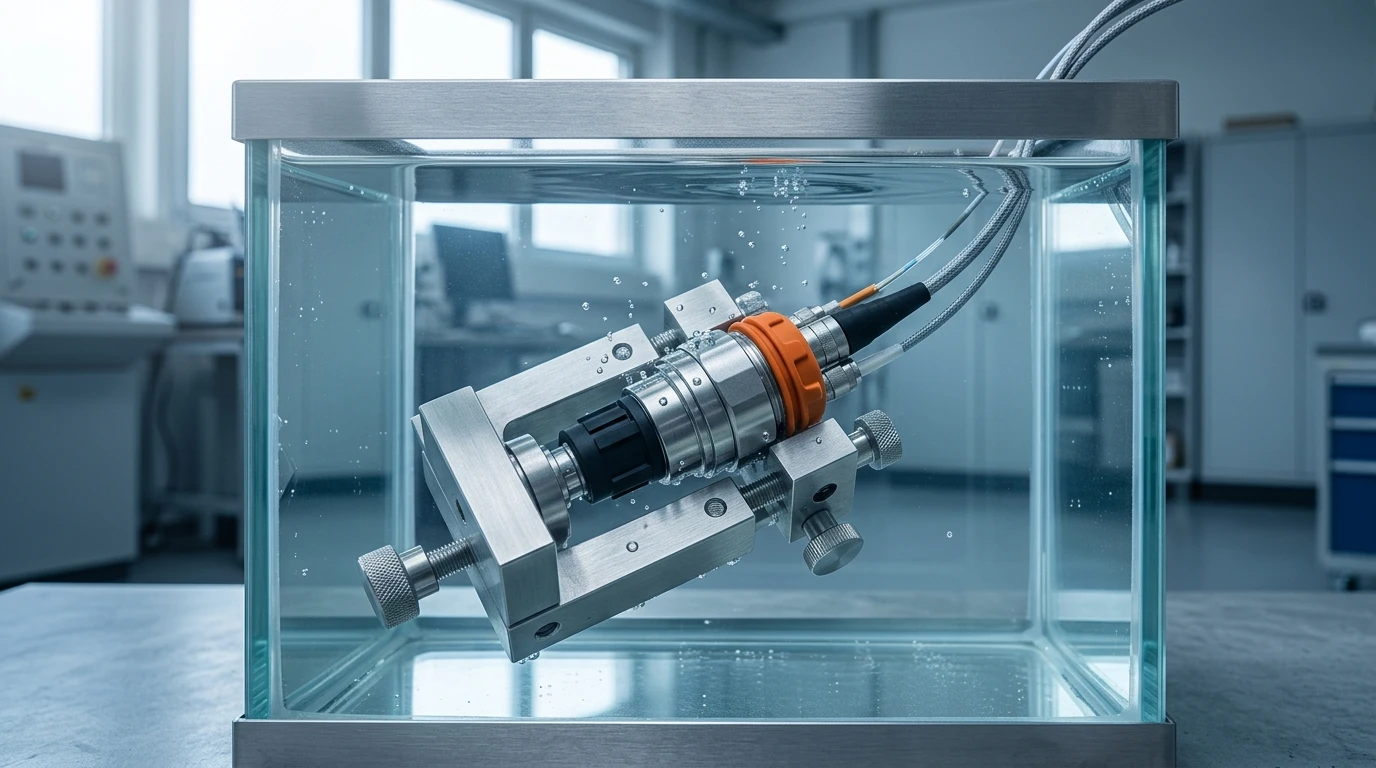
Numeral 7 is the temporary-immersion test. As independent test houses describe the clause, an enclosure shorter than 850 mm is immersed with its lowest point 1,000 mm under the surface for 30 minutes; an enclosure 850 mm or taller is immersed with its highest point 150 mm under the surface for the same duration (IPX7 and IPX8 immersion testing). That is where the familiar "1 meter for 30 minutes" comes from, and it is why the number you will see quoted as IP67's condition is not a marketing choice — it is a fixed target.
Numeral 8 is not that test made deeper. It is a continuous-immersion test whose depth, duration and water conditions are set for the product and must be more severe than the numeral-7 condition. Nothing in the standard fixes them for you. Two connectors can both say IP68 while one was proven at a shallow dunk for half an hour and the other against a head of water for days.
The sentence worth remembering: the digit tells you which test method was used, and only the declared condition tells you how hard the test was.
Two traps follow from the same structure. First, water jets are tested under numerals 5 and 6, not 7 and 8, and the failure mode is different — a moving jet against a static seal is not the same stress as standing water at depth (how IP rating testing works). A connector rated IP68 on immersion alone has not been shown to survive a hose-down, and an IP66 connector has not been shown to survive immersion. If your cleaning regime does both, you need both claims, tested separately. Second, high-pressure hot-water cleaning is numeral 9 territory — the IP69K marking on washdown-rated parts — and it too is a jet rating rather than an immersion one.
When the Higher Number Is the Weaker Specification
Here is the practical consequence of a fixed test versus a floating one. An IP67 purchase line is self-enforcing: the specification names the standard and the condition, the supplier tests against it, and if the connector fills with water you have a claim. An IP68 purchase line without a declared condition is a promise to try harder. It tells you the supplier ran some immersion test, and nothing about whether that test resembles your sump.
That is not a reason to avoid IP68. It is a reason to treat the rating as a form to complete rather than a checkbox. The engineering question behind IP67 vs IP68 connectors is therefore not "which is better" but "which stress am I actually buying protection against, and which of the two ratings lets me name it."
Compare the same marking across product categories and the point sharpens. On a phone, IP68 is a claim about an accidental dunk, argued entirely through the declared condition printed in the manual. On a connector bolted into a pump chamber, the same two digits stand between a dry joint and a flooded duct. Identical label, wildly different consequence, and in both cases the digits alone decide nothing.
It also pays to remember what the IP scheme is not. NEMA's enclosure standard adds tests the IP code does not run at all — corrosion, rust, icing, oil and coolants among them — and NEMA states plainly that its enclosure type numbers cannot be exactly equated with IEC 60529 designations, because the tests and evaluations behind the two schemes are not identical (NEMA's enclosure type definitions). So on a quay, in a tunnel or inside a food plant, an IP68 line on the datasheet may be silent about the very stress that ends the connector's life. If your site has a substance that eats jackets or attacks seals, it needs its own line in the specification. The same discipline applies to sealed closures and joint boxes, which is why our guide to choosing an IP68 fiber splice closure treats the declared conditions as the deciding column rather than the star rating.
What the IP Code Ignores — and What Actually Kills Fiber Connectors
An IP test asks one question: did dust or water get in? It does not ask what the ingress did afterwards, and in a fiber-optic connector that second question is where the money is. Water that reaches an electrical contact causes a fault you can see. Water, dust or dried cleaning residue that reaches a ferrule end face causes a fault you measure — insertion loss climbs, return loss collapses, and the link budget that looked comfortable at commissioning starts failing at the far end of the run.
The optical acceptance criterion is the part to insist on. IEC 61753-1 defines the performance categories and test severities for passive fiber-optic components — including a category for industrial environments, and separate treatment for hardened and field-mountable connectors — and its criterion for a connector is a bounded change in attenuation from the value measured before the test, not merely a dry interior (IEC 61753-1:2018 with amendment 1). A connector that kept the water out and drifted 0.5 dB has not passed.
Rank the stressors as they actually arrive in the field, and the IP digits cover surprisingly few of them:
Stressor | Does IP67 or IP68 test it? | What it does to a fiber connector |
|---|---|---|
End-face contamination at mating | No | The failure a rating never addresses; raises insertion loss and ruins return loss |
Temperature cycling with condensation | No — IEC 60529 excludes condensation and temperature cycling from its own scope; the immersion test only fixes the water-to-specimen temperature difference at the start (5 K) | Moist air trapped in the shell condenses on the first cold night; seals relax |
Chemicals, oils and coolants | No | Swells or hardens the seal elastomer, attacks the jacket |
UV and salt exposure | No | Seal degradation, jacket chalking, corrosion of metal shells |
Cable pull, bend radius, strain relief | No | Crushes the fiber, opens a path at the gland |
Repeated mating and re-termination | No | Each re-mate risks dragging contamination in and compressing the seal again |
The first row is the one no rating can cover. A perfect IP68 shell protects an end face that was already contaminated when it was plugged in — and because the shell is sealed, that contamination now sits in a humid microclimate. This is why end-face inspection before mating matters more than the rating on the box, and why we treat optical interfaces and their cleaning as an installation step rather than an accessory. The cable side carries the same lesson: strain relief, gland sizing and armor selection are what keep mechanical load off the ferrule, which is covered in more depth in our industrial fiber-optic cable guide.
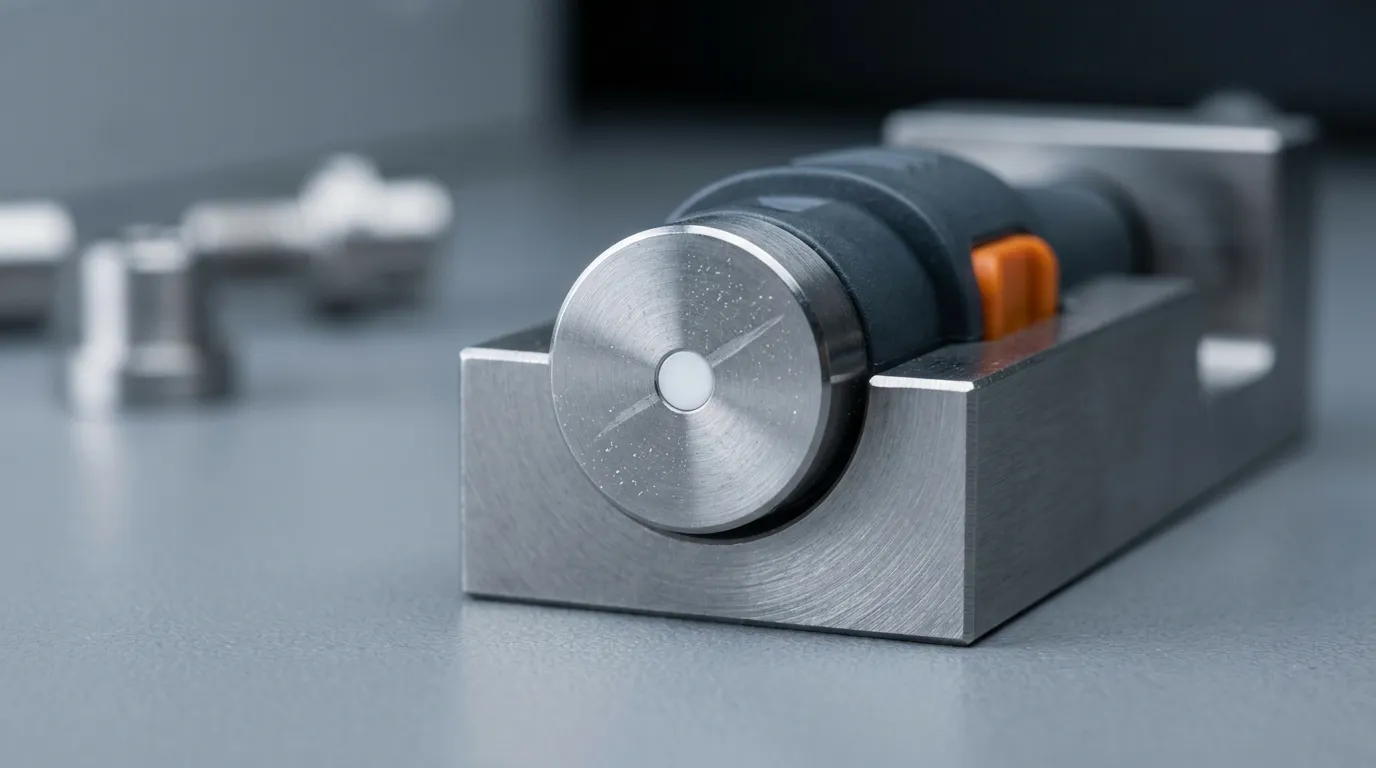
Salt deserves its own line in that list. Seawater and de-icing salt attack the metal shell and the seal elastomer long before they reach the fiber, and corrosion is outside the scope of IEC 60529 entirely — it is one of the characteristics NEMA tests and the IP code does not. A quay, a coastal cabinet or a snow-belt roadside enclosure therefore needs a corrosion requirement and, usually, a shell material chosen for it, on top of whatever ingress figure it carries.
One boundary is worth stating before it gets confused with the rating: hazardous-area approval is a separate scheme from ingress protection. An IP68 connector is not an Ex-approved component, and no IP digit substitutes for hazardous-area certification.
Mated or Unmated: Where the Rating Disappears
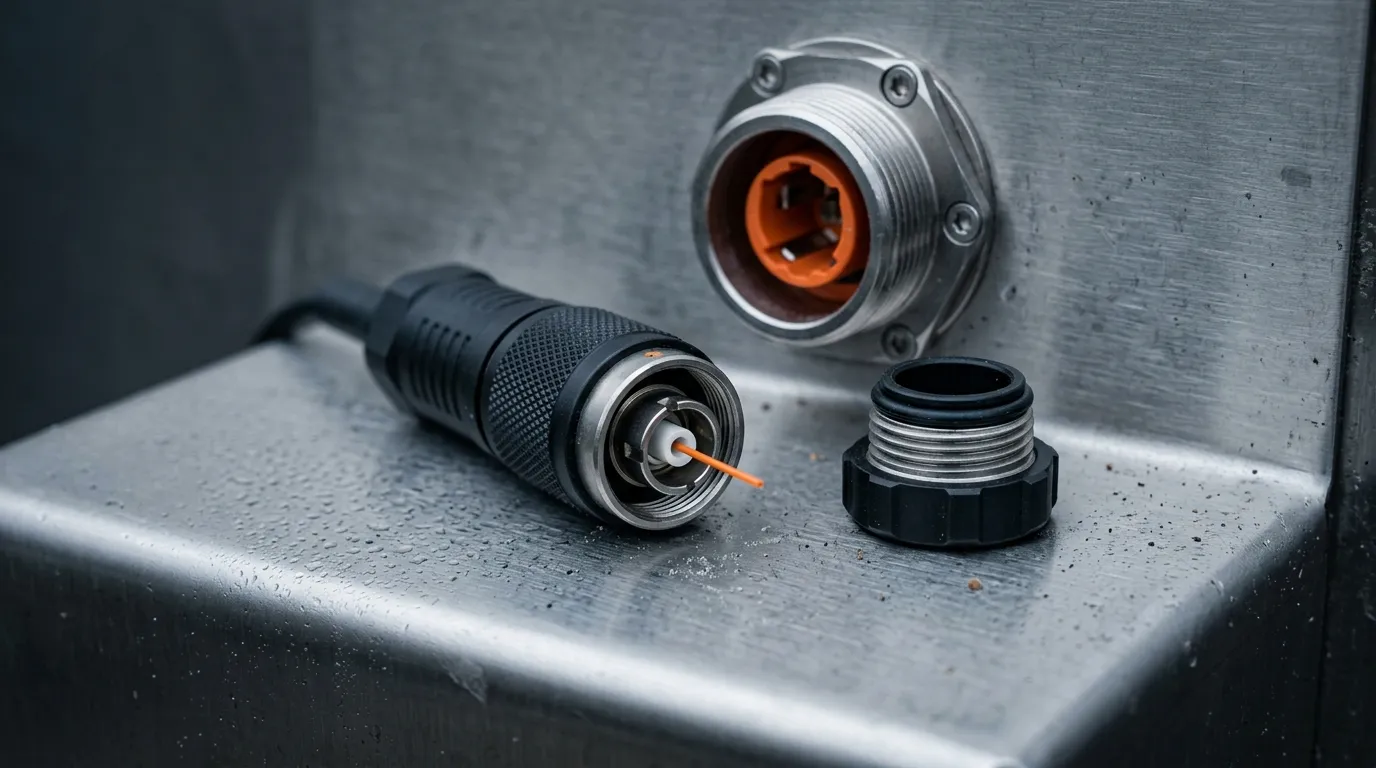
Every IP claim on a connector is a claim about a mated pair, in the mounting orientation the manufacturer states. Unplug it and the claim stops. An open bulkhead adapter, a dangling connector at the end of a tray, or a face that will not be mated until next month are all outside the rating, which is why protective caps are part of the sealing strategy and not packaging. Losing a cap destroys the rating just as effectively as cracking an O-ring.
The seal is also a system rather than a part. Four separate interfaces have to hold at once: the connector shell to the bulkhead, the plug to the receptacle, the gland to the shell, and the gland to the cable jacket. A gland sized for the wrong jacket outside diameter, an over-tightened gland that deforms the jacket, or a jacket cut back too far each opens a path that the connector's own test never saw, because the test was run on a connector and your installation is a connector plus a cable. Mating torque belongs on the same list: too little and the interface seal never compresses, too much and you crush it or distort the shell. Cycle count belongs there too — IEC 61753-1 fixes mating durability for connectors in its controlled, outdoor-protected and industrial categories at 200 mating cycles where the ferrule is cylindrical and 50 where it is rectangular, which is a concrete number to hold a supplier's durability claim against.
Interface standards matter here too, and they are not interchangeable. IEC 61076-2-101 is the detail specification for M12 screw-locking circular connectors, the default sealed interface across industrial networks (IEC 61076-2-101:2024) — but M12 is a copper interface. Fiber uses its own optical interfaces, an LC, SC or MPO/MTP ferrule inside a hardened outer shell, and the two lines of specification answer different questions. An IP68 shell says nothing about how sensitive the optical interface inside it is to a fingerprint. If you are still matching interfaces to the environment, our overview of fiber-optic connector types covers the families and their field behavior.
A small warning that saves expensive mistakes: dielectric grease is a remedy for wet copper contacts. On an optical end face it is contamination, and it will cost you more insertion loss than the water it was meant to keep out.
How to Specify IP67 vs IP68, and How to Verify It
Start from the deployment, not the datasheet. Four situations cover most industrial fiber work, and each one points at a different question.
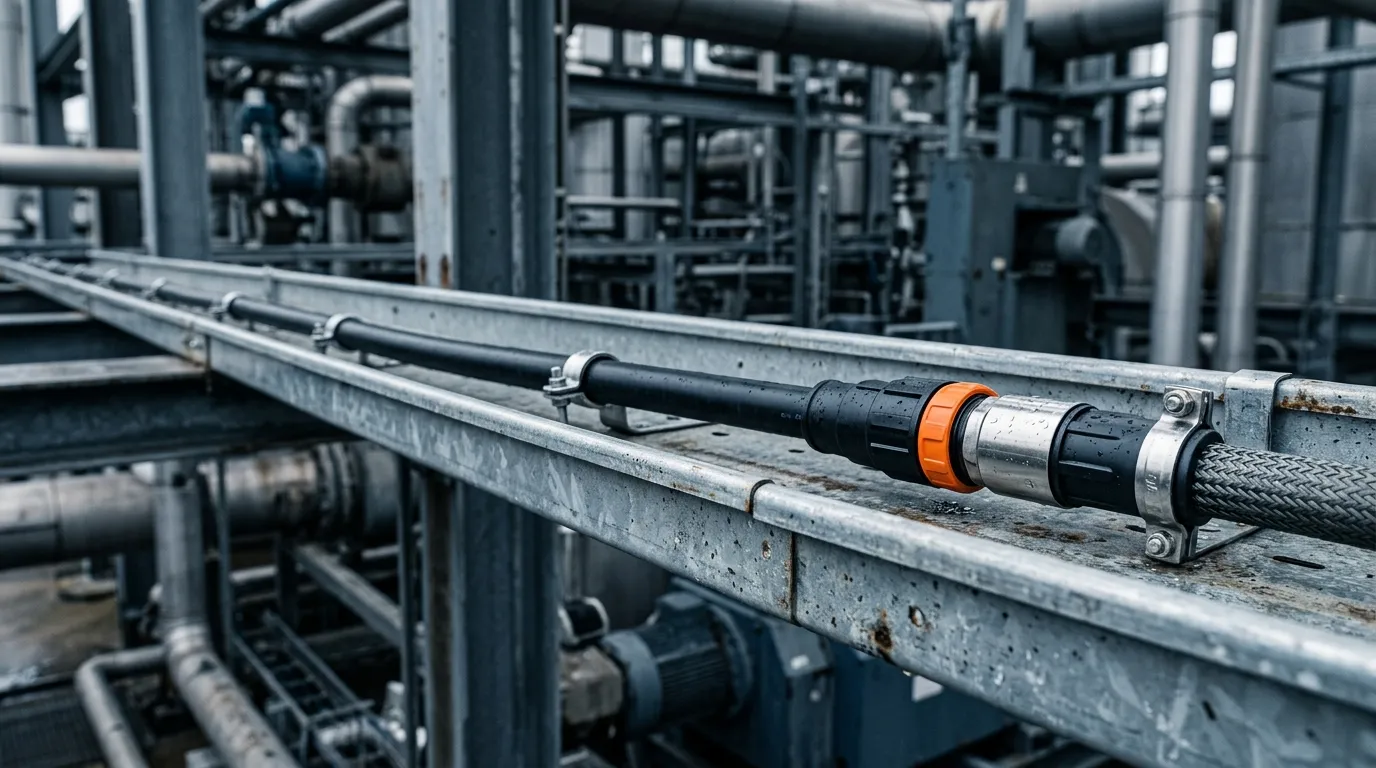
- Rain, snow, outdoor cabinets, aerial tray, ducted buried routes. IP67 is the right base claim, paired with a UV-stable jacket and a correctly sized gland; add armor where mechanical damage is likely. This is the mainstream outside-plant case, and our substation fiber-optic cabling guide walks through how the routing decides the construction.
- Plant hose-down and washdown spray. IP66 is the rating that covers jets. An IP67 or IP68 connector that was never tested against a jet is not a substitute, and high-pressure hot-water cleaning adds the numeral-9 case on top.
- Continuous immersion or pressure cycling — sumps, lift stations, manholes, flooded vaults, tank sides. This is the genuine IP68 case, and it is only real if the declared condition matches your water. Dust and water are the shallow part of mining duty too; mining fiber-optic cable adds abrasion, impact and standing water in the same deployment.
- Hot, humid interiors that cycle — substation buildings, tunnels, kilns. The enemy is condensation rather than immersion, so the question is how the design manages a trapped volume of moist air, not how deep it can go.
Then write the fields into the specification, because a supplier cannot answer a question you did not ask:
- The standard and its edition — for example IEC 60529:1989 with amendments 1:1999 and 2:2013.
- The state being rated: mated or unmated, and in which mounting orientation.
- The declared depth, or the equivalent pressure.
- The duration.
- The water temperature, and the permitted difference between the water and the specimen at the start of the test.
- The sample configuration — connector alone, or assembled with the cable, gland and intended jacket.
- The acceptance criterion after the test, stated optically: the permitted change in insertion loss and return loss.
- Whether the result comes from a type test on samples or from production testing of every unit, and whether the test report is available.
That last pair is where most specifications quietly fail. A type test on a handful of samples proves a design; it does not prove the unit in your hand, and the difference matters when the seal is assembled by hand torque on site. Ask which one you are buying, and ask for the report — a declared condition with no document behind it is a sentence, not evidence. For accessories such as glands, seals and caps, insist on the accessory's own environmental rating rather than letting it inherit the enclosure's; environmentally rated accessories are tested and certified in their own right (UL Solutions environmental-rated accessories for enclosures).
Bottom Line
If the connector lives in weather, dust and occasional spray, and it is mated and capped in service, IP67 is usually the honest specification — add IP66 if you jet-wash, and spend the money on the jacket, the gland and the end-face discipline instead of on a deeper digit. IP67 is not the budget compromise here; it is the option with a test condition you can enforce.
If the connector will sit in standing water, in a sump, or through repeated pressure cycles, specify IP68 and write the condition into the order: depth or pressure, duration, water temperature, sample configuration and an optical acceptance criterion. Without those, you have bought a marking rather than a test, and the first flood will teach you which one it was.
Both routes carry real costs worth naming. IP67 hardware will not tolerate standing water, and a mated pair left open in a wet vault loses its rating the moment it is unplugged. IP68 hardware is bulkier, less forgiving to field-terminate, and its seals are wear items — every re-mate is a chance to move an O-ring and drag contamination onto an end face. Neither digit speaks to chemicals, UV, corrosion or impact, so those need their own lines in the specification whatever you choose.
Where the run also has to survive mechanical abuse, start from the cable and work inwards — our waterproof patch cords and assemblies are built for exactly this conversation, and the specification questions above are the ones we would rather answer before the cable is on the drum than after. If the open question is the interface rather than the assembly, the fiber-optic connector range is the place to match a shell to the environment you just specified.