Industrial Fiber Optic Cable Guide: Complete Selection
What Makes a Fiber Optic Cable "Industrial"?
A maintenance supervisor once described the failure this way: the cable looked fine from the outside. Inside, the jacket had cracked, moisture had wicked along the strength members, and the fiber had snapped at a bend that had been perfectly legal in a data center. The run was in a steel mill, and the fix cost a full shift of production.
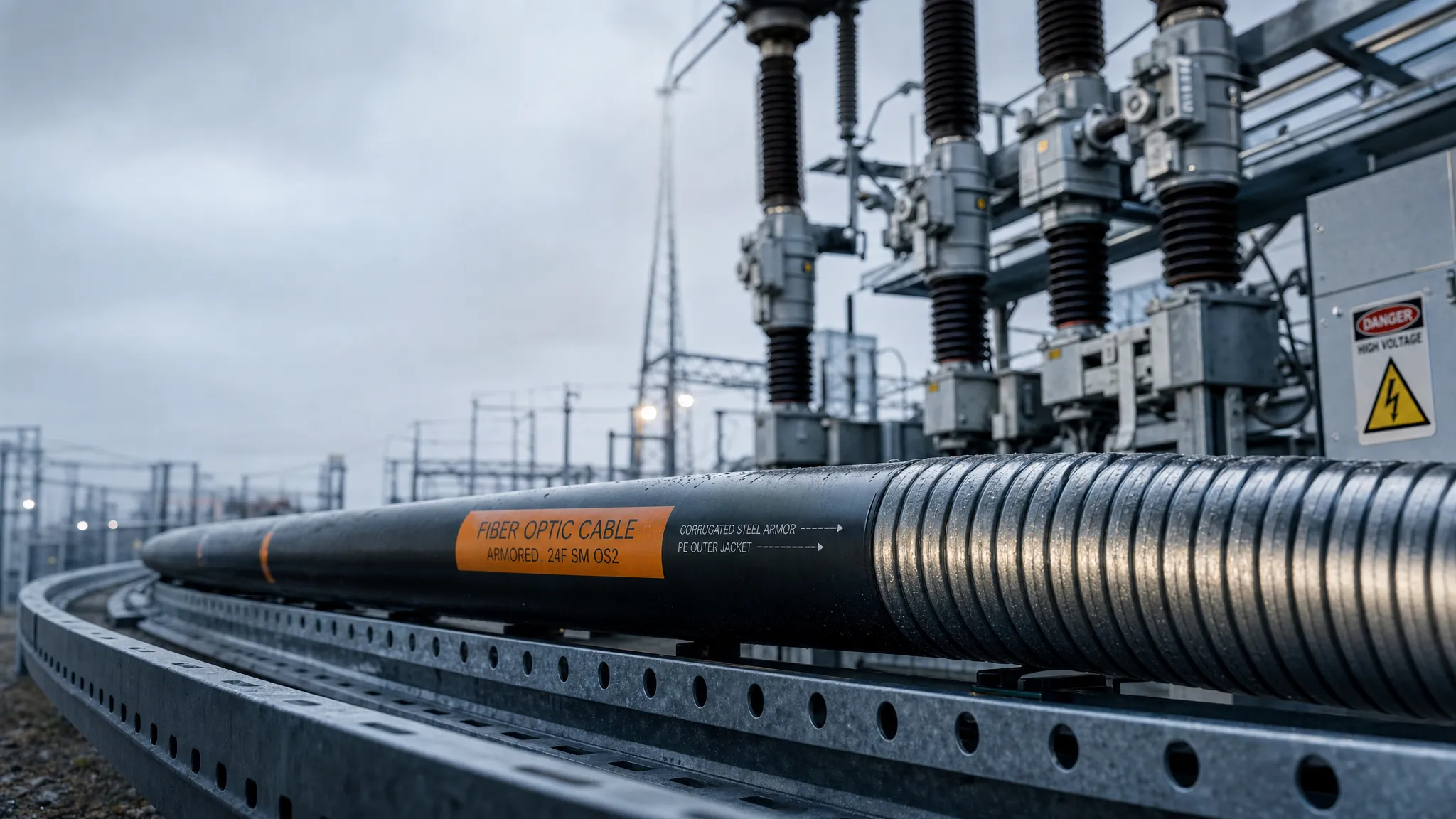
That story is the reason this guide exists. The fiber optic cable that works flawlessly in a climate-controlled building is not the same product you bury, tray, or conduit through an industrial site. "Industrial" is not a marketing label — it is a statement about the environmental threats a cable must survive: temperature extremes, moisture, chemicals, rodents, vibration, and fire codes that treat an industrial facility differently from an office.
Selection therefore follows a simple order: decide the construction first, then the glass. Jacket, buffer, and armor determine whether the cable survives its environment. Fiber type and count determine what it can carry once it does. This guide walks through that decision in that order, and it ends with a checklist you can hand to a supplier. For the broader picture of what belongs in this category, our industrial fiber optic cable hub collects the related selection guides.
Five Environmental Threats That Decide Cable Construction
Every industrial cable spec starts with one question: what is this cable actually going to be exposed to? Five threats account for nearly every premature failure we see in the field.
1. Temperature extremes. Outdoor cable in most regions must survive from roughly -40°C to +70°C, and cabinets and motor rooms push the top end higher. Cold makes jackets brittle; heat accelerates oxidation and softens materials until they creep under their own weight. The cable's rated operating range is a construction specification, not a footnote.
2. Moisture and ingress. Rain, condensation, washdown, and groundwater all find their way into damaged jackets. Water in a loose tube freezes and presses on the fiber; hydrogen generated by corroding metal parts adds attenuation. This is why outdoor cables use water-blocking materials and why direct-burial runs need a moisture barrier.
3. Chemicals, oils, and UV. Industrial sites are chemically hostile: cutting fluids, solvents, hydraulic oil, and UV-loaded sunlight degrade PVC and many polyethylenes over time. A jacket that is chemically compatible with the site is a selection criterion, not a nice-to-have.
4. Rodents and wildlife. Rats and squirrels chew through ordinary jackets — it is one of the most common causes of outdoor cable failure, and it is expensive because the damage is usually deep inside a conduit run. Steel tape and wire armor are the standard countermeasures.
5. Mechanical stress and vibration. Cable trays sag, machines vibrate, forklifts hit trays, and pulling tensions crush cable during installation. Tensile strength members (usually aramid yarn), crush resistance, and bend-radius limits are the construction features that answer this threat. In motor rooms, variable-frequency drives generate electrical noise that copper cables conduct straight into your control network — fiber's dielectric construction eliminates that failure mode entirely.
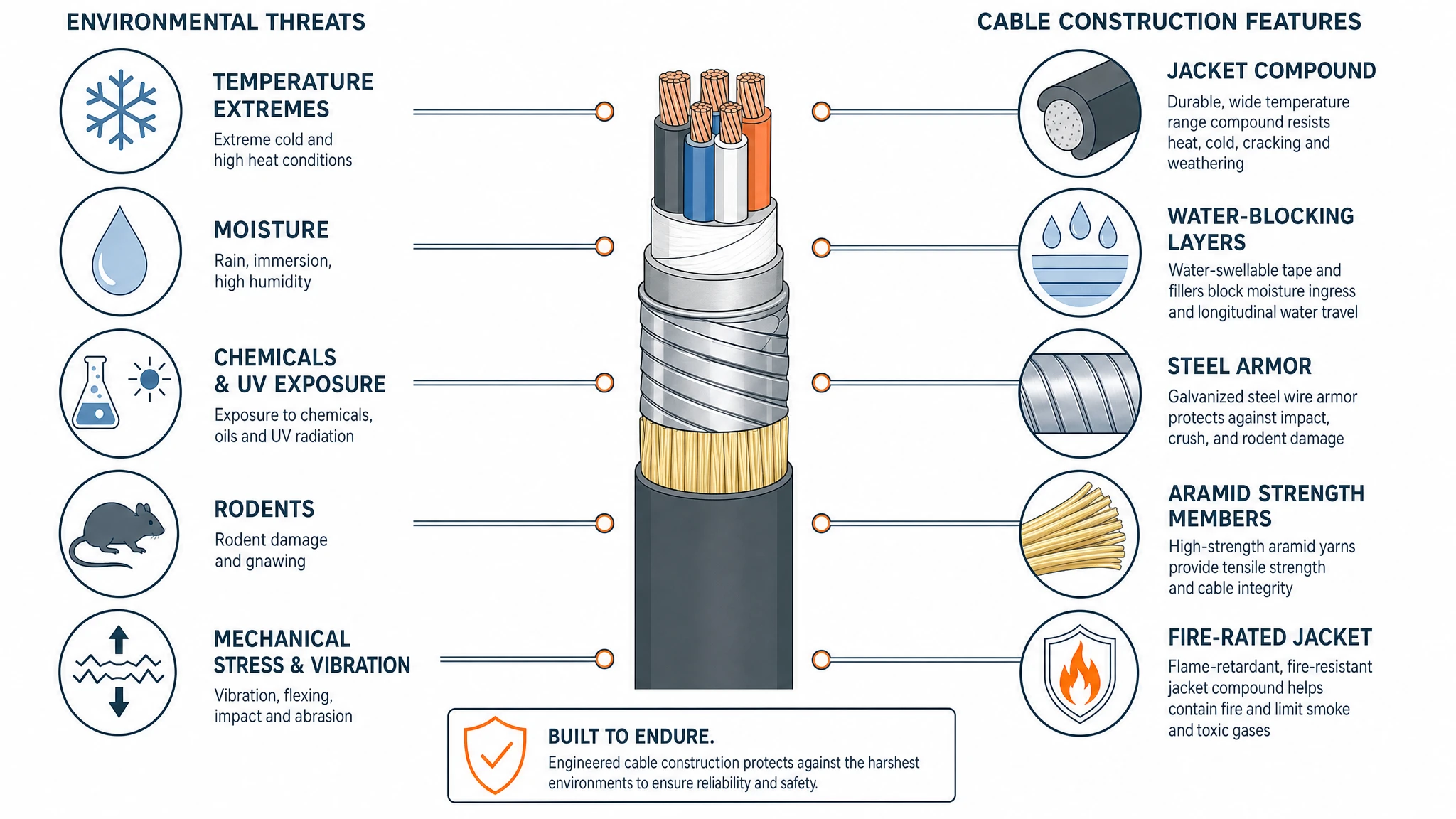
Read any industrial cable spec and you will find these five threats hiding inside it — as temperature classes, water-blocking requirements, jacket compounds, armor types, and tensile ratings. The rest of this guide explains how each construction layer answers them.
Cable Construction: Buffer, Strength Members, and Jacket
A fiber optic cable is a set of concentric layers, and each layer exists to defend the glass against one of the threats above. Understanding the layers tells you what to ask for.
The buffer is the first defense. Two architectures dominate. In tight-buffered cable, a thermoplastic coating is applied directly over the fiber's 250 µm coating, locking the fiber in place and making it easy to terminate — the standard choice for indoor and breakout runs, and for the drop legs inside industrial cabinets. In loose-tube cable, fibers ride loose inside gel-filled or dry water-blocked tubes, free to expand and contract with temperature. Loose tube is the standard for outdoor spans because it isolates the fiber from jacket expansion and contraction. The differences matter enough that we keep a dedicated tight-buffered and loose-tube cable comparison on this site — industrial plants frequently need both types in the same network, and knowing where each belongs is half the selection.
Strength members carry the load. Aramid yarn (Kevlar-type) is the industry workhorse: high tensile strength, light, and non-conductive. Some armored cables add steel elements that contribute both strength and crush protection. The tensile rating printed on the datasheet — how much pulling force the cable survives — is set by these layers, and it is the number that matters most during installation.
The jacket is the environment interface. It is the layer that sees sunlight, oil, and abrasion, and it is the layer that must satisfy fire codes. Jacket materials are covered in detail below, but the short version is: PVC for general indoor use, polyethylene (PE) for outdoor moisture and UV resistance, and LSZH (low smoke, zero halogen) where smoke and toxic gas are the primary concern — crowded control rooms, tunnels, and anywhere evacuation routes pass.
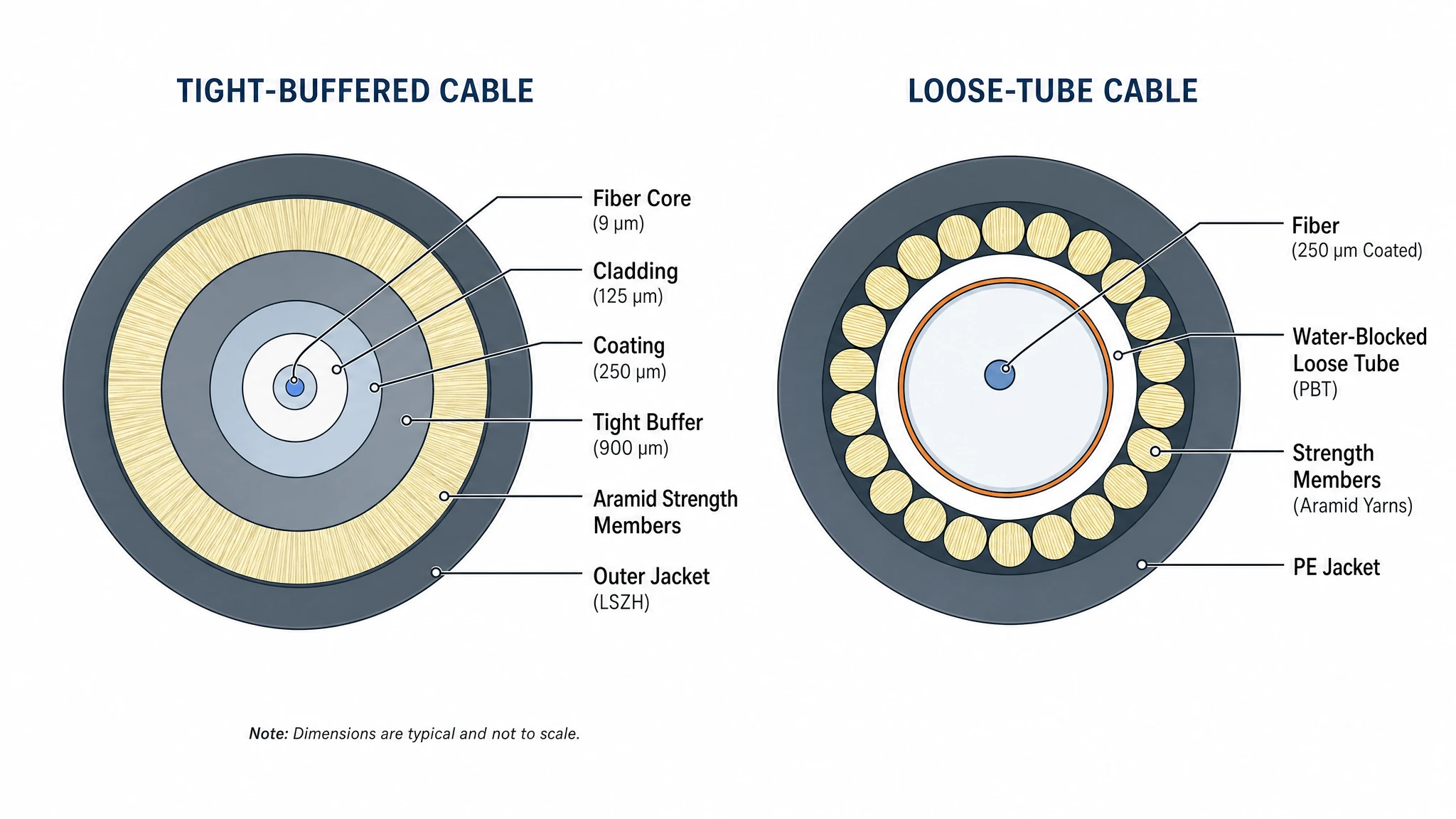
The FOA's fiber optic cable reference describes these layers and their designations in depth. When you read a spec, translate each requirement into the layer it belongs to — you will quickly see which threats the designer was thinking about.
Armored Fiber Optic Cable: When and Which Type
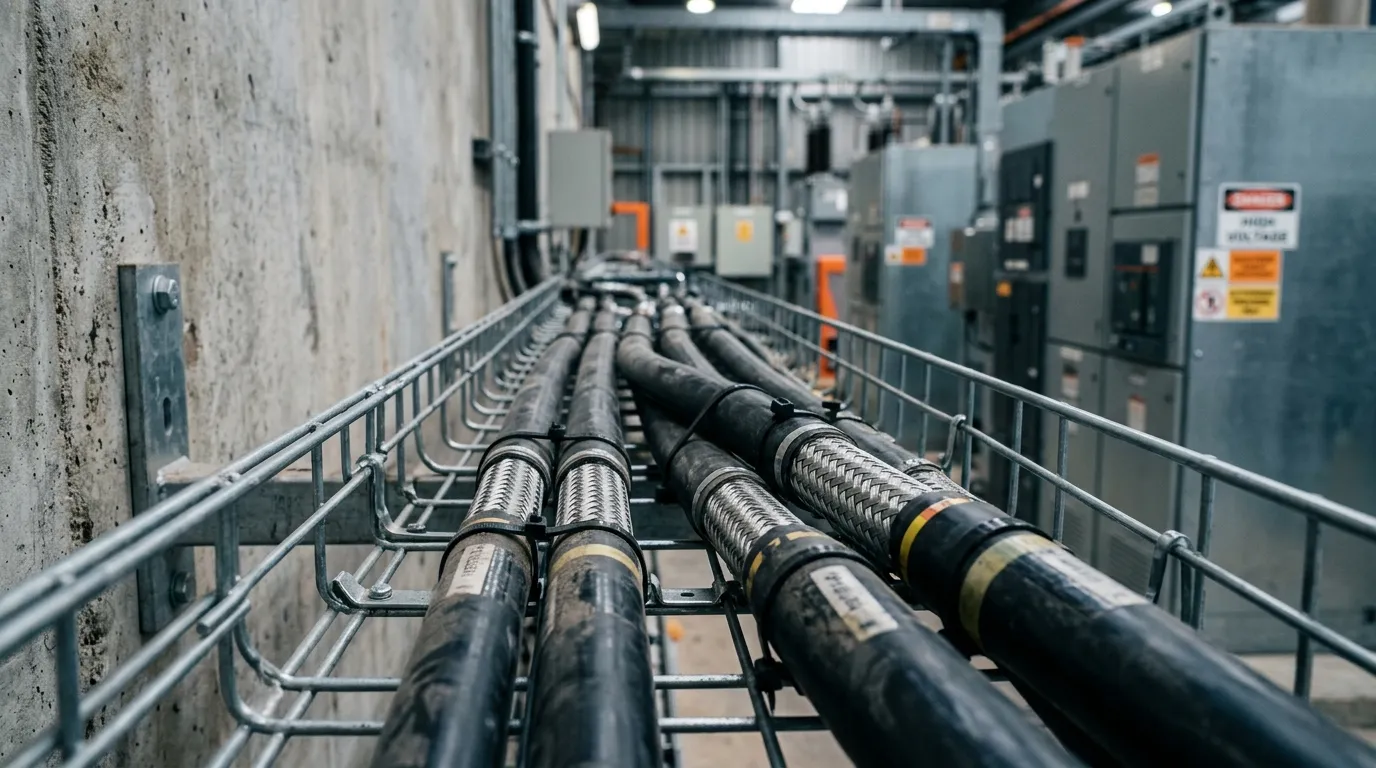
Armor is the difference between a cable that survives a plant and a cable that gets replaced every two years. It adds a metallic (or in some designs, non-metallic) protective layer under the outer jacket, and it is the single most visible construction decision in industrial fiber.
Three armored constructions cover most industrial needs:
Armor type | What it is | Best for |
|---|---|---|
Interlocked armor | Corrugated aluminum or steel strip wound helically | Flexible runs inside trays and raceways; crush and rodent resistance indoors |
Corrugated steel tape (CST) | Continuous steel tape, often paired with a PE jacket | Outdoor, duct, and direct-burial runs; strong rodent defense |
Steel wire armor (SWA) | Helical steel wires over the core | Extreme crush, tension, and rodent pressure — mines, railways, heavy plant |
A fourth option, non-metallic armor (glass or aramid reinforcement instead of steel), exists for environments where metal is unacceptable — near high-voltage equipment, in lightning-prone aerial runs, or where weight matters. It sacrifices some crush performance but keeps the cable fully dielectric.
The rule of thumb: if the cable is exposed, buried, or shared with rodents, armor it. If it lives in a protected indoor tray and nothing heavy will ever touch it, armor is optional. Our guide to outdoor armored fiber optic cable types breaks down each construction with the typical applications, and FS.com's armored fiber cable guide shows the layer-by-layer anatomy in photographs.
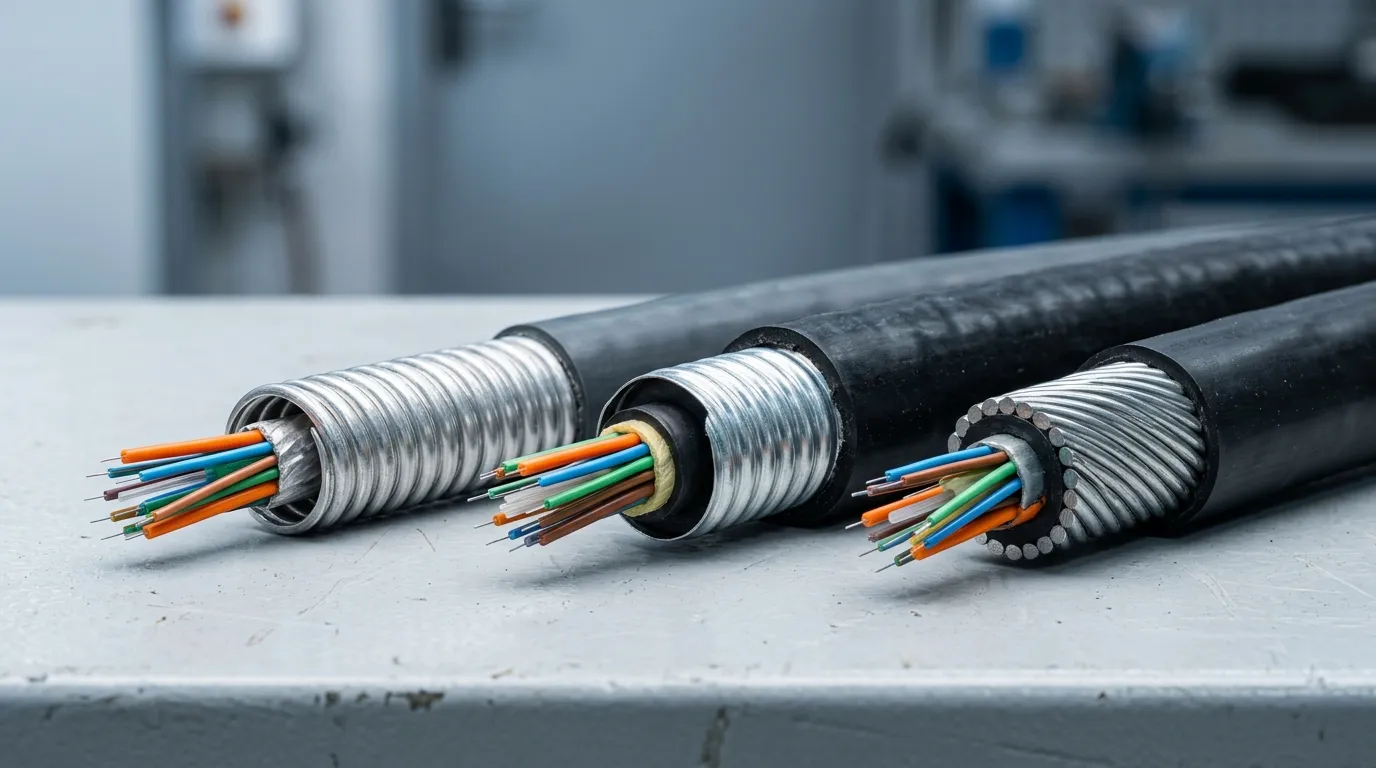
One caution from the field: armored cable is heavier and stiffer, which raises installation time and minimum bend radius. Armor is a solution to a threat, not a default. Spec the minimum armor that answers the actual threats at the site — an interlocked armor for a factory tray is overkill as often as an unarmored cable in a rodent-active trench is under-spec'd.
Jacket Materials and Fire Ratings: PVC, PE, LSZH, and the Codes
The jacket compound determines chemical resistance, moisture performance, UV tolerance, and how the cable behaves in a fire. The fire behavior, in turn, is regulated — which makes jacket selection partly a compliance exercise.
PVC is the default indoor jacket: flexible, inexpensive, flame-retardant enough for most building applications. Its weakness is halogen content — in a fire, PVC produces dense smoke and corrosive hydrogen chloride gas.
Polyethylene (PE) is the outdoor standard. It shrugs off moisture and UV, which is why outdoor and direct-burial cables almost always carry a PE jacket. It is not naturally flame-retardant, so PE-jacketed cables are usually kept out of building risers and plenums.
LSZH (low smoke, zero halogen) compounds are the answer for confined and occupied spaces: tunnels, control rooms, ships, and rail. They limit smoke and release no halogen acids, at the cost of less UV resistance than PE — which is why outdoor LSZH designs often pair an LSZH inner jacket with a PE outer layer.
In the US, fire ratings for fiber optic cable come from NEC Article 770: OFNP for plenum spaces, OFNR for risers, and general-purpose OFN/OFNG for ordinary building areas. UL's cable marking requirements define how those ratings are tested and labeled. In the EU, the Construction Products Regulation adds the CPR classes — Aca down to Fca — which our CPR cable classes guide explains in detail, including which class is typically required for buildings versus industrial installations.
For industrial sites, two additional test families matter even when no code forces them: the IEC 60332 series (flame propagation on single and bunched cables) and IEC 60754 (halogen acid gas release). Specs for mines, tunnels, and rail frequently reference both. Jacket color, meanwhile, follows TIA's TIA-598 convention — yellow for single-mode, aqua for OM3/OM4, lime green for OM5 — which makes field identification far easier in a crowded tray.
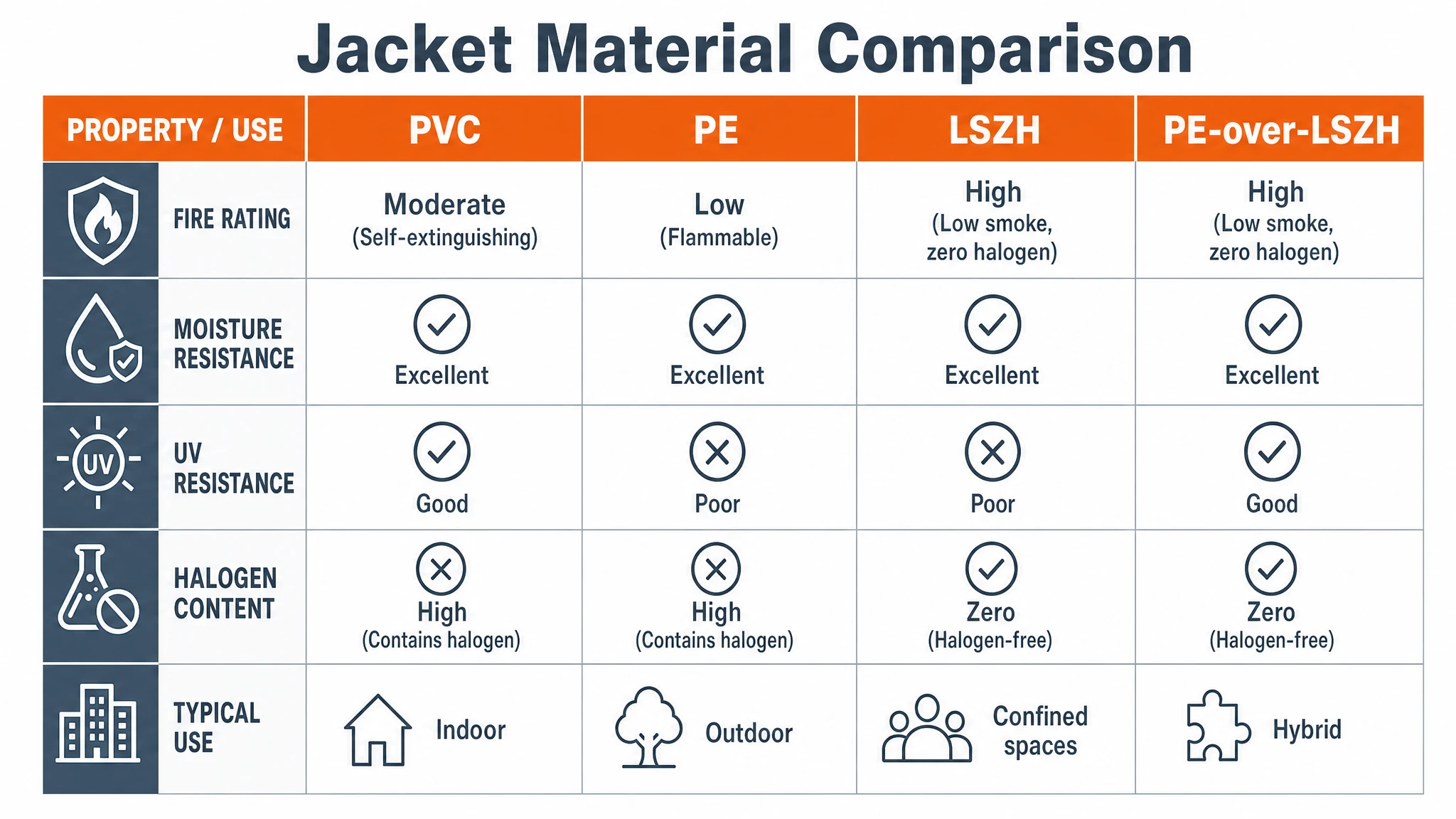
Fire and halogen requirements should be settled before any other jacket decision — they are the only requirements that can make a cable illegal to install, not merely unsuitable.
Temperature Ratings: What -40°C to +85°C Really Means
Every industrial cable datasheet carries a temperature rating, and most specifiers read it wrong. Two numbers matter, and they are not the same:
- Operating temperature range — the ambient range the cable tolerates once installed. Industrial cable commonly carries -40°C to +70°C or +85°C.
- Installation temperature range — the range in which the cable can be pulled, bent, and terminated without damage. It is always narrower, often -10°C to +50°C, because cold jackets crack under bending stress.
The distinction explains most "the cable failed during installation" calls: the crew pulled cable on a -20°C morning inside a range that allowed it, and hairline jacket cracks showed up as moisture ingress months later.
The rating itself is verified by temperature-cycling tests defined in the IEC 60794-1-22 test method — the cable is cycled between its rated extremes while attenuation is monitored. Outdoor reliability requirements are consolidated in Telcordia's GR-20-CORE generic requirements, which most telecom and utility specs reference directly. If you want to understand why temperature changes matter to the fiber itself — not just the jacket — our article on how temperature changes affect fiber performance runs through the physics.
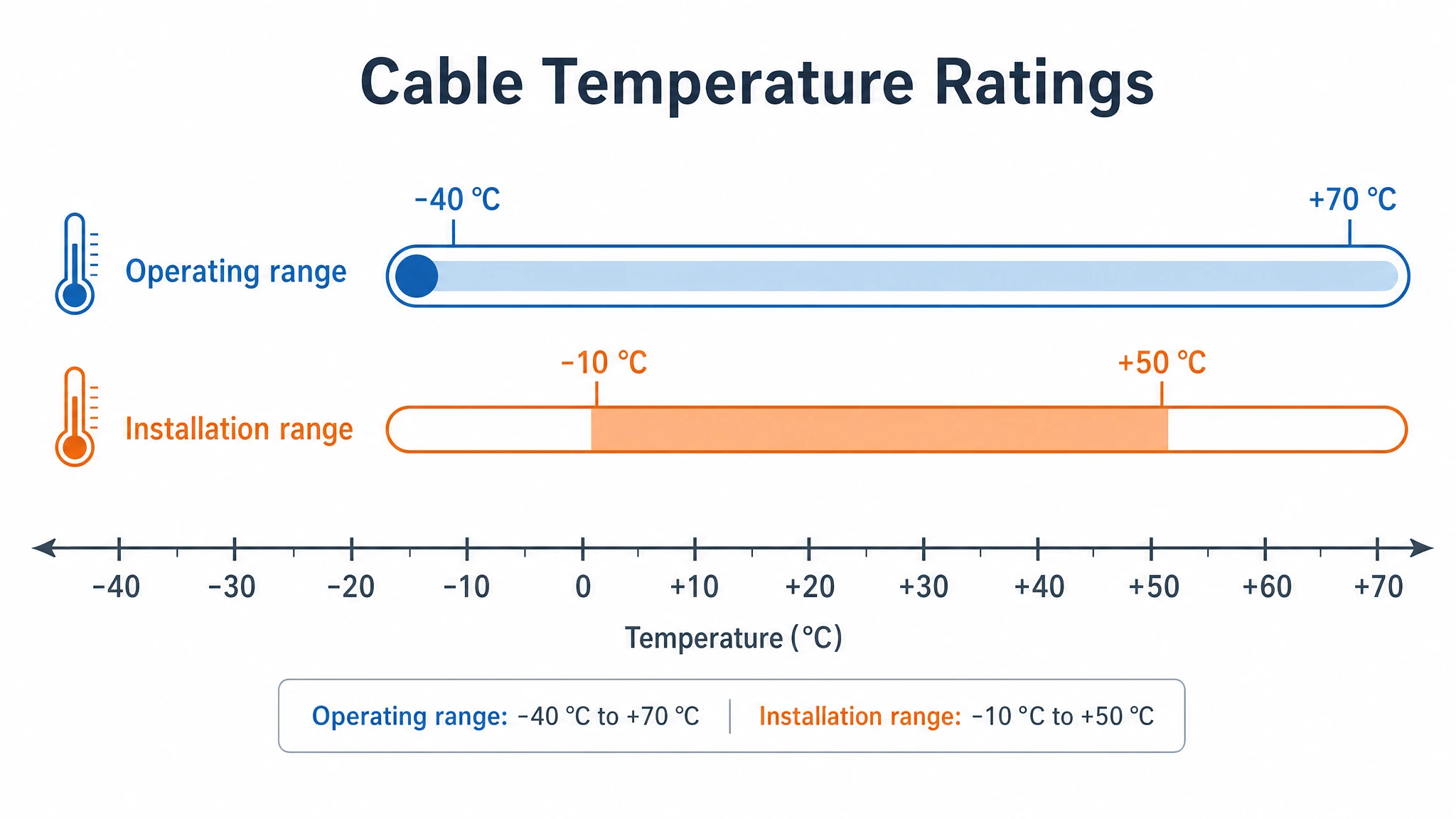
When you write a spec, state both ranges explicitly and separately. "Operating -40°C to +70°C" without an installation range invites exactly the failure described above.
Fiber Type and Fiber Count for Industrial Links
With construction settled, the glass decision is comparatively simple — but it is still worth doing deliberately, because industrial links have unusual distance and noise profiles.
Single-mode (OS2, 9/125 µm) is the default for industrial backbones. It carries signals over kilometers without repeaters, which covers plant-to-plant links, substation-to-control-room spans, and everything in a mine. Its higher cost is in the optics, not the fiber — and industrial networks tend to change optics less often than data centers.
Multimode (OM3/OM4/OM5, 50/125 µm) earns its place on short, high-bandwidth runs — within a plant building, between switches and machinery, or wherever transceivers are cheap and distances stay under a few hundred meters. If a link will ever exceed 300–400 m at 10 GbE, single-mode removes the distance question permanently.
Plastic optical fiber (POF) is the niche workhorse for the last few meters inside machines: short, low-cost, and immune to the electrical noise that surrounds servos and drives. It is not a backbone medium; it is the industrial equivalent of a patch cord.
Fiber count planning follows the same logic as in any network — count every path, double it for redundancy, and leave spare capacity — but industrial sites add two rules: armored cable is expensive to re-pull, so oversize the count within the armor; and hybrid fiber/copper composite cables are worth considering where the same route must carry both. Our single-mode vs. multimode guide covers the trade-off in depth if you are mid-decision. For reference on what manufacturers actually offer, Corning's fiber optic cable portfolio shows the range of standard constructions.
Industrial Applications: A Field Guide by Environment
This is where the framework comes together. For each environment, the same questions — what are the threats, what construction answers them — produce a different answer.
Oil and gas. Chemical exposure, temperature swings, hazardous-area rules, and long outdoor spans. Expect armored, chemically resistant jackets, LSZH or specialized compounds where flammable atmospheres concentrate, and careful attention to which fire standard the local authority applies. Fiber's dielectric nature is a major advantage in hazardous areas where sparking copper is a liability.
Mining. Crush, vibration, rodents, and mandatory flame resistance — underground mines in the US fall under MSHA requirements for flame-retardant cable. Steel wire armor and flame-retardant jackets are common; the cable must also tolerate the severe mechanical abuse of a working mine.
Substations and power. Electromagnetic fields, ground potential rise, lightning, and temperature swings around transformers. Non-metallic or properly bonded armored constructions, dielectric cable (no conductive path for GPR), and UV-resistant jackets. This is also where aerial power-line designs like OPGW come in — a different product family covered in our OPGW versus traditional wires explainer.
Railway. Vibration along the track, rodents, fire safety in tunnels, and decades of service life. Armored, flame-retardant, often LSZH in tunnel sections; wayside and trackside runs usually use armored cable in ducts or troughs.
Factory floor and process plants. Washdown, oils, vibration, and the electrical noise of drives and welding. Interlocked armored or tight-buffered ruggedized cable in trays, LSZH in control rooms, and fiber's noise immunity protecting the control network that copper would conduct straight into every drive.
Environment | Dominant threats | Typical construction |
|---|---|---|
Oil & gas | Chemicals, temperature, hazardous area | Armored, chemical-resistant jacket, LSZH where required |
Mining | Crush, rodents, fire code | Wire armored, flame-retardant (e.g., MSHA-compliant) |
Substation / power | EMI, GPR, lightning, UV | Dielectric (non-metallic armor), UV-resistant jacket |
Railway | Vibration, rodents, tunnel fire | Armored, flame-retardant, LSZH in tunnels |
Factory floor | Washdown, oil, noise, vibration | Interlocked armor, ruggedized tight-buffer, LSZH indoors |
The pattern is the point: you do not need a different selection philosophy per industry — you need the same threat analysis applied to each site. For the underground half of these networks, our underground fiber optic cable guide covers duct and direct-burial selection.
A Spec Checklist for Your Next Industrial Cable Order
Copy this into your request for quotation. Every line maps to a decision made above, and every blank is something the supplier must confirm in writing.
Checklist item | What to specify | Why it matters |
|---|---|---|
Environment threats | Temperature range, moisture, chemicals, rodents, vibration, fire code | Drives every construction choice |
Operating temperature | e.g., -40°C to +70°C | Jacket and buffer materials |
Installation temperature | e.g., -10°C to +50°C | Prevents installation-time cracking |
Buffer architecture | Tight-buffered, loose-tube, or both | Termination ease vs. outdoor stability |
Armor | None / interlocked / CST / SWA / non-metallic | Rodents, crush, tension |
Jacket compound | PVC, PE, LSZH, or hybrid | Fire code, chemicals, UV |
Fire rating | OFNP/OFNR/OFN or CPR class | Legality of installation |
Fiber type | OS2 single-mode, OM3/4/5 multimode, or POF | Distance and bandwidth |
Fiber count | Number of strands + spare | Re-pull cost is prohibitive |
Tensile and crush rating | Pulling tension, crush load | Installation survival |
Standards referenced | IEC 60794, GR-20, NEC 770, CPR | Verifiable conformance |
Rule of thumb: if you cannot explain which threat each line of the spec answers, you have not finished the spec — you have copied one.
Mistakes That Cost More Than the Cable
Five errors show up repeatedly in industrial fiber projects, and each one costs more than the cable it was meant to save.
Specifying indoor cable outdoors. PVC jackets crack under UV and moisture; the failure is slow, invisible, and total. This is the most common mistake we see, and the most preventable.
Ignoring the installation temperature range. Pulling cable below its installation rating embeds damage that surfaces as attenuation drift months later — after the warranty conversation has gone cold.
Skipping armor where rodents are active. A rural substation or a plant surrounded by fields is a rodent buffet. Unarmored cable in that environment has a measured lifetime, and it is short.
Overspecifying to the point of unbuildable. Steel-wire armor in an indoor tray is hard to bend, hard to terminate, and expensive. Armor should match the threat, not the fear.
Forgetting the termination plan. Industrial cable is often selected without checking how it will be spliced or connectorized in the field — armored cable needs proper grounding and bonding of its metallic layers, and both need to be in the installation plan, not discovered on site.
None of these are exotic failures. They are the routine, boring, expensive ways industrial fiber projects go wrong — and every one of them is avoidable with the checklist above.
FAQ: Quick Answers for Cable Specifiers
What are the three types of fiber optic cable? By glass type: single-mode (OS2), multimode (OM3/OM4/OM5), and plastic optical fiber (POF). By construction, the meaningful split is tight-buffered vs. loose-tube. Both taxonomies matter for industrial selection — glass type decides distance and speed, construction decides survival.
Do I need armored fiber optic cable? Armor it if the cable is buried, exposed to rodents, or subject to crush and vibration. In a protected indoor tray with nothing heavy nearby, unarmored is fine. When in doubt, count the rodents.
LSZH or PVC? LSZH when smoke and toxic gas are the risk — tunnels, control rooms, occupied spaces, and most industrial buildings under modern codes. PVC when cost and flexibility dominate and the space is well-ventilated. Outdoor runs want PE for UV and moisture regardless.
How deep should industrial fiber be buried? Direct-burial cable goes below the frost line with a warning tape above it — typically 600–900 mm in most regions. Local codes and the frost depth at your site govern the exact number, and armored cable is the right choice for the trench.
Can fiber optic cable run alongside power cable? Yes — and unlike copper, fiber has no induced-voltage problem, which is exactly why substations and plants run it alongside high-voltage circuits. Keep metallic armor properly bonded, and the dielectric core does the rest.
Getting the Cable Right: Next Steps
The decision order is the deliverable: threats → construction → glass → count → spec. Apply it once and the choices stop being opinions and start being answers. When the spec is written, the practical questions shift to sourcing — lead times, certifications, and construction drawings you can audit.
That is where a manufacturer earns its keep. TTIFiber publishes construction drawings and datasheets for its outdoor fiber optic cable range — armor type, jacket layers, and test data on every line — so the spec above can be checked against a real product before you commit. If you are mid-selection and want a second pair of eyes on the threat analysis, TTIFiber's engineers review industrial specs every week; send them yours and they will tell you which line will fail first.