How to Choose an IP68 Fiber Splice Closure
How to Choose an IP68 Fiber Splice Closure
Two closures sit in a warehouse. Both are stamped IP68. One survives eleven winters on a pole. The other takes on water in a hand hole before its first anniversary, and a crew spends a night re-splicing 96 fibers in the rain.
Nothing about the label was a lie. That is the uncomfortable part.
IP68 is a real rating, but it is a far weaker promise than most buyers assume — and once you understand exactly what it does and doesn't certify, the way you evaluate an IP68 fiber splice closure changes completely. This guide walks through what the rating actually guarantees, the questions that separate a genuinely sealed closure from a leaky one, and how to match body style, capacity, and seal type to the way you actually deploy fiber.
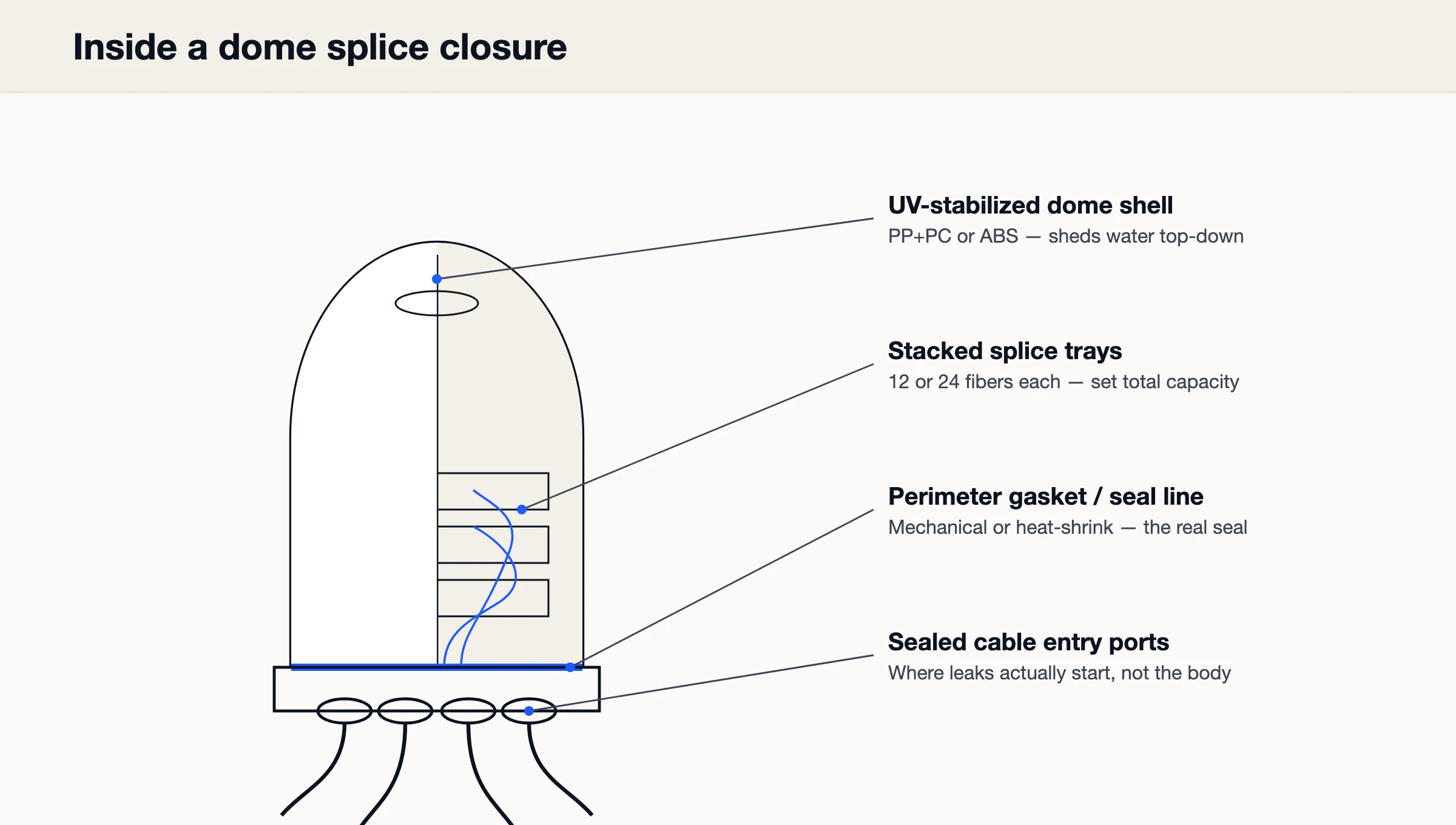
What IP68 Actually Certifies — and What It Doesn't
The IP code comes from IEC 60529, Degrees of protection provided by enclosures. It is two digits, and they are independent of each other.
The first digit — 6 — is the top of the solids scale: dust-tight. No ingress of dust, full stop. Every reputable outdoor closure clears this, which is precisely why it tells you almost nothing about which one to buy.
The second digit — 8 — is where the assumption breaks. Most people read "8" as "more waterproof than 7." What IEC 60529 actually says is subtler. Look at the clause titles in the official IEC 60529 sample text:
- Clause 14.2.7 — IPX7: temporary immersion between 0,15 m and 1 m. A fixed, universal condition. Every IPX7 product is tested the same way, conventionally for 30 minutes.
- Clause 14.2.8 — IPX8: continuous immersion. And here the standard hands the pen to the manufacturer. The depth and duration are subject to agreement between manufacturer and user, with only one constraint: they must be more severe than the IPX7 conditions.
Read that again, because it is the whole point of this article. IEC 60529 does not define a depth or a duration for IPX8. It defines a floor and lets the vendor choose everything above it.
IP67 | IP68 | |
|---|---|---|
Dust | Dust-tight | Dust-tight |
Water test | Temporary immersion, 0.15–1 m | Continuous immersion |
Depth & duration | Fixed by the standard | Set by the manufacturer |
Comparable across vendors? | Yes | No |
So a closure tested at 1.1 m for 31 minutes and a closure tested at 3 m for 14 days both earn the identical IP68 marking. Both are honest. Neither number appears on the box.
This is not a reason to ignore IP68 — an outdoor closure without it is disqualified before the conversation starts. It is a reason to stop treating IP68 as the finish line. It is the entry ticket, not the qualification.
The Questions That Separate a Sealed Closure From a Leaky One
If the rating won't discriminate between suppliers, something has to. Three things do.
1. Ask for the air-pressure hold test
This is the single most useful question you can put to a supplier, because it is reproducible and you can witness it. The closure is sealed, its interior is pressurized, it goes underwater, and someone watches for bubbles. Vendor datasheets commonly specify pressurizing to around 100 kPa and observing for 15 minutes with no bubbles escaping, often paired with a 1.5 m / 24-hour immersion soak.
Note how different this is from an IP68 label. A pressure-hold test interrogates every seal path at once — the gasket line, the cable entry ports, the moulded seams — and it fails loudly. A static immersion test can be passed by a closure whose port seals are one thermal cycle away from letting go.
Ask for the procedure, the pressure, the hold time, and the pass criterion in writing. A supplier who has actually run the test will answer in one email.
2. Ask which closure standard the product was built against
Two families matter, depending on your market.
North America: Telcordia GR-771 — Generic Requirements for Fiber Optic Splice Closures. This is the document written specifically for closures deployed across outside plant environments. It sets out functional design criteria plus mechanical and environmental requirements and the performance tests that go with them: accelerated thermal aging, freeze-thaw cycling, weather tightness, water spray, optical monitoring during the whole ordeal. Where IP68 is a single snapshot, GR-771 is a regime.
China: YD/T 814. The YD/T 814 series is the industry standard governing optical fiber cable splice closures — 814.1 for general outdoor closures, 814.2 for OPGW, 814.3 and 814.5 for submarine, 814.4 for micro closures. If a Chinese-manufactured closure cites a Chinese standard, this is the family it should be citing.
3. Watch out for one very common miscitation
Here is a trap that catches buyers and manufacturers alike, and it is worth being blunt about because we have seen it on our own product literature.
IEC 61073 is frequently cited as a splice closure standard. IEC 61073-1 is not one. Its official scope is mechanical splices and fusion splice protectors for optical fibres and cables — the little hardware that protects an individual fusion joint, not the box that houses hundreds of them. The part of the IEC 61073 series that actually addresses closures is 61073-2, Splice organizers and closures.
Two other standards get dragged into closure spec sheets where they don't belong. Telcordia GR-3125 covers Fiber Distribution Hubs, not closures. RUS PE-90 is a minimum performance specification for fiber optic cable itself.
None of this means a supplier citing IEC 61073 is dishonest — the miscitation is endemic. But a supplier who can tell you which part of 61073 applies, and why, is a supplier whose engineers have read the standard.
Match the Closure Body to How You Install It
With sealing settled, the form factor question is mostly a question about geometry and access.
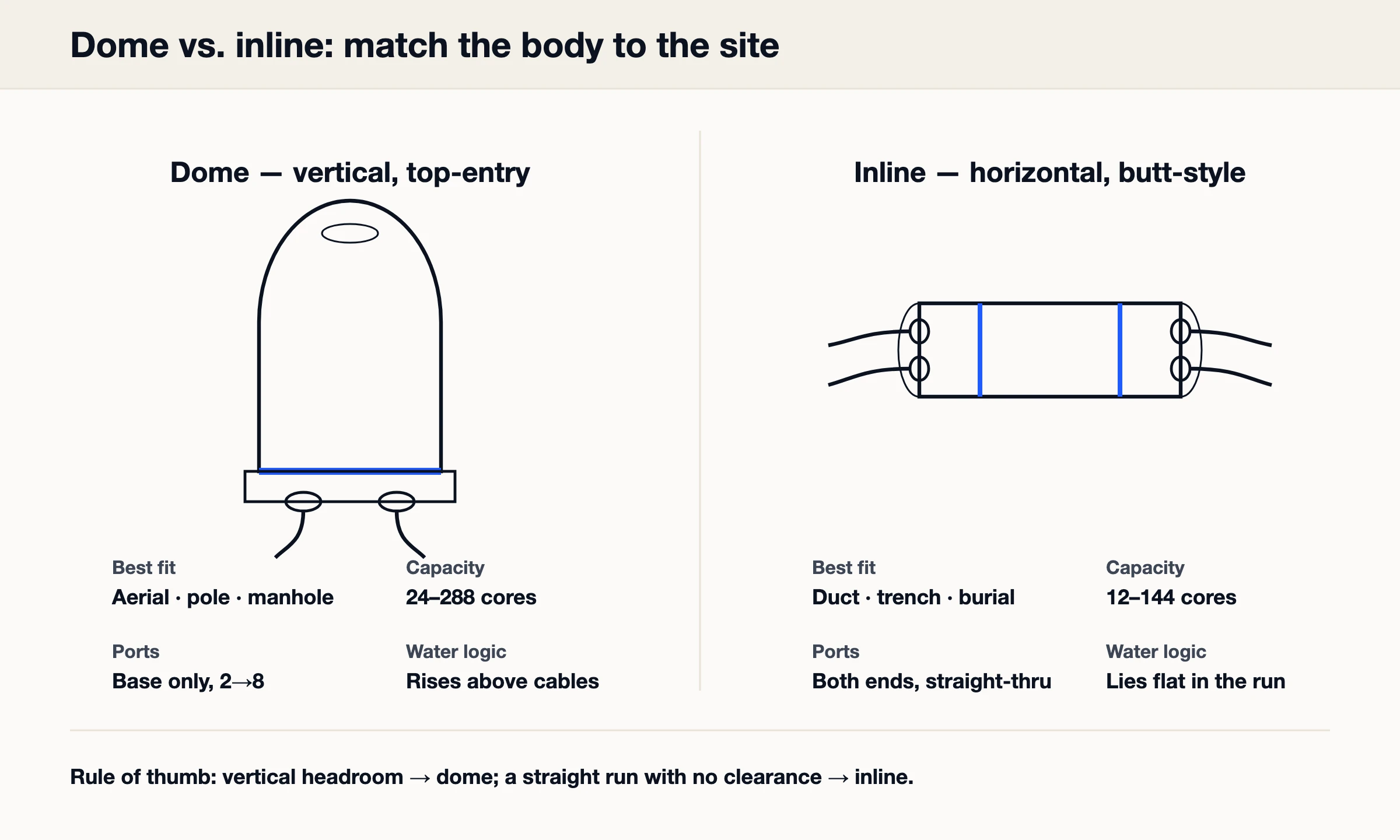
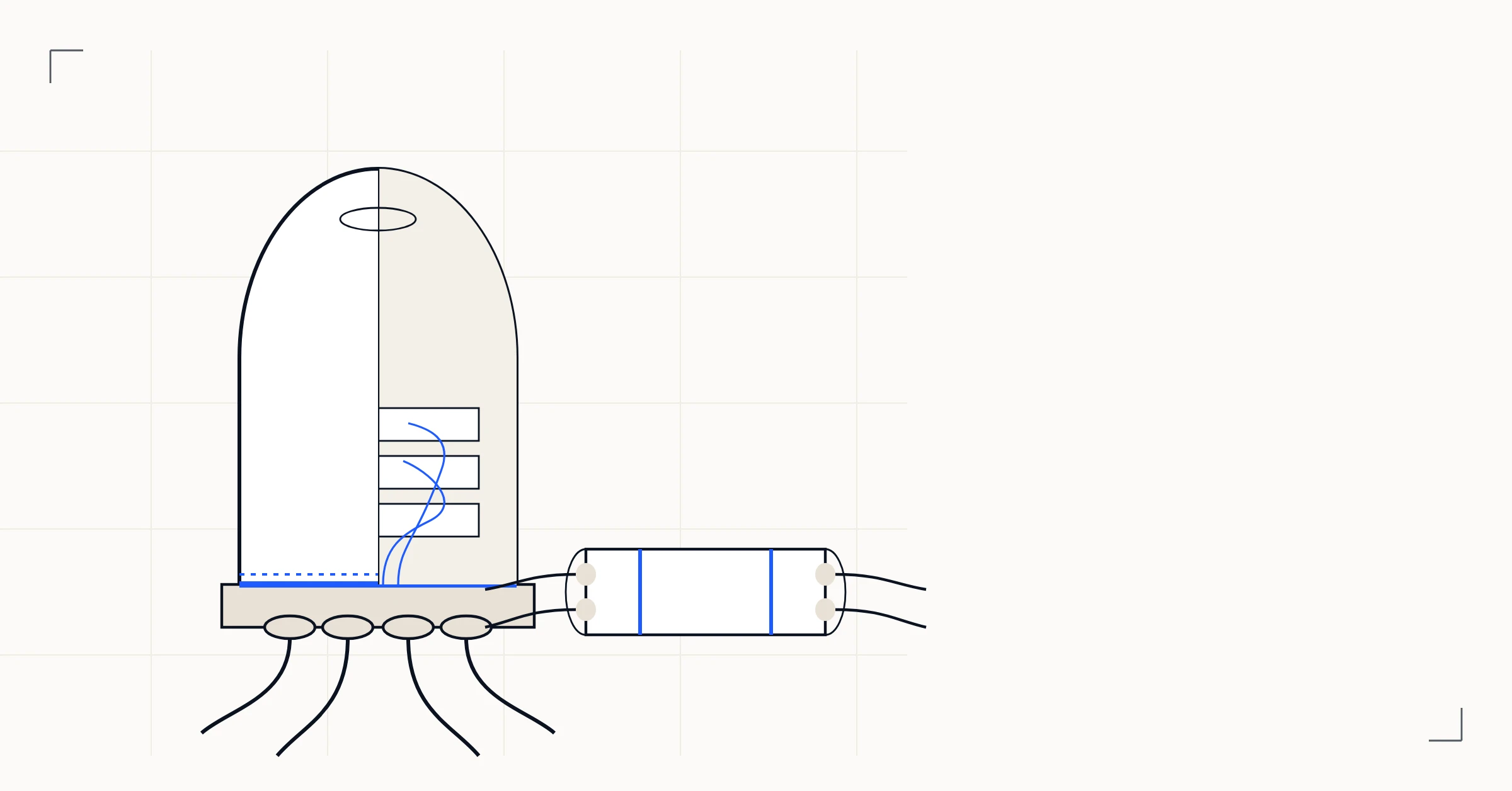
Dome (vertical, top-entry). Cables enter from the base and the body rises above them. Water has to climb to get in, which is why domes dominate aerial and pole-mount work. They suit hand holes and manholes where you have vertical headroom. TTI Fiber's dome range runs from a 24-core dome splice closure for distribution taps up to a 288-core high-capacity dome closure for trunk junctions.
Inline (horizontal, butt-style). Cables enter and exit from opposite ends and the body lies flat. This is the shape you want inside a duct, in a trench, or anywhere the run is straight and the headroom isn't there. An inline horizontal splice closure is usually the right call for direct burial — see our guide on how deep to bury fiber optic cable for the depth side of that decision.
Mini dome. A stripped-down dome for last-mile work: one cable in, two out. A compact mini splice closure for drop cables mounts on a pole or hangs from a messenger without a bracket kit, and it is the right size for a single subscriber branch.
Dome | Inline | Mini dome | |
|---|---|---|---|
Orientation | Vertical, top entry | Horizontal, both ends | Vertical, compact |
Best fit | Aerial, pole, manhole | Duct, trench, direct burial | Drop cable, last mile |
Typical capacity | 24–288 cores | 12–144 cores | 12–24 cores |
Ports | 2 in / 2 out up to 6–8 | Multiple, both ends | 1 in / 2 out |
If your plant is aerial, the closure body is only half the story — the cable matters too. Our notes on aerial GYFTY backbone cable and on jacket material for outdoor durability cover the other half.
Size for the Fiber Count You'll Have in Five Years
Splice closures are cheap. Reopening one on a live network is not.
Capacity is set by splice tray count, and trays are almost universally 12 or 24 fibers each. A 96-core dome closure is four 24-fiber trays; a 288-core body stacks twelve. Fiber splice trays are what actually enforce bend radius on the fibers inside, so tray quality is not a detail — a tray with sloppy routing guides will cost you loss you'll spend a day chasing. (If you're not sure what "acceptable" looks like, we wrote about splice loss budgets.)
Two rules that repay themselves:
- Buy the port count, not just the core count. A 96-core closure with 4 in / 4 out ports gives you somewhere to land the branch cable you haven't planned yet. A 96-core closure with two ports does not.
- Leave a spare tray slot. The marginal cost is a few dollars. The alternative is a truck roll and a service window.
Mechanical vs Heat-Shrink Seal: The Re-Entry Decision
This choice is not about which seal is better. It is about whether you ever intend to open the closure again.
Heat-shrink seal. A shrink sleeve is drawn down over the cable entry with a torch, bonding to the jacket and the closure body. Excellent, permanent, and cheap. Reopening it destroys the seal, and resealing needs a fresh kit and a flame — which you may not want to strike over a live trunk in a manhole.
Mechanical seal. A compressed gasket, tightened by a clamp or a slide-in-lock collar. It re-enters cleanly, as many times as you need, with no torch and no consumables. It costs more per unit and it depends entirely on gasket quality and correct torque at install.
The economics are simple. In a mature FTTH distribution network, you will reopen closures — new subscribers, new branches, repairs. In a point-to-point trunk splice that nobody has any business touching for twenty years, a heat-shrink seal is the cheaper, harder answer. Most operators end up mixed: mechanical at distribution, heat-shrink on the trunk.
Gaskets do age. A mechanical seal is a serviceable part, not a permanent one, and a closure that has been reopened eight times deserves a fresh gasket on the ninth.
How These Closures Actually Fail
Failures cluster, and almost none of them are the failure people design against.
Cable entry ports, not the body. The moulded shell is rarely the leak. Water gets in where the cable does — an oversized port bushing, a jacket that wasn't abraded before the sealant went on, a heat-shrink sleeve that never fully wetted the cable.
Freeze-thaw, not immersion. A closure holding a little condensation is fine until the water freezes, expands, and walks the gasket out of its channel. This is exactly what GR-771's freeze-thaw cycling exists to find, and exactly what a static IP68 immersion test never sees.
Re-entry damage. Every reopening is a chance to nick a gasket, cross-thread a clamp, or torque a lid unevenly. Closures fail on the fifth visit far more often than on the first.
UV embrittlement. Ten years of sun on a non-stabilized polymer and the shell goes chalky, then brittle, then cracked. PP+PC and ABS housings need genuine UV stabilization, not a datasheet claim. This is the same family of ingress problem we covered in common outdoor enclosure failures like moisture and corrosion.
Missing grounding. Any closure carrying a cable with metallic elements — armor, a central strength member — needs its earthing device bonded. In aerial plant this is a lightning-survival question, not a paperwork question.
Splice Closure, Terminal Box, FAT, ODF: Drawing the Lines
Four names, constantly confused, and buying the wrong one wastes a week.
- Splice closure — a sealed, usually re-enterable enclosure that protects fusion splices in outside plant. No connectors, no patching. It is a joint, not a demarcation point.
- Fiber terminal box / FAT — has adapters, so a technician can plug and unplug drops with a patch cord. It terminates rather than joins.
- Fiber distribution box — a distribution point that typically holds an optical splitter as well as terminations, feeding many subscribers from one feeder fiber.
- ODF — an indoor, rack-mounted frame at the central office or data center, where incoming cable fibers are spliced to pigtails and then patched.
The clean test: if a technician will ever plug something into it, it is not a splice closure. Closures exist so that a fusion joint — bare glass, protected by a heat-shrink sleeve, coiled inside a tray — survives a decade of weather untouched.
Cable construction matters at this boundary too, since what you're splicing determines how you prep it. Our comparison of tight-buffered and loose-tube construction is the relevant background.
A Selection Checklist You Can Send to a Supplier
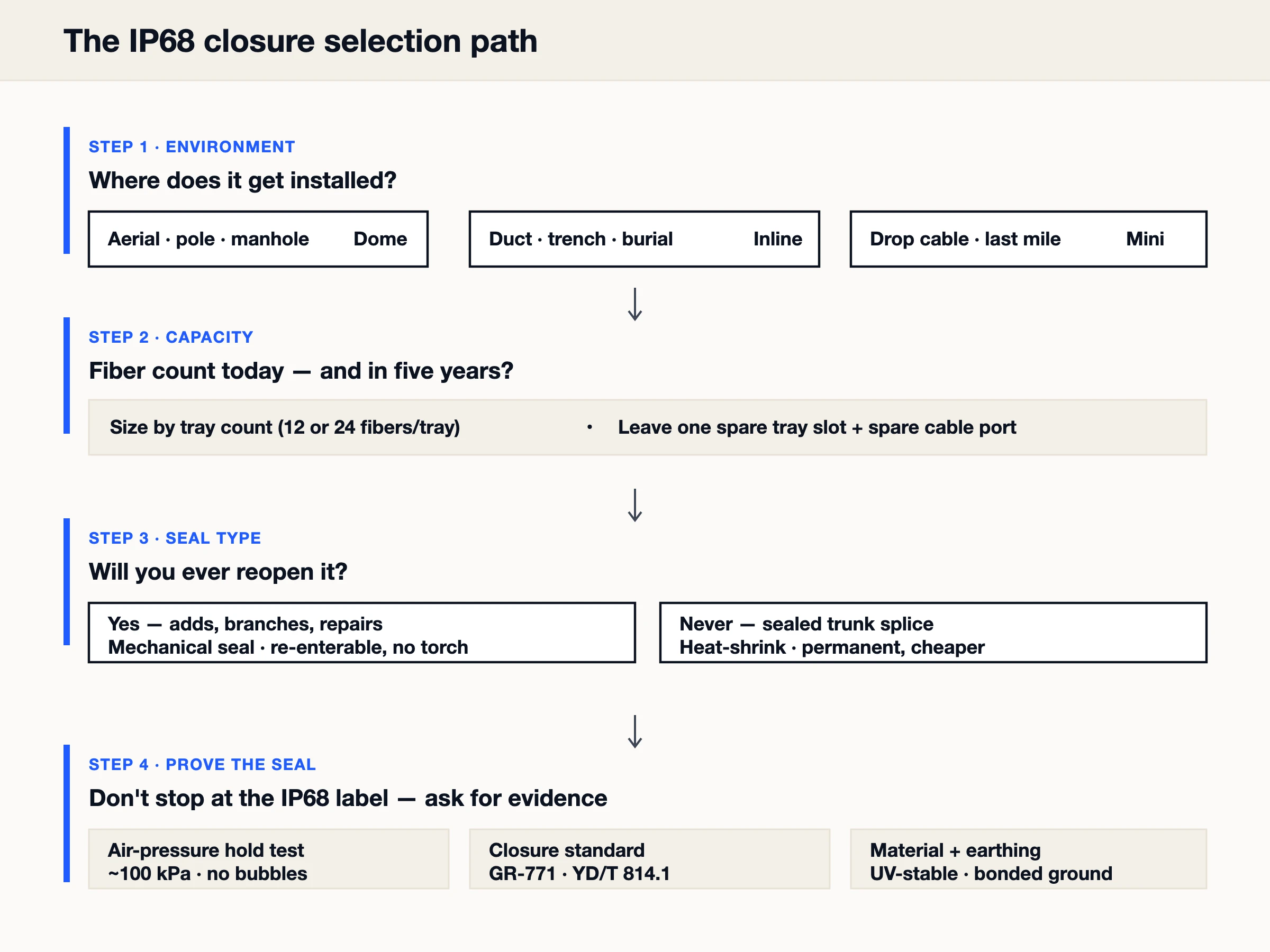
Copy this into an email:
- Environment — aerial / pole, hand hole or manhole, duct, direct burial? → body style
- Fiber count today, and in five years? → tray count, plus one spare slot
- Cable ports — how many in, how many out, and what jacket diameters?
- Will this closure be reopened? → mechanical seal if yes, heat-shrink if genuinely never
- What is the air-pressure test procedure? Pressure, hold time, pass criterion — in writing.
- Which closure standard was it built and tested against? GR-771? YD/T 814.1? If they say "IEC 61073," ask which part.
- Housing material and UV stabilization? PP+PC or ABS, with a stated operating range (−40 °C to +65 °C is a normal outdoor spec).
- Is there an earthing device, and is it bonded to the tray assembly?
- Certifications — ISO 9001, CE, RoHS as a floor.
Any supplier who answers all nine in one reply is a supplier worth quoting.
Frequently Asked Questions
Is IP68 waterproof? Not in any absolute sense. IP68 means continuous immersion under conditions the manufacturer defines, which IEC 60529 requires only to be more severe than IPX7's 0.15–1 m. "Waterproof" implies a universal guarantee that the rating does not make.
IP67 or IP68 for a buried splice closure? IP68 — but treat it as a minimum, and ask for the air-pressure hold test and a closure standard. For anything buried or in a flood-prone hand hole, the immersion condition the vendor actually tested to matters more than the digit.
Can an IP68 closure be direct-buried? Yes, if it is specified for it. Look for an inline body, a mechanical or heat-shrink seal rated for the soil conditions, and a housing that will not embrittle. IP68 alone does not qualify a closure for burial.
Dome or inline? Dome for aerial, pole-mount, and anywhere with vertical headroom. Inline for ducts, trenches, and direct burial where the cable runs straight through and clearance is tight.
Can a splice closure be reopened? Only if it has a mechanical seal. Heat-shrink seals are destroyed on entry and need a new kit to reseal. If you expect to add fibers, buy re-enterable and budget a replacement gasket every few entries.
How many fibers fit in a splice closure? From 12 in a mini dome up to 288 or more in a large dome. Capacity is trays × fibers-per-tray, and trays are usually 12 or 24.
Where This Leaves You
The rating on the box is the beginning of the diligence, not the end of it. IP68 tells you a closure was immersed under conditions somebody chose. The air-pressure hold test tells you whether the seals actually hold. GR-771 and YD/T 814 tell you whether anyone thought about the eleven winters.
Ask the nine questions. The suppliers who can answer them are a short list, and it is the list you want.
TTI Fiber manufactures the full IP68 splice closure range — dome bodies from 24 to 288 cores, inline closures from 12 to 144, mini domes for drop-cable branches, and the splice trays that go inside them. If you'd like the air-pressure test procedure and the standards documentation for any of them, ask us for it; we'd rather send the paperwork than the brochure.
For more on building fiber plant that survives the outdoors, start with our outside plant fiber deployment hub.