Oil Resistant Cable Jacket Materials Guide
Every datasheet in this category says the same three words: oil resistant. Ask what oil, at what temperature, for how long, and what number counts as a pass, and the answer usually stops. That gap is where field failures come from — not from buying PVC when you needed PUR, but from buying a compound that was qualified against a different fluid at a different temperature than the one dripping on it. The phrase oil resistant cable jacket describes a test result, not a material property, and comparing jacket materials only becomes useful once you know what you are comparing them against. This guide does the comparison on axes you can actually specify, and it sits inside our wider library on industrial fiber optics for harsh environments.
What "Oil Resistant Cable Jacket" Claims Actually Mean
The claim is narrower than the phrase suggests. In the IEC world, oil resistance of a sheath is measured by IEC 60811-404, a mineral oil immersion test aimed at cross-linked sheathing compounds: test pieces go into an oil bath at a stated temperature for a stated time, are then conditioned, and their mechanical properties are measured against unexposed pieces. The reference oil is oil No. 2, IRM 902, defined in ISO 1817, the ISO method for evaluating how rubber and rubber-like materials respond to liquids. Throughout, jacket and sheath mean the same layer — the outermost polymer covering; inner jacket is used only for a layer beneath that one.
Three things follow, and they matter more than any material ranking:
- The fluid is fixed by the test, not by your plant. IRM 902 is a reference mineral oil. Diesel, biodiesel, hydraulic fluid, glycol, caustic washdown and hydrocarbon condensate are different chemistries with different effects on the same polymer.
- The temperature is fixed by the test. A compound qualified at 70 °C may fail the same oil at 100 °C. Resistance is a curve, not a checkbox.
- The pass criterion is mechanical retention. IEC 60811-404 measures how much tensile strength and elongation survive — and, where the spec is written to ASTM D471 or ISO 1817, the volume swell alongside it — not whether the material "looks fine" after a wipe.
So when a supplier says oil resistant, the useful follow-up is: to which test, which fluid, which temperature, and what retention figure. The same applies to the phrase chemical resistant cable — a chemical resistant cable is a cable whose sheath has been qualified against a named chemical under named conditions, not one whose jacket is made of a polymer that sounds inert. Without those four answers, neither claim can be written into a requisition, and neither can be checked on delivery.
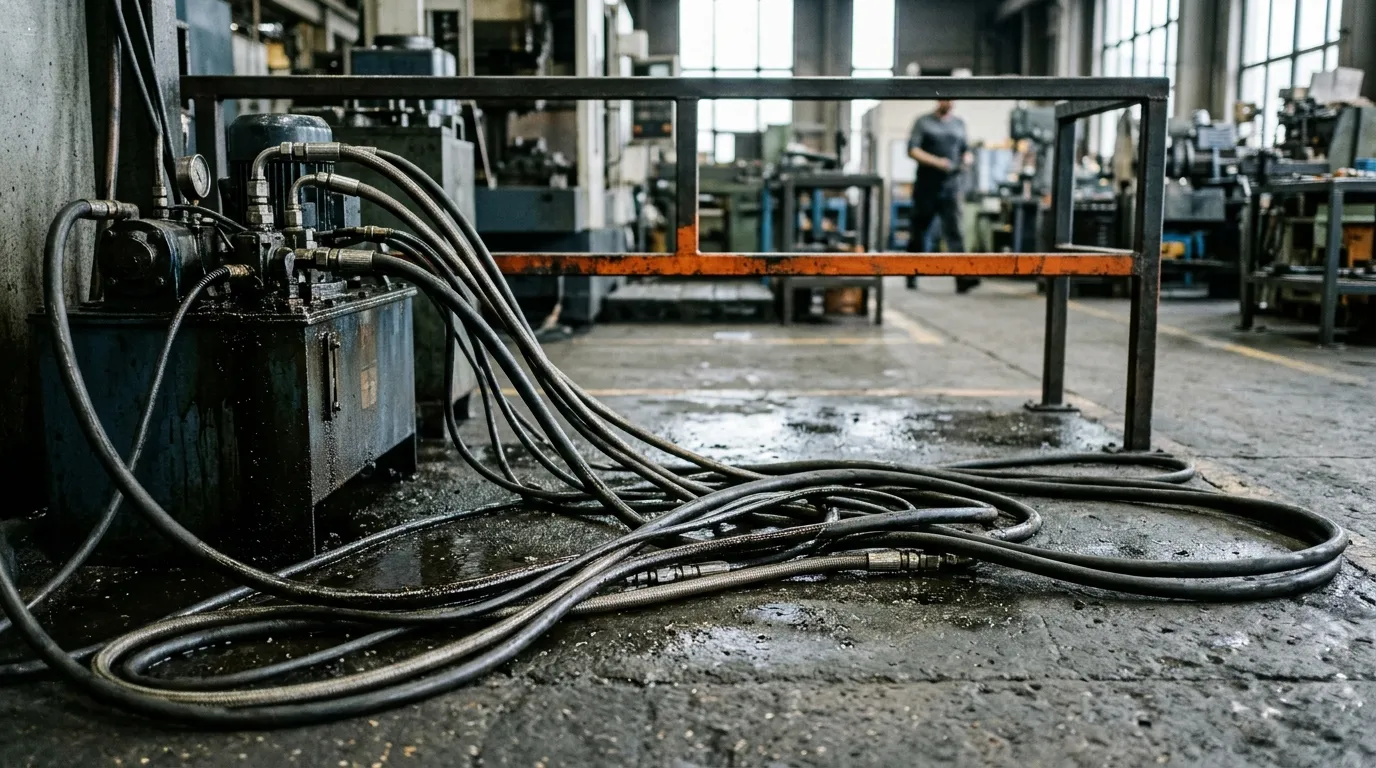
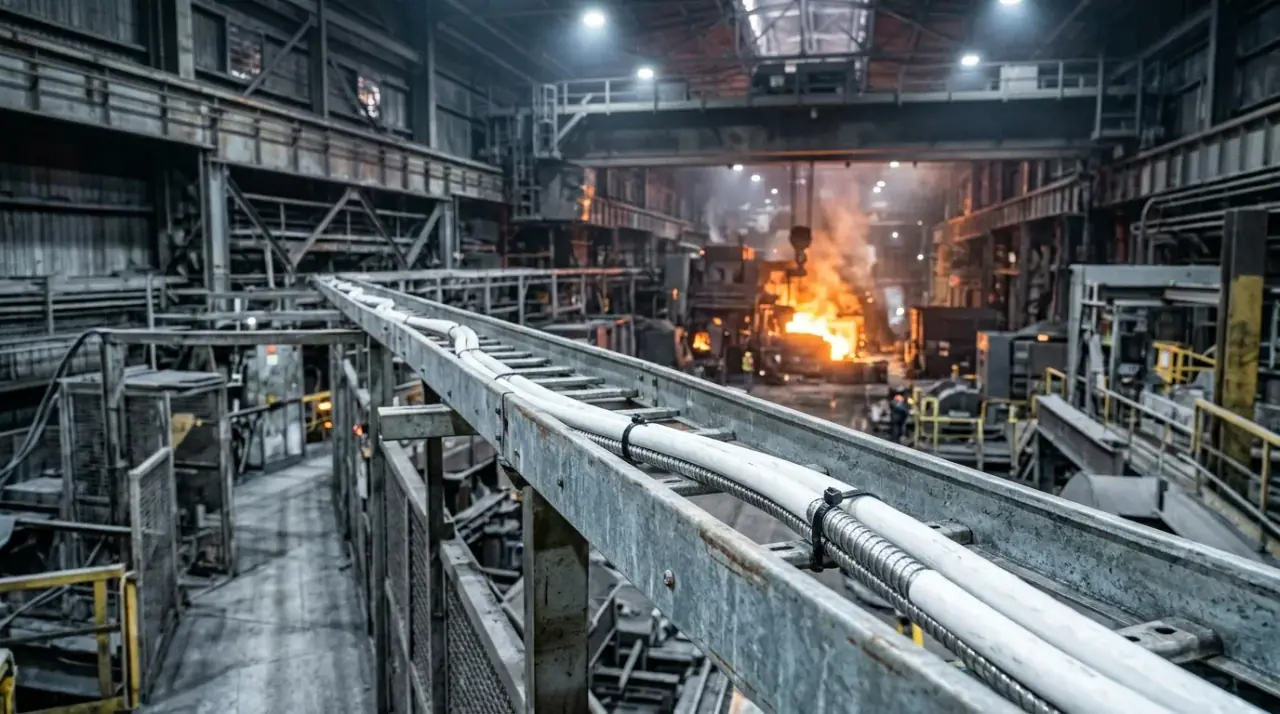
The exposure most industrial routes present: intermittent drips and splash on a floor that is never quite dry — closer to a wipe-down than to an immersion test.
Contact Mode Decides More Than Material Does
Before comparing polymers, compare how the chemical arrives. The same jacket that is adequate under occasional drips can be the wrong choice in a sump, and vice versa. Five contact modes cover most industrial routes, and each sets a different bar.
Contact mode | What the jacket actually sees | Failure mode if under-specified |
|---|---|---|
Continuous immersion | Permanent liquid contact, often warm; sumps, tanks, flooded ducts | Swelling, plasticizer or additive extraction, jacket softening, then water ingress at the core |
Frequent splash / washdown | Chemical plus mechanical action, then drying cycles | Surface cracking, hardening, loss of elongation, then cracking at bends |
Oil mist and vapour | Solvent-rich air, condensation on cold surfaces, no liquid pool | Slow surface degradation, gloss loss, gradual embrittlement |
Occasional drips | Localised stains, long dry periods | Usually tolerable — but the drip point is where a crack starts |
Fuel and hydraulic spray | Aggressive, low-viscosity, penetrating fluids at pressure | Rapid swelling and adhesion loss on the wrong compound |
A nylon inner jacket, for instance, resists hydrocarbons well but takes up moisture and changes dimension, which is why it is a thin barrier layer rather than the outer sheath on a wet route. Polyethylene is an excellent moisture barrier and a poor choice in a sump full of diesel, because both are non-polar hydrocarbons and the sheath will swell. Neither is "oil resistant" or "not oil resistant" in the abstract — the route decides which problem you have.
Routes that cross several modes at once are the hard ones: a refinery tray run that is dry for most of its length, splashed at the pump seals, and immersed where it dips into a pit. That is the kind of mixed exposure our oil and gas fiber optic cable selection guide works through zone by zone — mining galleries and offshore topsides present the same mix with different chemistry — and it is why a single material call rarely survives contact with an as-built drawing.
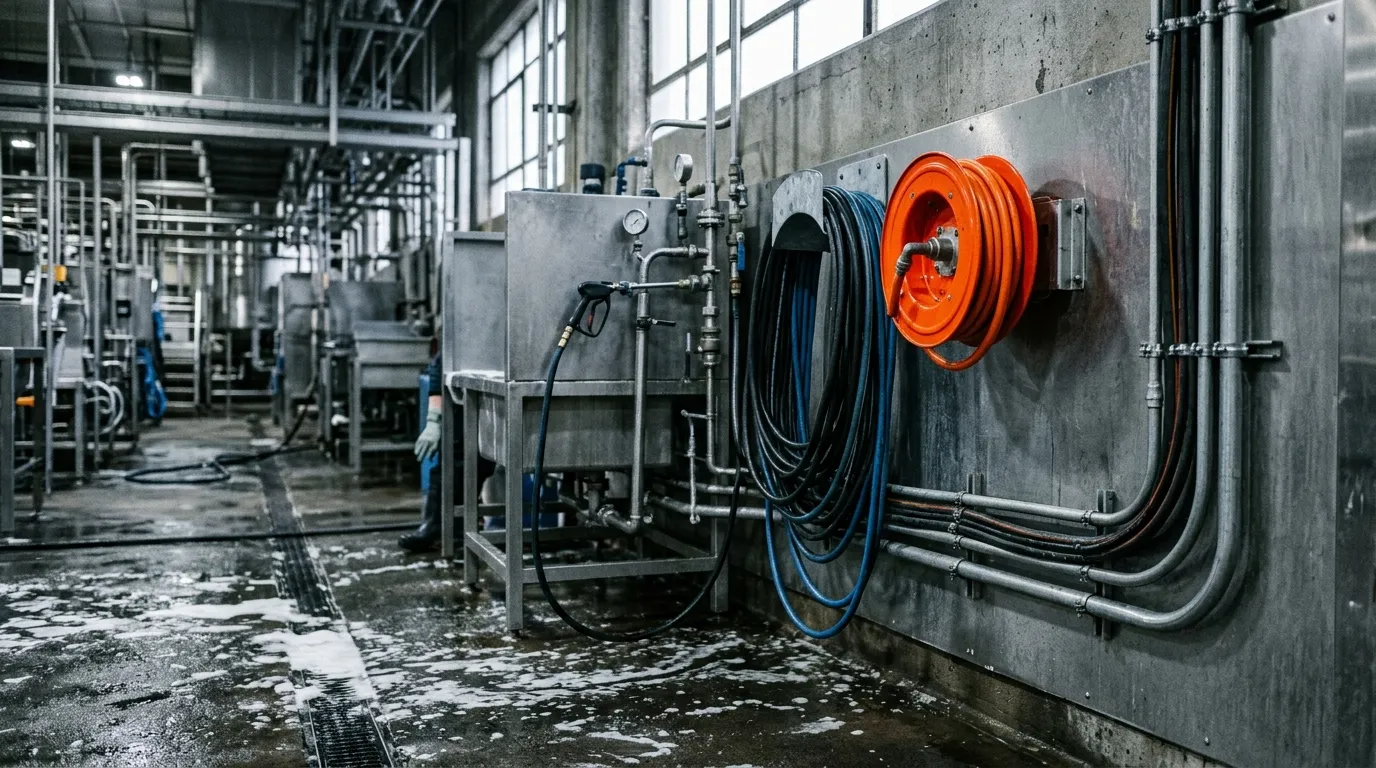
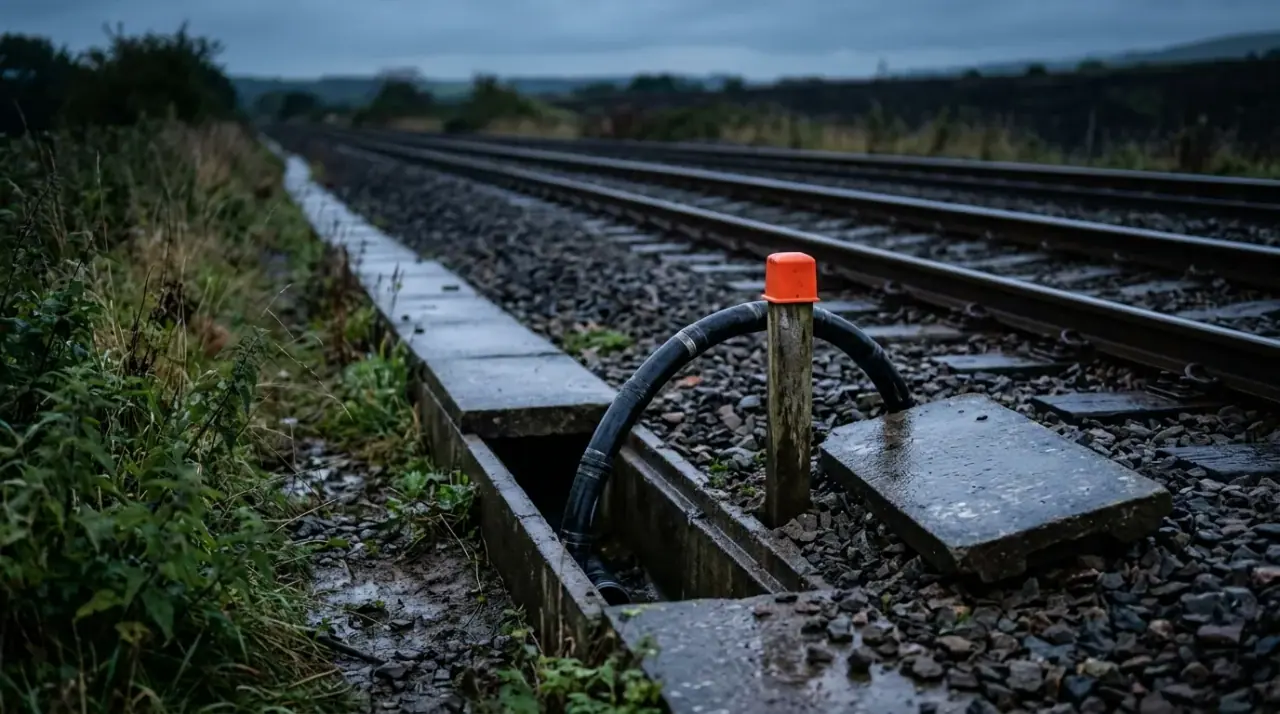
The mode most often left out of a jacket spec: chemistry, pressure and repeated drying cycles acting on the same route, year after year.
The Materials, Compared on the Axes That Matter
The table runs on three measurable axes — hydrocarbon resistance, acids and bases, water and UV — with temperature, flex and cost kept in the notes. It is deliberately qualitative: any table that puts a star rating on "chemical resistance" is hiding its test conditions.
Jacket family | Hydrocarbons (oil, fuel) | Acids / bases / solvents | Water and UV | Notes |
|---|---|---|---|---|
PVC | Moderate — good against many oils, but plasticizers are extracted | Moderate; poor against some solvents | Good UV; fair moisture barrier | Cheapest; stiffens in cold; halogenated |
PE / HDPE | Poor — swells in non-polar hydrocarbons | Good against acids and bases | Excellent moisture barrier; good UV with carbon black | The default outdoor sheath, not an oil sheath |
LSZH (polyolefin + mineral filler) | Compound-specific: often moderate | Moderate; varies widely by formulation | Fair; fillers raise water uptake | Chosen for fire performance, not for chemistry |
PUR / TPU | Good to excellent, including fuels | Good against many; weak against strong acids and hot water | Good; polyester types hydrolyse in hot wet service | Best abrasion and flex life; highest cost of the common four |
CPE | Good | Good, including many solvents | Good ozone and weather resistance | Common in industrial and washdown duty |
Nylon (PA) | Good | Moderate | Poor — absorbs moisture, changes dimension | Used as a thin inner barrier, not an outer sheath |
Fluoropolymer (FEP / PTFE / PVDF) | Excellent | Excellent, near-universal | Excellent | Cost and stiffness rule it out except where nothing else survives |
Polyethylene is the right answer to the wrong question. Outdoor cable after outdoor cable uses a PE sheath because it is the best moisture barrier available at the price, and it weathers well when it is carbon-black filled. The difference between MDPE and HDPE sheathing is worth knowing for that reason. But PE is a non-polar hydrocarbon, and so are diesel, kerosene and most lubricating oils: the sheath absorbs them, swells, and softens. A PE-sheathed cable run through a machine shop floor is an expensive way to learn polymer chemistry.
PUR is the right answer to a question people ask too early. Polyurethane handles oil, fuel and abrasion better than the other common thermoplastics, which is why it dominates drag-chain and robotics work. It is also the most expensive of the four, and the grade most often misapplied in hot wet service: polyester-based TPU is the one that hydrolyses under continuous steam or hot alkaline washdown, while polyether-based grades are what get specified for those routes. Specifications that say "PUR everywhere" buy performance they do not need in dry tray runs, and a liability in the washdown bay unless that distinction is written in.
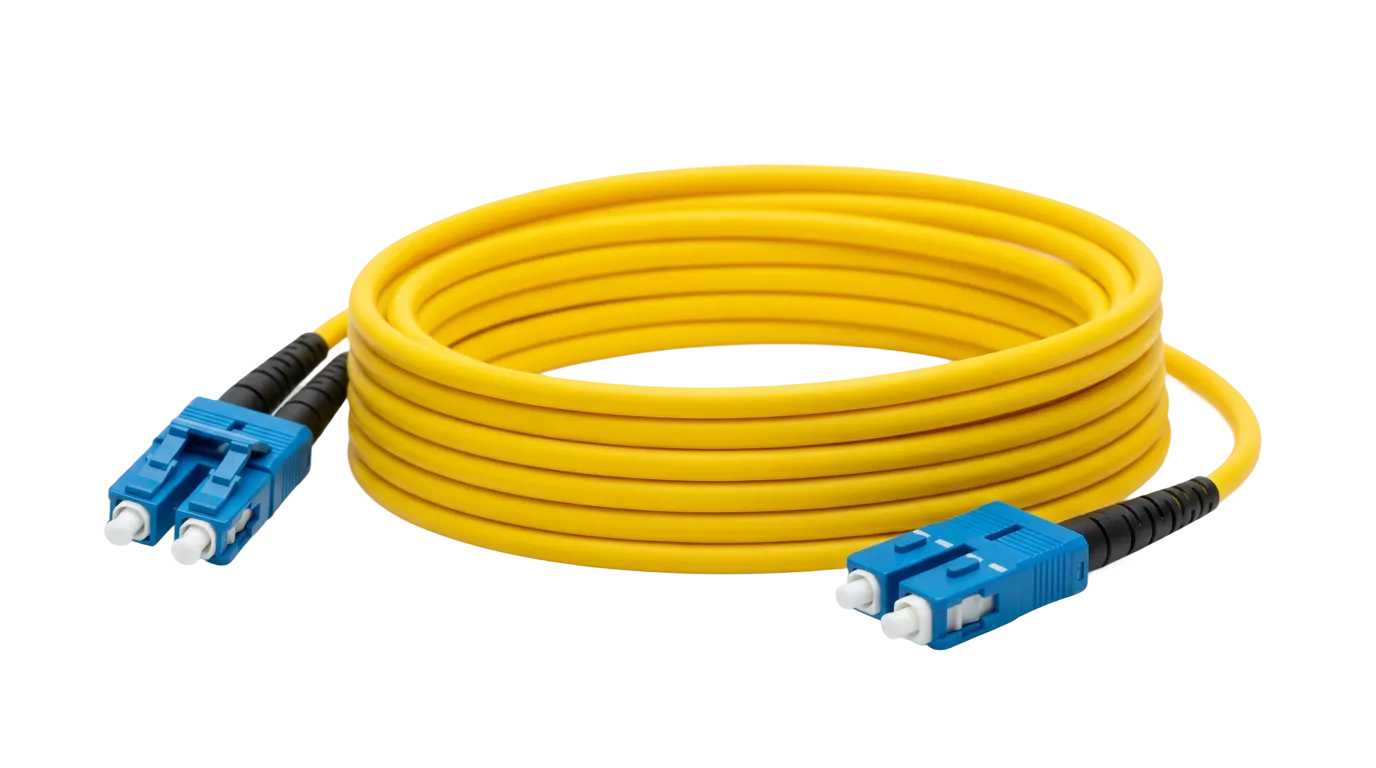
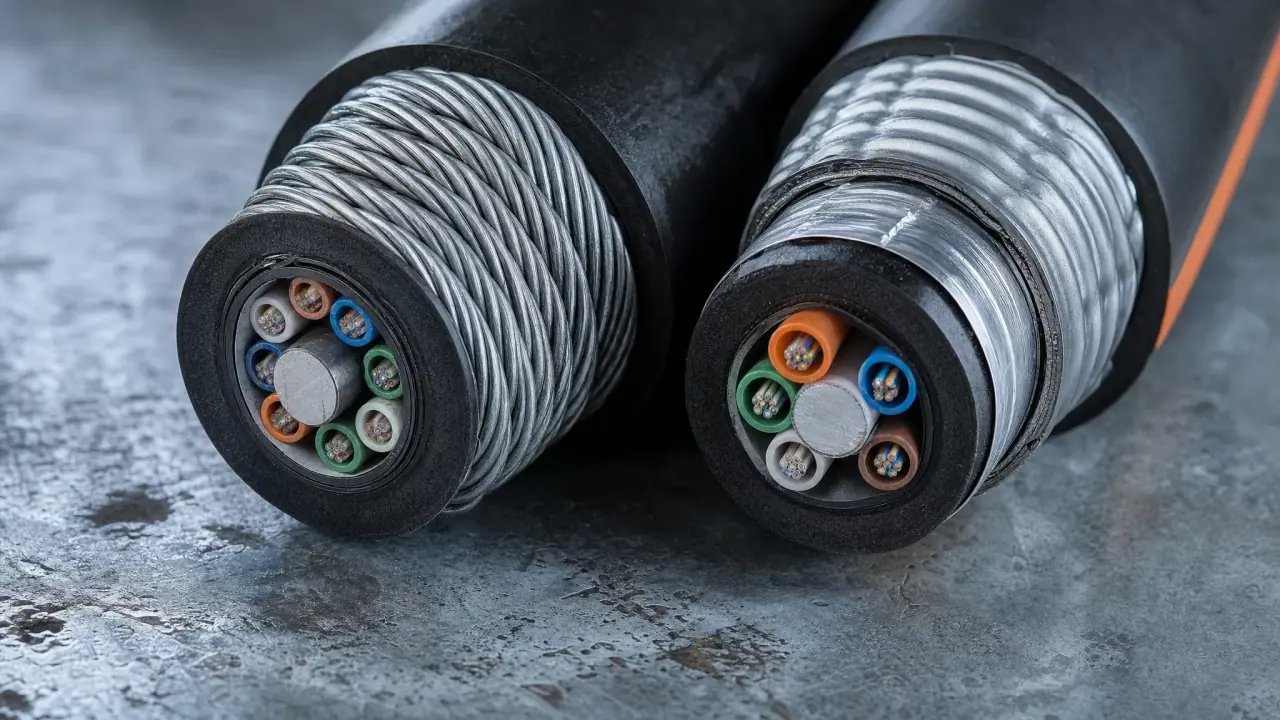
Where the jacket sits: the outer sheath is the last layer over the armor, the water-blocking fill and the loose tubes — it is the only layer the chemical actually touches.
Why Two LSZH Jackets Can Fail Differently
LSZH is not a polymer. It is a performance promise — low smoke, zero halogen — met by a family of compounds built on polyolefin or EVA base resins loaded with mineral flame retardants, usually aluminium trihydrate or magnesium hydroxide, at ratios high enough to change the mechanical behaviour of the jacket. That loading is why two cables both sold as LSZH can behave like different materials in the same oil. The fire-rating side of the same family question — where plenum ratings enter it, and how LSZH and PVC compare once smoke and code are counted — is set out in our guide to LSZH and PVC jacket differences; this section stays on the chemical side.
The filler is doing fire work, not chemical work. It releases water at temperature and dilutes the flame, and in exchange it raises stiffness, reduces elongation, and increases the compound's appetite for moisture. A 60% filled LSZH compound and a 35% filled one can pass the same flame test and still behave differently after a year in a wet, oily pit.
PVC has the mirror-image problem. Its oil resistance comes partly from the polymer's polarity — the carbon-chlorine bond makes it resist non-polar hydrocarbons better than PE does — but the flexibility comes from plasticizers, and oils and solvents extract them. The jacket does not dissolve; it hardens, shrinks, and loses elongation. Plasticizer loss shows up first at bends, where bending strain is highest, rather than in a straight run.
Both cases point to the same rule: the purchase specification has to name the compound and the test, not just the family. "LSZH" and "PVC" describe a starting point. They do not describe what the extrusion house actually ran as jacketing on the cable.
Temperature Is the Multiplier
Every chemical resistance conclusion in this article has an implicit temperature attached, and it is the variable most often left out of a requisition. Reaction and diffusion rates rise with temperature, so a compound that still holds, say, 80% of its elongation after a week in IRM 902 at 70 °C will not necessarily hold anything close to that at 100 °C. There is also no single standard condition to reach for: IEC 60811-404 fixes the method, while the oil temperature and immersion time come from the cable's own product standard. The jacket also softens as it approaches its service limit, which lets the fluid penetrate faster and lets the cable deform under tray pressure.
Which band the route actually needs is usually knowable from the plant, and it narrows the material list before chemistry does:
Service band | What commonly sits there | What changes at this band |
|---|---|---|
70 °C | Standard PVC, PE, LSZH, conventional PUR | The default band — most general-purpose jackets are qualified here, and most oil-resistance claims are written for it |
90 °C | Heat-stabilised PVC, cross-linked LSZH, PUR | Standard PVC needs a heat-stabilised compound; PE has dropped out of the set |
105 °C | Cross-linked polyolefin, CPE, heat-rated elastomer jackets | Thermoplastic PVC and PE are gone; the jacket is cross-linked or elastomeric |
125 °C and above | Fluoropolymer, silicone, speciality elastomers | The list narrows to a few families, and cost steps up sharply |
These are conventional service bands, not measured retention figures. The table says which families stay in the running at each band, not how much elongation they keep — and whichever candidate survives the band still has to clear the oil test at that temperature.
Practical consequence: take the temperature from the route, not the datasheet headline. A tray above a furnace duct, a cable clipped to a steam line, a run through an unventilated pump room — each runs hotter than the plant average, and that is the number to specify. Where the route genuinely runs hot, the jacket question becomes a different article: our guide to high-temperature fiber optic cable covers the constructions that survive sustained heat, and the chemistry discussion here still applies on top of it.
What Changes When the Cable Carries Fiber
Most jacket material advice online is written for copper. Fiber adds three constraints.
The jacket is part of the water defence. In a loose-tube cable, the sheath is the outer barrier in front of the water-blocking fill, the tube gel and the fiber itself. A sheath that swells and micro-cracks in oil lets moisture reach the fill, and moisture in a loose tube is a slow attenuation problem that surfaces months later as a link that will not pass its OTDR baseline. Water blocking buys time; it does not replace a sound sheath.
Stiffness propagates. LSZH's mineral loading makes the jacket stiffer, and on a tight-buffer cable that stiffness is felt at every bend and every connector boot. This is one reason construction and jacket have to be chosen together: the trade-offs between tight-buffered and loose-tube construction determine how much jacket stiffness the route can absorb before bend radius becomes the binding constraint.
Fire performance and chemistry pull in opposite directions. The facilities most likely to demand LSZH — enclosed process buildings, tunnels, platforms — are also the ones with the most chemical exposure. There is no single compound that maximises both; there is a compound tuned for your combination, which is what a specification conversation is for.
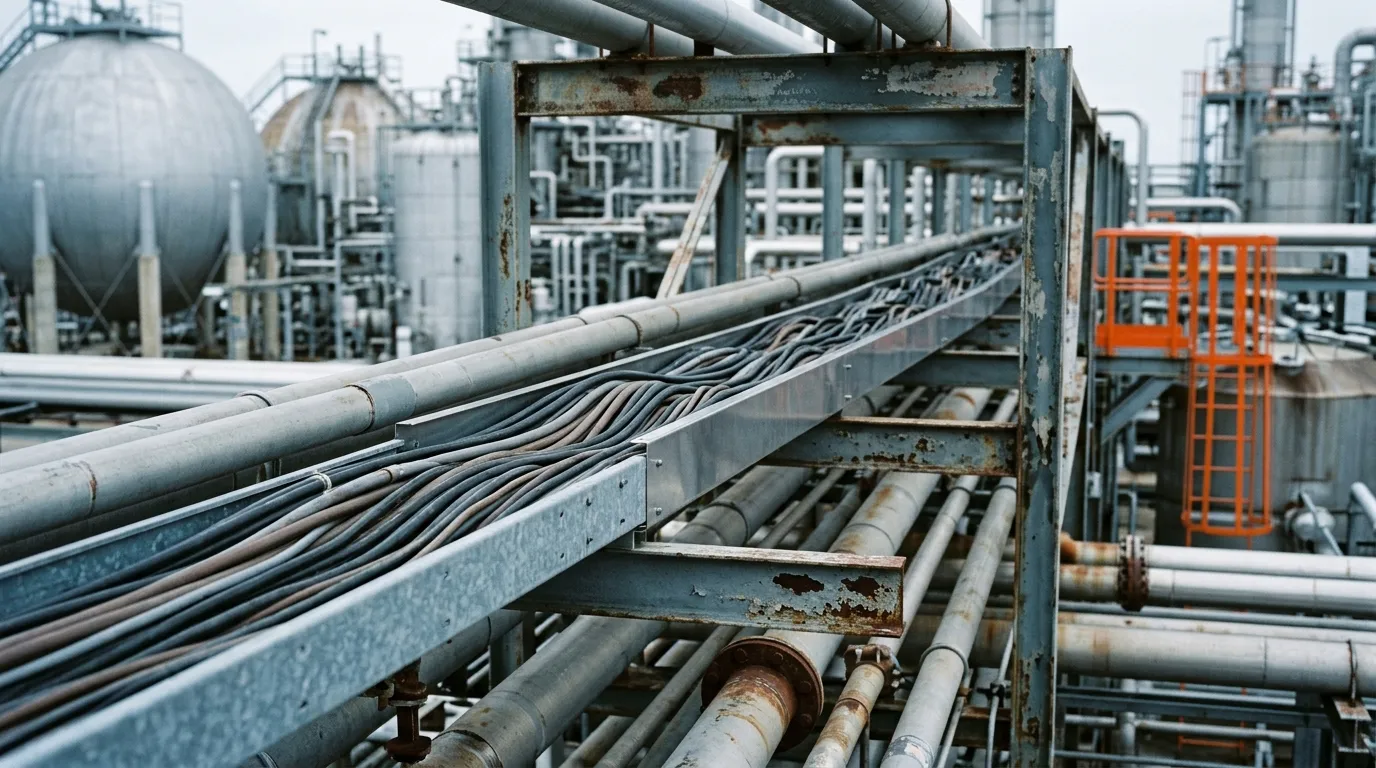
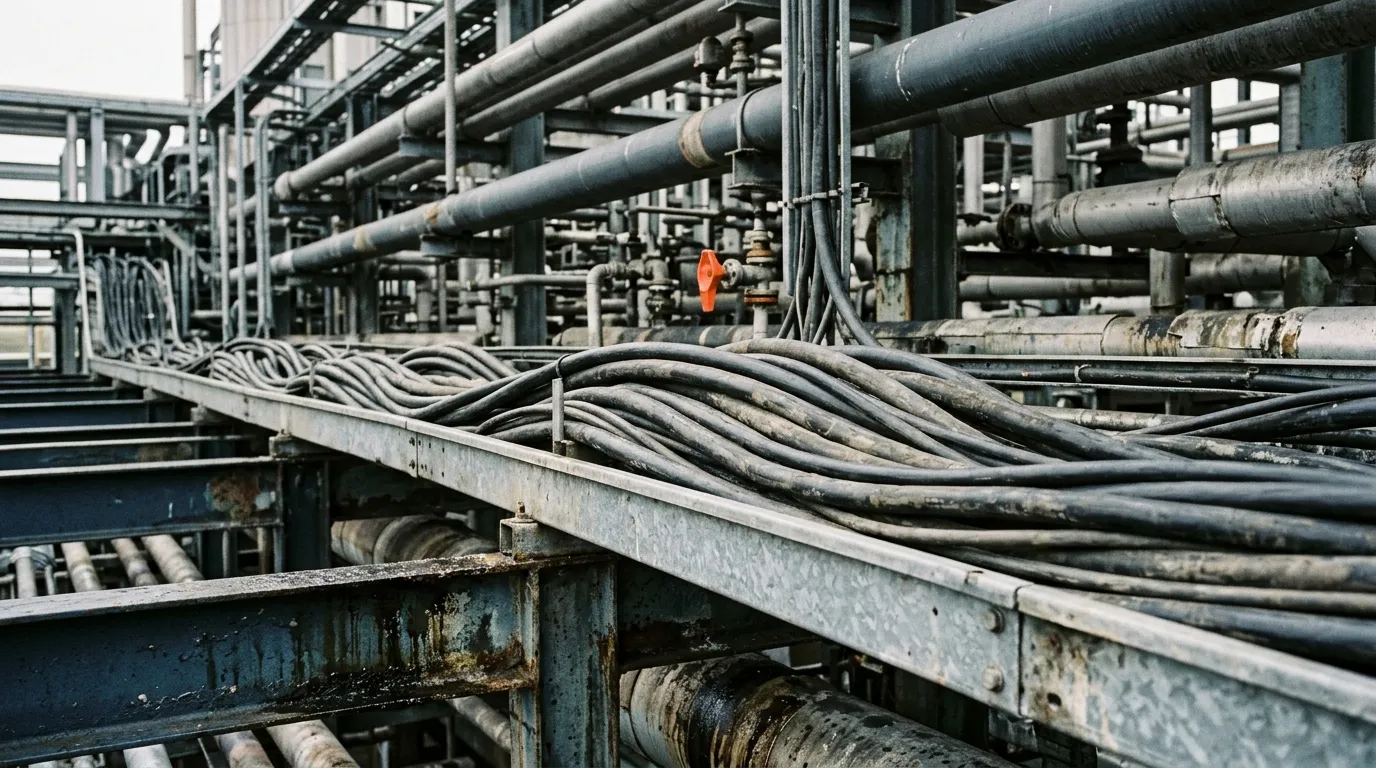
Bunched tray runs like this are why LSZH gets specified in the first place: the fire load is the bundle, not the single cable — and the same tray is exposed to the plant's chemistry.
The Tests Behind an Oil Resistance Claim
Once you know what to ask for, the documents are standard. Four references cover most of it.
- IEC 60811-404 — mineral oil immersion of sheaths, with the reference oil fixed by ISO 1817. This is the reference test for "oil resistant" in IEC-based cable specifications.
- ASTM D471 — the ASTM method for the effect of liquids on rubber and rubber-like materials: immersion, then measurement of volume swell, hardness and tensile change. This is where the swell numbers in a good datasheet come from.
- UL 1581 — the North American reference standard for electrical wires, cables and flexible cords, which carries the oil-resistance immersion tests used in UL listings. Its immersion clause names the same reference fluid as the IEC route — ASTM Oil No. 2, which is IRM 902 — so the two systems are calibrated against one oil even where they report different things.
- IEC 60794-3 — the outdoor optical fibre cable standard, which sets the mechanical and environmental requirements a fiber cable has to meet independent of jacket chemistry.
Two more apply when the jacket also does a fire job. Halogen content and combustion gas corrosivity are covered by the IEC 60754 series — IEC 60754-2 measures the acidity and conductivity of gases evolved during combustion — while flame spread of bunched cables is IEC 60332-3. On the North American side, the equivalent ratings are described in our guide to UL and NEC cable fire ratings.

What "oil resistant" is measured on: jacket samples soaked at a set temperature, then tested for retained tensile strength and elongation — not wiped and eyeballed.
A distributor chemical-resistance chart, such as the LAPP insulation and jacket materials chart, is a useful first filter for screening a fluid you have never met. Read it as a screening tool, not a qualification: those charts aggregate manufacturer data at unspecified temperatures and concentrations, and the good ones say so. The general classification of jacket compounds into thermoplastics and thermosets, and what each does under heat and load, is set out in distributor references such as Wesco's jacket selection guide for harsh environments.
Writing the Spec: Six Fields That Settle It
Fill in these six lines and the material choice usually makes itself.
- Fluid, named. Not "oil" — the actual product or its class: diesel, hydraulic ISO VG 46, 30% caustic, produced water, glycol. If several, list them and rank by volume and contact time.
- Contact mode and duration. Continuous immersion, daily washdown, mist, or occasional drip. Include the proportion of the route in each.
- Temperature at the jacket, not the plant ambient, plus any short-term peaks during cleaning or upset.
- Mechanical duty. Static tray, flexing, drag chain, or repeated handling — this is where PUR earns its cost.
- Fire and smoke requirement. Whether the route is inside a building, a tunnel or a classified area, and which rating the authority having jurisdiction expects.
- Evidence required. The type-test report for the exact construction, not the family: oil immersion result with fluid and temperature stated, flame test report, and lot-level optical data.
Sent to a manufacturer instead of "what oil resistant cable jacket do you sell", those six change the conversation from adjectives to data. TTI Fiber's engineering team builds armored, LSZH and outdoor fiber optic cables to IEC construction standards and answers these questions with type-test reports; the fastest way to start is to send them your exposure list — fluids, temperatures, contact modes, and whether the route is tray, duct, buried or flexing.
Which Jacket for Which Job
The scenario calls, stated plainly, including where TTI is not the answer:
- Dry indoor tray in a process building, fire rating required: LSZH, with the flame test report for the bunched construction. Accept the stiffness and specify the bend radius accordingly.
- Outdoor, buried or duct, water is the enemy and oil is not: PE or HDPE sheath over armor. Do not pay for oil resistance you will never test.
- Machine shop floor, hydraulic drips, flexing: PUR. Nothing else in the common set combines the oil resistance with the flex life.
- Chemical washdown bay, food or pharma adjacent: CPE or a purpose-formulated LSZH compound, chosen on the actual cleaning agents rather than on the word "chemical".
- Sump, pit or any continuous immersion: specify the immersion test and the retention figure, then choose between CPE, PUR and a jacketed-and-sheathed construction. The material name alone will not decide it.
- Hot, solvent-rich, and nothing survives: fluoropolymer, at fluoropolymer cost, on the shortest possible length.
Oil- and Chemical-Resistant Jacket FAQ
Is a PE jacket oil resistant? Not in any useful sense. Polyethylene is a non-polar hydrocarbon and swells in oils and fuels. It is an excellent moisture and UV barrier, which is why it is the default outdoor sheath — a different job.
Is LSZH oil resistant? It depends entirely on the compound. LSZH describes smoke and halogen performance, not chemical performance; the mineral filler loading that delivers the fire result is also what makes one LSZH compound behave differently from another in oil.
Does "oil resistant" mean oil proof? Resistance is relative to fluid, temperature and time, expressed as retained mechanical properties rather than as an absolute.
Can I test a sample before buying a drum? Yes — for an unfamiliar fluid it is the cheapest step: a short immersion of a cable sample in the actual fluid at the actual temperature, followed by a bend and an elongation check, tells you more than any chart.
The short version: name the fluid, the temperature and the contact mode, then ask for the test that proves the claim. The material follows from those answers, not the other way round.