Steel Wire Armored vs Double Armored Cable
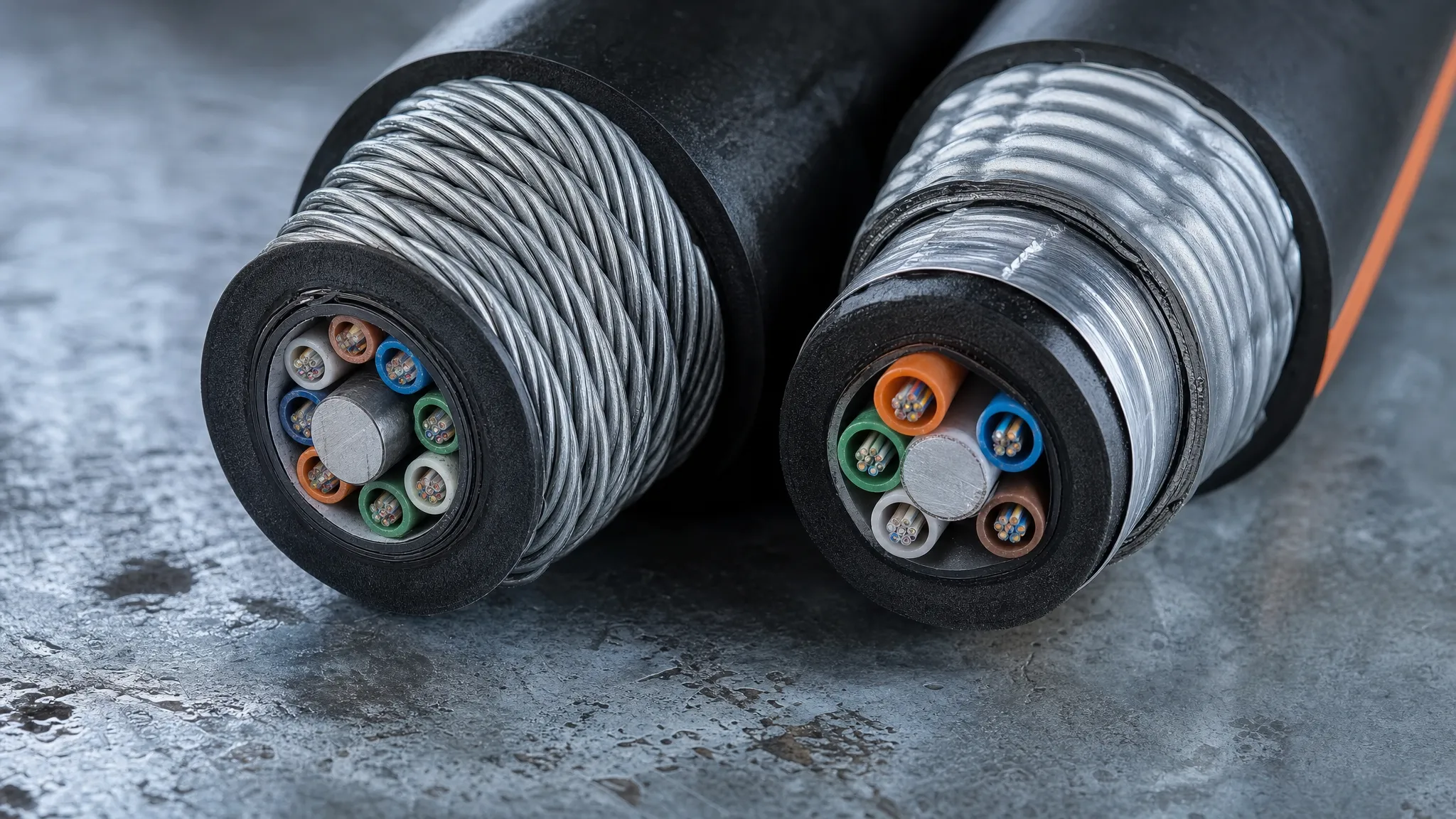
If you are choosing between steel wire armored and double armored cable, you are really choosing between two answers to two different threats. Steel wire armor generally provides higher tensile and crush ratings than a tape-only build; a two-layer construction can improve mechanical and environmental protection, but moisture blocking depends on the cable’s dedicated water-blocking system — such as APL, filling compound or water-swellable materials — not on the label “double armored” alone. Neither is the "stronger" cable in the abstract, and the companies that sell both will tell you so. The decision is a short list of questions: how much pull does the route impose, what crush load sits on the cable, is the soil wet, and is anything alive down there that chews.
This is a working comparison for specifiers, not a product pitch. It defines both terms, puts their numbers side by side, and ends with the scenarios that decide it — plus the two failure modes that cost more than the armor.
Steel Wire Armor vs Double Armor: What Each Term Means
The confusion starts with marketing. "Double armored" is used loosely, so pin the vocabulary before the comparison.
Steel wire armored (SWA). Round galvanized steel wires are laid helically around the cable core, under the outer jacket. In the YD/T 908-style model nomenclature used for these GY cables, the suffix 33 denotes fine round steel-wire armor with a PE sheath, 43 denotes coarse round steel-wire armor with a PE sheath, and 333 denotes double fine round-steel-wire armor with a PE sheath. Because manufacturers may vary their notation, confirm the actual construction and ratings on the product datasheet. Wire armor is the strongest of the standard armor types because each wire shares the load.
Double armored. Two separate armor or barrier layers live between the core and the outer sheath. There are two common builds:
- Steel tape + aluminum laminate (APL). A corrugated steel tape is applied over an aluminum–polyethylene laminate. This is the direct-burial default, sold as GYTA53; the model code steps are
53= corrugated steel tape and3= outer PE jacket. - Steel tape + steel wire. A wire layer is added on top of the tape. This is written GYTA53+33. In a GYTA53+33 construction, the APL and other dedicated water-blocking elements provide longitudinal moisture protection, while the steel tape and steel wire provide mechanical protection. The exact layer sequence and ratings must be confirmed against the product datasheet.
So "double armored" and "steel wire armored" are not opposites. The +33 build is both. The real comparison is wire armor alone versus a two-layer build, and the practical version is GYTA53 versus GYTA53+33 for anything that gets buried.
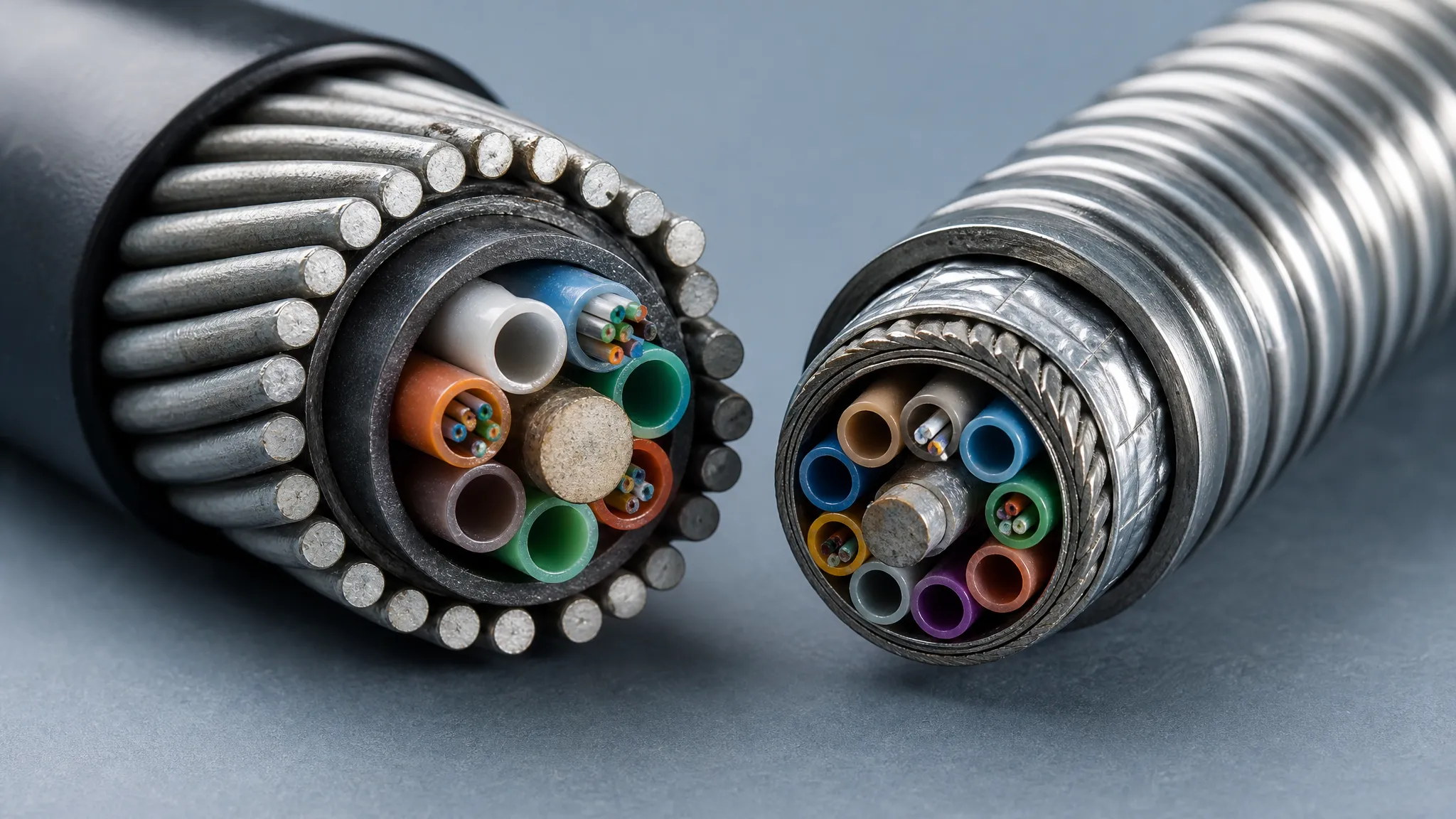
Two construction families, different layer stacks: round wires share the pulling load, while a tape-plus-APL build combines dedicated longitudinal water blocking with distributed mechanical protection.
The underlying rule-set is not vendor-specific. The IEC 60794 series separates a cable's transmission properties from its mechanical and environmental properties, which is why the same ITU-T G.652 glass sits inside either build — armor is a mechanical layer, and it is specified separately. The general anatomy of those layers is described in the FOA's fiber optic cable reference, and our own industrial fiber optics hub collects the selection guides that go with it.
Mechanical Protection: Tensile Load and Crush
This is where the numbers separate the two, and where most "which is stronger" arguments actually resolve.
Build | Typical armor | Tensile (short term) | Crush (short term) | Typical role |
|---|---|---|---|---|
Single corrugated steel-tape and PE-sheath build (GYTS) | Corrugated steel tape | Approximately 2,000 N short-term | Approximately 3,000 N/100 mm short-term (representative; confirm supplier datasheet) | Duct, aerial, and supplier-approved light direct burial |
Steel tape, double sheath (GYTY53) | Steel tape | ~3,000 N | ~3,000 N/100 mm | Economy burial |
Double armored tape + APL (GYTA53) | Steel tape + aluminum laminate | ~3,000 N | ~1,000–3,000 N/100 mm | Standard direct burial |
Double armored tape + wire (GYTA53+33) | Steel tape + steel wire | ~10,000–20,000 N | ~8,000 N/100 mm | Water crossing, deep burial |
(Representative catalog values; confirm against your supplier's datasheet — see the checklist below.)
Two things stand out. First, the jump from a tape build to a wire build is not incremental — it is roughly a four- to six-fold increase in short-term tensile rating and a several-fold increase in crush, because round wires are wound to carry load rather than to wrap a core. AFL's published specification for its high-strength wire armor reports the same shape of result: a near ten-fold gain in tensile performance, a two-fold gain in crush, and a three-fold gain in impact energy over traditional steel tape. Second, double armor without wire does not raise tensile rating much — GYTA53's ~3,000 N is close to a light-armored tape cable's. Its payoff is the stack, not the pull.
That is the single most useful sentence in this article: If pulling tension is the governing concern, select a cable whose verified tensile rating meets the calculated installation load. Steel-wire armor is one common way to obtain higher tensile and crush performance, but it is not the only possible high-strength construction. If water ingress and soil point loads are the governing concerns, a double-layer build may be appropriate; select it against the route conditions and the cable’s verified water-blocking and mechanical ratings, with wire armor added only when the calculated loads require it.
A second axis is impact versus static load. Tape resists a point load spread over its width; wire resists it as individual strands that can also recover. Under the backfill of a roadbed or against a rock edge, the wire layer is what keeps the loose tubes from being pinched into microbending loss.
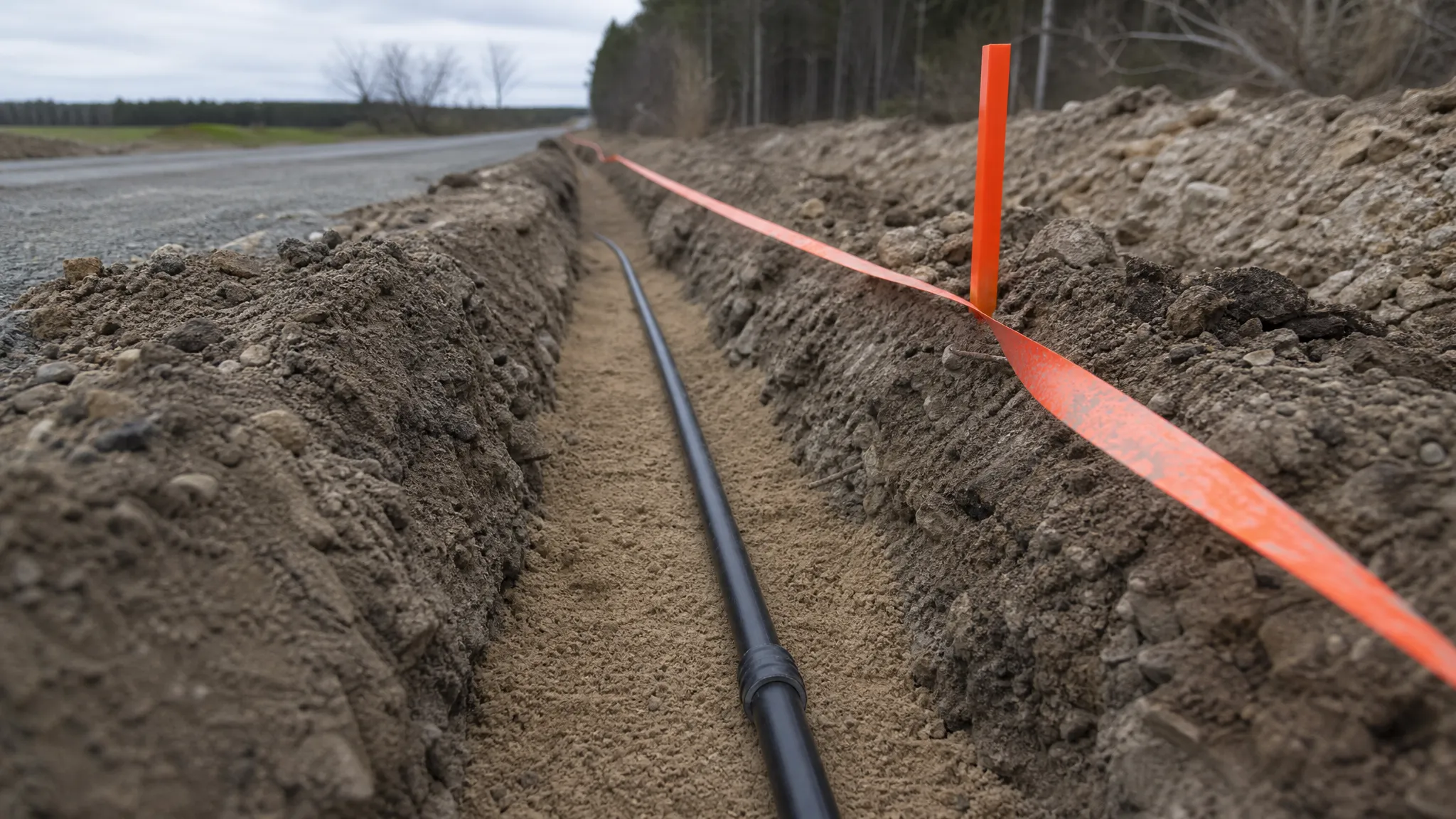
Direct burial is a crush-and-water problem before it is a tension problem — which is why the double armored tape build, not wire, is the default here.
Rodents: What Actually Stops a Gnaw
Rodent attack is one of the hazards that cable armor exists to defeat, and the countermeasure is a metal layer — not a thicker jacket. Optical fiber cable is armored specifically to resist hazards that include gnawing animals.
Both armor types deter rodents, and neither is a guarantee. Steel tape presents a continuous, hard, smooth surface that a rodent has to get through before it reaches anything; wire armor presents individual strands with gaps between them, which in practice a determined rodent can work at. Where chewing is the dominant, recurring failure — rural and agricultural routes, warm ducts — the extra answer is a non-metallic glass-yarn layer between the sheaths (our GYTY53 and SLTN RP builds specify it as the anti-rodent layer), used with or without metal armor.
Practical rule: for rodent pressure alone, a steel-tape double armored cable is usually sufficient; add wire when the same route also carries high tension or extreme crush. Do not armor "to be safe" — see the mistakes section.
Water: Where Double Armor Earns Its Keep
Armor protects against mechanical damage; it does not replace the cable's water-blocking system, which is why the double armored build separates the two jobs.
- Longitudinal blocking comes from the gel- or dry-filled loose tubes and, in the APL builds, the aluminum laminate that runs the length of the core.
- The steel tape then sits over that barrier, between an inner and an outer sheath, so the tape itself is encapsulated and cannot corrode freely in wet soil.
A GYTS-type cable uses a single corrugated steel-tape and PE-sheath construction and is commonly used for duct, lashed-aerial and some light direct-burial applications. For direct burial, do not approve or reject it by model name alone; verify the manufacturer’s stated installation class, water-blocking system, jacket protection, crush and tensile ratings, and applicable product specification. This is the structural distinction that vendors' selection guides spell out: a dual-jacket, dual-armor build amplifies the positives (crush and impact resistance) precisely because the layers are separate. Sterlite's selection guide for optical cable puts it plainly — dual jacket with dual armor "provides best crush and impact resistance as compared to a single jacketed cable," and is used for increased protection in direct-buried, high-rodent areas.
Bend Radius, Weight, and Installation
The armor that adds protection also adds stiffness, mass, and handling work — and this is where steel wire armor is most often oversold.
- Bend radius. Wire armor lays as a stiff cylinder of parallel strands; the minimum bend radius is larger than for a tape build of similar core. A tape build bends more easily. If the route has tight pulls, a handhole at every change of direction, or a machine bend, tape is friendlier.
- Weight. Wire armor is the heaviest standard build. It raises reel weight, drum length limits, and the handling burden on site.
- Splicing and preparation. Both builds are harder to prepare than a single-jacket cable; the dual-jacket, dual-armor stack is the most labor-intensive, because sheaths and armor layers must be cut back in sequence without nicking the tubes. Sterlite's guide warns exactly that a dual-jacket dual-armor cable is "heavier, stiffer, and more labor intensive to prepare for splicing than a single jacket cable."
- Bonding and grounding. Metallic armor is electrically conductive and may require bonding, grounding or isolation measures under the applicable electrical code, utility requirements and project design. Near power infrastructure, assess induced voltage and fault-current exposure; do not assume a universal grounding arrangement or that both ends must always be earthed. Use an all-dielectric design where the project requires no conductive path.
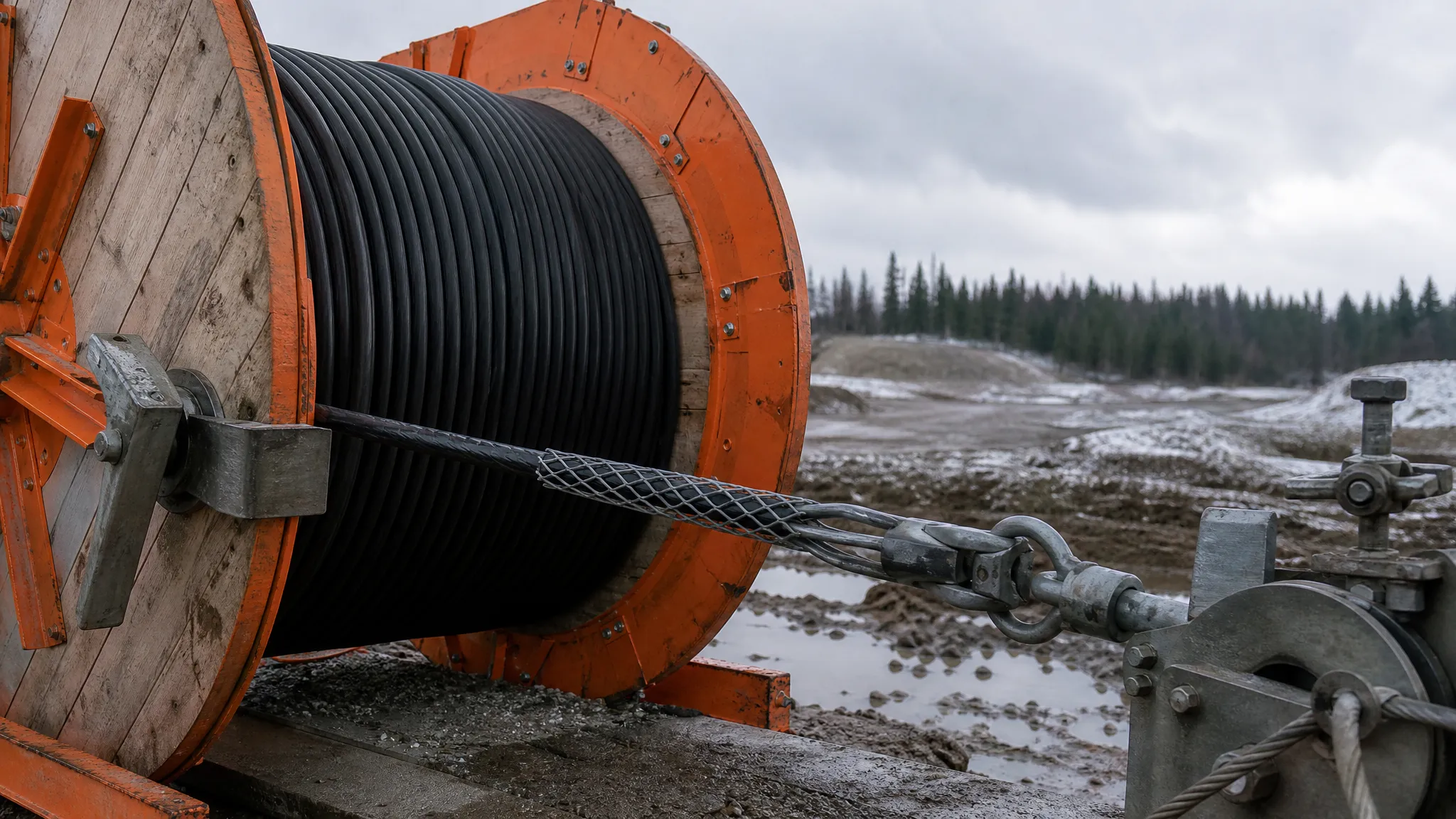
Wire armor buys tensile rating at the cost of stiffness and weight — the trade is real on the reel, not just on the datasheet.
Quick Comparison
Steel wire armored (SWA) | Double armored (tape + laminate, or tape + wire) | |
|---|---|---|
Layers | One wire armor layer | Two armor/barrier layers |
Tensile strength | Very high | High (tape+APL) to very high (tape+wire) |
Crush resistance | Very high | High to very high |
Rodent resistance | High | High (tape surface; +glass yarn option) |
Water blocking | Depends on the complete construction | APL applies to GYTA53-type builds, not every tape-plus-wire design. |
Bend radius | Largest (stiffest) | Moderate (tape) to largest (with wire) |
Weight & cost | Highest | Lower (tape+APL) to highest (tape+wire) |
Typical use | Heavy tension, water crossings, steep or vertical pulls | Standard direct burial (tape+APL); deep burial and crossings (tape+wire) |
Which to Choose: A Scenario Decision
Work down the route, not the catalog.
Scenario | Recommended construction | Why |
|---|---|---|
Duct / conduit, aerial with messenger | Single steel-tape build (GYTS-class) | Conduit crush is light; wire adds only cost |
Standard direct burial | Double armored tape + APL (GYTA53-class) | APL water block + tape crush, at moderate weight |
Economy direct burial, dry soil | Steel tape in a double sheath (GYTY53-class) | Tape crush plus a second sheath; lower cost than an APL build |
Deep burial under roadbed | Double armored tape + wire (GYTA53+33-class) | Crush loads exceed a tape-only envelope |
River, canal, lake crossing | Double armored tape + wire | High tension plus crush, often installed by pull |
Substation / near power assets | Non-metallic or bonded short run | Metallic armor needs a grounding scheme |
Two rows are worth isolating. Water crossings and steep pulls may justify a wire-armored build when the calculated installation or service loads exceed the tape-only rating. For a lake or river crossing, verify that the specific cable and installation design are qualified for the water depth, current, abrasion, bend radius, water blocking and pulling or laying method; do not infer suitability from the GYTA53+33 code alone. Standard burial is the double-layer tape row — the GYTA53 double armored cable exists for the ordinary direct-buried trunk where moisture, not tension, is the enemy. If the route crosses one of the harsh applications rather than a plain trench, the selection logic for that environment is covered in the wider guide to outdoor armored fiber optic cable types, the underground burial versus duct versus aerial comparison, and the environment-specific notes in our mining cable guide and the broader industrial fiber optic cable guide.
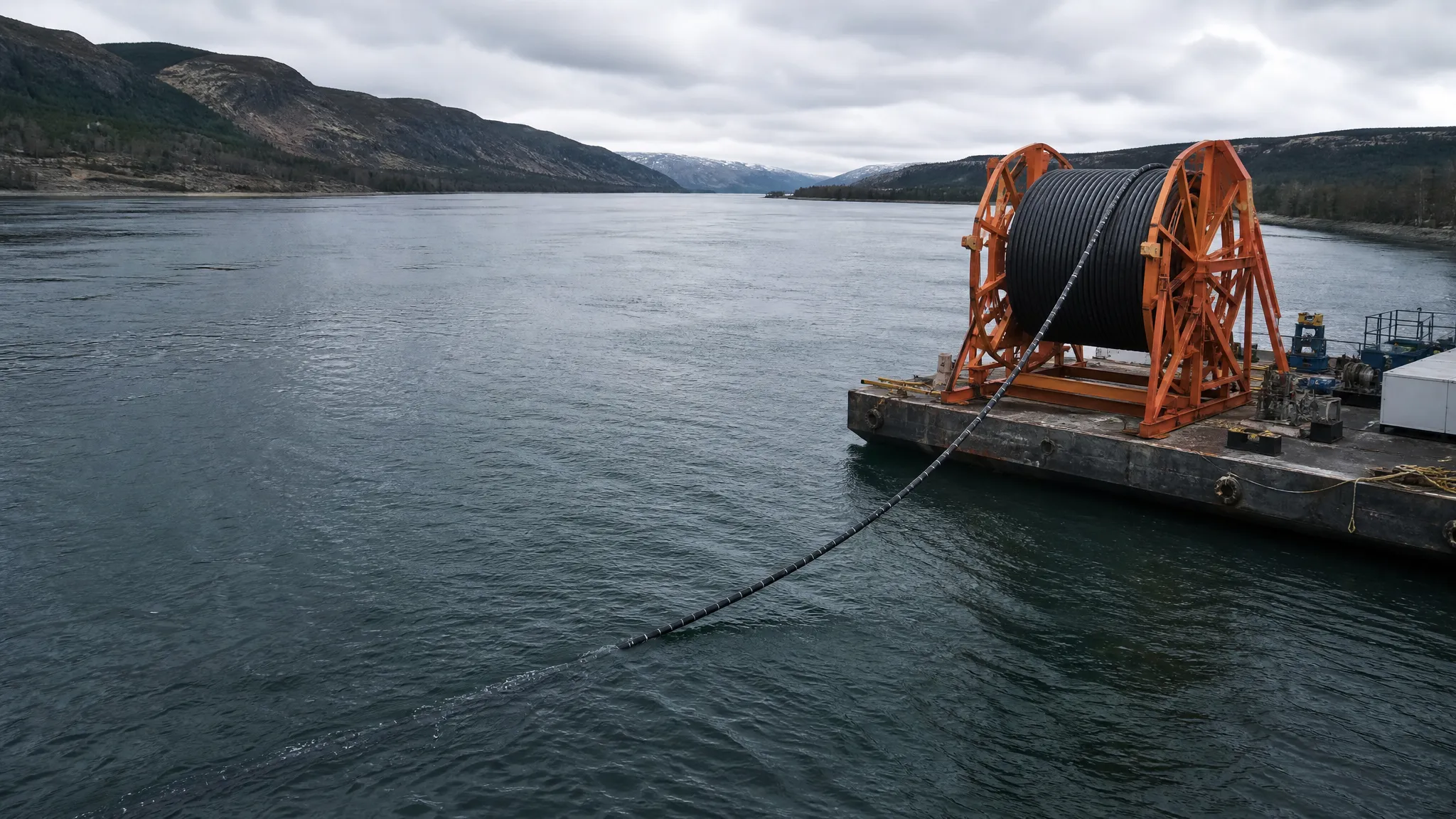
Water crossings can be a strong case for wire armor when the calculated installation loads and environmental exposure exceed the capability of the selected tape-only design. The cable type must still be matched to the crossing method and project specification.
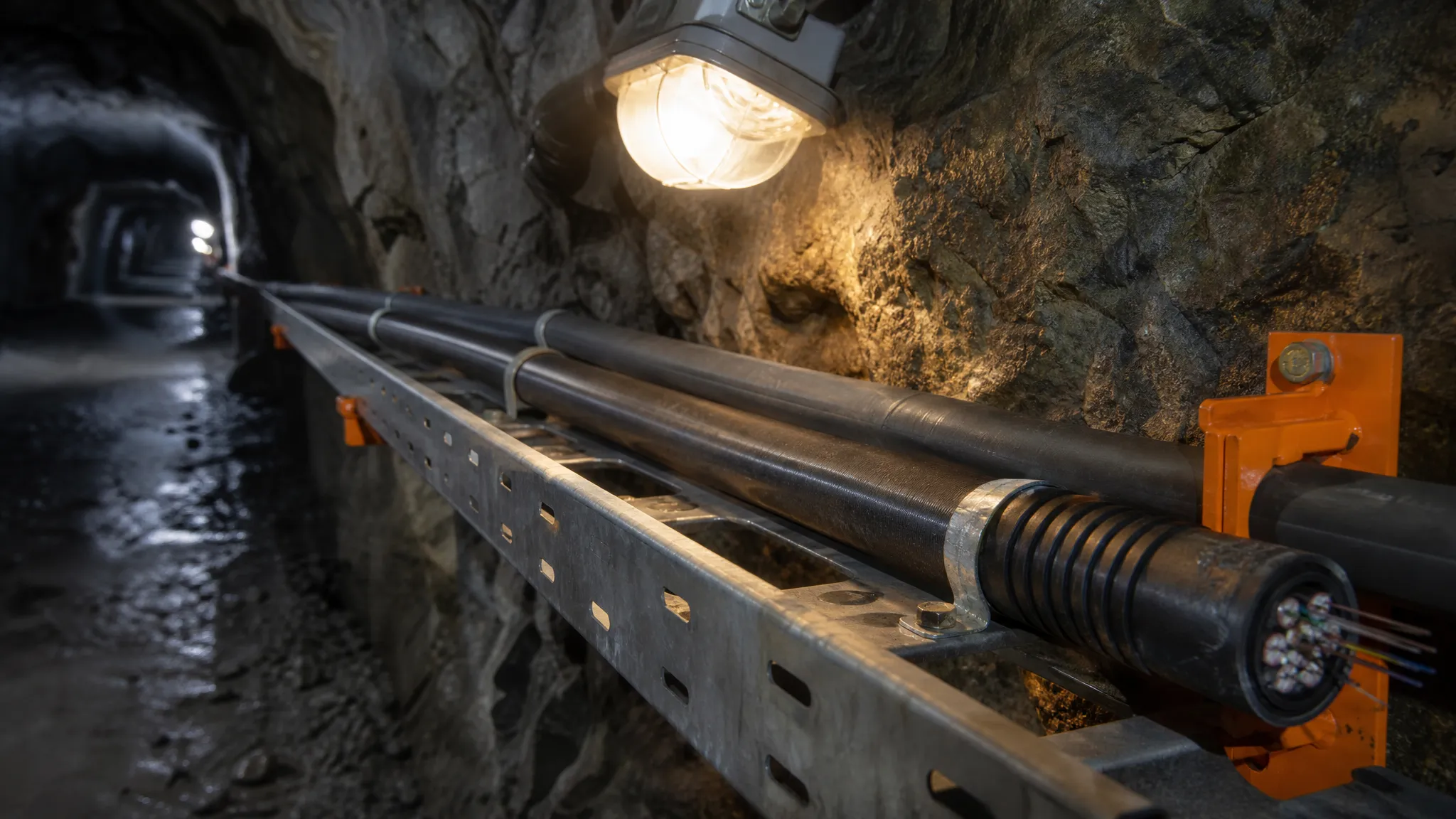
Underground mines combine crush, tension, water, rodents, movement and fire-safety requirements. Select a mining-specific or project-qualified construction against all of these conditions; a generic SWA or GYTA53 label is not sufficient by itself.
What to Verify on the Datasheet
The model code names the family; these numbers decide whether the cable survives your route:
- Armor type and code —
33,43,53, or a+combination. Confirm it is what you asked for, not what the code implies. - Tensile rating (N) — short-term (installation) and long-term (service), both. The short-term figure must exceed your maximum pulling tension with margin.
- Crush rating (N/100 mm) — the static load the cable survives without attenuation change.
- Minimum bend radius — stated for static and dynamic (pulling) conditions separately.
- Water blocking — gel or dry core, plus the longitudinal barrier (APL or equivalent).
- Standards and detail specification — use the applicable IEC 60794-3 outdoor-cable specification or national/detail specification. Mechanical claims should identify the relevant test method, such as the tensile, crush and impact methods in IEC 60794-1-21 or its current cross-reference, together with the load, duration and acceptance criteria.
- Fiber spec — G.652D single-mode is the outdoor default.
- Bonding, grounding or isolation provision — the required connection points and mitigation method defined by the applicable code and project design; do not assume that both ends must be grounded.
IEC 60794-1-1 provides the general framework, while the applicable outdoor-cable specification and mechanical or environmental test methods define how each rating is verified. Ask for the test method, load, duration and acceptance criteria behind every tensile, crush and environmental value.
Mistakes That Cost More Than the Cable
Using a GYTS cable for direct burial without checking its rated installation class and construction. Some GYTS designs are suitable for light direct burial, while others are intended mainly for duct or aerial use. Confirm the cable’s water blocking, jacket structure, crush rating, tensile rating and manufacturer-approved application before burial.
Specifying steel wire armor "to be safe." Wire armor stiffens the cable, enlarges the bend radius, raises weight, and adds splice time. If the governing threat is moisture or rodents on a normal buried route, a tape-based double armored cable is the correct and cheaper call.
Treating the moisture barrier as armor. The APL laminate blocks water; it does not spread point loads. The two layers do different jobs and both are needed in a direct-buried double armored cable.
Forgetting to bond the armor. Metallic armor near power infrastructure requires an engineered bonding, grounding or isolation scheme based on the applicable code, utility requirements and induced-voltage assessment. If a conductive path cannot be safely managed, choose a fully dielectric construction rather than leaving the armor unaddressed.
Trusting the model code alone. Codes vary between manufacturers and editions of the standard. Confirm armor type, tensile, and crush against the datasheet every time.
FAQ
Is double armored stronger than steel wire armored? Not in tensile terms. A double armored tape build (GYTA53) has tensile capacity close to a light tape cable — its strength is the two-layer moisture-and-crush stack. Steel wire armor carries the highest tensile and crush ratings. The strongest option combines them: a tape-plus-wire double armored build (GYTA53+33).
Is steel wire armored cable the same as double armored cable? No, though they can overlap. "Steel wire armored" describes the armor material — round steel wires. "Double armored" describes the layer count — two protective layers. A tape-plus-wire cable is both wire armored and double armored; a tape-plus-laminate cable is double armored but not wire armored.
Which is better for direct burial? For a standard buried trunk, a double armored tape-plus-laminate cable is the usual answer: it blocks water along the length and resists soil crush without wire's weight. Reach for wire armor when the burial is deep under a roadbed or the route crosses water.
Does armored fiber cable need grounding? Metallic armor — tape or wire — may require bonding, grounding or isolation according to the applicable electrical code, utility requirements and project design, especially near power infrastructure. If a conductive path cannot be safely managed, consider a fully dielectric or non-metallic construction.
What do the numbers 33, 43 and 53 mean? Under the YD/T 908-style nomenclature used for these GY cables, 33 denotes fine round steel-wire armor with a PE sheath, 43 denotes coarse round steel-wire armor with a PE sheath, 53 denotes corrugated steel-tape armor with a PE outer jacket, and 333 denotes double fine round-steel-wire armor with a PE sheath. In a designation such as GYTA53+33, both steel tape and round steel wire are present. Because manufacturers may vary their notation, confirm the actual construction and ratings on the product datasheet.
Next Step: Match the Build to the Route
Send us the route — trench depth, soil and water conditions, whether it crosses a waterway or a roadbed, the pulling distances, and whether pulling tension or moisture is the governing threat — and TTI Fiber's engineering team will return the construction, the armor type and the mechanical rating set that fits it, with the datasheet behind every number. We build the full outdoor armored range in-house, from the standard double armored direct-burial GYTA53 to the steel tape and round wire GYTA53+33 used for water crossings, and we will quote against the standard your route has to comply with rather than a generic outdoor sheet. Send your route and let us specify the armor.