EU CPR Ratings for Indoor Fiber Cable
What an Indoor Fiber CPR Rating Actually Is
Search for an indoor fiber CPR rating and most of what comes back describes plenum and riser jacket codes — OFNP, OFNR, general purpose. Useful if the building is in Texas; useless when the cable schedule must satisfy a European insurer or tender evaluator — that code belongs to a different legal system.
In the EU, the fire performance of a cable permanently installed in a building is a declared value under the Construction Products Regulation, and since 8 January 2026 that regulation has been Regulation (EU) 2024/3110. It repeals the 2011 regulation while keeping its Annexes III and V alive until 8 January 2040, and harmonised standards published under the old regime — EN 50575 among them — stay valid until the Commission withdraws them. Which is why most declarations you will be handed on a 2026 project were drawn up under Regulation (EU) No 305/2011 and remain valid.
The standard that turns the regulation into something specifiable is EN 50575. Since 1 July 2017, cables placed on the EU market for permanent installation in construction works subject to reaction-to-fire requirements must carry a CE mark and be accompanied by a Declaration of Performance — a duty set out alongside the standard's test methods in Eupen's CPR guide.
Scope covers power, control and communication cables — the family optical fiber belongs to. If your cable is fixed to the structure, in a riser, a ceiling void or a tray above a corridor, it is a construction product and its rating is a Euroclass. That holds for tight-buffered distribution, breakout and loose-tube riser constructions alike.
One clarification before the details: the two systems do not convert, and they are not two names for the same idea.
North America | European Union | |
|---|---|---|
Rating printed on the cable | OFNP, OFNR, general purpose | Euroclass, |
Legal basis | National Electrical Code | CPR (2024/3110) with EN 50575 |
What you receive as proof | UL listing | DoP, CE mark, notified-body certificate |
The EU ladder is defined through EN 50575 and EN 13501-6 and proven with EN 50399 and EN 60332-1-2. TIA-568 governs how the cabling is designed and says nothing about fire class. A UL listing is not a DoP, and OFNR is not "roughly Cca". If you want the jacket-code side on its own terms, our comparison of OFNR and OFNP ratings covers it; the wider discipline of in-building design sits in our enterprise structured cabling hub.
The Euroclasses You Will Actually See on Indoor Fiber
Seven classes exist. Five appear on datasheets in volume, and two of those — Eca and Fca — are a warning rather than a feature.
The table is the classification itself, from the EN 13501-6 criteria as reproduced in CommScope's CPR white paper. Read it as thresholds, not adjectives: a cable is B2ca because it stayed under all four limits in a heat-release test, not because a marketing department liked the sound of it.
Class | Test evidence required | Limits that must all be met |
|---|---|---|
Aca | EN ISO 1716 | PCS ≤ 2.0 MJ/kg, excluding metallic materials |
B1ca | EN 50399 (30 kW burner) + EN 60332-1-2 | FS ≤ 1.75 m · THR₁₂₀₀ₛ ≤ 10 MJ · peak HRR ≤ 20 kW · FIGRA ≤ 120 W/s · H ≤ 425 mm |
B2ca | EN 50399 (20.5 kW burner) + EN 60332-1-2 | FS ≤ 1.5 m · THR₁₂₀₀ₛ ≤ 15 MJ · peak HRR ≤ 30 kW · FIGRA ≤ 150 W/s · H ≤ 425 mm |
Cca | EN 50399 (20.5 kW burner) + EN 60332-1-2 | FS ≤ 2.0 m · THR₁₂₀₀ₛ ≤ 30 MJ · peak HRR ≤ 60 kW · FIGRA ≤ 300 W/s · H ≤ 425 mm |
Dca | EN 50399 (20.5 kW burner) + EN 60332-1-2 | THR₁₂₀₀ₛ ≤ 70 MJ · peak HRR ≤ 400 kW · FIGRA ≤ 1300 W/s · H ≤ 425 mm |
Eca | EN 60332-1-2 only | Flame spread H ≤ 425 mm |
Fca | EN 60332-1-2 only | H > 425 mm — fails the Eca threshold |
Three things matter more than the numbers. FS, THR and FIGRA all come from the same 20.5 kW ladder test, so a Cca claim and a B2ca claim are the same apparatus with different pass lines — upgrading a class is a genuine re-test. Aca and B1ca are not realistic targets for indoor fiber: the compounds that make a cable flexible enough to install rarely clear the calorific-potential or peak-HRR limits. And Fca is what you get when the small-flame test is failed or no performance is declared — legal to place on the market, not an endorsement.
For the seven classes in full and how they behave by building type, our CPR cable classes guide goes deeper.
The Sub-Classes: What s, d and a Actually Bind
A datasheet line reading Cca is not by itself a defect. EN 13501-6 defines the additional classifications as optional declarations: a manufacturer may lawfully put a bare main class on the DoP. They stop being optional the moment a national building regulation, a client specification or a tender schedule names them — which for indoor riser, plenum and escape-route work in most EU markets is the normal case. The right question is therefore not "why is the sub-class missing" but "does the specification on this project require it".
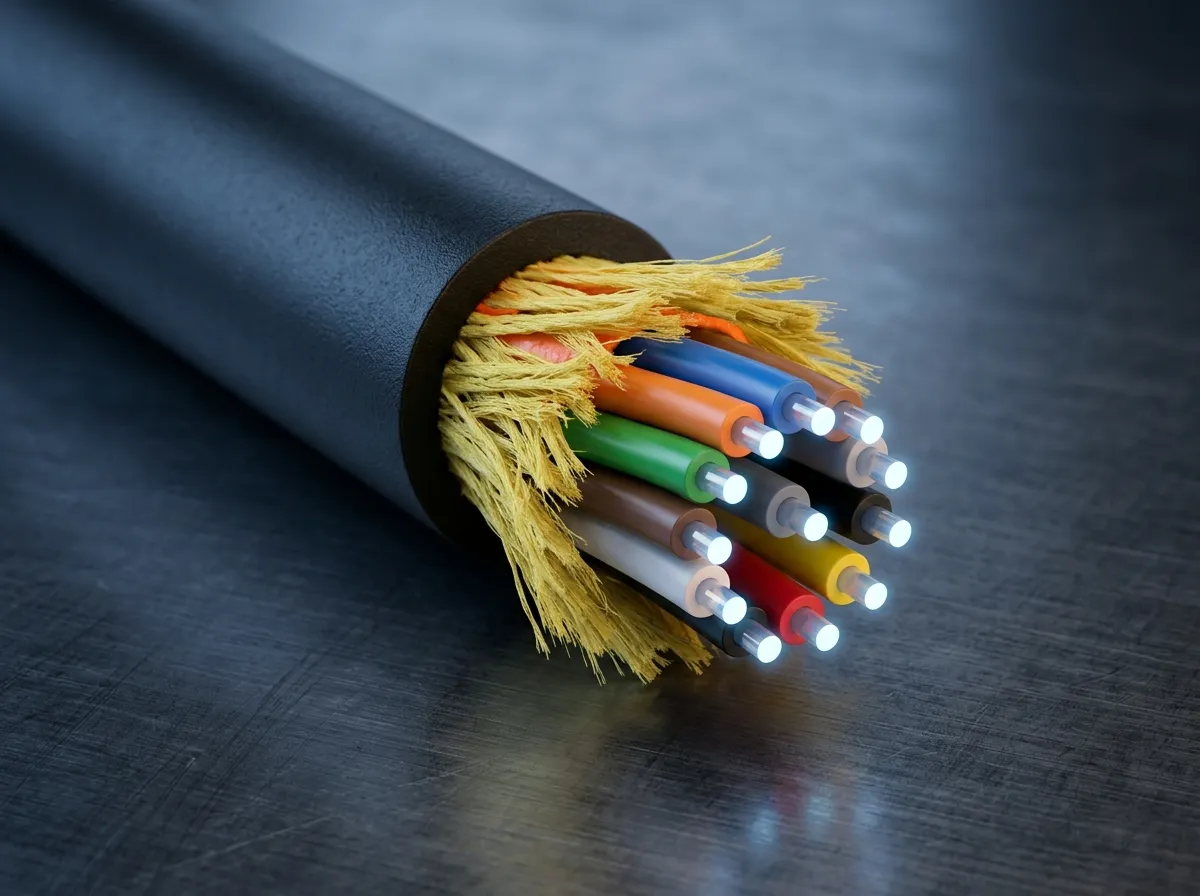
- s — smoke production. s1, s2 or s3, with s1 split into s1a and s1b by light transmittance measured in the smoke-density test.
- d — flaming droplets. d0, d1 or d2. d0 means no burning droplets within the test window, which is what you want above an escape route.
- a — acidity. a1, a2 or a3, derived from the pH and conductivity of gases released during combustion. This is the one that correlates with corrosion damage to nearby equipment, not with life safety.
The additional classifications apply to B1ca, B2ca, Cca and Dca. They are not required for Aca, Eca or Fca — a distinction the Europacable CPR compliance check makes explicit when it lists which fields are mandatory on which class.
So the credible string looks like B2ca-s1a,d1,a1: high-tier flame and heat performance, minimal smoke, no droplets, low acidity. Escape routes, hospitals and stations usually specify at that level; a plain riser often lands at Cca-s1b,d1,a1. A cable offered as "Cca" with no suffix has no declared smoke, droplet or acidity behavior, and you cannot fill in the blanks — those values come from tests on that product family.
Acidity and smoke are where jacket chemistry enters: LSZH compounds are chosen for exactly these sub-classes, so the material decision and the CPR decision are the same conversation; our LSZH vs PVC vs plenum comparison covers the trade-offs.
Which Test Proves Which Class
Every class maps to a specific test, and the mapping tells you what evidence to ask for.
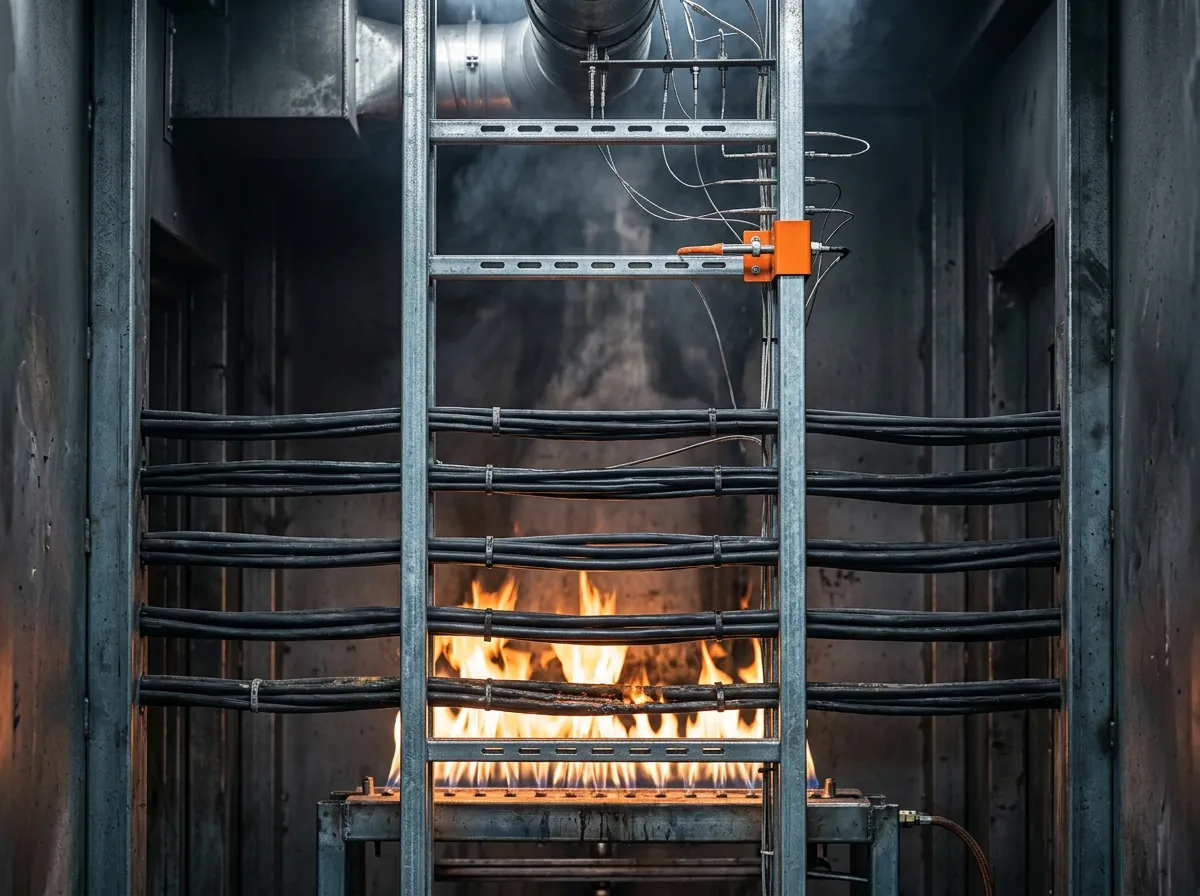
EN 50399 is the heat-release and flame-spread test on a ladder of cable in a chamber, run at 20.5 kW for B2ca, Cca and Dca and at 30 kW for B1ca. It produces the FIGRA, THR and peak-HRR figures above, plus the smoke and droplet classifications. Anything declared Dca or better has an EN 50399 result behind it.
EN 60332-1-2 is the single vertical flame test with a 1 kW pre-mixed flame. It is the only test behind Eca, and it is mandatory in addition to EN 50399 above it — a cable with a good EN 50399 result but a failed single-flame test cannot be declared at the higher class.
EN 61034-2 measures smoke density and feeds the s1a/s1b split. EN 60754-2 measures pH and conductivity of combustion gases and feeds the acidity grades.
The Class Decides Who Certifies It: AVCP 1+, 3 and 4
Here is the part that changes lead times and unit prices, and it is rarely explained on a product page. The class determines the assessment and verification of constancy of performance system — AVCP — the manufacturer must operate under, and that system determines how much third-party involvement stands behind the CE mark.
Commission Decision 2011/284/EU, carried into the CPR framework and implemented through EN 50575, assigns the systems by reaction-to-fire class: system 1+ for Aca, B1ca, B2ca and Cca; system 3 for Dca and Eca; system 4 for Fca. The Europacable CPR checklist states the same split in buyer-facing form.
- System 1+ — a notified product certification body determines the product type, inspects the plant and the factory production control, keeps both under continuous surveillance, and audit-tests samples taken before the product goes to market. It issues a certificate of constancy of performance.
- System 3 — a notified testing laboratory determines the product type from samples. The manufacturer then runs factory production control alone, with no ongoing third-party surveillance.
- System 4 — no notified body task at all; the manufacturer's own type testing and FPC carry the declaration.
Two consequences follow. A move from Dca to Cca is not a datasheet edit: it moves the product from a one-off laboratory type test to a certification body with continuous surveillance, which is why B2ca and Cca fiber often carries longer lead times and a price step. And a supplier claiming system 1+ must name the notified body and its four-digit number, because that number is a DoP field and it can be checked against the Commission's NANDO database. If nobody can produce it, the claim is decorative.
Choosing an Indoor Fiber CPR Rating for Each Route
No regulation tells you which class a riser needs. The CPR sets the classification system; each member state sets the class required for a given application through its own building rules, as Europacable notes in its country requirements guidance. Check that before opening a datasheet.
The table below is the pattern European specifications tend to converge on — a starting point for the conversation with the local authority, not a substitute for one.
Indoor route | Typical floor | Why |
|---|---|---|
Horizontal runs above a corridor ceiling, non-plenum void | Dca, usually | Lowest class that still carries a declared EN 50399 result |
Vertical riser serving multiple floors | Cca, often | Fire travels the shaft; smoke and droplets matter more than in a horizontal run |
Escape routes, hospitals, stations, tunnels | B2ca, | Highest practical class; s1a caps smoke, d1 caps droplet travel |
Data hall, technical room, industrial space | Dca or Cca depending on local rules and insurer | Fuel load and occupancy decide, not cable count |
Route leaving the building envelope | Not a CPR question on its own | Outdoor sections need UV and moisture protection; see indoor vs outdoor CPR rating |
Two rules of thumb survive contact with real projects. Where a specification is silent, ask the insurer and the fire consultant rather than picking the cheapest compliant class — a rejected reel at commissioning costs more than the class upgrade. And never let a value-engineer downgrade a class on a route that crosses a fire compartment boundary, because the cable is part of the penetration's performance argument.
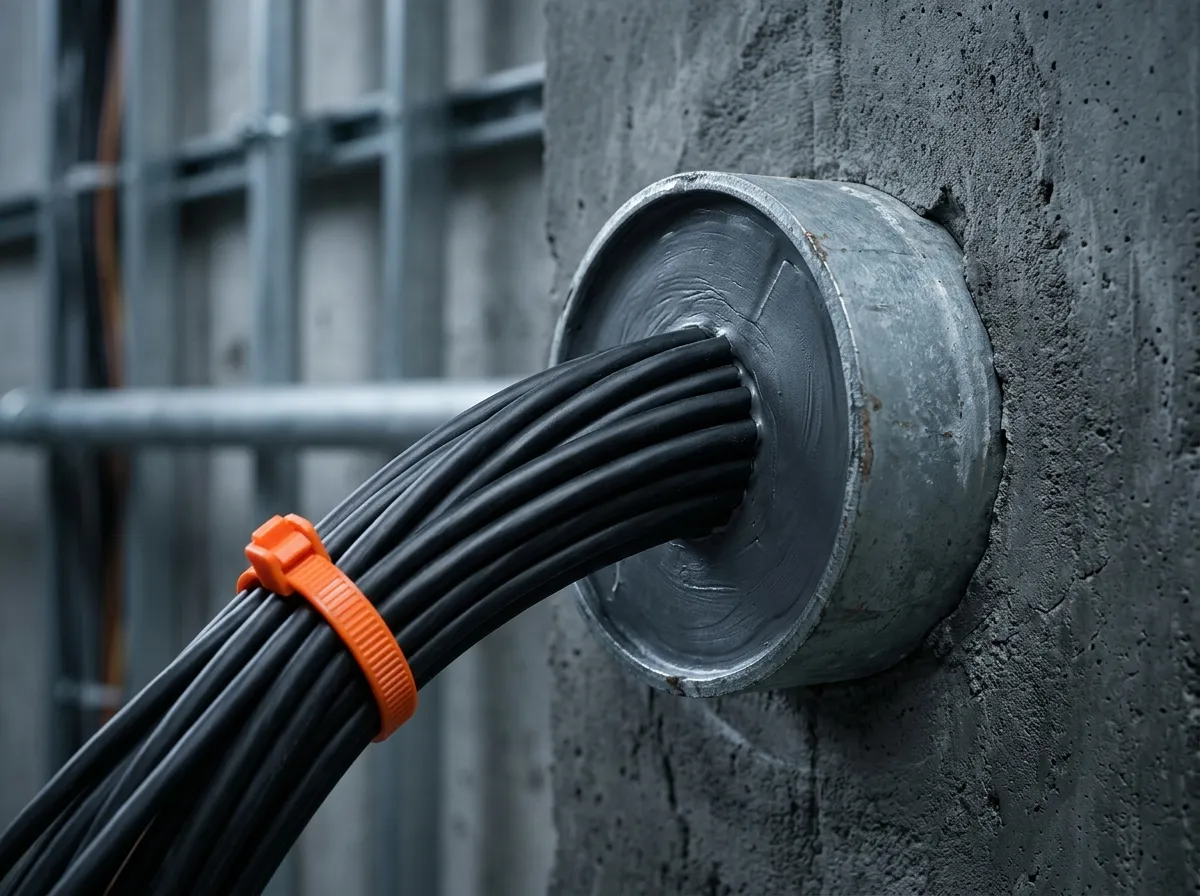
Armored and steel-tape constructions change the mechanical argument, not the fire class. The Euroclass is declared on the construction as tested, so a DoP for the unarmored version does not cover the armored one.
Reading the DoP and the Label
The Declaration of Performance is what makes the CE mark mean something, and it is not a test report. Europacable's field guide is blunt about the difference: the DoP is an official document the manufacturer issues, listing mandatory information, translated into the languages of the markets where it is sold, and kept for ten years.
Eleven items are mandatory. Any missing field is a compliance problem.
- DoP number, one per product family.
- Unique identification code of the product type — one per product reference, or the range precisely defined.
- Intended use, in the standard's own wording: cable for general applications in construction works subject to reaction to fire requirements.
- Manufacturer, with a real address — check that the actual producer is named, not just a brand.
- Authorised representative, where one has been appointed. This field may legitimately be blank.
- AVCP system: 1+, 3 or 4.
- Dated reference to the harmonised standard, i.e. EN 50575:2014+A1:2016.
- Notified body number, for the systems that involve one.
- Declared class of performance including the s/d/a suffixes where required.
- The declaration of responsibility the manufacturer signs, with name, function, place and date.
- The language or languages the declaration is issued in.
Under Regulation (EU) 2024/3110 the transition is staged, not a switchover: Article 94 keeps the existing Annex III declaration routes open until 2040, Article 95 keeps EN 50575 and the 305/2011 declaration and CE-marking articles in force for products already covered, and the new Chapter II obligations phase in per product family. On a 2026 project, the older declaration of performance and the newer combined declaration of performance and conformity are therefore both legitimately in circulation.
The label on the reel is a separate document carrying a shorter list: DoP number, product code, intended use, manufacturer, dated standard reference, notified body number, declared class, the CE mark itself, and the year it was first affixed. Goods-in inspection is worth ten minutes. Match the class string on the label to the class string on the DoP, then to your purchase order.
At TTI Fiber, indoor fiber cable shipments are prepared as a document set — DoP, CE label data and the notified-body certificate for the declared class — so the goods-in check has something to check against rather than a promise.
Five Red Flags in a Supplier's CPR Claim
- A class with no sub-classes where the specification demands them.
Ccaalone, on a project whose specification requires smoke, droplet and acidity declarations, means the DoP does not cover what the job actually needs — ask for the sub-classed declaration or a written statement that none is required. - A DoP offered as a test report, or a test report offered as a DoP. Neither substitutes for the other; a lab report proves a type test happened, the DoP is the legal declaration.
- System 1+ claimed with no notified body number. The number is a mandatory field and is verifiable.
- An undated standard reference. "EN 50575" without the year is not a dated reference, and the dated reference is what the regulation asks for.
- A DoP for the wrong product. Ask which permanently installed cable family the document covers. A DoP that names only a cordset does not cover the cable in your tray.
If a certificate is offered, verify it at source rather than accepting a PDF — our guide to verifying a supplier certificate walks through the checks.
The Clause to Put in Your Tender
Most of these disputes disappear when the requirement is written into the specification in the language of the regulation:
Indoor fiber optic cable shall be CE-marked in accordance with Regulation (EU) 2024/3110 or, where the declaration was drawn up under the previous regime, Regulation (EU) No 305/2011, and shall be supplied with a Declaration of Performance per product family. Declared reaction to fire: [B2ca-s1a,d1,a1 | Cca-s1b,d1,a1 | Dca-s2,d2,a2] as required by the applicable national building regulation for the route. The manufacturer shall operate under AVCP system 1+ for Cca and above, or system 3 for Dca and Eca, and shall state the notified body number on the DoP. Reels shall carry the CE marking and the declared class. Submissions without a DoP matching the delivered product will be rejected at goods-in.Attach the DoP, the classification report behind it and the notified-body certificate to the submittal. Three documents, one class string, no argument at commissioning.
That clause is specification text, not legal advice. Confirm the required class and the acceptable documentation with the relevant national authority and your notified body before it goes into a tender.
Where to Go Next
If the class is still open, start from the route: risers and escape routes drive Cca or B2ca, horizontal runs settle at Dca, and the member state's rules set the floor. If it is already specified, the work left is documentary.
Send us the fiber schedule and the member state, and we will come back with the class per route and the document set that supports it.