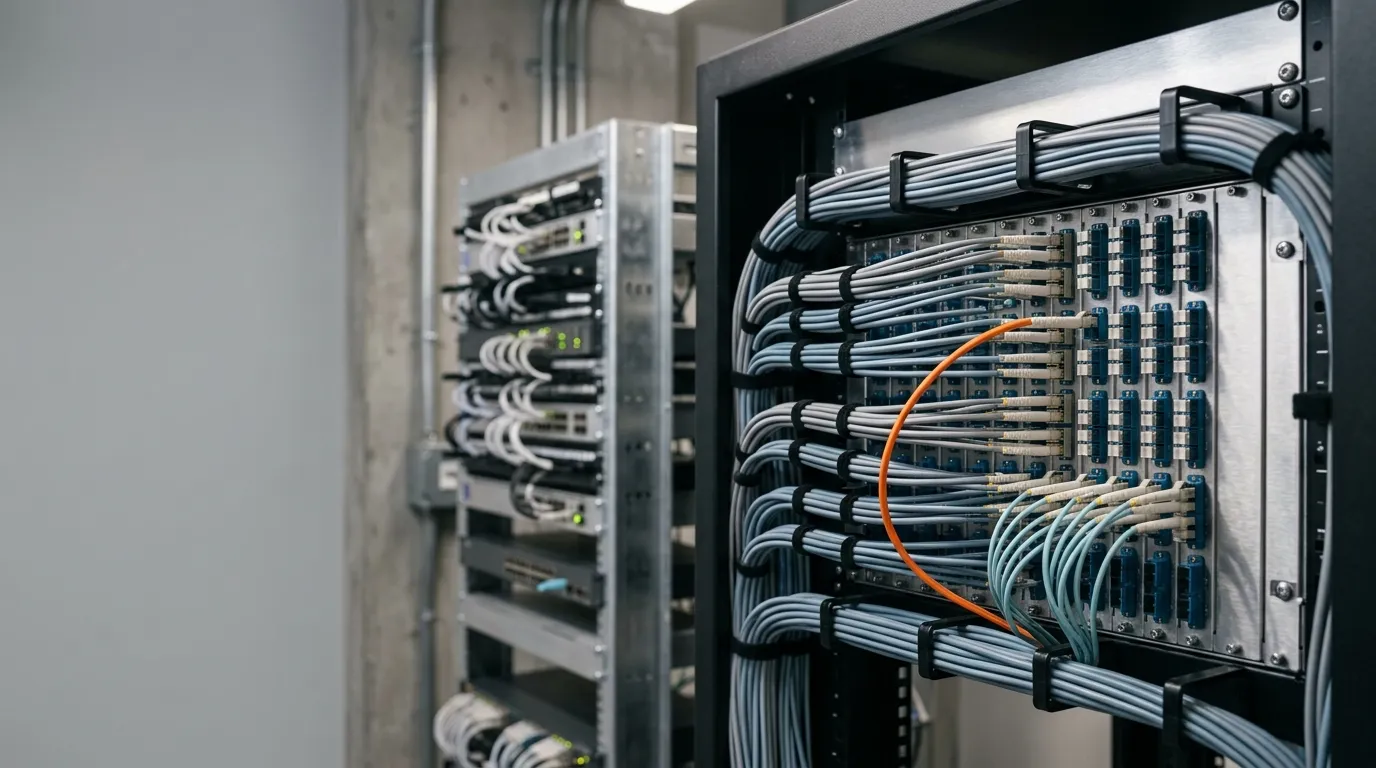
OFNR vs OFNP: Riser vs Plenum Fiber Cable
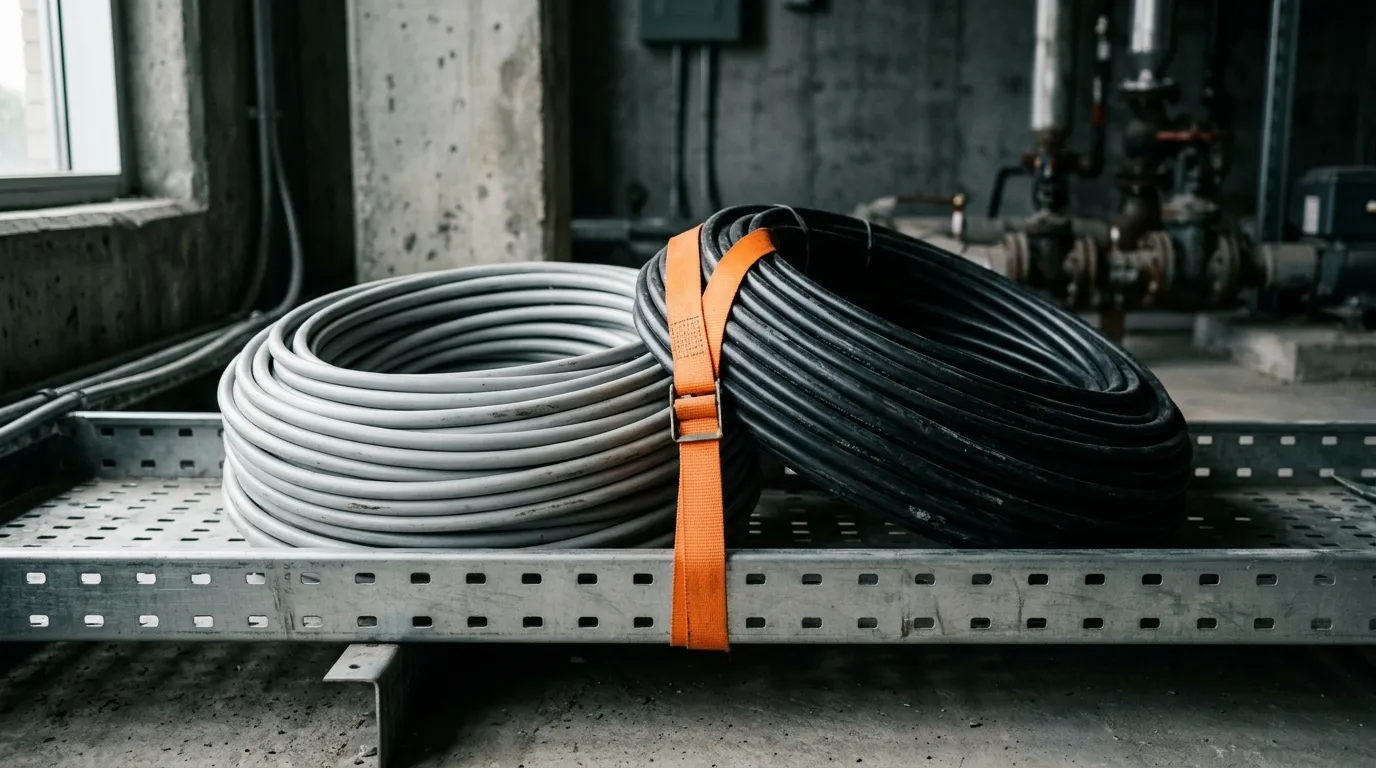
OFNR and OFNP are the two common nonconductive fire-performance type designations you will see printed on premises fiber optic cable in the United States, and the difference between them is not jacket quality, bandwidth or price tier. It is a space permission. OFNR passes UL 1666, the vertical shaft flame-propagation test, and may be installed in a riser and in general-purpose spaces. OFNP passes NFPA 262 — the horizontal Steiner tunnel test that measures both flame travel and smoke density — and is the designation that unlocks a plenum or other air-handling space. Because OFNP has the broader permitted installation scope, the substitution runs one way only: an OFNP cable can be used where OFNR is required, but not vice versa.
That single asymmetry is why two cables that look identical on a price list cannot be swapped on site, and why the answer to "which one do I order" starts with the route rather than the spec sheet. This article covers the OFNR-versus-OFNP decision end to end: what each designation certifies, the two tests behind the letters, how to work out which one a given run needs, where the cost and lead-time gap comes from, and how to read the claim when a supplier's datasheet gives you a marketing word instead of a designation. One scope note first. Enforcement of the National Electrical Code sits with states and local jurisdictions, which adopt NFPA 70 on their own timetable — the current published edition is 2026, but the one your inspector is holding may be older. The 2026 edition reorganizes several former Article 770 provisions into a new limited-energy article structure, so the Article 770 references in this article describe the 2023 NEC structure and earlier editions. For projects governed by the 2026 NEC, confirm the corresponding section numbers with the authority having jurisdiction. What complies on a given project is decided by the authority having jurisdiction, not by this page. What follows describes what the letters mean and where each of them is required; it is not a code interpretation, nor can it stand in for the edition your project adopted. The full chain from code to test standard to listing, across every cable family, is in our guide to cable fire ratings under UL, the NEC and NFPA. This piece sits inside our wider library on enterprise structured cabling for campuses and in-building fiber.
OFNR vs OFNP at a Glance
OFNR | OFNP | |
|---|---|---|
Type designation | Optical fiber, nonconductive, riser | Optical fiber, nonconductive, plenum |
Fire test it passes | UL 1666 — flame propagation in a vertical shaft | NFPA 262 — flame travel and smoke in a horizontal air-handling tunnel |
Test orientation | Cable mounted vertically | Cable run horizontally through a Steiner tunnel |
Smoke measured | The riser test is about flame propagation up the shaft | Yes — smoke density is one of the pass criteria |
Permitted in | Riser shafts and general-purpose spaces | Riser, general-purpose and air-handling (plenum) spaces |
Copper analogue (not an equivalent) | CMR | CMP |
Typical application | Backbone between the main and intermediate distribution frames | Cable in a ceiling void, raised floor or duct used to move environmental air |
Cost and availability | Lower cost per meter; the high-volume construction | Higher cost per meter; lead times lengthen on unusual fiber counts or armored versions |
Read that table once and most purchasing mistakes are already visible. A plenum-rated fiber cable has broader permitted installation locations than an OFNR cable under NEC substitution rules, but the designation does not guarantee the same fiber count, optical type, connector interface, jacket material or mechanical construction. Compare those attributes separately. What it does not do is make the riser version illegal where the riser version is correct — which is why the rest of this article is about the two spaces, not about which letter is "better".
What the Letters Stand For
The designation family exists for optical fiber only, and the Fiber Optic Association's premises cabling reference publishes the fullest public version of it. The rule the association states alongside its table is the one that governs everything below: a premises cable has to carry the optical-fiber cable fire and listing designation required by the adopted NEC edition — Article 770 in the 2023 NEC structure, with corresponding provisions reorganized in the 2026 edition.
Designation | Meaning | Where it applies |
|---|---|---|
OFN / OFNG | Optical fiber, nonconductive — general purpose | Spaces that are neither risers nor air-handling |
OFNR | Nonconductive, riser | Vertical shafts between floors |
OFNP | Nonconductive, plenum | Plenums and other air-handling spaces |
OFN-LS | Nonconductive, low smoke density | A low-smoke variant, not a location rating |
OFC | Optical fiber, conductive — general purpose | General-purpose spaces, on a construction that contains metallic members |
OFCR / OFCP | Conductive, riser / plenum | The same two space permissions as OFNR and OFNP, carried on a construction that contains metallic members |
The suffix grammar is not fiber-specific, and the letters are easier to read once you know that. UL Solutions' wire and cable application guide treats every cable it covers — the optical fibers of Article 770 included — as being investigated for one of four applications, and writes the outcome into a suffix: -P marks a plenum construction, -R a riser construction, -G or no suffix at all a general-purpose construction, and -X limited residential use. Copper runs on the same grammar, which is where the familiar CMR and CMP come from: in the copper family the R suffix is the riser version and the P suffix the plenum version. OFNR and OFNP are the optical fiber run of that same grammar — analogous in function to CMR and CMP, but not equivalent designations. They sit in a different NEC article and are built to a different product standard, so a specification that asks for "riser rated" without naming the medium has already opened the substitution argument this article exists to close.
What the designation does not tell you is equally worth writing down. It says nothing about fiber type, core size, bandwidth or loss budget. It says nothing about the jacketing compound, which is a separate axis — low-smoke zero-halogen and PVC jackets are a materials question, not a location permission, as our plenum vs non-plenum jacket comparison sets out. It says nothing about outdoor suitability, and nothing about circuit integrity under fire, which is a different specification line with its own evidence. A type designation is one attribute, and it is the one this article is about.
The Two Tests Behind the Letters
The reason OFNR and OFNP cannot be treated as two grades of the same thing is that they are two different physical experiments.
UL 1666 is the riser test. The cable is mounted vertically inside a simulated shaft and ignited, and the test asks how high the flame travels up the cable. This is the experiment that maps onto the space it protects: a riser is a vertical void that acts as a chimney, and the design question there is whether burning cable will carry fire from floor to floor. UL's own wire and cable service pages describe its laboratory work across both designations in the same breath, treating the plenum and riser methods as a pair — a useful reminder that they are two routes to two separate ratings, not two grades of one test.
NFPA 262 is the plenum test. It is a horizontal Steiner-tunnel experiment rather than a vertical one: the cable is run along a tray inside the tunnel under a forced air stream, and the method scores flame travel distance and smoke optical density together in a single pass. NFPA's standard-development page keeps its stated purpose narrow and functional — a procedure for judging how smoke and fire would spread through the wires and cables that occupy an air-handling space.
Two differences in that pair decide everything downstream. The first is orientation: a construction that resists vertical flame propagation in a shaft is not automatically the one that behaves in a long horizontal run under forced airflow, so a passing UL 1666 result is not evidence for NFPA 262. The second is smoke. Because a plenum is a space whose air is returned to, or moved through, occupied areas, the plenum test measures smoke as a first-class criterion. Under the NEC substitution rules, OFNP can be used where OFNR is required, but the reverse is not permitted. The two designations should therefore be treated as different test paths with different permitted installation locations, not simply as two grades of one test.
One naming trap to keep separate. Cables that also meet a limited-smoke requirement carry the suffix -ST1, formerly -LS, evaluated to UL 1685 or UL 2556 according to the same UL application guide. Limited smoke is an additional attribute of the construction. It is not a location rating, and a datasheet that offers "-LS" as its answer to a plenum requirement has not answered the plenum question.
Where Each Rating Is Required
Work from the route, not the reel. Mark every space the cable will pass through on its way from the main distribution frame to the outlet; the strictest space on that path sets the designation you need. Three answers cover nearly every premises fiber run in North America.
Air-handling spaces and plenums require OFNP for nonconductive optical fiber cable, or OFCP where the cable contains conductive members. The space is defined by the code, not by the cable vendor: Section 300.22 is the clause that governs what may be wired inside ducts and the spaces used to move environmental air, and its part (C) carries the heading Other Spaces Used for Environmental Air (Plenums) — readable in a code repository such as UpCodes if you do not have your adopted edition on the shelf. The common case is the ceiling void of a commercial floor where the return air travels through that void, and the raised-floor void in equipment rooms where the same is true. If a cable will be installed directly in that air path, the designation is OFNP for nonconductive cable or OFCP for conductive cable, as applicable.
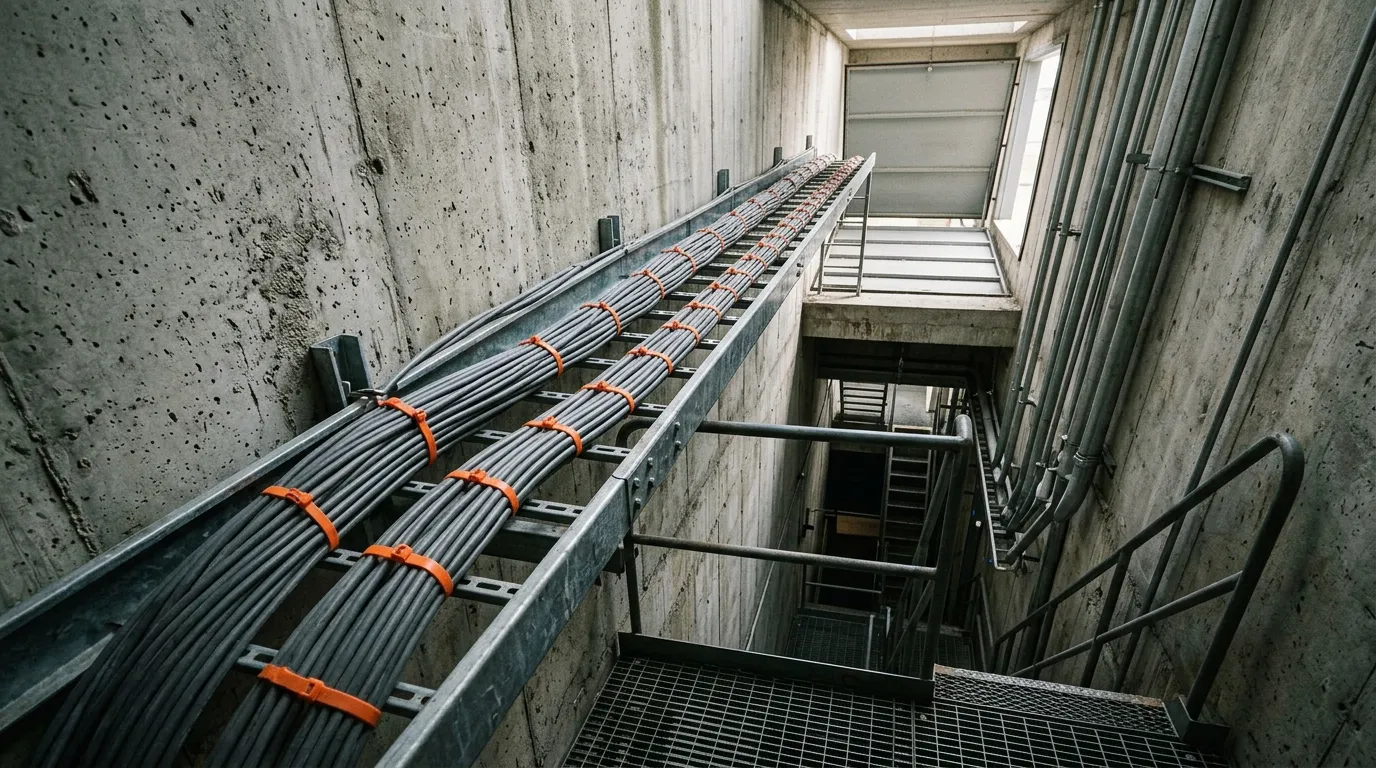
Riser shafts require at least OFNR for nonconductive cable or OFCR for conductive cable. OFNP and OFCP are higher-designation alternatives where permitted by the adopted NEC edition and installation method. The vertical backbone between the main distribution frame and the intermediate distribution frames on each floor is a shaft, which is the space UL 1666 models.
Everything else is general purpose. Cable in a dedicated telecom room, in surface raceway, in a fully enclosed pathway that is not part of an air-handling space or a shaft, is covered by the general-purpose designation — OFN or OFNG — and you will often see OFNR used there anyway because it is the construction that is stocked.
For a drawing or a submittal, those three answers reduce to one line each:
Route the run crosses | Required designation | Why that one |
|---|---|---|
An air-handling space — an unducted return-air ceiling void, an equipment-room floor void in the air path, a duct | OFNP | OFNP for nonconductive cable; OFCP for conductive cable |
A vertical shaft between floors | OFNR | OFNR for nonconductive cable; OFCR for conductive cable. OFNP or OFCP may substitute where permitted by the adopted NEC edition and installation method. |
Neither — a telecom room, surface raceway, a sealed pathway | OFN, OFNG, or OFNR where that is what the shelf holds | General purpose is the floor of the designations, not a restriction layered on top of them |
Then apply the one-way rule. Belden's explainer on riser versus plenum cable selection puts it in a single sentence: a plenum cable "can be used in a riser space", while a riser cable "generally cannot be used in a plenum space". Contractors who work in mixed buildings often standardize on the plenum construction for exactly this reason: one reel, no field decision, no inspection question about which segment went where.
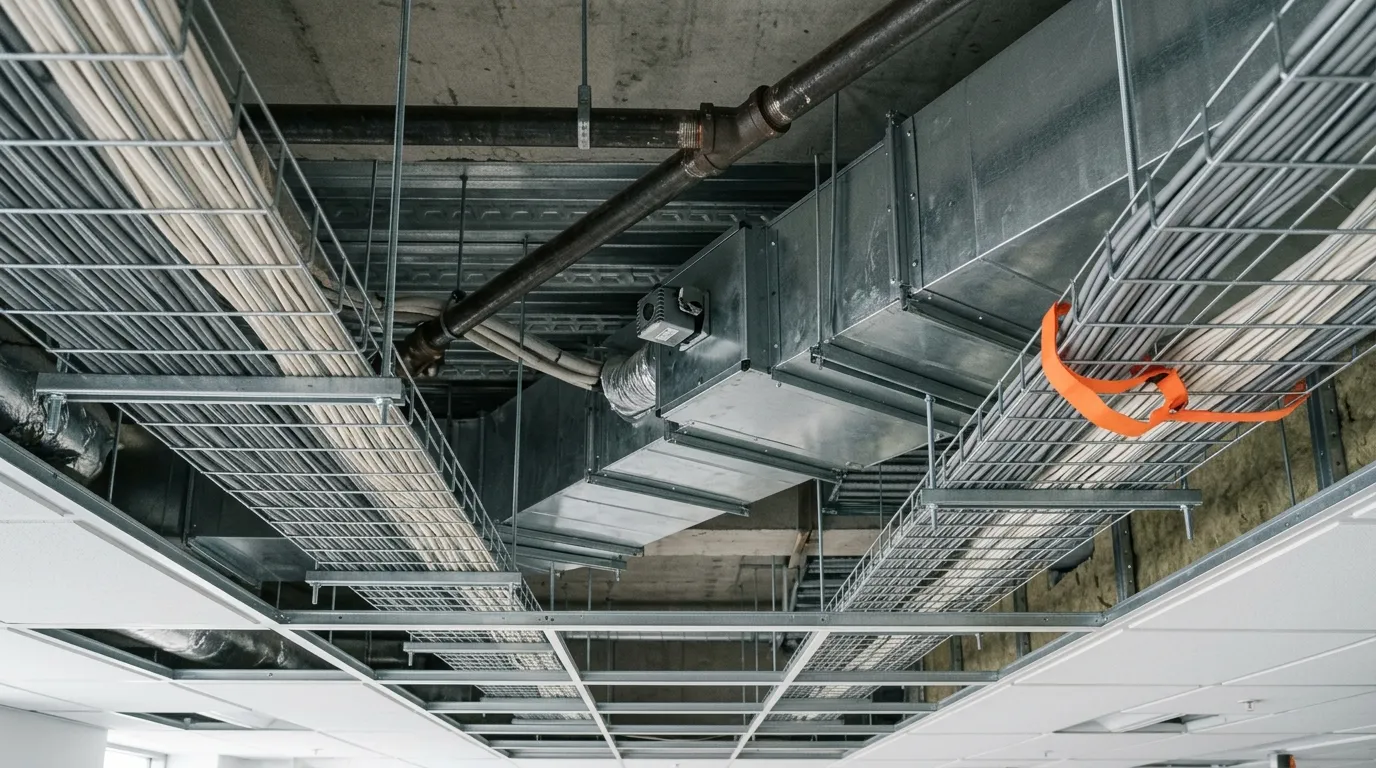
Two boundary points that cost projects real money. First, whether a particular ceiling void counts as an air-handling space is a project-specific determination, not a vendor's opinion: where the return air is fully ducted, the void may not be an air-handling space at all, and that call belongs to the mechanical designer and the AHJ. Getting it answered early is worth more than any price negotiation on the cable. Second, a design standard is not an installation permission either — TIA-568 sets out what the finished link has to do optically and says nothing about whether a given cable type may be installed in a ceiling void. The optical budget and the fire rating are proved on different tracks; a single reel happens to carry both obligations.
The Cost and Availability Gap
The premium on a plenum-rated fiber cable is not arbitrary, and understanding where it comes from tells you what to negotiate.
The plenum test uses different flame-travel and smoke criteria, so fewer jacketing and subunit compounds may qualify for a given construction. The compounds that do pass are engineered materials rather than commodity PVC, and UL Solutions runs recognition programs for them — its wire and cable pages describe QMTM2 recognition for plenum cable compounds that support NFPA 262 composition analysis — a qualification cost the manufacturer carries once and then recovers on every meter shipped. Volume is the second driver: in our experience, riser and general-purpose constructions are the products that ship in quantity, while a plenum construction in an unusual fiber count, an armored version or a non-standard jacket color typically has to be scheduled as a production run rather than picked from the shelf.
That is why we do not publish a percentage here. The gap between the two versions of the same cable moves with fiber count, construction, armor, order size and the supplier's stock position, and a rule-of-thumb number would be wrong on your project. Ask for it as a delta instead: price per meter for both designations at your fiber count, minimum order quantity on the plenum version, lead time for each, and whether the plenum construction is stocked. While you have the supplier on the line, ask for the outside diameter and minimum bend radius of both versions — the two are rarely identical, and both feed straight back into tray fill and bend-radius checks that are cheaper to fix on paper than on site.
There is also a design lever that is not a cable decision: if re-routing the run keeps it out of the air-handling space, an OFNR construction may be compliant, and moving a pathway can cost less than upgrading a reel. That trade-off needs the designer and the AHJ, but it is worth raising before the bill of materials is frozen.
How to Read an OFNR or OFNP Claim
A datasheet that says "plenum rated" has told you nothing you can defend in a submittal. Three checks turn the claim into evidence, and each one leaves a document you can file:
Check | What you should be holding | Where it comes from |
|---|---|---|
The designation, as the code writes it | The type designation printed on the product and on its listing label — OFNR or OFNP, not a marketing synonym | The print legend on the jacket, read against the label |
The listing record | The complete listing mark from the coil, reel, flange or smallest unit container, together with the identifier needed to resolve the listing in UL Product iQ | The label itself, then the listing entry |
The test standard | The standard the construction was evaluated to for that space — NFPA 262 for a plenum, UL 1666 for a riser | The supplier's test report and listing record |
One: the designation string as the code writes it. You want the actual type designation — OFNR or OFNP — printed on the product and on its listing label, not a marketing synonym. Contractors and buyers sometimes ask for "plenum cable" and receive a cable whose print legend carries a different designation entirely; the printed legend is the thing an inspector can read, so it is the thing worth specifying.
Two: the listing record, not the print on the jacket. This is the check most people get backwards. UL's application guide is explicit that "the UL Mark appearing on the coil, reel, flange or box is the only means to identify wire/cable covered under UL Solutions certification", and that the complete listing mark sits on "a tag attached to the reel or smallest unit container". Printing that symbol on the jacket itself, the guide adds, is treated as a supplementary marking method rather than as evidence of certification — worth holding on to, because the jacket mark is the easiest thing to see from the aisle and the weakest thing in the pack. The guide also records that holographic labels are required on listed optical fiber cable, among other categories, specifically to control marking and counterfeiting. So the evidence you file is the complete label from the reel or box plus the corresponding Product iQ listing record, resolved using the file number or other identifier supplied by the manufacturer. One detail from the guide is worth knowing: the guide information for the product category states whether the symbol on the cable itself is required or permitted, which tells you whether a jacket with no UL symbol is a red flag or simply how that category is marked.
Three: the test standard, named explicitly. Ask for the standard the construction was tested to for the space you are buying into — NFPA 262 where the cable goes into a plenum, UL 1666 where it goes into a riser. A supplier who can name both the standard and the listing record behind it is handing you an evidence pack that will hold up. Our guide to vetting a supplier certificate pack walks that pack document by document, from the test report to the follow-up service record.
If the Project Is Not in the US
OFNR and OFNP are a North American framework, and they do not travel. A European project is classified under the CPR Euroclasses, a market-access classification for cable fire performance that says nothing about which space inside a building a cable may occupy — different system, different logic, unpacked in our guide to CPR cable classes. Clearing the European bar earns you nothing on a US submittal, and a type designation is not accepted in place of a Euroclass in Europe.
Quick Answers
What does OFNR stand for?
Optical fiber, nonconductive, riser. The "nonconductive" part means the cable contains no metallic members; the "riser" part means it has passed UL 1666 and may be installed in a vertical shaft.
What does OFNP mean?
Optical fiber, nonconductive, plenum. It has passed NFPA 262, the flame-travel and smoke test for cables in air-handling spaces, and it may be installed in a plenum as well as in riser and general-purpose spaces.
Is OFNR the same as LSZH?
No. LSZH describes the jacketing compound — low smoke, zero halogen — while OFNR describes where the cable may be installed. The two claims sit on different axes, and a low-smoke jacket does not by itself make a cable plenum-rated.
Can OFNR cable be installed directly in a plenum?
Generally no. For cable installed directly in an air-handling space, use OFNP for nonconductive cable or OFCP for conductive cable, as applicable. An OFNR or OFCR cable may be permitted inside a code-compliant raceway or other listed wiring method, depending on the adopted NEC edition and the installation arrangement. Confirm that method with the AHJ. This is an installation-method exception, not a reversal of the OFNP-to-OFNR substitution rule.
Which one should I order?
Whichever the strictest space on the route requires. If you are still deciding, list the spaces first, then price the plenum construction for the whole run against the cost of transitioning mid-run — and remember that a mixed reel strategy has a field risk attached: it only works for the life of the building if everyone who ever pulls cable there knows which segment is which.
Bottom Line
Three habits that keep an OFN specification out of trouble. Survey the route before comparing prices — the designation you need is a property of the path, and the strictest space on it decides; a price comparison run before that survey is a comparison of two different scopes. Put the designation and the test standard on the same submittal line — OFNP against NFPA 262, OFNR against UL 1666 — because a supplier who can name both is the one whose evidence holds up. Carry the one-way rule into the change-order template — a plenum construction may drop into a riser or a general-purpose space and the reverse may not, and the moment a route changes mid-project is the moment that line has to be enforced.
If a project spans both spaces, the cable that solves it in a single pull is the plenum construction — and it still has to arrive with paperwork that matches the designation you wrote down. Our fiber patch cords and pre-terminated assemblies are specified alongside the bulk cable for exactly that reason: jacket print legend, construction and test data documented for the submittal, so the question of which cable belongs in which space gets answered before the reel is cut.