Outdoor Fiber Cable CPR Rating: EU Compliance | TTI Fiber
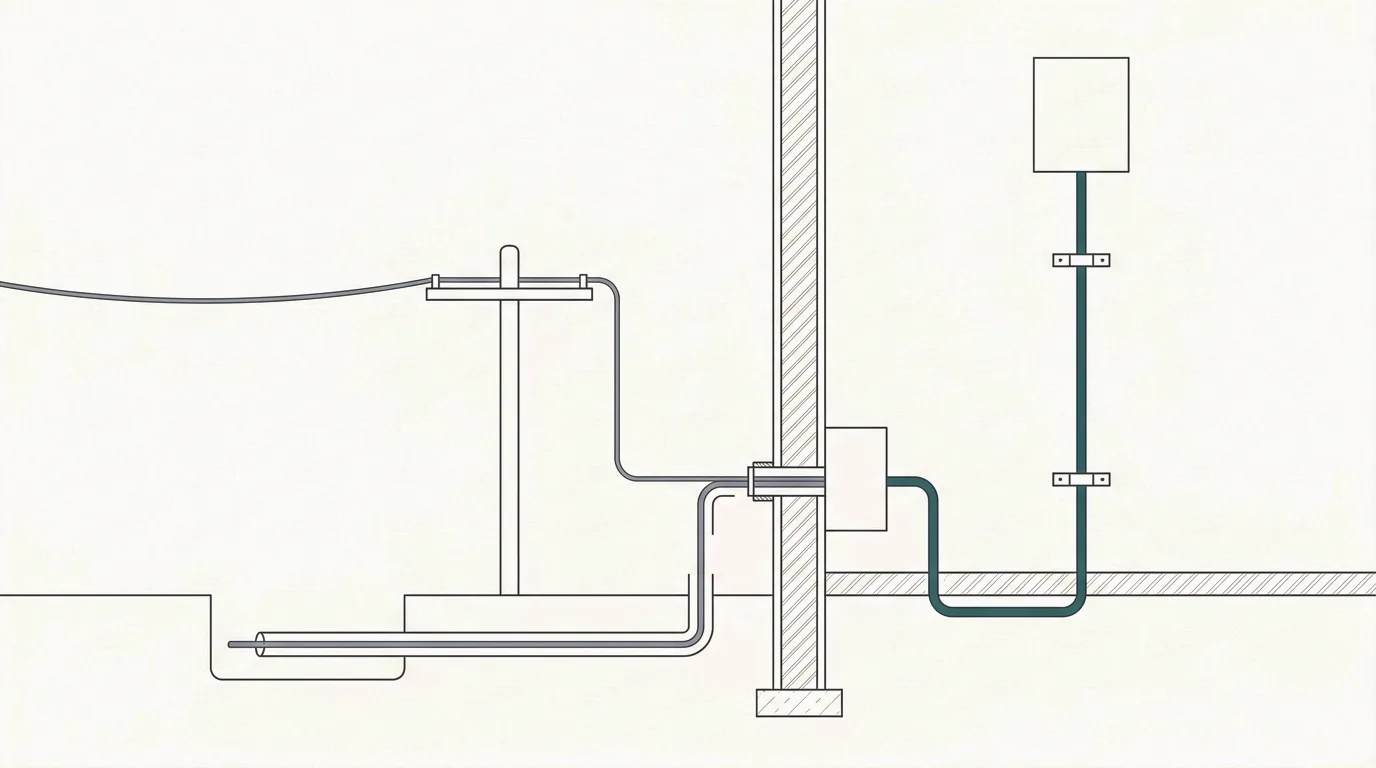
An outdoor fiber optic cable running in a duct, direct-buried, or strung between poles does not need a CPR Euroclass. It needs one from the moment it crosses into a building.
That is the whole answer, and it is worth stating plainly because the Construction Products Regulation does not ask the question most buyers think it asks. It never asks "is this cable an outdoor cable?" It asks "is this cable permanently installed in a construction work?" Those are different questions, and the boundary between them is a physical place — the external wall of the building — not a category in a product catalogue.
Get that distinction wrong in either direction and it costs money. Ask your supplier for a Euroclass on trench cable and you will get a refusal, an unnecessarily expensive cable, or a document that does not mean what you think it means. Pull that same trench cable 40 metres up a riser because it was already on the drum, and you have a genuine violation that can only be fixed by re-pulling.
This guide walks the boundary from both sides: what falls outside CPR and why, exactly where compliance starts, what the Euroclasses mean in measured numbers, what each national market enforces, and how to verify a Declaration of Performance before you accept a shipment.
The 30-Second Answer
Where the cable runs | In CPR scope? | What to specify |
|---|---|---|
Duct, direct-buried, aerial — entirely outdoors | No | No Euroclass needed. Specify sheath material, water blocking, UV and rodent protection instead |
Ends outside the building's external fire barrier (street cabinet, external entrance facility) | No | Transition to a CPR-classified cable at the boundary |
Enters the building, terminated within 2 m of penetration | Effectively no, if the EN 50174-2 condition is met | Terminate within 2 m and document it |
Any run inside beyond that — riser, ceiling, plant room | Yes | Declared Euroclass + CE marking + DoP, at the class the national code demands |
Indoor/outdoor dual-rated cable used end to end | Yes | Euroclass declared for the whole cable (commonly Dca or Cca) |
Patch cords and connectorised assemblies | It depends — see below | Equipment cords are generally not permanently installed; prewired conduit and plug-in systems are treated differently |
The rule in one line: CPR follows the wall, not the product category.
The Scope Test: Not Indoor vs Outdoor
The CPR is market-access law. It governs how a construction product may be placed on the market — not how it is installed. Installation is national building-code territory. Conflating the two layers causes half the arguments on site.
For cables the harmonised standard is EN 50575:2014+A1:2016, Power, control and communication cables — Cables for general applications in construction works subject to reaction to fire requirements. Optical fibre cables sit inside its scope alongside power and data cables, and it has been mandatory for cables placed on the EU market since 1 July 2017.
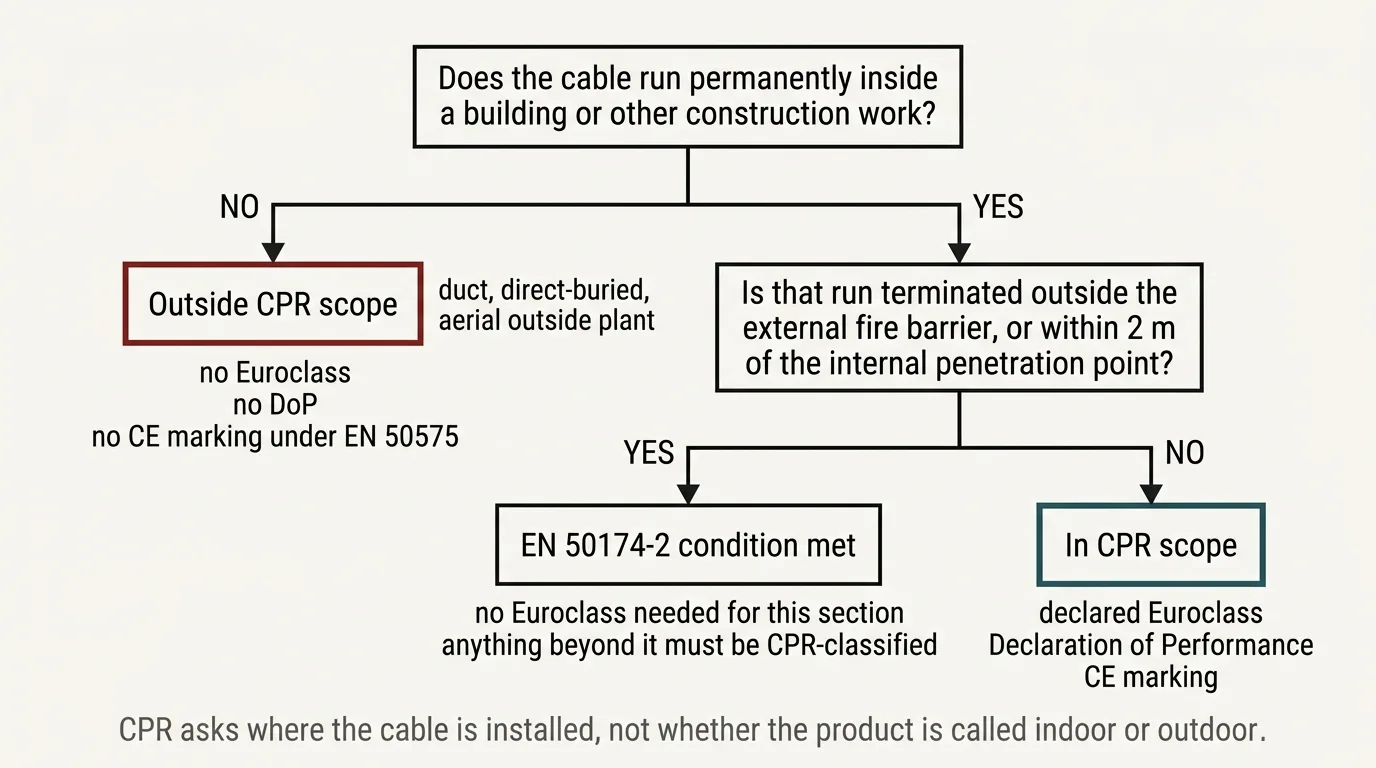
The scope wording is what matters: cables intended for permanent installation in construction works — buildings and other civil engineering works. So the test has two parts, and both must be true:
- Permanent. Cable designed only for temporary installation is excluded.
- In a construction work. This is where outdoor cable usually falls out.
The party who first places the product on the market decides the intended use, and that declared intended use is what determines scope. This is also why "civil engineering works" is a genuine grey area rather than a bright line — a duct under a highway is arguably a civil engineering work. The honest position, and the one the industry's own guidance takes, is that pure outside plant is normally outside scope but anomalies exist and the determination follows intended use. Anyone who tells you the boundary is perfectly crisp has not read the wording.
Some exclusions are settled. Cables inside machinery, cables for industrial processes on industrial premises, and lift cables are outside the scope — lift cables were never brought in under the mandate that produced EN 50575. Special applications, such as cables above a rated voltage that a national regulator has designated special, are also excluded.
Connectorised products are the one area where you should not accept a blanket answer, in either direction. It is widely repeated that patch cords and assemblies with connectors fitted are automatically out of scope. That is too broad. The permanence test still governs: an equipment cord patched between a panel and a switch is not permanently installed in the construction work, and is generally treated as outside scope. But prewired conduit and plug-in systems are a different matter — Nexans' guidance states that the cables inside prewired conduits and plug-in systems must be CPR-classified and the final product must bear a CE marking showing the cable's reaction-to-fire performance, precisely because these systems are designed to be installed inside buildings.
If a supplier tells you "it has connectors, so CPR does not apply", ask how the assembly is installed. That question, not the presence of a connector, decides the answer.
Which Outdoor Cables Fall Outside — and Why
There are two independent reasons, and keeping them separate prevents a lot of confusion.
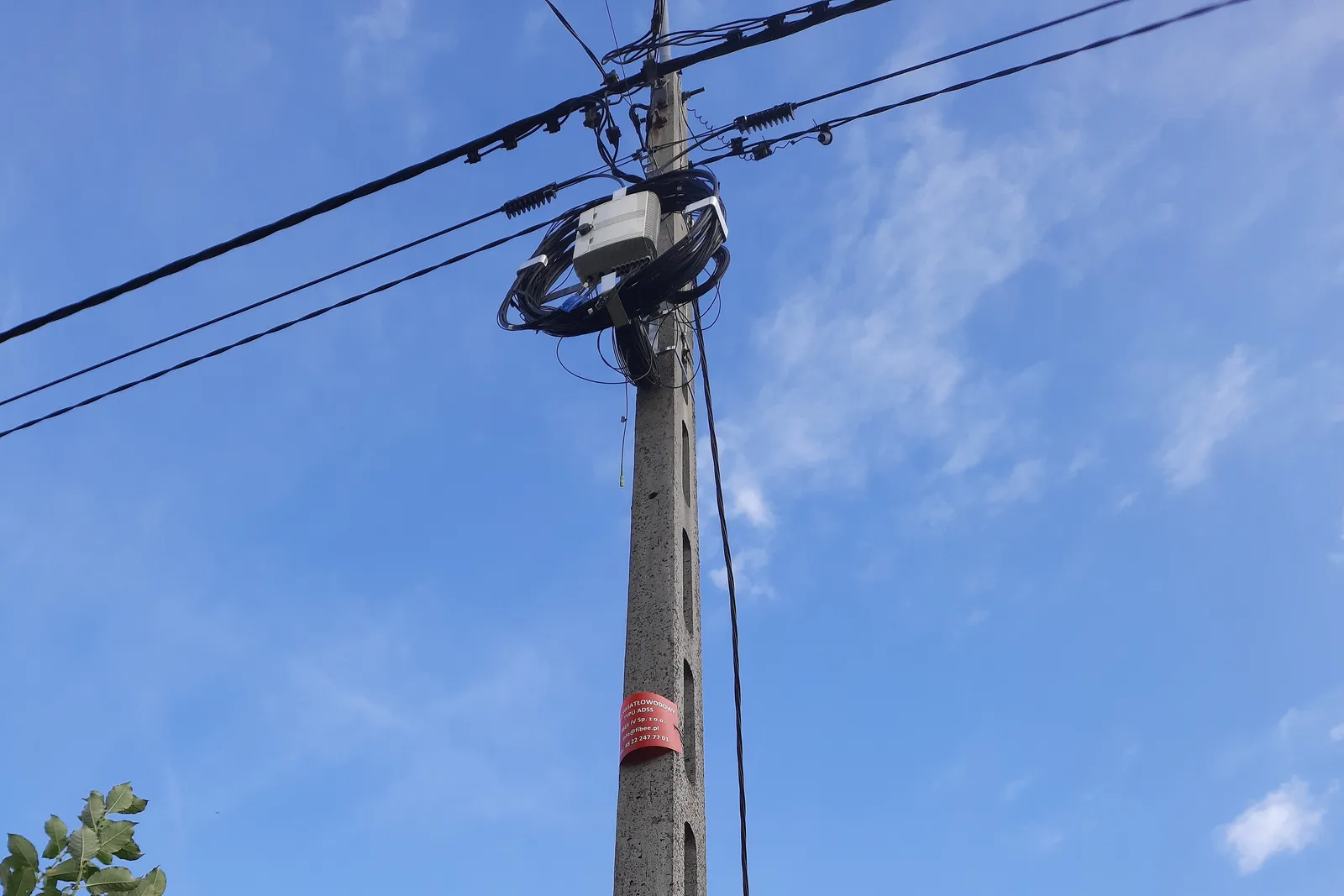
Reason one is legal. Duct, aerial, and direct-buried cables are not permanently installed in a construction work. No Euroclass required, no DoP required, no CE marking under EN 50575.
Reason two is material. Even if you asked, standard outside plant construction is not built to pass. Outdoor jackets are polyethylene — MDPE or HDPE — chosen for UV stability, moisture resistance, abrasion tolerance and low-temperature flexibility. PE is also excellent fuel: high calorific value, and it drips as it burns. Loose-tube designs add hydrocarbon filling gel, and armoured constructions add a flooded core.
That is not a defect. It is the correct trade for a cable that will spend 25 years in a wet duct or buried in a trench.
Mapping it by product type:
Cable type | Typical scope position | If tested, expect | Practical note |
|---|---|---|---|
ADSS (all-dielectric self-supporting) | Outside | Fca | Aerial between structures; entering a substation building is the exception to handle |
GYTS / GYTA armoured duct & buried | Outside | Fca | PE sheath, flooded core |
GYFTY dielectric | Outside | Fca | Non-metallic, still PE-sheathed |
Air-blown micro cable (outdoor microduct) | Outside | Fca | In scope if the microduct route continues inside the building |
FTTH drop cable, outdoor | Outside up to the wall | Fca | The most common place the boundary is crossed carelessly |
Indoor/outdoor dual-rated (LSZH) | Inside scope | Dca or Cca | Sold specifically to cross the boundary — needs a declared class |
Indoor riser / distribution | Inside scope | Dca to B2ca | Class set by national code |
Equipment / patch cords | Normally outside | — | Not permanently installed. Prewired conduit and plug-in systems are not covered by this — see above |
Read the table by row, then read the two shaded ideas: everything above the dual-rated row is a cable you should not be chasing a Euroclass for. Everything from that row down is a cable where the absence of a declared class should stop the order.
The Compliance Boundary Is the Wall
This is the part that decides inspections, and it is the part the rest of the internet skips.
EN 50174-2:2018, the CENELEC standard for planning and installing IT cabling inside buildings, sets the rule at clause 4.1.6.2.3 (Outdoor cables which enter into buildings). Information technology cables that do not comply with the minimum recommended performance requirements of EN 60332-1-2 — equivalent to Euroclass Eca, which is every PE-sheathed outside plant cable — shall be either:
- a) terminated in an entrance facility which is outside the external fire barrier of the building; or
- b) terminated inside the building, within 2 m of the point of internal penetration of the external fire barrier, or any length exceeding 2 m installed within trunking or conduit that is considered as a fire barrier in accordance with local fire regulations.
The external fire barrier is, in practice, the first fire-resisting barrier that services meet as they enter the building. Two metres is the figure in the standard; some national regulators define their own negligible-contribution threshold, so confirm it for the country you are building in.
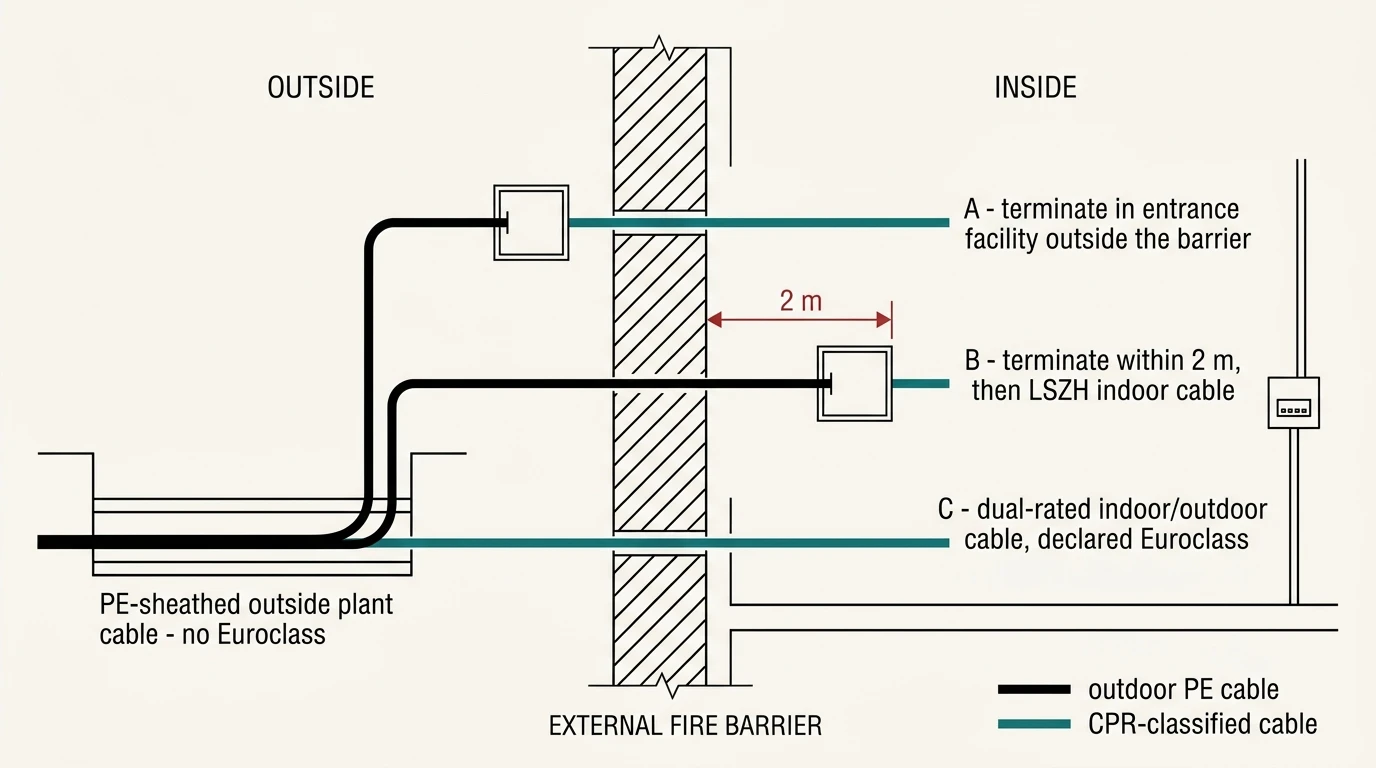
That gives three compliant designs, and the choice between them is a real engineering trade rather than a formality.
Option A — Transition outside the fire barrier. Land the outdoor cable in an external entrance facility or wall box; everything inward is a CPR-classified indoor cable. Cleanest to defend in a handover pack, but it puts a splice outside, where you need real ingress protection rather than a weatherproof-looking box.
Option B — Transition within 2 m inside. Penetrate the wall, then splice to LSZH indoor cable in a compact closure or enclosure within 2 m. The most common approach in practice. It works only if the discipline holds: the 2 m is measured to the termination point, and a 12 m run to a conveniently located patch panel is a violation no matter how neat it looks.
Option C — Use a dual-rated indoor/outdoor cable. An LSZH jacket, dry water blocking, and a declared Euroclass — commonly Dca-s2,d2,a1 or Cca-s1a,d1,a1 — lets the cable run from the outside plant to the equipment room with no transition. You pay for it: LSZH is less UV- and abrasion-tolerant than PE, jacket cost is higher, and permitted pulling tensions are usually lower. What you buy back is a splice, a closure, and an argument with the inspector. On campus and multi-building projects — or an FTTB build entering a basement — Option C often wins on total installed cost despite the higher cable price, because you are buying out labour at dozens of transition points.
Fca Is a Class, Not a Failure: The Three Legal States
Almost every argument about CPR paperwork comes from collapsing three different situations into one. They are legally distinct:
State | Euroclass | CE marking under CPR? | DoP? | AVCP |
|---|---|---|---|---|
Out of scope — pure outside plant, equipment cords | None. The question does not apply | No | No | — |
In scope, declared Fca | Fca = no performance determined | Yes | Yes | System 4 |
In scope, declared Eca or better | Eca → Aca | Yes | Yes | System 3 or 1+ |
Two consequences people get wrong in opposite directions:
- Fca is a legitimate declared class, not a failure. A cable that is in scope and declared Fca is fully compliant with the regulation — it has simply declared that no reaction-to-fire performance is determined. Whether Fca is acceptable for the installation is a national building-code question, not a CPR question.
- Out of scope is not the same as Fca. An out-of-scope cable has no class at all and must not carry a CPR CE mark. A supplier who hands you an "Fca DoP" for direct-buried duct cable is not being extra-diligent; they are declaring against a standard that does not apply to the product.
One correction worth making, because it is circulating widely — including in Google's own AI-generated summary of this topic: Eca and Fca are not equivalent, and Eca is not "generally unacceptable indoors." Eca is the legal minimum in several member states and is explicitly recognised in the UK for cables other than installation cables. Lumping the two together will make you over-specify.
The Euroclass Ladder, With the Actual Numbers
Reaction-to-fire classification runs under EN 13501-6:2018+A1:2022, using data from four test methods. Most published guides give the class letters and stop; these are the thresholds behind them.
Class | Main test | Criteria | Meaning |
|---|---|---|---|
Aca | EN ISO 1716 | PCS ≤ 2.0 MJ/kg | No contribution to fire. Effectively mineral-insulated cable only — no realistic fibre construction reaches it |
B1ca | EN 50399 (30 kW source) + EN 60332-1-2 | FS ≤ 1.75 m; THR1200s ≤ 10 MJ; peak HRR ≤ 20 kW; FIGRA ≤ 120 W/s; H ≤ 425 mm | Very limited contribution. Tunnels, metros, the most critical escape routes |
B2ca | EN 50399 (20.5 kW) + EN 60332-1-2 | FS ≤ 1.5 m; THR1200s ≤ 15 MJ; peak HRR ≤ 30 kW; FIGRA ≤ 150 W/s; H ≤ 425 mm | Limited contribution. Escape routes, hospitals, high-occupancy buildings |
Cca | EN 50399 (20.5 kW) + EN 60332-1-2 | FS ≤ 2.0 m; THR1200s ≤ 30 MJ; peak HRR ≤ 60 kW; FIGRA ≤ 300 W/s; H ≤ 425 mm | Controlled contribution. The workhorse for commercial buildings, offices, schools, data centres |
Dca | EN 50399 (20.5 kW) + EN 60332-1-2 | THR1200s ≤ 70 MJ; peak HRR ≤ 400 kW; FIGRA ≤ 1300 W/s; H ≤ 425 mm | Acceptable basic performance. Common baseline for residential and general use |
Eca | EN 60332-1-2 | H ≤ 425 mm | Single-cable flame test only. Legal minimum in several markets |
Fca | — | Fails Eca / no performance determined | No declared performance |
FS is flame spread up the test ladder, THR1200s total heat released in the first 1200 seconds, peak HRR the maximum heat release rate, FIGRA the fire growth rate index, and H the extent of charring in the small-scale single-wire test.
The commercially significant step is Dca → Cca: peak HRR drops from 400 kW to 60 kW and total heat from 70 MJ to 30 MJ. That is not a jacket tweak, it is a different compound system — which is why Cca cable costs materially more than Dca.
The suffixes
A class alone is an incomplete specification. A real requirement reads Cca-s1b,d1,a1.
Suffix | Meaning | Threshold |
|---|---|---|
s1 | Smoke production (EN 50399) | TSP1200s ≤ 50 m² and peak SPR ≤ 0.25 m²/s |
s1a | s1 + light transmittance (EN 61034-2) | ≥ 80 % |
s1b | s1 + light transmittance | 60 % ≤ transmittance < 80 % |
s2 | Moderate smoke | TSP1200s ≤ 400 m² and peak SPR ≤ 1.5 m²/s |
s3 | Neither s1 nor s2 | No limit |
d0 | Flaming droplets | None within 1200 s |
d1 | Flaming droplets | None persisting longer than 10 s within 1200 s |
d2 | Flaming droplets | No requirement |
a1 | Acidity (EN 60754-2 / EN 50267-2-3) | Conductivity < 2.5 µS/mm and pH > 4.3 |
a2 | Acidity | Conductivity < 10 µS/mm and pH > 4.3 |
a3 | Acidity | No requirement |
Smoke and acidity are what actually harm people and equipment in a cable fire. For a data centre or hospital client, moving from s3,a3 to s1a,a1 is often worth more than moving from Cca to B2ca. A tender that says "Cca minimum" without suffixes will be won by the cheaper cable, and Cca-s3,d2,a3 is a legitimate Cca.
AVCP: The Fastest Way to Test a Supplier's Claim
The declared class determines how much third-party involvement the law requires. This makes AVCP the quickest sanity check available to a buyer.
Class | AVCP system | Who does what |
|---|---|---|
Aca, B1ca, B2ca, Cca | System 1+ | Notified product certification body: initial type testing, factory production control audit, ongoing surveillance, audit testing of samples. Issues a certificate of constancy of performance |
Dca, Eca | System 3 | Notified laboratory performs the type test; manufacturer runs factory production control. No certificate — a classification report |
Fca | System 4 | Manufacturer only |
Two tests fall straight out of that table, and they cut in both directions:
- A Cca or B2ca claim with no notified body number is not a valid claim. System 1+ produces a certificate of constancy of performance. If the supplier cannot give you the number, the declaration does not stand up.
- Do not demand a certificate for a Dca cable. System 3 does not produce one. Asking for it tells your supplier you have not read the framework — and invites them to send you something impressive-looking that is not a certificate of constancy of performance either.
Notified bodies for EN 50575 include BASEC and BRE Global (LPCB) in the UK and VDE in Germany, among others. Any number a supplier quotes can be checked against the European Commission's notified bodies database, which turns "verify the certificate" from an intention into a two-minute action.
Three Things That Look Like a Euroclass But Aren't
LSZH is a material, not a class. Low-smoke zero-halogen describes jacket chemistry; a Euroclass is a measured, declared result from standardised fire tests on the finished cable. Plenty of LSZH cables classify as Dca rather than Cca, and an LSZH cable that has never been tested to EN 50575 has no class at all. LSOH, LS0H and LSZH are the same thing under different vendor spellings. "Our jacket is LSZH" is not an answer to "what is your declared Euroclass?"
A plenum or riser rating is a different legal system. OFNP, OFNR, CMP and CMR come from the North American NFPA 70 (NEC) framework. There is no mapping between the two systems in either direction — an OFNP cable is not automatically Cca, and a B2ca cable is not automatically plenum-rated. A cable sold into both markets needs both, tested separately.
Reaction to fire is not resistance to fire. Euroclasses measure how much a cable contributes to a fire. Circuit integrity under fire — a cable continuing to work while burning, for alarms and emergency systems — is a separate standard family (IEC 60331 / EN 50200) and a separate product. Buyers routinely ask for one and mean the other.
What Each Market Actually Enforces
The CPR harmonises how fire performance is measured and declared. It deliberately does not harmonise which class a building needs. That is a member state decision, taken in national building codes, and it varies more than most exporters expect.
The UK is the clearest case, and the one most often missed. There is no statutory minimum Euroclass for general building cables in Great Britain, but BS 6701:2016+A1:2017 recommends a minimum of Cca-s1b,d2,a2 for telecommunications installation cables inside the external fire barrier — stricter than the baseline in several EU member states. Northern Ireland remains under EU CPR while Great Britain accepts both UKCA and CE marking, with UKNI marking used where a UK notified body is involved for the NI market. A single "EU compliant" claim no longer covers the whole of the British Isles.
For the rest, the classes below are those commonly cited in national implementations. Treat this as orientation, not specification — national codes are amended, and the binding requirement is the current local regulation plus whatever the tender says.
Market | Commonly cited requirement |
|---|---|
Germany | B2ca on escape routes; Cca for data centres, hospitals, tunnels and general building use. MBO and MLAR remain in force alongside CPR |
France | Dca as general baseline; Cca for high-rise and larger offices; B2ca in underground stations and tunnels |
Netherlands | Dca baseline for bundled installations; Cca in tunnels and protected routes; B2ca for large hospital buildings |
Italy | Cca for most public buildings; B2ca in rail and underground stations |
Spain | Cca broadly applied |
Belgium | Cca for bundled cables; Eca for single laid cables |
Nordics | Sweden and Denmark commonly Eca–Dca; Norway Dca, relaxed to Eca where automatic suppression is fitted |
Poland | Dca for public buildings; Eca otherwise |
UK (GB) | No statutory minimum; BS 6701 recommends |
Two follow-on points: large operators, rail authorities and data-centre clients routinely specify above the national minimum, so read the tender before assuming the legal floor is the requirement; and shipping one class across the whole EU because it satisfies your easiest market is how a container gets rejected on arrival.
One regulatory change that does not change your spec
Regulation (EU) 305/2011 has been replaced by Regulation (EU) 2024/3110, in force since 7 January 2025 and applying to most construction products from 8 January 2026. The recast adds digital product passports, environmental declarations and stricter economic-operator duties.
What it does not change: the Euroclass system, EN 50575, the test methods, or your existing Declarations of Performance. Transitional provisions keep harmonised standards published under the old regulation valid until they are replaced, and DoPs and CE markings issued under 305/2011 remain valid. No certificate has been voided by the recast — if a supplier tells you their competitor's paperwork expired in January 2026, ask them to point at the article. The Commission's CPR portal carries the current implementation roadmap.
"My Customer Wants a DoP for ADSS"
This is the request that arrives most often at a cable factory's export desk, and it deserves a precise answer rather than an apologetic one.
A customer asks for a Euroclass or a Declaration of Performance on ADSS, GYTS, or outdoor microduct cable. Here is what is and is not possible.
What can legitimately be done: the cable can be fire-tested. Testing to IEC, CENELEC or national fire standards continues perfectly normally for applications outside the scope of CPR and for markets outside the EU, as Nexans' CPR guidance puts it: existing fire certification continues to be used, "but only for applications outside the scope of CPR, such as industrial applications or applications outside the EU". A manufacturer can run EN 60332-1-2 or EN 50399 on an outside plant cable and report the measured result.
What cannot be done: that result cannot be turned into a CPR Euroclass declaration, a DoP under EN 50575, or a CPR CE mark. The British Cables Association's guidance (CPR and cables, Edition 2, July 2019) states it plainly: where a customer asks for CPR testing on cables that are not for permanent installation or are otherwise excluded, "this is permissible, but the results ... must not be used to claim CPR compliance, and no DoP should be issued." The reason is structural rather than bureaucratic — a Declaration of Performance declares a product's performance against a harmonised standard for its declared intended use, and an outside plant cable's intended use is not permanent installation in a construction work. There is no intended use for the declaration to attach to. Issuing one anyway does not make the customer safer; it puts a false declaration into their compliance file, and the liability travels with it.
What to say instead. The productive reply is not "no", it is to move the conversation to the boundary:
- Confirm where the cable actually terminates. If it lands in an external cabinet or within 2 m of the wall, the Euroclass question resolves itself and you can say so with the clause reference.
- If it runs further inside, quote a dual-rated indoor/outdoor cable with a declared class for that section — that product genuinely carries a DoP.
- Offer the fire test result as a test report, clearly labelled as such, if the customer wants evidence of behaviour rather than a legal declaration.
Note the one product that trips exporters up in the opposite direction: indoor/outdoor dual-use cable is squarely inside scope. If you sell it for building entry, it needs the declared class and the DoP. Treating your whole outdoor range as out of scope will put a compliance gap in the middle of your own catalogue.
If you are an OEM or private-label buyer asking a manufacturer to bring an in-scope cable to a specific Euroclass, the question behind the question is usually cost and lead time, and it is decided by the AVCP route. A Dca target needs a notified laboratory to run the EN 50399 type test plus the manufacturer's own factory production control — a test campaign, not a certification. A Cca or better target triggers AVCP System 1+: notified-body type testing, a factory production control audit, and ongoing surveillance, with the certificate of constancy of performance held by the manufacturer that places the product on the market under its name. That is why moving a cable up one class is rarely a same-quarter change, and why the party whose name is on the DoP — not whoever pressed for the class — carries the certificate and the liability.
Writing the Spec, and the Buyer's Checklist
A good outside plant specification treats the outdoor and indoor sections as two products with two requirement sets:
Outside plant sections (duct, direct-buried, aerial): PE-sheathed loose-tube cable to the mechanical, environmental and optical requirements of clause X. Not within CPR scope; no Euroclass declaration required. >Building entry: outdoor cable shall terminate either in an entrance facility outside the external fire barrier, or within 2 m of the point of internal penetration, in accordance with EN 50174-2:2018 clause 4.1.6.2.3. Any length exceeding 2 m shall be installed in fire-rated trunking or conduit. >In-building sections (riser, horizontal, plant room): cable shall be CE marked under EN 50575:2014+A1:2016 with a declared reaction-to-fire class of not less than Cca-s1b,d1,a1, supported by a Declaration of Performance and, where AVCP System 1+ applies, a notified body certificate of constancy of performance.
Then verify what arrives. Check the DoP for: the unique product type identification matching the exact construction ordered, not a family name; the intended use; EN 50575:2014+A1:2016 as the harmonised specification; the full class string (Cca-s1b,d1,a1, not "Cca"); the AVCP system and notified body identity and number; and manufacturer details with a dated signature.
Five things should stop an order:
- A class declared for a different construction. Fibre count, jacket thickness, armour and compound all affect the result. A 24-fibre classification does not automatically cover the 144-fibre version.
- A test report offered instead of a DoP. A classification report is evidence; the DoP is the declaration. You need the declaration.
- "CE marked" with no declared class. CE under CPR is meaningless without the performance behind it, and CE for EMC or Low Voltage is a different regime entirely.
- Cca or B2ca with no notified body number. As above — System 1+ requires certification.
- A DoP offered for pure outside plant cable. It should not exist, and its existence tells you the supplier is producing documents on request rather than from a system.
One vocabulary note that will save you from the same mistake several manufacturers make in public: there is no such thing as "CPR certification." Under the CPR there is a Declaration of Performance and a CE marking, plus — for Systems 1+ and 3 — a notified body certificate or report supporting it. A supplier advertising a "CPR certificate" is telling you something about how carefully they read the regulation.
If you are importing from outside the EU, the importer is an economic operator with duties of its own: verify the DoP and CE marking exist, keep documentation, and ensure storage and transport do not compromise performance. "The factory said it was compliant" is not a defence in a market-surveillance action.
TTI Fiber manufactures on both sides of this boundary — PE-sheathed outside plant cable including ADSS, GYTS and air-blown microduct, and LSZH indoor and indoor/outdoor cable for the in-building sections — under ISO 9001 and ISO 14001 systems. If you are pricing an EU or UK project, tell us the country, the building type and the class the tender demands: we will tell you which sections of your build genuinely need a declared Euroclass, which do not, and exactly what documentation ships with each. Our full outdoor cable range and certification portfolio are the starting points, and our roundup of fiber optic cable companies in Europe is useful if you are still shortlisting.
FAQ
What is the CPR rating for cables? CPR "rating" means the reaction-to-fire Euroclass declared under EN 50575 and classified to EN 13501-6: Aca, B1ca, B2ca, Cca, Dca, Eca or Fca, followed by suffixes for smoke (s), flaming droplets (d) and acidity (a) — for example Cca-s1b,d1,a1. Strictly there is no "CPR certification"; there is a Declaration of Performance and a CE marking.
Does outdoor fibre optic cable need a CPR rating? Not if it stays outdoors. Duct, direct-buried and aerial cables are not permanently installed in a construction work, so they fall outside CPR scope and need no Euroclass, no DoP and no CE marking under EN 50575. The requirement is triggered by permanent installation inside a building.
What type of fibre optic cable is used outdoors only? Loose-tube cables with polyethylene sheaths — GYTS and GYTA armoured duct and buried cables, GYFTY dielectric cable, ADSS for aerial spans, and outdoor microduct cable. Their gel-filled, PE-jacketed construction is built for wet ducts and UV exposure, which is exactly why they classify as Fca if tested.
What is the CPR regulation for cable? Regulation (EU) 305/2011, replaced by Regulation (EU) 2024/3110 from 8 January 2026, with EN 50575:2014+A1:2016 as the harmonised standard for cables. It has applied to cables placed on the EU market since 1 July 2017.
What is the minimum recommended CPR Euroclass to be used inside buildings contained within BS 6701? Cca-s1b,d2,a2 for telecommunications installation cables inside the external fire barrier, per BS 6701:2016+A1:2017. It is a recommendation in a standard rather than a statutory minimum in Great Britain, but it is what UK specifications and audits generally hold you to.
What is the difference between DCA and CCA cable? Both are Euroclasses. Cca allows a peak heat release of 60 kW, total heat of 30 MJ and flame spread of 2.0 m; Dca allows 400 kW, 70 MJ and has no flame-spread limit. Cca also requires AVCP System 1+ with a notified body certificate, while Dca uses System 3. Note that "CCA" in cable sales often means copper-clad aluminium, an unrelated and much cheaper conductor material — check which one is being discussed before answering.
What is the declaration of performance for cables? The DoP is the manufacturer's legal declaration of the cable's declared Euroclass against EN 50575 for a stated intended use. It identifies the product type, the harmonised standard, the full class string, the AVCP system and the notified body where one is involved. It must be kept available for 10 years, and without it a cable cannot legally bear the CPR CE marking.
Are LSOH and LSZH the same? Yes — LSZH, LSOH, LS0H and zero-halogen are vendor spellings of the same jacket description. None of them is a Euroclass, and none of them proves CPR compliance on its own.
Is a plenum-rated (OFNP) cable CPR compliant? No. OFNP and OFNR come from the North American NEC framework and have no equivalence to Euroclasses in either direction. A cable sold in both regions must be tested and declared under both systems separately.
Does ADSS cable need a CPR Euroclass? Not for the aerial span, which is outside CPR scope. The question only arises where the cable enters a building — a substation control room, for instance — at which point either terminate it within 2 m of the external fire barrier or transition to a cable with a declared class.
Can a manufacturer outside the EU issue a valid CPR Declaration of Performance? Yes. The DoP is issued by whoever places the product on the EU market under their own name, and a non-EU manufacturer can do this provided the product is within scope, the required testing and AVCP route have been completed, and — for Cca and above — a notified body has issued a certificate of constancy of performance. The importer still carries its own verification duties.
Do cables need CE marking? Cables within the scope of EN 50575 do, under the CPR, with the declared Euroclass and accompanying information. Cables outside scope — pure outside plant, and equipment cords that are not permanently installed — must not carry a CPR CE mark, though they may carry CE marking under other legislation where it applies. Note that prewired conduit and plug-in systems intended for installation inside buildings are treated as in scope, so "it has a connector on it" is not by itself an exemption.