Fiber Optic Splice Closure Types Explained
Fiber Optic Splice Closure Types Explained
Search "splice closure types" and you'll typically get told there are three: horizontal, vertical, and cap-style. Check a Chinese supplier catalog and you'll see the same pattern — 卧式, 立式, 帽式. Cross-reference either list against actual manufacturer product lines, though, and something doesn't add up: nobody sells a standalone "cap-style" product. That's because there isn't one — "vertical" and "cap-style" (立式/帽式) are two names for the exact same closure. There are really only two structural families, not three, and once you know what actually separates them, choosing the right one gets a lot simpler.
This guide sorts naming from engineering: what dome/vertical and horizontal/inline splice closures actually are, why they're built differently, how each seals, what capacity each handles, and a quick framework for choosing between them.
Quick Comparison: Dome vs. Horizontal Splice Closures
Before the deep dive, here's the short version.
Dome / Vertical (aka Cap-Style, Butt Closure) | Horizontal / Inline | |
|---|---|---|
Cable entry | One end (bottom) | Both ends |
Common seal | Mechanical/O-ring (most models), heat-shrink on some high-capacity models | Mechanical clamp (re-enterable) |
Re-entry | Depends on seal — mechanical/O-ring models re-enter freely; heat-shrink requires cutting and replacing the sleeve | Open, work, reseal — repeatable |
Shape | Cylindrical, ribbed, vertical mount | Elongated box, mounted in-line |
Typical capacity | 12–288 cores | 12–144 cores |
Common install | Aerial/pole, handhole, manhole | Underground duct, direct burial |
Mid-span branch access | Limited | Straightforward |
Neither type is "better" — they solve different structural problems, and picking the wrong one mostly costs you re-entry convenience or capacity headroom, not reliability (both are IP68-rated when properly installed).
"Cap-Style," "Butt Closure," "帽式" — Same Closure, Different Name
Most splice closure guides — including a lot of supplier catalogs — list "cap-style" or "帽式" as if it were a third structural category, sitting alongside horizontal and vertical. It isn't, and cross-referencing how the industry's most established sources actually use the term makes that clear.
Look at how the industry's own manufacturers name their products and the two-way split holds up. Corning's dome closure line is explicitly "designed for butt applications" — "butt" describing the single-ended cable entry, not a separate product line sold alongside "dome." CommScope's product range follows the same pattern: single-ended closures (its FOSC-400 line) versus in-line closures (its SCIL series) — two families, named by cable-entry configuration, not three. No major manufacturer sells a standalone "cap-style" or "ball" closure as a third structural family alongside dome and horizontal.
The confusion is easy to trace. In both English and Chinese supplier material, "vertical" and "cap-style" (立式/帽式) routinely appear side by side, describing the same product line from two different angles: "vertical" describes the mounting orientation, "cap-style" (or "butt") describes the shape — a rounded cap over a single cable entry, like a bottle cap over a bottle. Written together often enough, two descriptions of one thing start to read like two different things.
Why this matters beyond semantics: if you're cross-referencing an English datasheet against a Chinese supplier catalog — a routine task for anyone sourcing internationally — knowing that 帽式接续盒 and a vertical/dome/butt closure are the same physical product means you're comparing apples to apples, not accidentally ruling out a supplier because their naming didn't match your spec sheet.
One term that is a genuine variant rather than a synonym: "hinged closure," used by some suppliers for a horizontal/inline closure with a hinged rather than fully removable lid. That's a difference in how the lid opens, not a third cable-entry topology — it's still an inline closure by the two-family structure this guide uses, just with different opening hardware.
Dome / Vertical Closures: Structure and Sealing
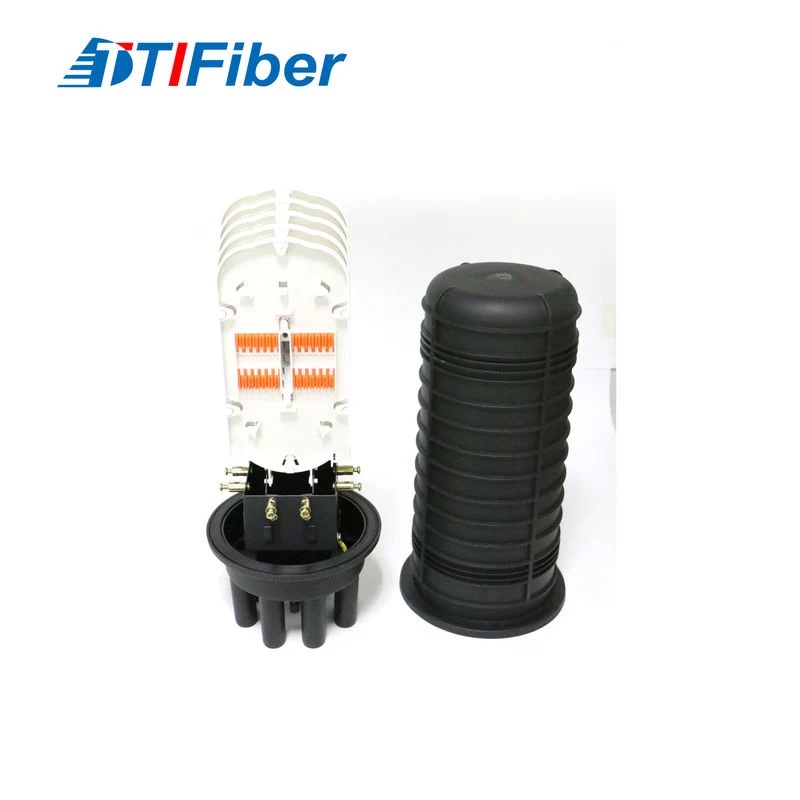
A dome closure does exactly what its shape suggests: a rounded shell caps over a bundle of cable ends entering from the bottom, with splice trays stacked inside around a central spine.
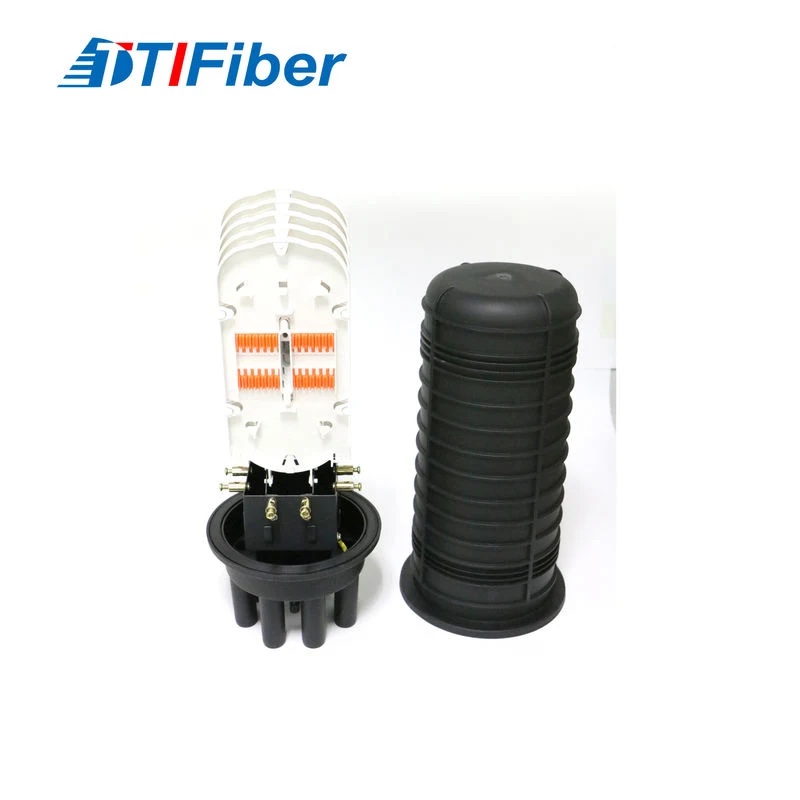
A dome closure opened to show the internal tray stack and cable entry (left) next to its assembled outer shell (right).
That single-entry design is what drives the sealing options. With cable entering from only one end, manufacturers seal a dome closure one of two ways: a heat-shrink sleeve — a section of heat-activated polymer that shrinks around the cable jacket and closure body to form a permanent, gasket-free barrier — or a mechanical O-ring-and-latch system that trades a marginally more complex seal for tool-free re-entry. Don't assume either one from "dome" alone — it's a spec to confirm per model. TTI Fiber's dome closures, for instance, ship mechanical and re-enterable by default (a slide-in-lock mechanism, no special tools) on smaller models, with heat-shrink offered as an alternative sealing option on higher-capacity models for installers who prefer a permanent one-time barrier.
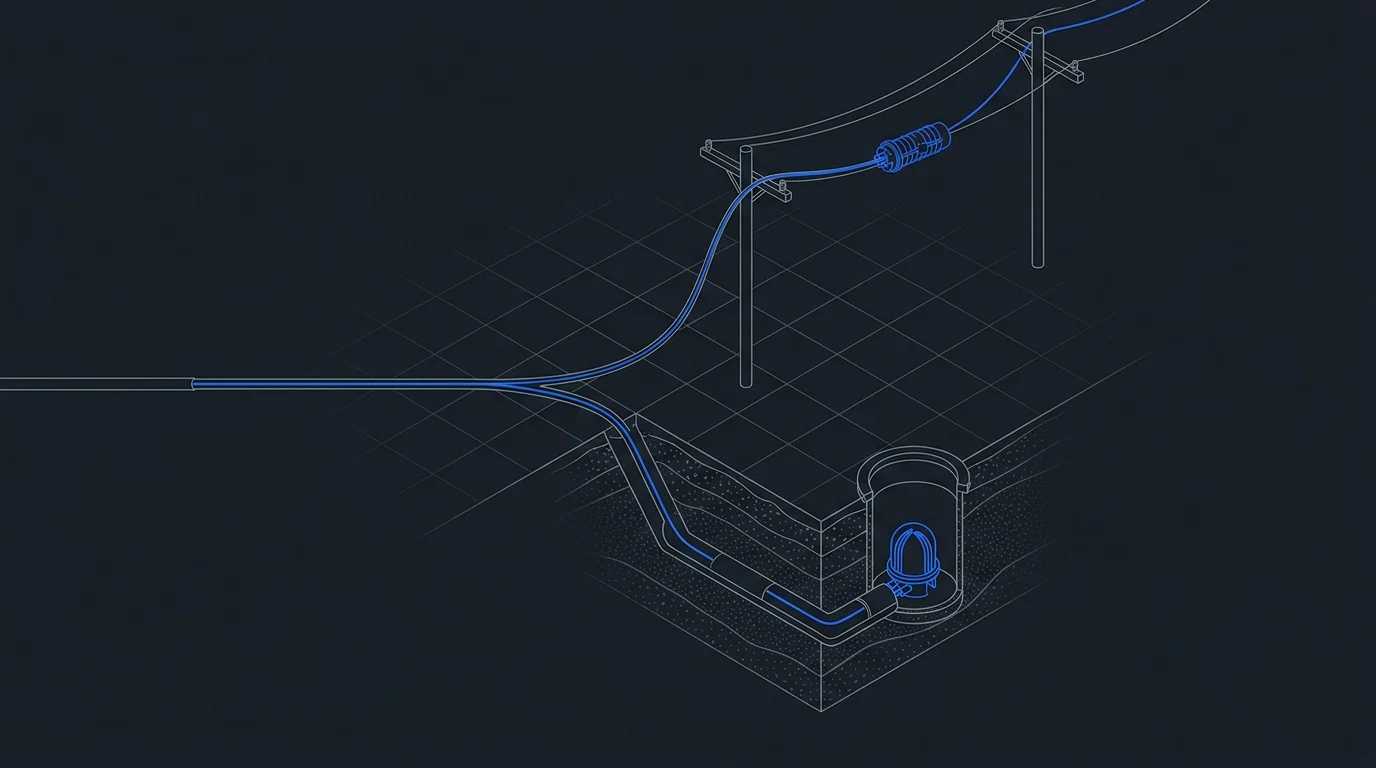
TTI Fiber's dome closures run from 12 to 288 fiber cores across several models, holding up to four splice trays. On the 24-core model, trays open past 90 degrees for full access without removing them from the closure, cable ports seal with size-specific grommets, and a built-in earthing device grounds any metallic strength member or armor layer in the incoming cable — the same armored outdoor cable construction discussed on the terrestrial side of a route. Dome closures are also the default at pole-top and aerial junctions, the same routes typically carrying ADSS aerial cable.
Horizontal / Inline Closures: Structure and Sealing
A horizontal (inline) closure is built the opposite way: an elongated housing with cable entering both ends in a straight run, splice trays stacked flat inside, and the assembly clamped shut rather than sealed permanently.
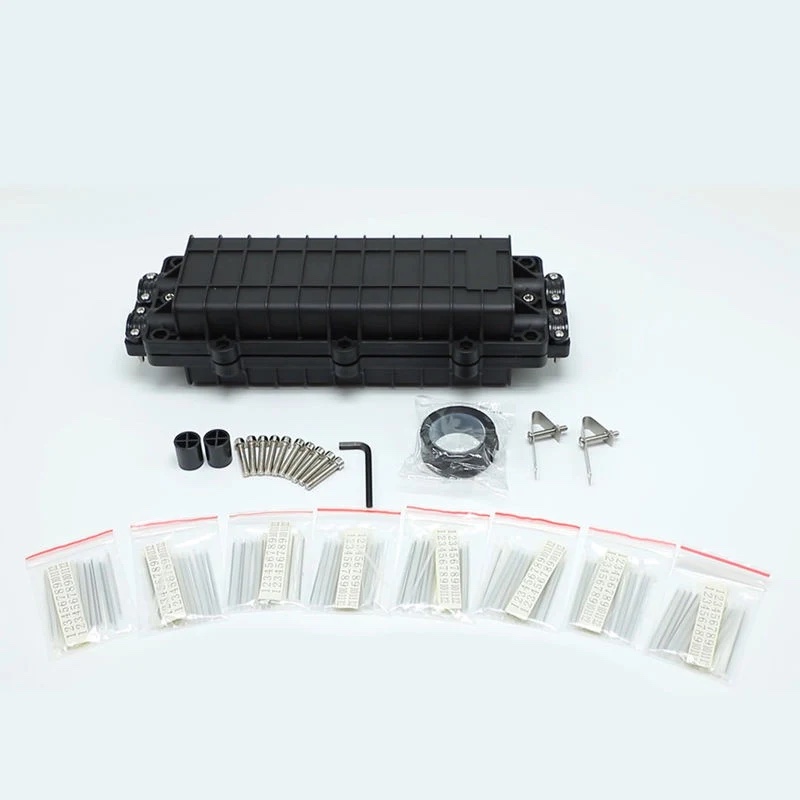
An inline closure kit: the elongated housing plus the clamp hardware and splice protector sleeves needed for a full install.
That both-ends design exists for a reason competing content rarely explains: it's built for mid-span access — splicing into or branching off a cable that continues past the closure in both directions, which a bottom-entry dome closure can't do cleanly. The tradeoff for that flexibility is the seal: instead of a one-time heat-shrink sleeve, inline closures use a mechanical clamp — often paired with a gasket or O-ring — that bolts the housing shut around each cable port.
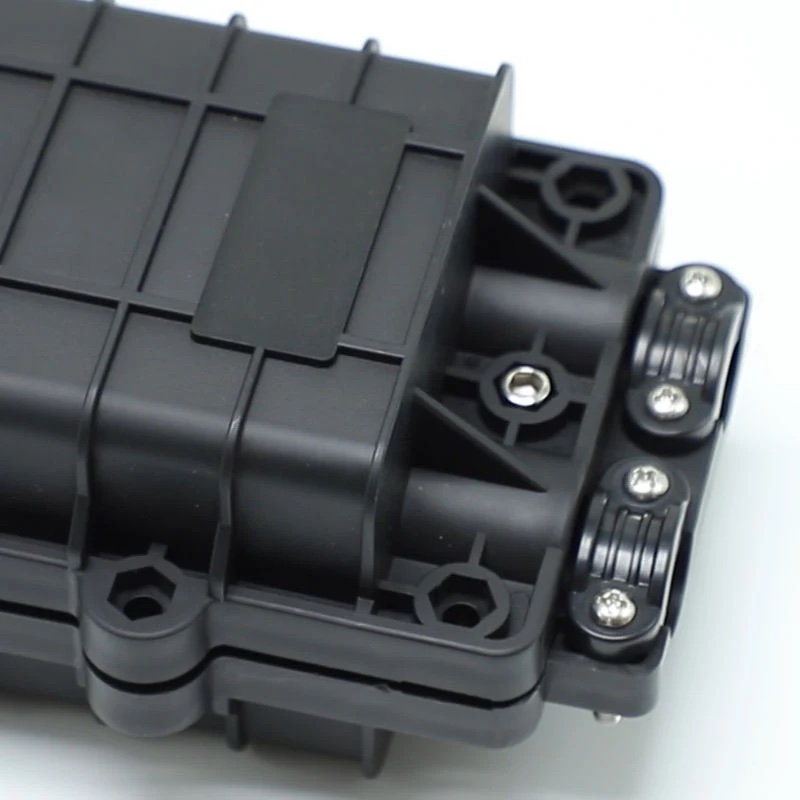
The mechanical clamp mechanism: screw-down hardware that reseals around the cable port instead of a one-time heat-shrink sleeve — the detail that makes a closure re-enterable.
That clamp is what makes the closure re-enterable: loosen it, do the work, reseal — no replacement parts needed. That's exactly what you want on a duct or direct-burial route likely to see future splices, taps, or capacity additions. TTI Fiber's inline closures cover 12 to 144 cores, with 2 to 6 cable entry ports depending on the model — each kit ships with the clamp hardware, port grommets, and splice protector sleeves needed for a complete install.
Standards That Actually Matter
Type aside, a splice closure worth specifying should carry two kinds of proof: that its structure and materials hold up mechanically and environmentally, and that its waterproofing is independently verified. Those are two different claims, and vague marketing copy ("waterproof," "rugged") often blurs them together.
IEC 62134 covers generic requirements for fibre optic closures, and Telcordia GR-771-CORE is the equivalent North American generic requirements standard commonly required on carrier and utility RFPs — both are closure-specific mechanical and environmental test standards, worth asking about when a spec sheet just says "tested." Neither is the same thing as an IP68 rating, which follows a separate standard, IEC 60529 — the international ingress-protection scale — and specifically means the enclosure survived submersion at 1.5 meters for 24 hours without water ingress. When a manufacturer cites a specific standard number, ask for the test report, not just the label — B2B procurement is exactly the context where that distinction matters.
All TTI Fiber closures, dome or horizontal, are IP68-rated regardless of type — waterproofing isn't a reason to choose one shape over the other. (TTI's product documentation also references IEC 62134 and GR-771; confirm current certification scope directly with TTI's engineering team for your specific RFP requirements.)
How to Choose: A Quick Decision Framework
Strip away the naming confusion and shape trivia, and the choice mostly comes down to three questions:
- Will this closure need to be reopened? If you expect future taps, capacity upgrades, or maintenance access, look for a mechanical-clamp or O-ring-and-latch seal — standard on horizontal/inline closures, and the default on most of TTI Fiber's dome models too. If the site is genuinely install-and-forget for the next 20+ years, a heat-shrink-sealed closure (offered as an option on TTI's higher-capacity dome models) gives you a marginally more robust one-time barrier.
- Does the route need mid-span branching? Splicing into a cable that continues in both directions — a common need on long duct or direct-burial trunk runs — favors horizontal/inline by design. A single terminating cable bundle, like a typical pole-top or drop-cable joint, is dome territory.
- What capacity do you actually need? Dome closures scale higher (up to 288 cores in TTI's lineup) because stacking trays around a central spine has more room to grow than a flat inline tray stack (capped around 144 cores). If you're building a high-count backbone junction, that capacity ceiling alone may decide it.
A fourth, related question — aerial versus underground or direct-burial routing — shapes which mounting hardware and grommet sizing you need, but that's its own decision with enough moving parts (burial depth, mounting brackets, ADSS strand attachment) to deserve separate treatment rather than being squeezed in here.
Quick Answers
Is a dome closure the same as a cap-style or butt closure? Yes. "Cap-style," "butt closure," and "vertical closure" (立式/帽式) all describe the same single-entry, dome-shaped closure — not a separate third type.
Which is better, dome or horizontal? Neither — they solve different problems. Dome closures suit permanent, single-entry, high-capacity installs (aerial, pole-top, backbone junctions). Horizontal closures suit re-enterable, mid-span, duct or direct-burial installs.
Can a splice closure be re-opened after installation? It depends on the seal, not the shape. Mechanical-clamp or O-ring-and-latch closures are designed for repeated re-entry — that's standard on horizontal/inline closures, and it's also the default on most of TTI Fiber's dome models. Heat-shrink-sealed closures, offered as an option on some higher-capacity dome models, require cutting and replacing the shrink sleeve for each re-entry. Always confirm the seal type rather than assuming it from the shape.
How many fiber cores can a splice closure hold? It varies by model and tray count. TTI Fiber's dome closures range from 12 to 288 cores; horizontal/inline closures range from 12 to 144 cores.
What certifications should I look for in a splice closure? IEC 62134 and Telcordia GR-771-CORE cover closure-specific mechanical and environmental testing, and an IP68 rating per IEC 60529 covers waterproofing — ask the manufacturer for the actual test report behind any of these, not just the label on a spec sheet.
Where TTI Fiber Fits
TTI Fiber manufactures both closure families covered in this guide — dome closures from 12 to 288 cores and horizontal/inline closures from 12 to 144 cores, all IP68-rated. If you already know which shape your route needs, browse the full splice closure lineup for specific models, port configurations, and cable-entry sizing. If you're still working through the choice, share your route details — aerial or buried, expected core count, whether you need mid-span access — and TTI's engineers will recommend a specific model within 24 hours.