Underground Fiber Optic Cable: Direct Burial vs Duct vs Aerial
Underground Fiber Optic Cable: Direct Burial vs Duct vs Aerial
The cable inside the trench might cost a dollar a foot. Getting it into the ground can cost six. That gap — between the cable and the method of deploying it — is the single biggest decision in any outside-plant build, and it's the one people rush. Pick direct burial where you should have used duct, and your next upgrade means re-digging the whole route. Hang it aerially to save money up front, and an ice storm three winters later turns the savings into an outage.
There are really only three ways to get fiber from A to B outdoors: direct burial (cable straight in the ground), duct/conduit (cable inside a buried pathway), and aerial (cable on poles). The first two are what people mean by underground fiber optic cable; the third is the overhead alternative. This guide breaks down what each method is, when it wins, what it costs, and gives you a decision framework to choose with confidence.
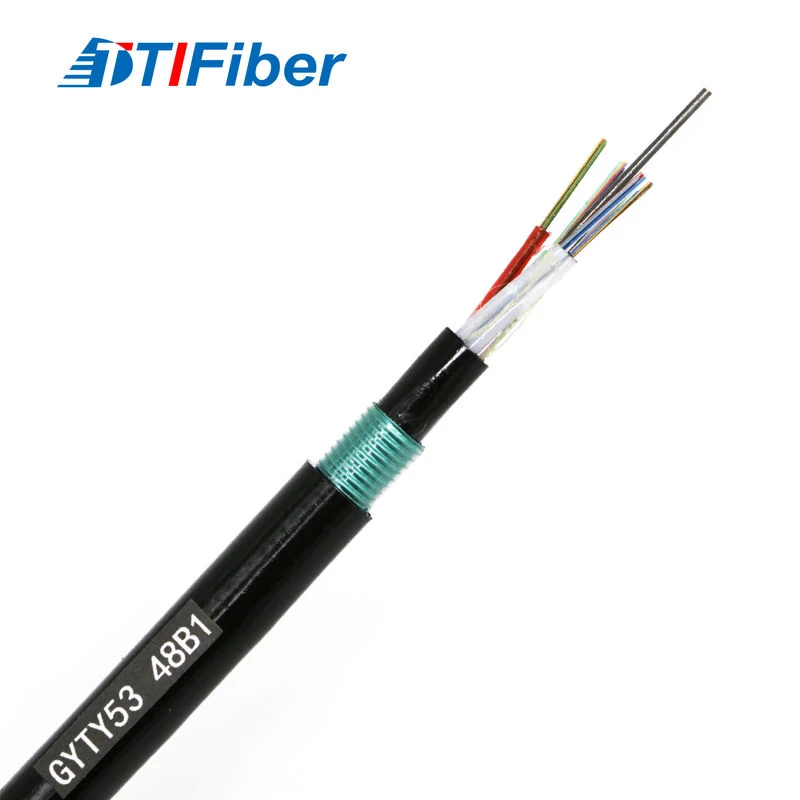
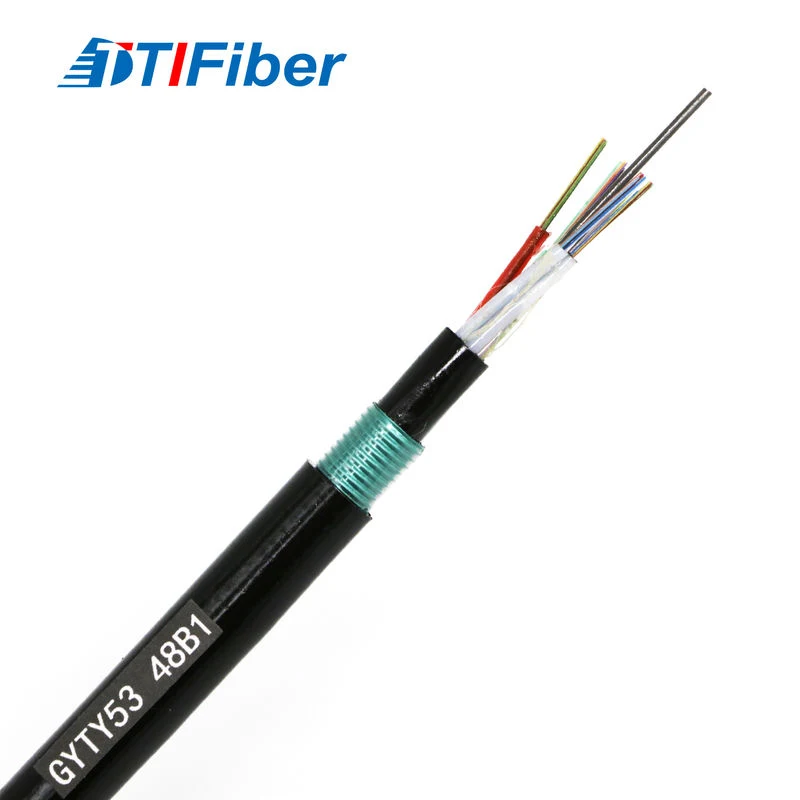
An armored outdoor cable — the workhorse of underground routes, whether buried directly or pulled through duct.
Method 1 — Direct Burial: Cable Straight in the Ground
Direct burial means exactly what it says: an armored outdoor cable is laid into a trench (or plowed in) and covered with soil — no pipe, no pathway. As Wikipedia's entry on direct-buried cable puts it, it's cable "specially designed to be buried under the ground without any other cover, sheath, or duct." The cable's own armor is the protection.
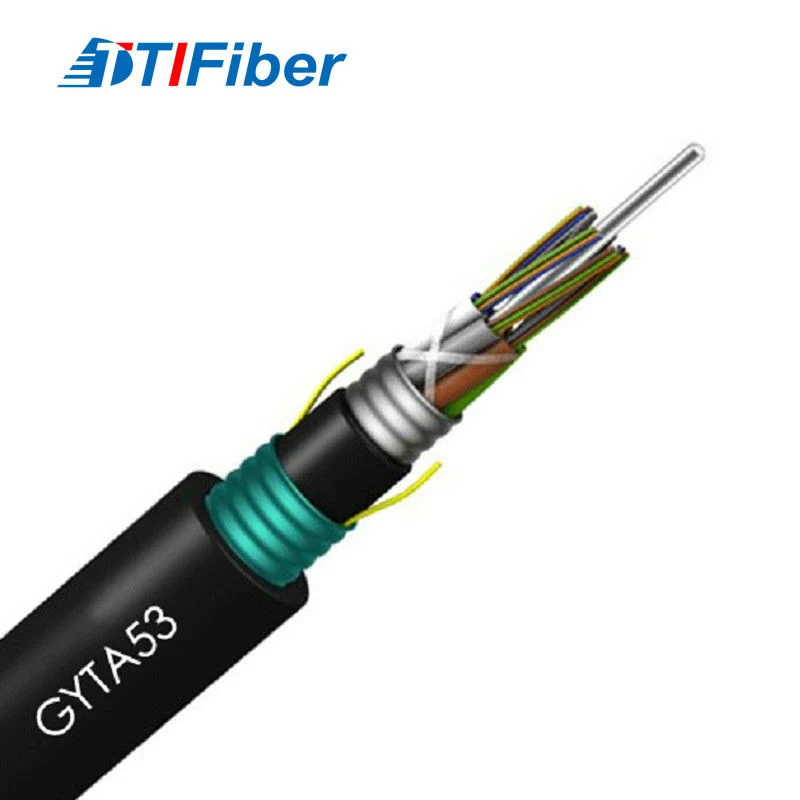
Direct-burial cable carries its own defense: steel-tape armor and a double PE sheath rated to survive soil pressure and rodents.
Cable types: you need a genuinely armored cable here — GYTA53 (steel-tape armor, APL moisture barrier), the economy GYTY53, or for heavy/rocky routes and water crossings, steel-wire-armored GYTA53+33. (Choosing among them is its own topic — see our guide to outdoor armored cable types.) A non-armored cable buried bare will not survive.
Burial depth is set by local code, utility/DOT standards, and traffic load — there is no single universal minimum. As a common rule of thumb (not a code citation): roughly 24 in (0.6 m) in open areas, 30–48 in (0.75–1.2 m) under roads and rail crossings, and always below the local frost line. We cover this in detail in how deep fiber should be buried.
Strengths: lowest material cost of the underground methods (no conduit to buy or install), fastest single-pass installation where a plow can be used, and excellent protection from weather once it's in the ground.
Weaknesses: the route is effectively permanent. Adding or replacing cable later means re-trenching. Repairs mean re-excavation. And it's unforgiving of rocky terrain, tree roots, and dense utility corridors.
Method 2 — Duct / Conduit: Cable Inside a Pathway
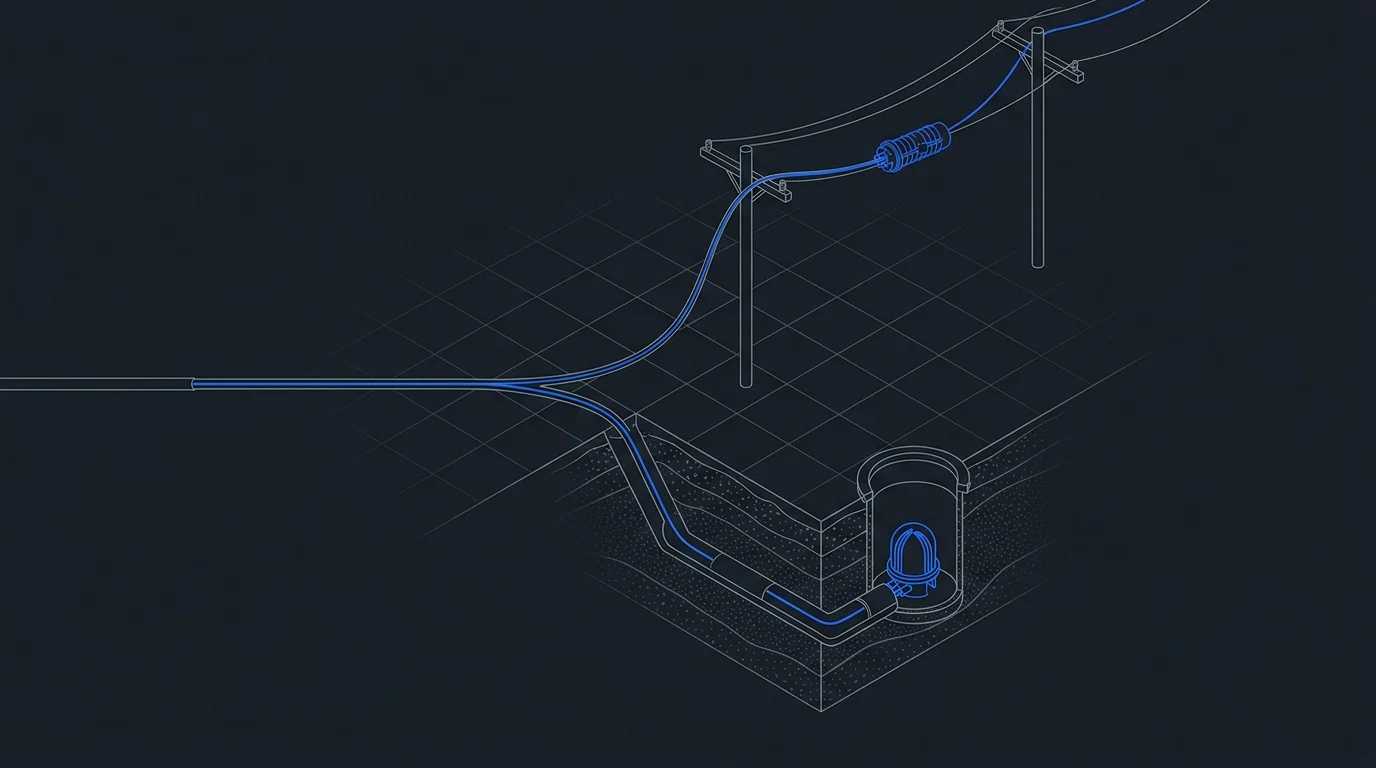
Here you bury a conduit (typically HDPE) or a bundle of innerducts/microducts first, then pull or blow the fiber through it. The cable is protected by the pipe, so it can be a lighter, often non-armored or micro cable rather than a heavy direct-burial build.
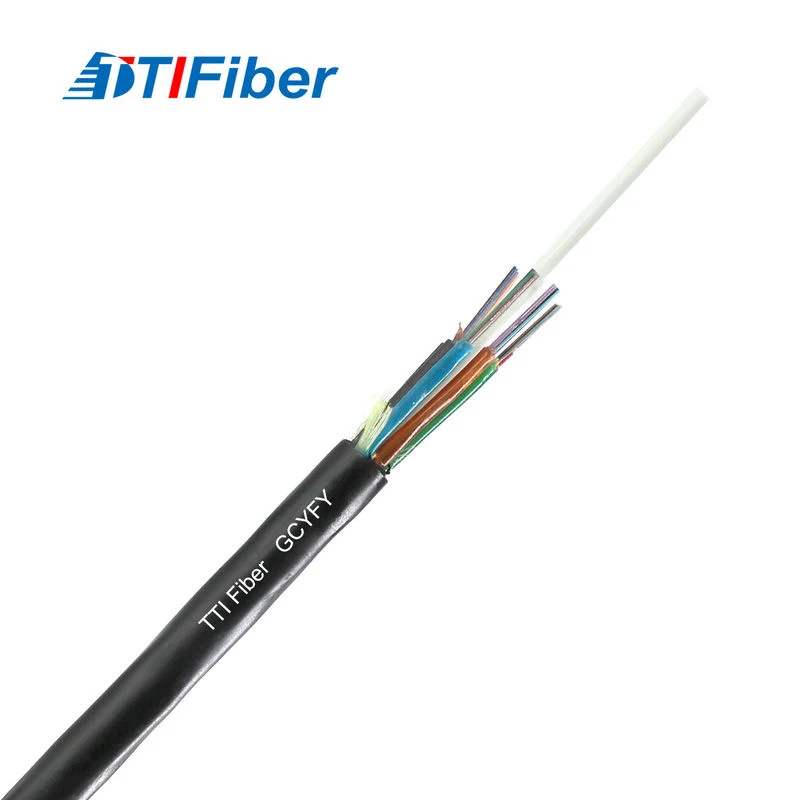
Microduct + air-blown cable: the modern duct approach — fiber is jetted through a pre-installed pathway, leaving spare ducts for the next upgrade.
The big advantage is the future. With duct in the ground, the next capacity upgrade is a cable pull or an air-blow, not a re-dig. Operators routinely lay extra empty innerducts precisely so the second and third cables cost a fraction of the first. The conduit also shields the cable from crush, rodents, and accidental dig-ins far better than soil alone.
What to get right:
- Conduit material: HDPE is the default for buried outside-plant runs; PVC suits duct banks and open trenches. (Jacket and duct polyethylene grades matter — see MDPE vs HDPE for fiber cable.)
- Pull geometry: keep bend radius generous (a common rule is ≥10× the cable diameter), limit pull sections to manageable lengths, and avoid stacking 90° bends between pull points.
- Lubricant: use proper fiber cable lube — never household detergent, which can stress-crack polyethylene.
- Microduct ID: for blown installs, size the duct to the cable and keep the path smooth; undulating buried innerduct sharply increases install force.
- Locate-ability: non-metallic duct and all-dielectric cable are invisible to standard locators — lay a tracer wire and burial warning tape so the route can be found, protected, and avoided by future digs.
Cost trade-off: higher up front (you're buying and placing conduit and cable — conduit adds roughly a dollar a foot on top of the cable) but dramatically cheaper over the life of the route once you factor in upgrades and repairs.
Method 3 — Aerial: Cable on Poles
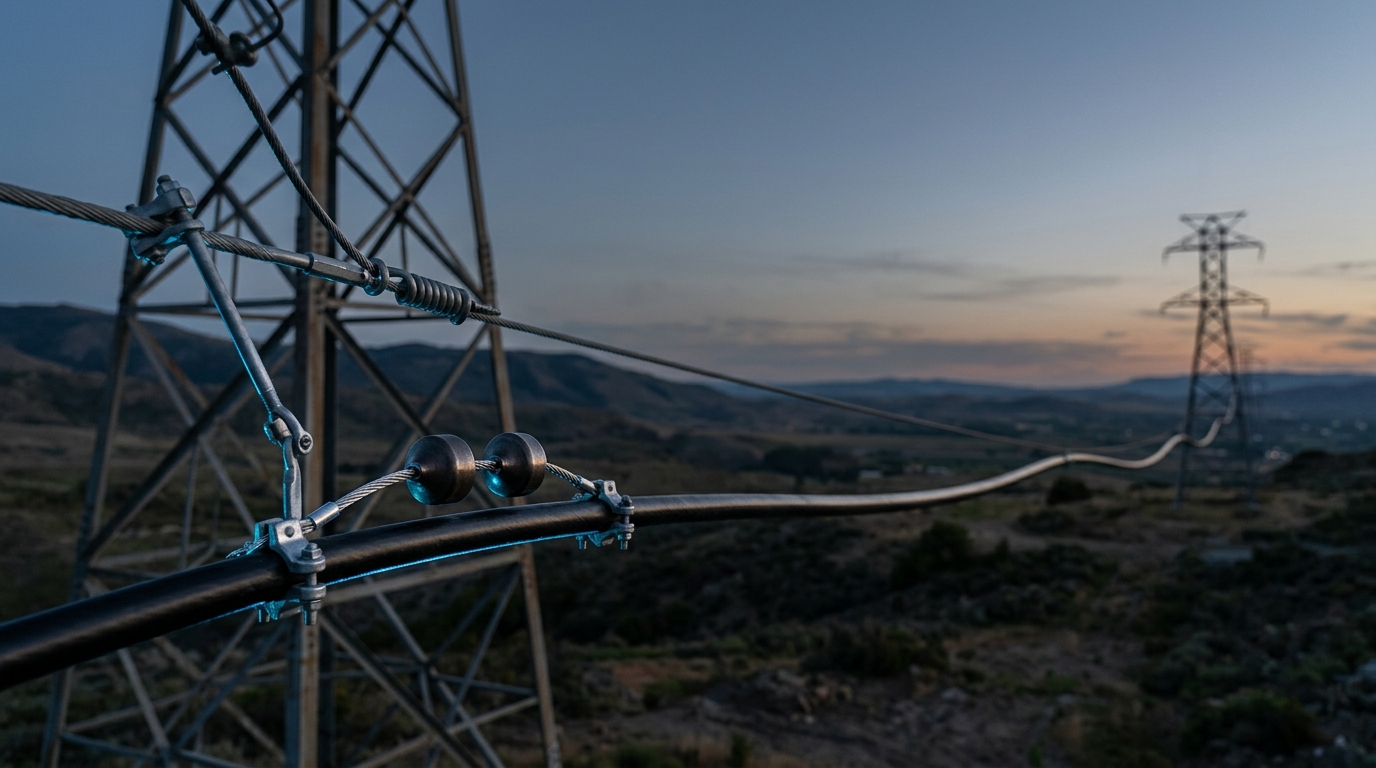
Aerial deployment hangs the cable from existing or new poles, either self-supporting (the cable carries its own messenger — ADSS all-dielectric cable, or figure-8 designs) or lashed to a separate steel messenger strand. Where the route follows high-voltage power lines, the relatives are ADSS and OPGW — built specifically for the electrical environment.
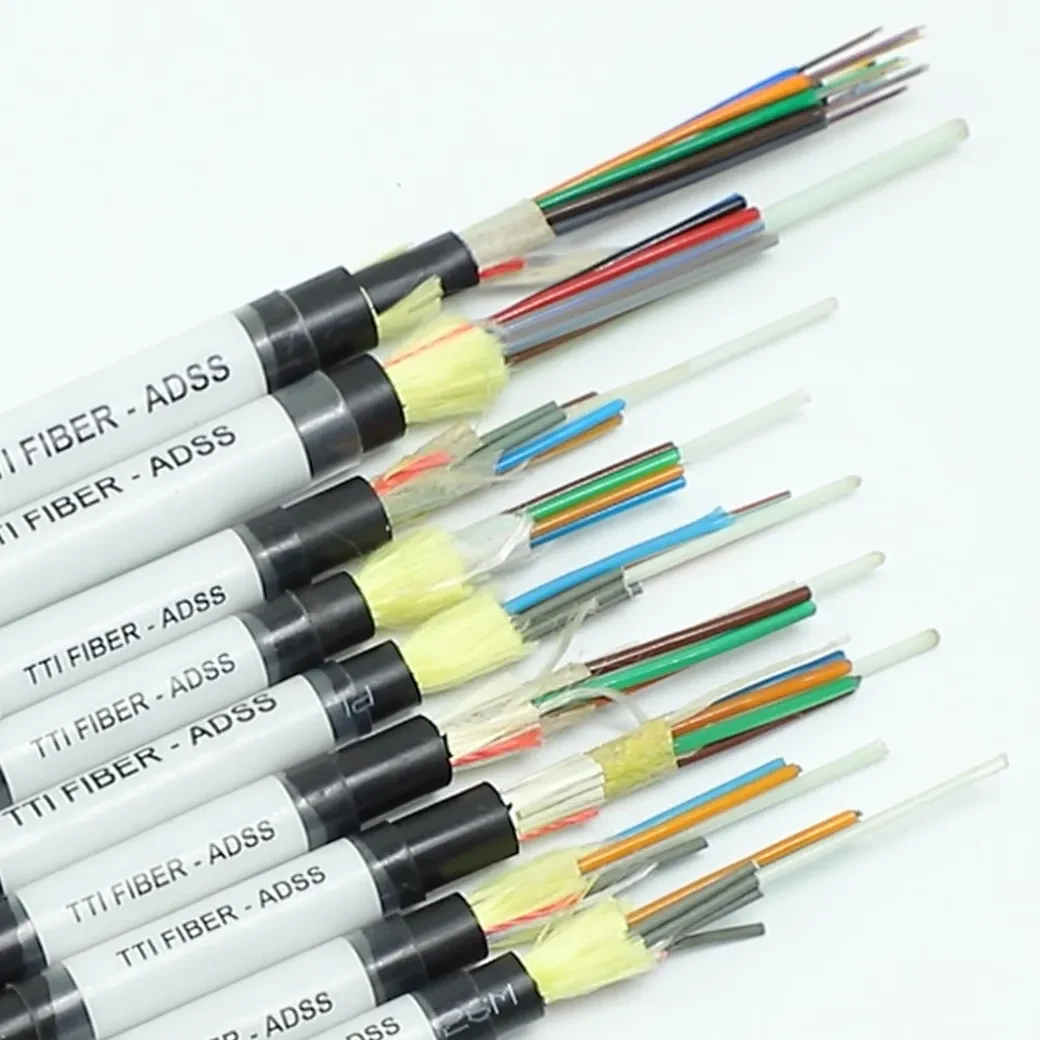
ADSS — all-dielectric self-supporting — is the classic aerial cable: no metal, carries its own span, ideal alongside power lines.
Strengths: by far the cheapest and fastest to deploy when poles already exist — no excavation, no permits for trenching, crews can place long spans quickly. Faults are visible and repairs don't require digging.
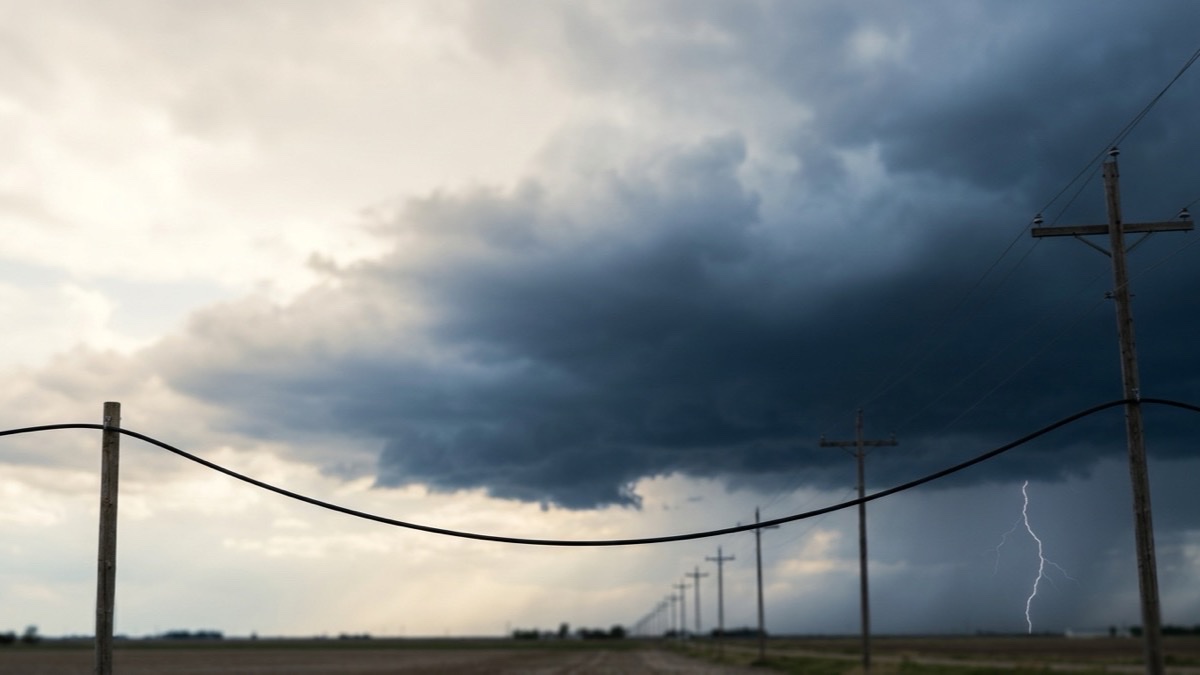
Weaknesses: exposure. Aerial cable contends with wind, ice loading, temperature swing, falling limbs, vehicle strikes on poles, and wildlife. Because buried routes are shielded from all of that, they are widely regarded as substantially more reliable than aerial in harsh-weather regions — the single biggest reason operators pay to go underground. There are also clearance rules: the NESC governs vertical and horizontal clearances from buildings, roads, and power conductors that the design must respect. Overhead routes are also where shield-wire fiber lives — the overhead power line standard documents how OPGW doubles as lightning protection and communication path.
Deployment Method vs Installation Technique
One distinction that trips people up: the method (burial, duct, aerial) is where the cable lives; the technique is how you put it there. Direct burial and duct both have several techniques, and the technique often drives more of the cost than the method:
- Open-cut trenching — excavate, lay, backfill. Flexible and common, but the slowest and most disruptive.
- Plowing (direct plowing) — a vibratory plow slices the ground and feeds cable or duct in one pass. Fast and cheap in open, workable soil; not for rock or dense utilities.
- Horizontal directional drilling (HDD) / boring — a trenchless bore under roads, rivers, driveways, and existing utilities. More expensive per foot but avoids surface restoration and is often the only option in paved or congested corridors.
- Microtrenching — a narrow saw-cut (typically in pavement) for small duct, popular for urban fiber. Fast and low-disruption, but shallow — depth and pavement-condition rules vary by city.
So "direct burial" might mean plowing in a field or microtrenching a city street; "duct" might be open-cut in a subdivision or an HDD shot under a highway. Choose the method first, then the technique that fits the ground.
Head-to-Head Comparison
Factor | Direct Burial | Duct / Conduit | Aerial |
|---|---|---|---|
Up-front cost | Low–medium | Highest | Lowest (if poles exist) |
Lifetime cost (with upgrades) | High (re-dig to change) | Lowest | Medium |
Install speed | Fast (plow) | Slowest | Fastest |
Weather reliability | Excellent | Excellent | Poorest |
Future upgrades | Re-trench | Pull/blow new cable | Re-hang |
Repair | Re-excavate | Pull section | Visible, no dig |
Typical cable | GYTA53 / GYTY53 / GYTA53+33 | Micro / non-armored / GYTS | ADSS / figure-8 / OPGW |
Main risk | Permanent route | Higher capex | Storm & ice damage |
What Actually Drives the Cost
Sticker prices on cable are a small part of the picture. Industry estimates put direct-burial armored cable around $0.70–$2 per foot and HDPE conduit around $1 per foot, but the installed cost of an underground route typically lands anywhere from $1 to $6 per foot — because labor and excavation are 60–80% of the total. The terrain decides that labor number: sandy soil is cheap to trench, clay is slower, and rock can require specialized cutting or boring.
The asymmetry that catches people out is repair and upgrade cost. A single underground fault repair can run well into five figures in urban or road-crossing settings once you include re-excavation, traffic control, and restoration (a rural splice repair is far less). That's the math that makes pre-laid duct look cheap in hindsight, and it's why "lowest up-front cost" (often aerial or bare direct burial) is rarely the same as "lowest total cost."
Cost and reliability figures here are typical industry patterns for context, not quotes or measured statistics — they vary widely by region, year, fiber count, and ground conditions. Always price and risk-assess your specific route.
The Decision Framework
Work down this list; the first hard constraint usually makes the call:
- Are there usable poles on the route? Yes, and budget is tight, and the climate is mild → aerial is hard to beat on cost and speed. Severe-weather region → lean underground despite the cost.
- Will you need to add capacity later? Yes → duct. Pre-laid innerduct turns every future upgrade into a pull instead of a dig. This alone justifies duct on backbone and growth routes.
- Is it a single, stable, long-life run with no expected changes? And the ground is workable → direct burial is the most cost-effective underground option.
- What's the terrain? Rock, high water table, or dense existing utilities push you toward duct (or directional boring) over direct burial.
- Regulation and aesthetics? Many municipalities now require undergrounding in new developments; that removes aerial from the table regardless of cost.
A useful default for most operators: duct on the backbone and any route you expect to grow; direct burial for stable laterals in good soil; aerial only where poles exist and weather is forgiving.
Matching the Cable to the Method
Buying the right deployment method but the wrong cable is a common, expensive mistake. The cable family follows the method:
Method | Use this cable family | Avoid |
|---|---|---|
Direct burial | Armored: GYTA53, GYTY53, GYTA53+33 | Non-armored, single-jacket cable |
Duct / conduit | Micro/air-blown, non-armored, or steel-tape GYTS | Heavy double-wire armor (wasted weight/cost) |
Aerial self-supporting | ADSS, figure-8 (GYTC8S/GYXTC8S) | Plain duct cable with no messenger |
Aerial along HV lines | ADSS (all-dielectric) or OPGW | Metallic-armored cable (induction risk) |
All three install environments are covered by one standard — IEC 60794-3 (outdoor cables) — which explicitly specifies cables for duct, directly buried, aerial, and water-crossing use. When you compare datasheets, confirm the cable's rated install method, tensile and crush ratings, and that it cites this standard.
Common Mistakes
- Direct-burying a duct/aerial cable. Light or non-armored cable laid bare in soil fails on crush and rodents. Match armor to method.
- Skipping spare duct. Laying exactly one innerduct saves pennies now and costs a re-dig later. Pull extra empties while the trench is open.
- Choosing aerial purely on up-front price in an ice- or wind-prone region — the lifetime reliability gap erases the saving.
- Ignoring the frost line and traffic load on burial depth. Too shallow invites dig-ins and freeze damage.
- Over-tight bends and over-long pulls in conduit, which spike pulling tension and can damage the cable. (Loose-tube construction tolerates install stress better — see tight-buffered vs loose-tube.)
- Forgetting the terminations. However the cable travels, it ends in closures and boxes with their own failure modes — see our splice closure types guide.
Frequently Asked Questions
Is direct burial or conduit better for underground fiber? Direct burial is cheaper and faster for a single, permanent run in good soil. Conduit costs more up front but wins over the life of the route because upgrades and repairs become cable pulls instead of re-digs. For backbone or any route you expect to grow, choose conduit.
How deep should underground fiber optic cable be buried? As a general guide: ~24 in (0.6 m) in open areas, ~36 in (0.9 m) under roads, ~48 in (1.2 m) under rail, and always below the frost line — but follow local code, which governs. See our burial depth guide.
Is aerial or underground fiber more reliable? Underground. Buried routes are largely immune to wind, ice, and falling debris, so they are widely considered substantially more reliable than aerial in harsh-weather regions. Aerial wins on cost and repair access, not on weather resilience.
Can I use the same cable for direct burial and conduit? You can pull an armored direct-burial cable through duct, but it's heavier and costlier than necessary — duct lets you use a lighter micro or non-armored cable. You should not go the other way and bury a duct cable directly.
Sourcing Cable for Any Deployment Method
The fastest way to derail an OSP build is a cable that doesn't match the method — a duct cable in a trench, or a metallic cable strung beside a 110 kV line. A manufacturer that builds the full outdoor range under one roof removes that risk: you spec the route, they match the cable.
TTI Fiber manufactures the complete outdoor lineup for all three methods — direct-burial armored (GYTA53, GYTY53, GYTA53+33), duct and air-blown micro cables, and aerial ADSS and figure-8 self-supporting cables, in 2–576 fiber counts — across an 11-line cable plant, with every cable tested before it ships and OEM length, print, and packaging as standard. One source from backbone to lateral keeps the cable matched to the method and the batch quality consistent.
Not sure which method — or which cable — fits your route? Send the route details (distance, terrain, poles or trench, fiber count, climate) and TTI Fiber's engineers will return a recommended deployment method, matched cable, datasheet, and quote, usually within 24 hours. Get a route recommendation →