The Complete Guide to Outdoor Armored Fiber Optic Cable Types
The Complete Guide to Outdoor Armored Fiber Optic Cable Types
Two cables can carry the exact same fiber, hit the exact same insertion loss, and still behave completely differently in the ground. The difference is almost never the glass — it's the armor and jacket structure wrapped around it. Specify that structure wrong and you get crushed tubes under a forklift route, gnawed cores in a rodent-heavy corridor, or water creeping into a splice closure two winters later. Specify it right and the cable outlives the network it was built for.
The problem is that outdoor armored cables hide all of this information inside cryptic model codes — GYTA53, GYTS, GYTY53, GYTA53+33 — that look like license plates. This guide decodes those codes, walks through every major outdoor armored cable type, and gives you a scenario-by-scenario way to choose. By the end you should be able to read a datasheet model number and know, at a glance, where that cable belongs.
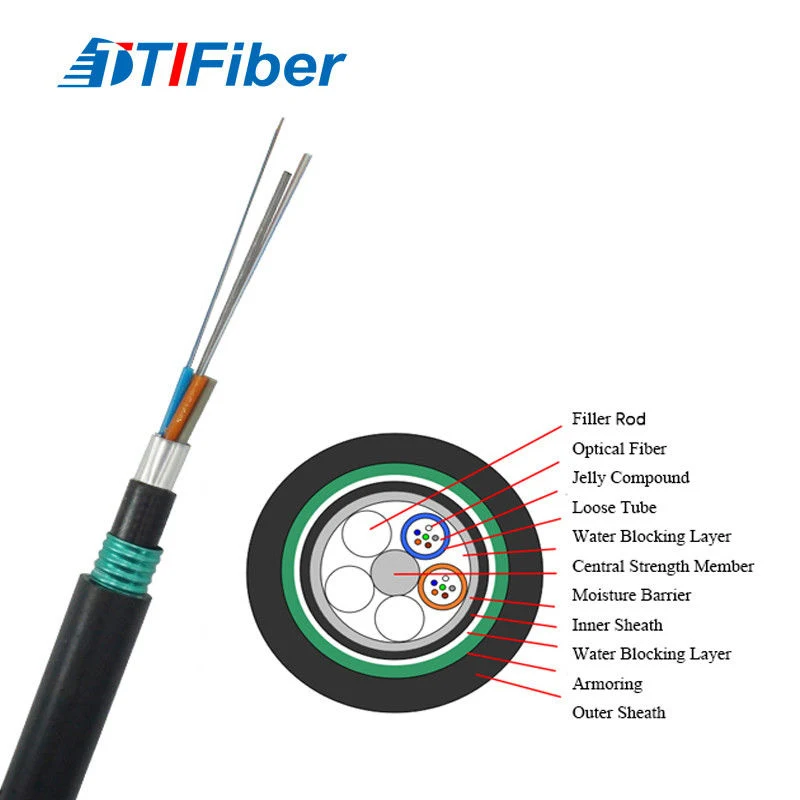
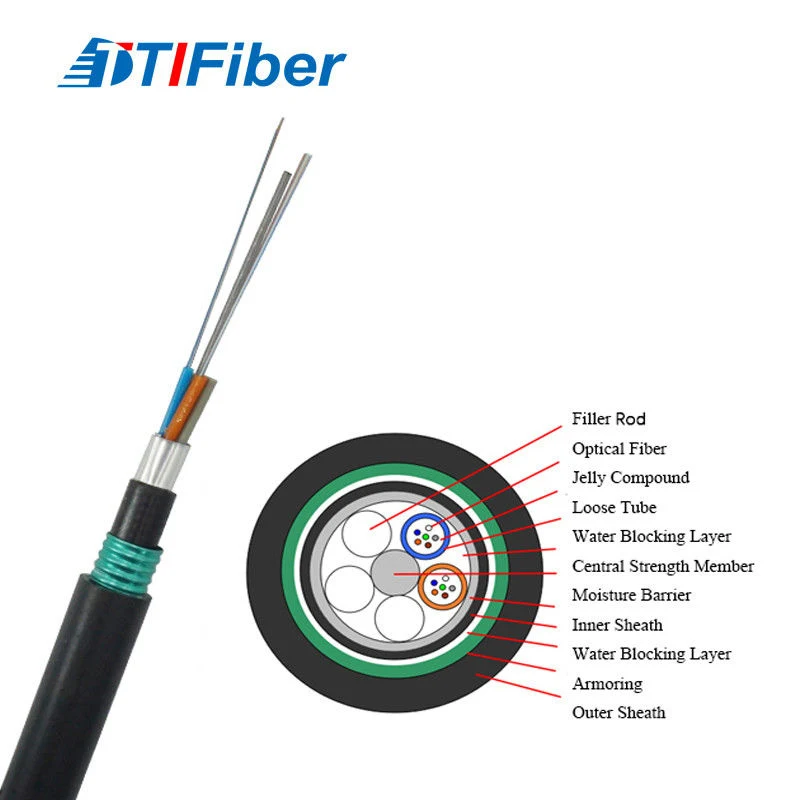
Anatomy of an outdoor armored cable: the armoring layer (here, corrugated steel tape) sits between the moisture barrier and the outer sheath — separate from the fiber itself.
What "Armored" Actually Means in an Outdoor Cable
In an outdoor optical cable, "armor" is a dedicated mechanical layer — usually a metal tape or metal wire — added between the cable core and the outer jacket. Its job is not optical. As the IEC generic cable specification (IEC 60794-1-1) frames it, a cable's mechanical and environmental properties are engineered separately from its transmission properties — so the fiber inside an armored and a non-armored cable can be identical while the protection around it is not.
Armor does three things a bare jacket can't:
- Crush resistance. A metal layer spreads point loads — a rock under a buried cable, a forklift wheel over a duct — so they don't pinch the loose tubes and stress the fiber.
- Rodent protection. Gophers, rats, and squirrels chew cable. A steel layer is the single most effective deterrent; as the general note on optical fiber cable construction puts it, cable is armored specifically to protect it from hazards including "gnawing animals."
- Tension and longitudinal strength for pulling through long ducts or hanging across spans.
What armor does not replace is the cable's water blocking. That's a separate system — the gel-filled loose tubes and the moisture-barrier laminate — and it's why understanding the full model code matters. (For the loose-tube design that does the water and stress management, see our explainer on tight-buffered vs loose-tube cable.)
How to Read an Outdoor Cable Model Code
Almost every outdoor armored cable on the global market — Chinese-manufactured or not — uses the YD/T 901 / GB naming convention. Once you can parse it, the model number tells you the structure before you ever open the datasheet.
A code like GYTA53 splits into two halves: letters (the core and material structure) and numbers (the armor and outer jacket).
The letters
Letter | Meaning |
|---|---|
G | Outdoor communication cable |
Y | Polyethylene (PE) sheath |
F | Non-metallic (e.g. FRP strength member, all-dielectric) |
T | Gel-filled loose tube (water-blocked core) |
S | Steel–PE laminate (steel tape) moisture/light-armor layer |
A | Aluminum–PE laminate (APL) moisture barrier |
X | Central loose tube construction |
W | Steel-tape longitudinal (used in some access cables) |
The numbers
The two-digit suffix describes the armor layer (first digit) and the outer jacket (second digit):
First digit (armor) | Meaning |
|---|---|
0 | No separate armor |
3 | Single round steel wire armor |
4 | Double round steel wire armor |
5 | Corrugated steel tape armor |
Second digit (jacket) | Meaning |
|---|---|
3 | PE outer jacket |
So 53 = corrugated steel-tape armor + PE outer jacket, and 33 = single round steel-wire armor + PE outer jacket. A trailing 53+33 means both — steel tape and steel wire.
Put it together and the codes read cleanly:
- GYTA53 → outdoor, PE, loose tube, APL moisture barrier, steel-tape armor, PE outer jacket.
- GYTS → outdoor, PE, loose tube, steel-tape laminate (combined moisture barrier + light armor), single PE jacket.
- GYTA53+33 → the GYTA53 build, plus an added steel-wire armor layer.
One honest caveat: numeric conventions vary slightly between manufacturers and editions of the standard, and some suppliers blur "moisture barrier" and "armor." Always confirm armor type, tensile rating, and crush rating against the actual datasheet — the model code tells you the family, the datasheet tells you the numbers.
The Main Outdoor Armored Cable Types
Here's the working lineup, ordered roughly from lightest to heaviest protection. The fiber count ranges and scenarios below reflect a typical full outdoor catalog.
Model | Armor | Structure | Best for | Typical fibers |
|---|---|---|---|---|
GYTS | Steel-tape laminated sheath (light) | Loose tube, single jacket | Duct, aerial, light direct burial | 2–216 |
GYXTW | Light steel tape (PSP) | Central tube | Access-network duct/aerial | 2–24 |
GYTY53 | Single steel-tape armor, double PE sheath | Loose tube (no APL) | Economy duct / direct burial | 2–144 |
GYTA53 | Steel-tape armor + APL, double sheath | Loose tube | Standard direct burial | 2–144 |
GYTA53+33 | Steel tape + steel wire | Loose tube, double armor | Heavy burial, water crossings | 2–36 |
GYFTY53 | Steel-tape armor, non-metallic core | Loose tube, FRP strength | Direct burial in lightning zones | 2–144 |
GYFTY63 | Steel tape + glass-yarn anti-rodent | Loose tube, non-metallic | Rodent-heavy burial/duct | 2–144 |
GYTC8S | Steel-tape armor, figure-8 self-support | Aerial messenger | Self-supporting aerial spans | 4–144 |
Two outdoor siblings deliberately sit outside this armored taxonomy: ADSS (all-dielectric self-supporting) and OPGW are metal-free or ground-wire cables built for long aerial spans along power lines, not buried armor. They solve a different problem and are covered separately — but it's worth knowing they exist so the "outdoor cable" picture feels complete.
Light-armored steel tape: GYTS and GYXTW
GYTS is the workhorse of outdoor duct and aerial runs. Strictly, its corrugated steel tape is a bonded sheath, not a formal armor layer — which is exactly why GYTS carries no numeric suffix. But that steel-tape sheath still does double duty as the moisture barrier and a light mechanical shield, enough to resist crush in a conduit and deter casual rodent damage, without the weight and cost of a full double-jacket build. GYXTW is its compact, central-tube cousin for low-count access work.
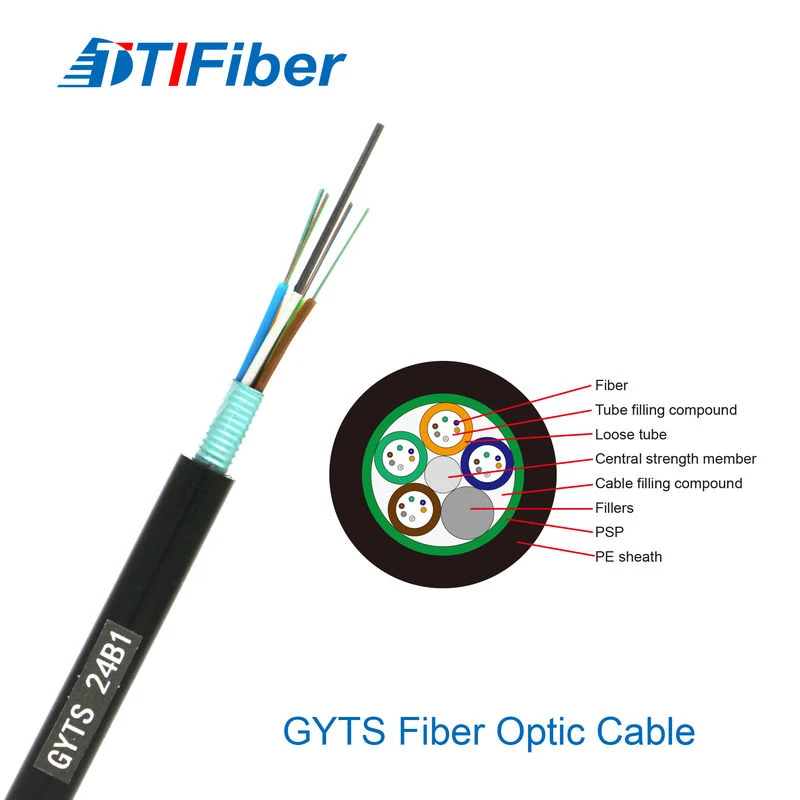
GYTS: a single corrugated steel-tape (PSP) layer doubles as moisture barrier and light mechanical protection — the duct/aerial workhorse.
If your cable lives inside a duct or hangs on a messenger and won't see direct soil contact or heavy mechanical traffic, GYTS-class cable is usually the right, cost-efficient call.
Single-armored, double-jacket: GYTY53 and GYTA53
This is the direct-burial family. Both wrap a corrugated steel-tape armor between an inner sheath and an outer PE jacket — the "double-sheath" construction the 53 code implies in practice — so the armor is fully encapsulated and protected from corrosion even when buried bare in soil.
The difference between them is the moisture barrier:
- GYTY53 uses PE for the inner sheath — no aluminum layer. It's the economy direct-burial choice: still steel-tape armored and double-jacketed, just without the APL.
- GYTA53 adds the aluminum–PE laminate (APL) moisture barrier under the armor. The aluminum gives a superior longitudinal water block, which is why GYTA53 is the default specification for serious direct-burial trunk routes.
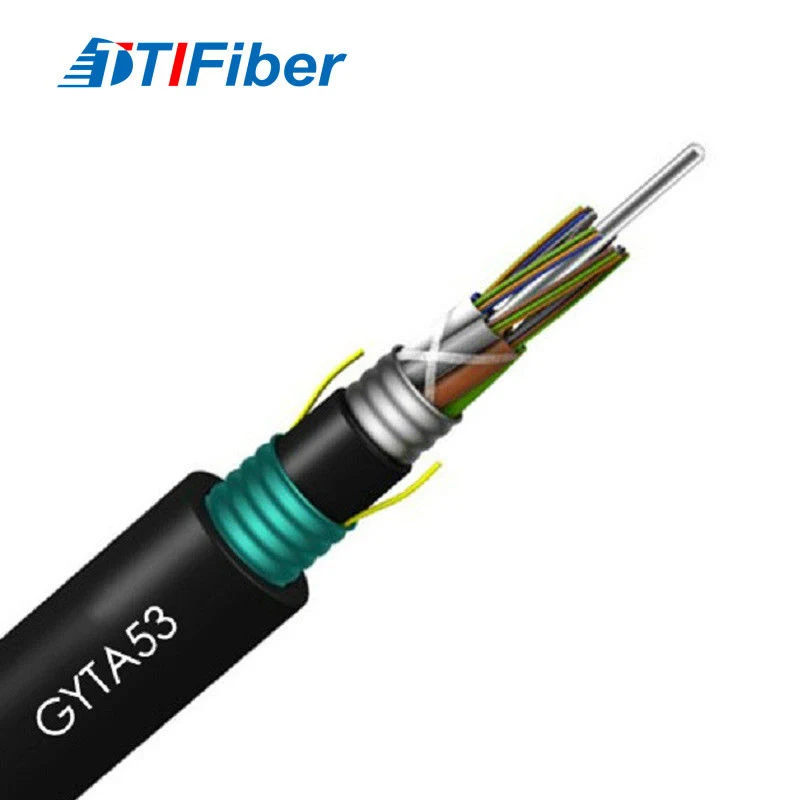
GYTA53 — the default direct-burial trunk cable: APL moisture barrier plus corrugated steel-tape armor between two sheaths.
For depth and trenching practice that pairs with these cables, see how deep fiber should be buried. And because the outer jacket grade matters as much as the armor in wet soil, it's worth knowing the difference between MDPE and HDPE jackets.
Heavy steel-wire armored: GYTA53+33
When crush and tension loads exceed what steel tape can handle — deep burial under roadbeds, river and lake crossings, or any run where the cable may be dragged hard — you add a layer of round steel wire on top of the steel tape. That's the +33 in GYTA53+33.
Steel-wire armor dramatically raises both crush rating and tensile strength, at the cost of weight, bend radius, and price. It's a special-application cable, not a default, but in a water crossing it's the difference between a link that lasts decades and a premature re-dig.
Non-metallic hybrids: GYFTY53 and GYFTY63
Sometimes you need armor's mechanical protection but can't tolerate metal in the strength member — typically near high-voltage lines or in lightning-prone corridors, where an all-metal cable becomes an induction and grounding liability.
- GYFTY53 keeps a non-metallic (FRP) central strength member and a non-metallic core, but still adds steel-tape armor for buried crush protection. It's the answer for direct burial in electrically hostile environments. (If your run is fully aerial along a power line, an all-dielectric self-supporting cable or OPGW may fit better — different problem, different cable.)
- GYFTY63 layers a glass-yarn anti-rodent armor with steel tape for the worst rodent zones, where chewing damage is the dominant failure mode.
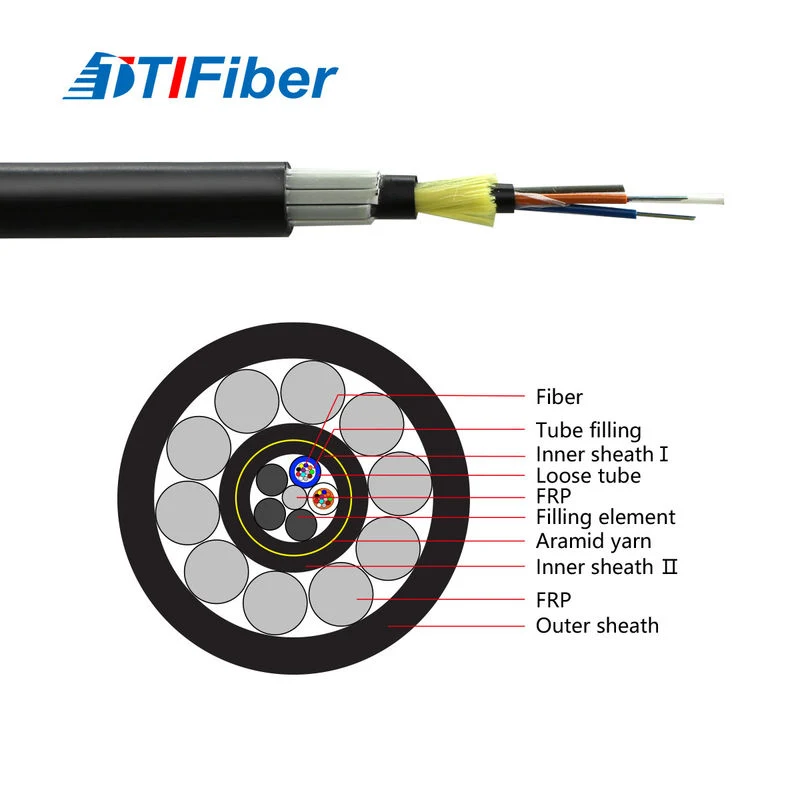
GYFTY63: an all-dielectric core (FRP + aramid yarn) combined with anti-rodent armor — protection without the metal where induction is a concern.
For background on why the non-metallic, FRP-strengthened build exists at all, our piece on what GYFTY fiber cable is goes deeper.
Self-supporting armored aerial: GYTC8S
The figure-8 ("8字") cables carry their own steel messenger molded alongside the core, so they hang across spans without a separate strand. GYTC8S adds steel-tape armor to that self-supporting build for aerial runs that need extra crush and rodent resistance — for example, lower spans within reach of wildlife.
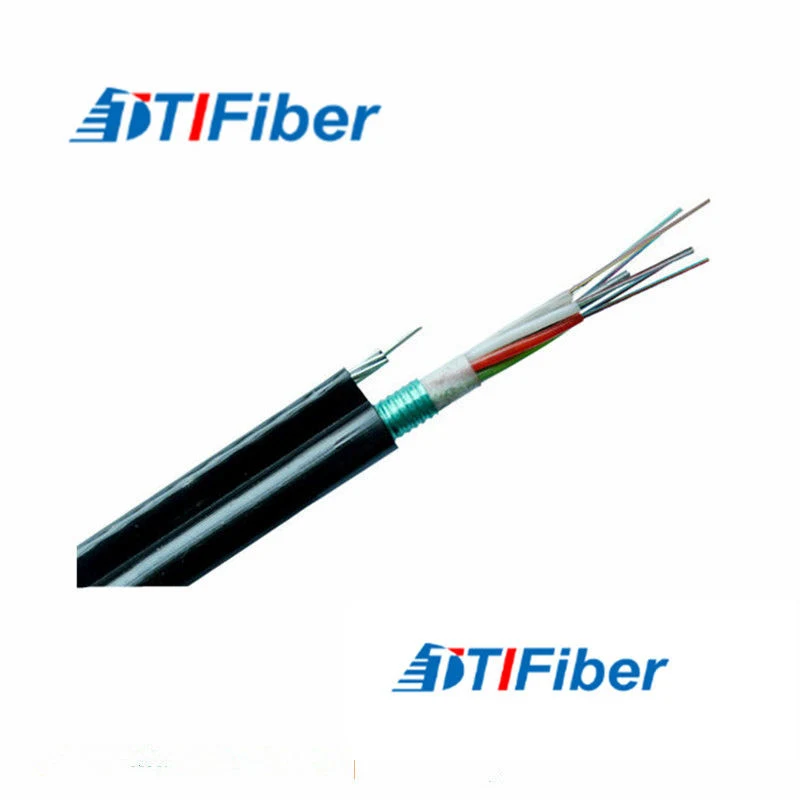
GYTC8S: the figure-8 profile carries its own steel messenger, so the armored cable hangs across spans without a separate strand.
Steel Tape vs Steel Wire Armor
This is the single most common point of confusion, so it's worth isolating.
Steel tape ( | Steel wire ( | |
|---|---|---|
Form | Corrugated tape wrapped longitudinally | Round wires laid around the core |
Crush resistance | High | Very high |
Tensile strength | Moderate | Very high |
Weight & cost | Lower | Higher |
Bend radius | Smaller (more flexible) | Larger (stiffer) |
Typical use | Duct, standard direct burial | Heavy burial, water crossings, high-pull routes |
The rule of thumb: steel tape is your default armor for the vast majority of buried and ducted runs. Reach for steel wire only when the mechanical load — crush or pulling tension — genuinely exceeds tape's envelope. Over-specifying steel wire everywhere just adds weight, stiffness, and cost you don't need.
Armored vs Non-Armored: Do You Actually Need Armor?
Armor isn't free — it adds weight, raises cost, increases bend radius, and (with metallic armor) requires grounding. So the honest first question is whether you need it at all.
Choose armored when:
- The cable is directly buried in soil.
- The route runs through rodent territory (rural, agricultural, forested).
- The cable shares trays or ducts with heavy mechanical traffic (forklifts, machinery).
- You need high pulling tension for long duct pulls.
Non-armored (or all-dielectric) is fine when:
- The cable is inside a protective inner duct or microduct.
- You're running aerial all-dielectric along power lines (where metal is a liability).
- The route is indoor or protected end to end.
Remember that armor protects the cable mechanically; it does nothing for signal integrity inside the glass. If you're chasing loss or interference problems, those live elsewhere — see what can actually disrupt the light signal inside the fiber and what can interfere with fiber optic internet.
Choosing by Installation Scenario
If you only remember one table, make it this one.
Scenario | Recommended type | Why |
|---|---|---|
Duct / conduit | GYTS, GYTY53 | Light steel-tape armor handles conduit crush; no need for double armor |
Aerial (with strand) | GYTS | Steel-tape armor + lashed to messenger |
Self-supporting aerial | GYTC8S | Built-in figure-8 messenger |
Standard direct burial | GYTA53 | APL moisture barrier + steel tape, double jacket |
Economy direct burial | GYTY53 | Steel tape + double jacket, no APL |
Heavy burial / water crossing | GYTA53+33 | Steel-wire armor for crush + tension |
Rodent-heavy route | GYFTY63, GYTA53 | Glass-yarn + steel armor; steel tape deters chewing |
Lightning / near power lines (buried) | GYFTY53 | Non-metallic core + steel-tape armor |
Along high-voltage lines (aerial) | All-dielectric / OPGW | Avoids metallic induction |
Whichever type you land on, the cable eventually terminates into outdoor closures and distribution boxes — enclosures that have their own failure modes worth designing around. See our guide to splice closure types before you finalize the run.
What to Verify on the Datasheet
The model code narrows the family; these numbers confirm the cable will survive your route:
- Tensile rating (N) — must exceed your maximum pulling tension with margin. Common outdoor ratings run 600 N (short/install) to 3000 N (long pulls, heavy armor).
- Crush rating (N/100 mm) — the load the cable survives without optical degradation.
- Operating temperature — outdoor cables typically span −40 °C to +60/70 °C.
- Fiber spec — G.652D for standard single-mode, G.657A for bend-tolerant access.
- Standards compliance — outdoor cables are governed by the IEC 60794-3 outdoor-cables sectional specification, which explicitly covers duct, directly buried, aerial, and water-crossing cables; also look for IEC 60793 (fiber) and TIA/EIA-598 (color coding). The presence of a real standards list is itself a quality signal.
- Water-blocking method — gel-filled loose tube vs dry/water-swellable; both work, but confirm one is present for buried cable.
Common Mistakes When Specifying Armored Cable
- Using GYTS for direct burial. GYTS is duct/aerial-grade. Bury it bare and you've skipped the double jacket that protects the armor from corrosion.
- Specifying steel wire "to be safe." Steel-wire armor stiffens the cable and blows the bend radius. Use it where loads demand it, not as a blanket upgrade.
- Putting metal armor near power lines. Metallic armor near high-voltage infrastructure is an induction and grounding hazard — that's exactly what the non-metallic GYFTY family solves.
- Ignoring the jacket grade. Armor without a proper PE (MDPE/HDPE) outer jacket still lets moisture and UV win over time.
- Trusting the model code alone. Codes vary by maker. Confirm armor type, tensile, and crush ratings against the datasheet every time.
Frequently Asked Questions
What's the difference between GYTA53 and GYTS? GYTS has a single corrugated steel-tape layer and one jacket — it's duct/aerial-grade. GYTA53 adds an aluminum (APL) moisture barrier under the steel-tape armor and uses a double jacket, making it the standard direct-burial cable.
Is GYTY53 or GYTA53 better for direct burial? Both are valid double-jacket, steel-tape-armored burial cables. GYTA53 adds an APL aluminum moisture barrier for better longitudinal water blocking; GYTY53 omits it for a lower-cost build. For critical trunk routes, GYTA53. For budget-sensitive runs in drier soil, GYTY53.
Does armored fiber cable need to be grounded? Metallic-armored cable (steel tape or wire) should be bonded and grounded per local practice, especially near power infrastructure. If grounding is impractical or risky, use a non-metallic cable such as the GYFTY family.
Can armored cable be used aerially? Yes — GYTS is lashed to a messenger, and figure-8 types like GYTC8S are self-supporting. Just match the tensile and span ratings to your route.
Sourcing Armored Outdoor Cable
Armored cable quality is decided in the factory, not on the datasheet. The two things that actually vary between suppliers are whether the steel-tape and APL layers are applied consistently (gaps and overlaps are where water gets in) and whether the cable is tested per-reel or sampled.
This is where vertically integrated manufacturing matters. At TTI Fiber, the full outdoor armored lineup above — GYTS, GYTY53, GYTA53, GYTA53+33, GYFTY53, GYFTY63 and the figure-8 self-supporting types, in 2–576 fiber counts — is produced in-house across an 11-line cable plant that runs the entire process from fiber coloring and tube extrusion through stranding, armoring, and jacketing. Every cable is 100% tested before it ships rather than batch-sampled, and OEM length, print, and packaging are standard. For projects that need a single source from feeder to access, that single-vendor consistency removes a whole class of mixed-batch risk.
Need help matching a model to your route? Send your installation scenario — duct, aerial, burial depth, fiber count, environment — and TTI Fiber's engineers will return a recommended type, datasheet, and quote, typically within 24 hours. Get a tailored recommendation →