All-Dielectric Fiber Cable Lightning Protection | TTI Fiber
Ask Google whether all-dielectric fiber optic cable needs lightning protection and the AI Overview answers, near enough verbatim: "No grounding required: unlike armored cables, you do not need special grounding blocks or surge protectors on the outside line."
Every word of that is true. The last four words are doing most of the work, and almost nobody reads them. "No surge protectors on the outside line" is correct. "No surge protectors" is what gets carried into the design file — and that is what costs a line card.
The gap between those two readings is what this guide is about. "All-dielectric" is a statement about exactly one component of your plant: the cable. It means the cable contains no metal, and therefore contains nothing for lightning to conduct along, couple into, or arc toward. That is a real design win, and it is the main reason the cable type exists. But a lightning event does not stop at the boundary of your cable specification. Choosing all-dielectric does not delete the lightning problem from your route. It relocates it — to the places on that route where metal is still present.
This guide covers where those places are, what the code actually regulates (and what it doesn't), and how the answer changes across four deployment scenarios.
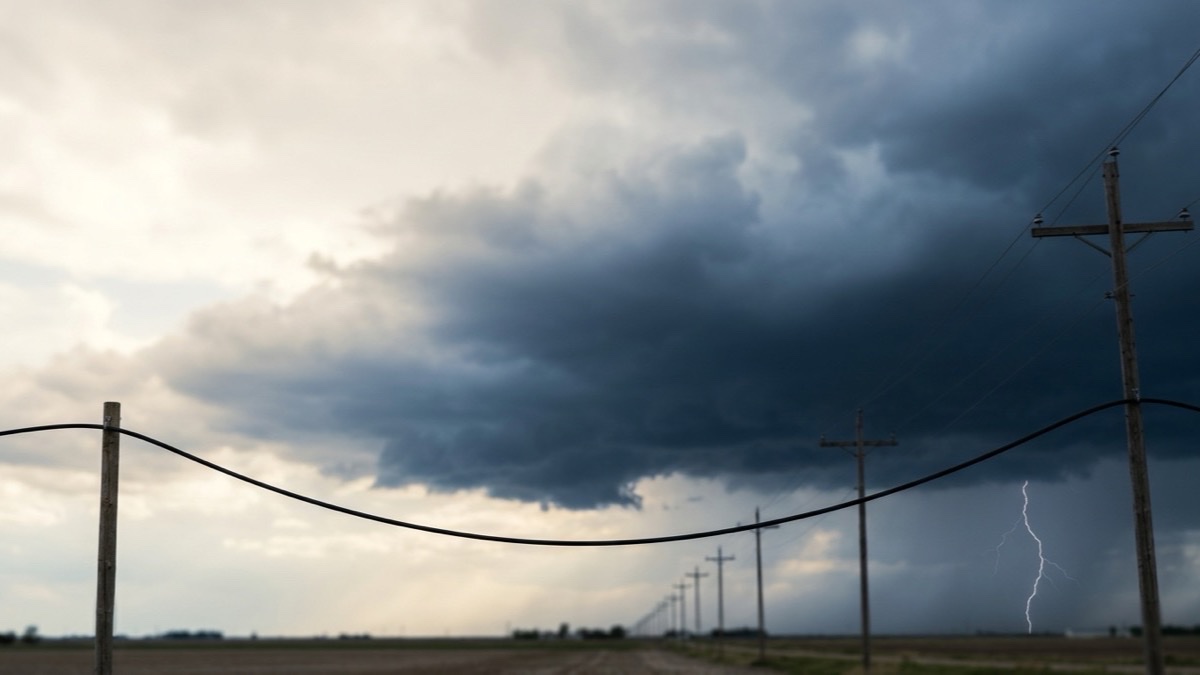
An all-dielectric span carries no metal at all — which settles two of the three ways lightning damages a fiber route, and none of the rest.
Start here: which row is your route?
Route | What all-dielectric buys you | What still needs designing |
|---|---|---|
Direct-buried | No metallic path for soil arcing or ground potential rise. No bonding electrode at any splice closure. | The tracer/locate wire, if you install one — this is the big one |
Aerial, non-power poles | No induced coupling from nearby strikes. No bonding at each pole. | Thermal damage at a direct arc attachment; the hardware at both ends |
Attached to an energized line (ADSS) | No line shutdown to string, no bonding, no induced current in the cable | Jacket electrical aging — which is not a lightning problem at all |
Building entrance & terminal | Nothing. This is where the cable's dielectric property stops helping. | Armored indoor transition, busbar bonding, port-level SPD |
Can lightning strike through fiber optic cable?
Lightning cannot travel along an all-dielectric fiber optic cable, because there is no conductor inside it to travel along. It can still damage one — by burning through the jacket where an arc attaches directly, and by reaching the equipment at either end through metal that is not part of the cable.
Three mechanisms are usually collapsed into one word ("lightning"), and only two of them are removed by choosing a dielectric cable.
1. Direct attachment — not removed. Lightning does not preferentially seek a non-conductive object, but a cable strung across a long open span can still be in the channel's path. The damage is thermal and mechanical: the arc vaporizes polyethylene and blows out a section of jacket. What matters is not the strike itself but the breach — water reaches the aramid yarn or the loose tubes, and the failure shows up months later as rising attenuation. No cable material prevents this. Mitigation is route-level: shielding conductors, span placement, and structure height.
2. Induction into metallic members — fully removed. This one has been measured rather than asserted. At the International Center for Lightning Research and Testing at Camp Blanding, Florida, researchers instrumented a buried 15 kV shielded coaxial power cable and recorded the currents that lightning induced in it. Their finding: "the induced current in the cable shield can reach relatively large values of about 100 A for stroke locations within 200 m of the cable" — with no direct strike on the cable at all (Paolone et al., IEEE Transactions on Electromagnetic Compatibility, vol. 47, no. 3, 2005, DOI 10.1109/TEMC.2005.853163). The magnitude belongs to that cable and that geometry, not to yours — but the mechanism is general, and it needs a metallic member to act on. Remove the metal and there is nothing left in the cable to induce a current into. The same removal eliminates EMI pickup, for the same reason: it is the same metal.
3. Ground potential rise and soil arcing — fully removed. Lightning injects current into the earth, and because the earth's resistance is non-zero, the potential in the soil rises. Anything conductive buried nearby then becomes a preferential path, and in high-resistivity soil the current will arc through the ground to reach it. A steel-tape-armored cable buried in dry sand is a far better conductor than the sand around it. An all-dielectric cable is not a better conductor than anything. It is simply not a candidate.
So: two of three removed, and the one that remains is a routing question, not a cable-material question.
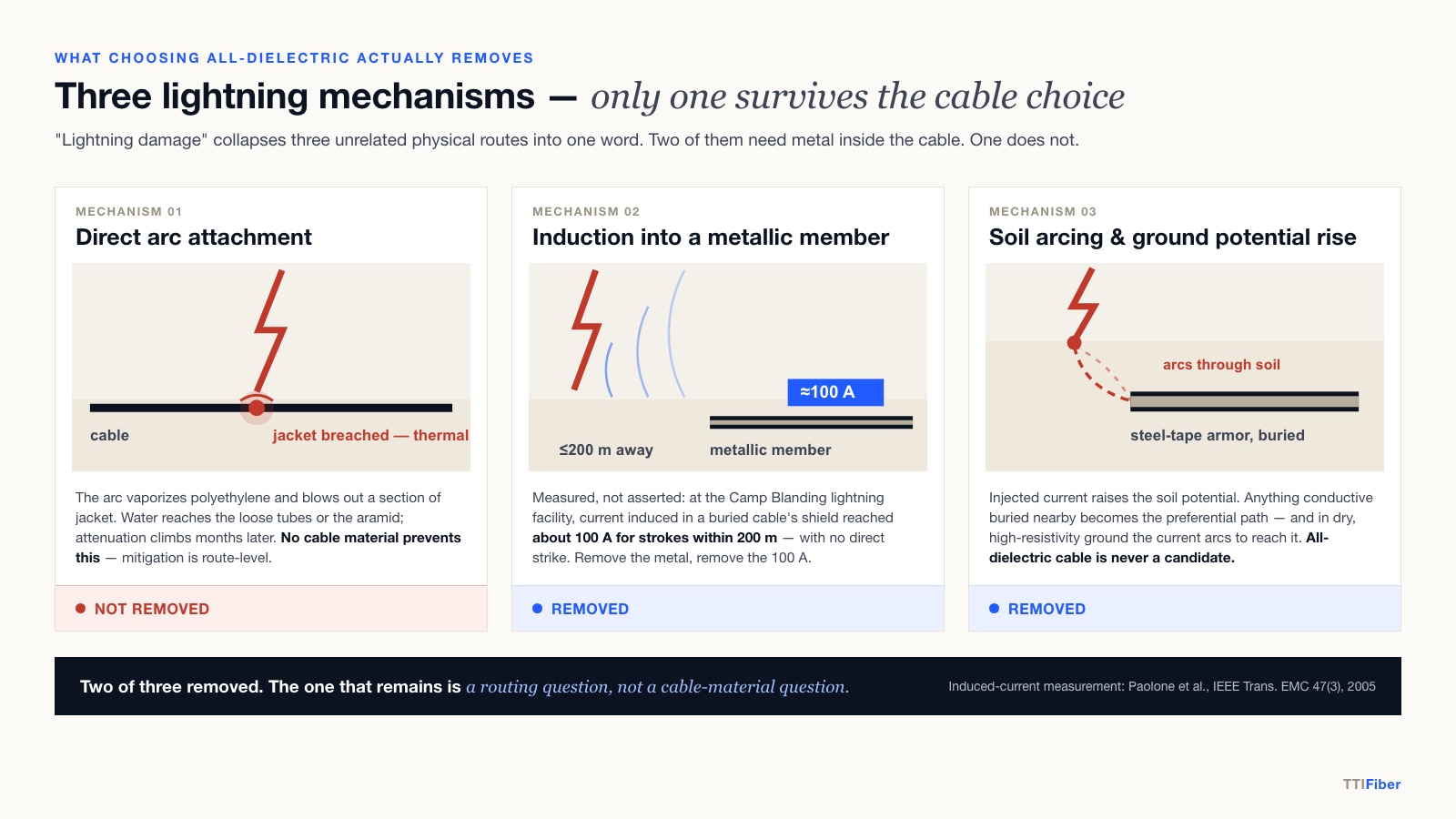
Two of the three mechanisms require metal inside the cable, so cable selection removes them outright. Direct arc attachment does not care what the cable is made of.
What "all-dielectric" actually means
An all-dielectric fiber optic cable contains no metal of any kind — no armor, no metallic central strength member, no metallic moisture barrier, and no messenger wire. Tensile strength comes from a fiber-reinforced plastic (FRP) rod and aramid yarn, and the jacket is polyethylene.
Two families dominate outside plant, and they are not interchangeable:
- GYFTY — stranded loose-tube construction on an FRP central strength member, with a non-metallic sheath. It is the general-purpose all-dielectric outdoor cable: duct, and lashed aerial where a separate messenger carries the load. How GYFTY builds a fully non-metallic cable covers the construction layer by layer.
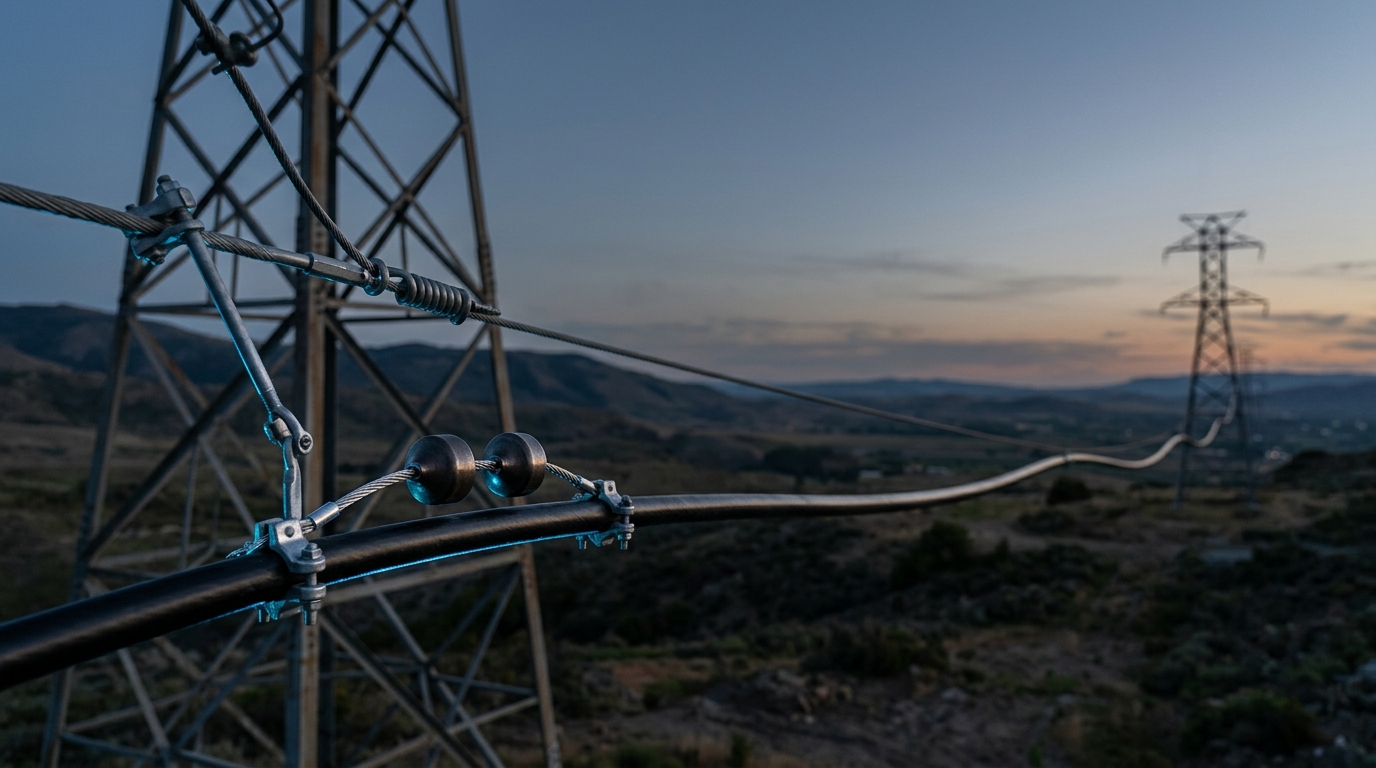
- ADSS — all-dielectric self-supporting. It adds enough aramid to carry its own span with no messenger at all, which is what allows it to hang directly on a transmission or distribution structure. Its family specification is IEC 60794-4-20:2018, and its testing and performance standard is IEEE 1222-2019.
Two disambiguations worth getting right, because both cost real money:
"Dielectric-armored" is still all-dielectric. Rodent and crush protection do not have to be steel. Glass-yarn or FRP-rod armor gives bite and compression resistance with no metal anywhere in the cable. If your specification says "armored" because of gophers, it does not automatically have to say "metallic" — and if it does say metallic, you have traded away everything in the section above.
A steel-messenger figure-8 is not all-dielectric. A self-supporting figure-8 cable with an integrated steel messenger has a continuous metallic conductor running the entire length of the route. IEC 60794-4-20 explicitly excludes figure-8 cables from the ADSS family. Calling one "dielectric cable" because the optical section is non-metallic is a specification error that quietly reinstates both of the mechanisms above.
One line on the alternative: if you need the fiber to double as an overhead earth wire, you need OPGW, and you accept a line shutdown to string it plus a bonding design at every structure — the ADSS and OPGW trade-off covers when that is worth it.
Does all-dielectric cable need to be grounded?
No — and the reason usually given for this is wrong.
The common explanation is "glass doesn't conduct, so there's nothing to ground." True, but irrelevant: nobody was ever proposing to ground the glass. What you would be grounding is the metal around it.
The code-level reason is cleaner. NEC 770.93 is titled Grounding or Interruption of Non-Current-Carrying Metallic Members of Optical Fiber Cables. Its object is metallic members. An all-dielectric cable has none, so the section has nothing to act upon. That is why there is no grounding requirement — a property of the cable's construction, not a property of glass.
For cables that do have metallic members, the rule bites where the cable is exposed to contact with electric light or power conductors: 770.93(A) covers cable entering a building, 770.93(B) covers cable terminating outside. In both cases those members must be either grounded per 770.100, or — and this alternative is written into the code itself — interrupted by an insulating joint or equivalent device, close to the point of entrance or termination. Hold onto that "or". It is the answer to the tracer wire problem below.
When the conductor is required, this is the size:
Requirement | NEC 770.100(A), 2023 Edition |
|---|---|
Material | Copper or other corrosion-resistant conductive material |
Minimum size | 14 AWG |
Maximum size required | 6 AWG (not required to be larger) |
Length, one- and two-family dwellings | As short as practicable, not to exceed 20 ft (6.0 m) |
In short: the minimum size grounding or bonding conductor for a fiber optic cable's metallic members is 14 AWG copper, and it is never required to be larger than 6 AWG — NEC 770.100(A), 2023 Edition. Check which NEC edition your jurisdiction has adopted before quoting it in a tender; adoption lags publication by years and varies by state.
If your outside plant is all-dielectric, this table applies to none of it. If any part of the route uses metallic-armored cable — including the indoor section after the entrance splice — it applies there, and the outdoor armored cable types guide shows which model codes carry metal and which don't.
Four routes, four different answers
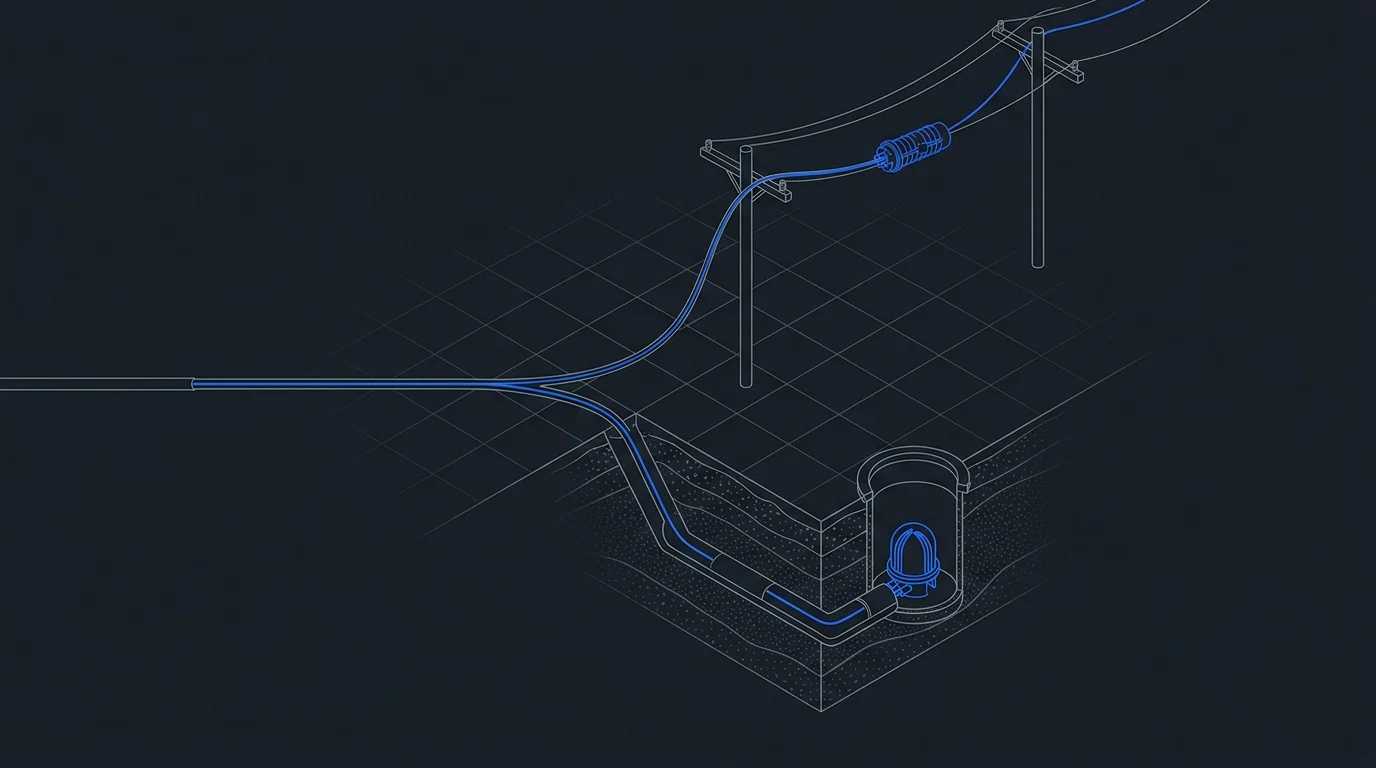
Direct-buried
All-dielectric buys the most here. Soil arcing has nothing to reach for, and every grounding electrode you would otherwise install at each splice closure disappears with it. On a 40 km route with closures every 2 km, that is twenty electrode installations you never build and never have to re-test for resistance.
What still needs designing is locatability — the tracer wire question below — plus depth and mechanical protection, which are separate questions covered in direct burial versus duct versus aerial. The applicable cable recommendation is ITU-T L.101 (08/2024), Optical fibre cables for directly buried application.
Aerial on non-power poles
Induced coupling is gone, and there is no bond to make at each pole, which is why all-dielectric aerial is the cheaper install as well as the safer one. What remains is direct attachment, and cable choice does not touch it. The real question on an exposed ridgeline or a long water crossing is whether a shielding conductor exists above your span — not what your cable is made of. See ITU-T L.102 (11/2025), Optical fibre cables for aerial application.
Attached to an energized line
Here the honest answer is that lightning is not your dominant electrical risk — a fair-weather mechanism is, and it is covered in the next section. The one thing to carry away before you get there: on an energized line it is the jacket decision, not the lightning decision, that people get wrong, and it is governed by where on the structure the cable hangs rather than by the line voltage printed on the drawing.
Everything else on this route is mechanical: span, sag, tension and the fiber-strain limit, worked through in ADSS sag and tension calculation.
Building entrance and terminal
This is where "all-dielectric" stops helping entirely. It gets the checklist in the "three places metal is still hiding" section below.
The failure mode that is not lightning
If you hang an all-dielectric cable on an energized transmission line, the thing most likely to destroy the jacket over the next ten years is not lightning. It is a fair-weather mechanism called dry-band arcing.
With no metallic core to hold it at earth potential, the cable floats electrically in the field between the phase conductors and ground. Contamination settles on the jacket; dew or fog wets it; a leakage current flows along the surface toward the grounded hardware; that current heats the film unevenly until a narrow dry band forms. The full potential difference then falls across a few millimeters of dry jacket and arcs — repeatedly, for years. What ends the span is not the arc but its residue: a carbonized, permanently conductive track that walks across the jacket until it breaches and exposes the aramid carrying the load.
This is why ADSS jackets above certain electrical stress levels are specified as AT (anti-tracking) rather than plain PE, and why IEEE 1222-2019 includes electrical surface-degradation testing at all. It has nothing to do with lightning, and no amount of lightning protection design will touch it.
Which number decides your jacket — and it is not line voltage — is a separate question with a real answer: space potential is what actually picks the jacket. It is worth flagging here only so that "we chose all-dielectric for lightning immunity" does not get filed as "electrical risk: solved."
The tracer wire paradox
You buried an all-dielectric cable specifically so that no continuous metallic conductor would run along the route. Then, so the next backhoe operator can find it, you laid a copper tracer wire directly on top of that cable, along its entire length, and grounded it at both ends.
You have just rebuilt the thing you paid to remove, and put it in physical contact with your cable.
That tracer wire is now exactly the class of buried conductor the induction and soil-arcing mechanisms describe: it couples to strikes hundreds of meters away, and it is what a nearby strike will arc through the soil to reach. Every argument for the all-dielectric cable now applies against the wire you installed beside it.
Three ways out, ordered by how well each preserves the original design intent:
1. Interrupt it. NEC 770.93(B) already gives you the pattern — metallic members may be interrupted by an insulating joint or equivalent device instead of being grounded. Apply the same logic along the route: break the tracer wire into electrically isolated segments with insulating joints at each handhole or access point, and ground each segment locally or not at all. You keep locatability within a segment while denying lightning a continuous kilometers-long conductor. The cost is operational — crews must tone segment by segment rather than pulling one continuous trace.
2. Replace it with non-conductive marking. Non-detectable warning tape or detectable marking tape (typically 300–450 mm (approx. 12–18 in), per the utility's own standard), or EMS ball markers dropped at splice points, bends and road crossings. The trade-off is honest and worth stating in the design file: markers give you point locations rather than a continuous trace, and tape only works if it was laid correctly and has not been disturbed since.
3. Accept the wire and treat the route as metallic plant. If locate accuracy is contractually non-negotiable, stop calling the route dielectric. Ground the wire properly, specify its bonding as you would for armored cable, and put the surge-protection budget back in.
What you should not do is install a continuous grounded tracer wire and then record in the design file that lightning protection was addressed through cable selection. That is the single most common way this decision goes wrong.
Worth saying the unpopular thing here too: all-dielectric is not automatically the right answer. Where the surrounding plant is metallic and already bonded, a dielectric cable is the odd one out — harder to locate, and once you have added a locate wire, insulating joints and the crew time to tone it segment by segment, installed cost can meet or exceed armored cable that was going to be grounded anyway. The case is strongest where the route is long, the soil is dry and high-resistivity, or the cable shares structures with power. It is weakest where the route is short, the ground is wet and conductive, and the locate requirement is strict.
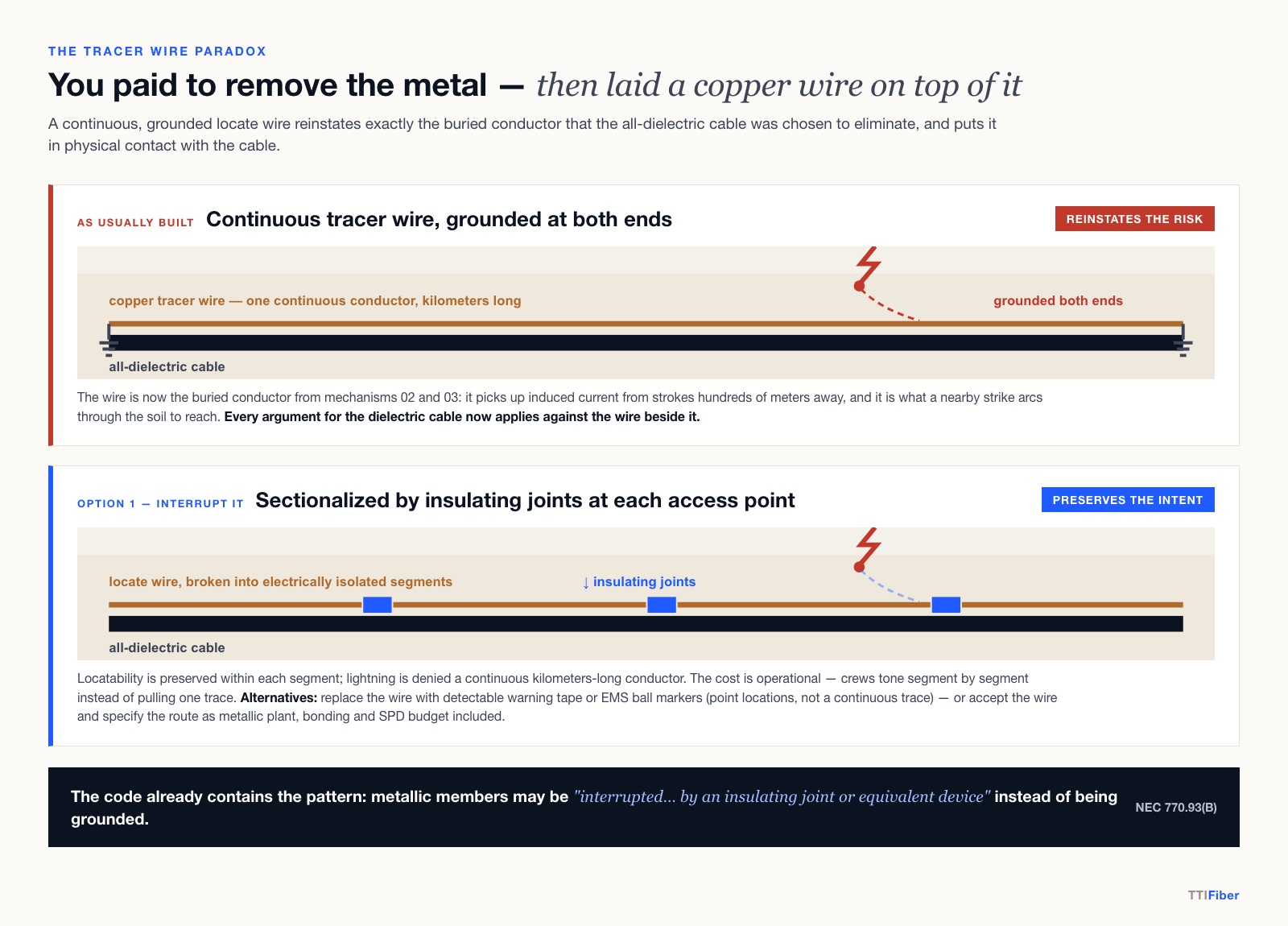
A continuous grounded locate wire undoes the cable decision. NEC 770.93(B) already supplies the fix — interrupt the conductor instead of grounding it.
"No grounding" is not "no lightning protection": three places metal is still hiding
Run this list against your own route before signing anything off.
1. The tracer or locate wire. Covered above. If it is continuous and grounded, your route is not dielectric in any sense that matters to lightning.
2. The building-entrance transition. Outside-plant all-dielectric cable is rarely the cable that reaches the rack. At the entrance it is spliced to an indoor-rated cable, and indoor cables are frequently armored. That armor is a metallic member entering a building, which puts it squarely inside NEC 770.93 and 770.100 and requires bonding to the main grounding busbar. The same applies to the metalwork it lands in: the ODF or patch panel chassis and the rack itself are bonded plant regardless of what the cable is made of. All-dielectric outside plant does not exempt this splice, and the splice is usually somebody else's scope — which is precisely why it gets missed.
3. The equipment port. "You do not need surge protectors" is the sentence to strike. Your SFP is not protected by your cable being dielectric. The shelf is exposed through its AC or DC feed, through copper management, alarm and out-of-band wiring landing in the same rack, and through the chassis bond. A strike that never came near your fiber route can still arrive at the OLT through the power feed. Surge protective devices on the telecom side are covered by IEC 61643-21 and ITU-T K.66, Protection of customer premises from overvoltages.
One scope note, because it is miscited in both directions. IEC 62305, Protection against lightning, is the right framework for the terminal building — risk assessment, zone concept, equipotential bonding, SPD coordination. It does not, however, specify protection of the line itself: Edition 2 of IEC 62305-1 no longer covers protection of services connected to structures. For the line itself the applicable recommendation is ITU-T K.47, Protection of telecommunication lines against direct lightning flashes. And if a datasheet cites ITU-T K.25 at you — that recommendation was withdrawn on 25 January 2013 and its content folded into K.47.
What to put in the specification
The design decision is not "dielectric or not." It is "dielectric, and what happens at the three places metal remains." One paragraph covers it:
Outside-plant optical cable shall be all-dielectric, containing no metallic armor, strength member, moisture barrier or messenger. Where a locating conductor is installed, it shall be sectionalized by insulating joints at each access point, or replaced by non-metallic detectable marking. Metallic members of any cable entering a building shall be bonded in accordance with NEC 770.93 and 770.100, or interrupted by an insulating joint at the point of entrance. Surge protection at equipment interfaces shall be specified independently of outside-plant cable selection, in accordance with IEC 61643-21.
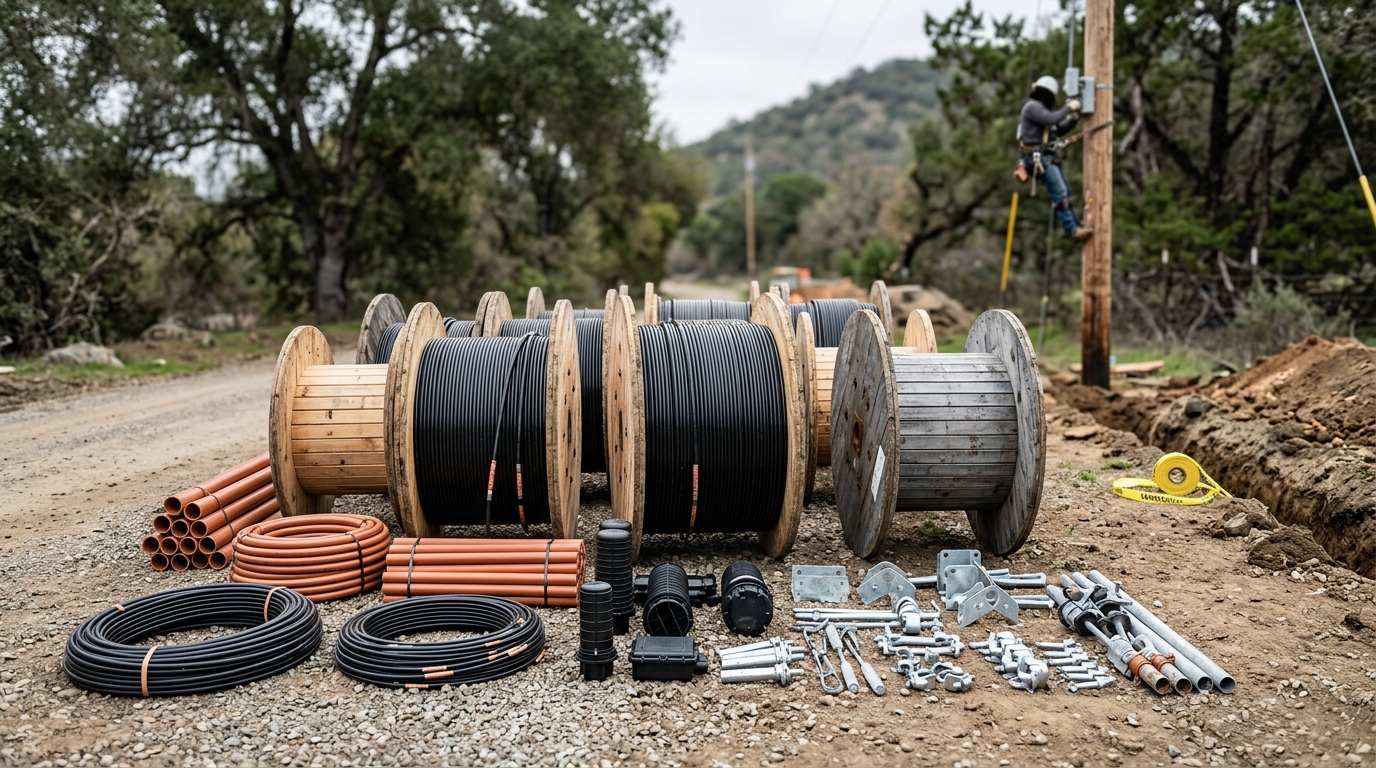
If you are selecting the cable itself, the two all-dielectric constructions that cover most outside plant are ADSS for self-supported spans on utility structures and GYFTY for duct and lashed aerial routes — both built with FRP and aramid rather than steel, in 6 to 288 fiber counts. More on route and cable selection across the whole plant in our outside plant and backbone guides.
FAQ
Can lightning strike through fiber optic cable? Lightning cannot travel along an all-dielectric fiber optic cable, because there is no conductor in it to travel along. A direct arc attachment can still burn through the jacket, and if the cable contains any metallic member — armor, a metallic strength member, or a steel messenger — that member will carry induced current from strikes up to a few hundred meters away.
What is all dielectric fiber cable? An all-dielectric fiber optic cable contains no metal of any kind: no armor, no metallic central strength member, no metallic moisture barrier and no messenger wire. Strength comes from FRP and aramid yarn, and the jacket is polyethylene. GYFTY is the general-purpose duct and lashed-aerial version; ADSS adds enough aramid to support its own span with no messenger.
What type of wire is used for lightning protection? On conventional plant, a galvanized steel earth or shield wire above the route. On an all-dielectric route this is exactly the thing you are not installing — the design intent is that no continuous conductor accompanies the cable. Note the terminology trap: search results for "lightning protection cable" are mostly about copper and aluminum down-conductors for building lightning protection systems, which is an unrelated product.
How do I protect my fiber optic cable? Match the answer to the route. Direct-buried: all-dielectric cable, plus a decision about the tracer wire, plus adequate burial depth. Aerial on non-power poles: all-dielectric, and check whether a shielding conductor exists above exposed spans. On an energized line: ADSS with the jacket selected for electrical stress, not for lightning. At the building: bond the armored indoor transition and fit SPDs at the equipment interfaces.
Does fiber optic cable need to be grounded? Only its metallic members, and only where the cable is exposed to contact with electric light or power conductors — NEC 770.93(A) for cable entering a building, 770.93(B) for cable terminating outside. In both cases grounding and interruption by an insulating joint are equal alternatives. A cable with no metallic members has nothing for the clause to apply to, so no grounding is required — and none is possible.
What is the minimum size grounding conductor for a fiber optic cable? 14 AWG copper is the minimum, and it is never required to be larger than 6 AWG — NEC 770.100(A), 2023 Edition. In one- and two-family dwellings it must be as short as practicable and no longer than 20 ft (6.0 m). This sizing applies only to a cable's non-current-carrying metallic members; an all-dielectric cable has none, so there is nothing to size.
Is dielectric fiber optic cable the same as ADSS? No. ADSS is one type of all-dielectric cable — the self-supporting one. All ADSS is all-dielectric; not all all-dielectric cable is ADSS. GYFTY, for example, is fully non-metallic but is not designed to carry its own span without a messenger.