Aerial vs Underground Splice Closure: How the Route Actually Changes Your Hardware
Aerial vs Underground Splice Closure: How the Route Actually Changes Your Hardware
Ask a supplier which closure you need for an aerial run and you will usually get a fast answer: a dome. Ask about a buried run and you will hear inline. It is a clean rule, it is easy to remember, and it is wrong often enough to cost you a truck roll.
Here is the inconvenient evidence. The Fiber Optic Association's own reference page on splice closures runs a photo captioned "Dome closures underground and aerial" — the same closure family, in both environments, in an industry reference that predates most of the vendor blogs repeating the rule. And the FOA is explicit about what actually separates the two form factors: "Some splice closures have all cables entering into one end, usually called dome closures or sometimes called a butt closure, while some have cable entries on both ends, sometimes called inline closures." (FOA, Fiber Optic Splice Closures)
Read that again. The distinction is where the cables enter, not whether the closure hangs from a strand or sits in a vault.
That single confusion is why "aerial vs underground splice closure" is such a frustrating thing to search. Half the results compare routes — trenching cost versus pole make-ready — and never mention hardware. The other half compare form factors — dome versus inline — and treat the deployment environment as a footnote. Neither answers the question you actually have, which is: I know my route. What does that route change about the box?
The honest answer is that your route changes two things, and they are independent of each other:
- The environmental load spectrum the closure must survive — UV, ice, vibration, submersion, soil pressure, rodents.
- Nothing at all about dome versus inline. That is decided by your splice topology, and you can run either form factor in either environment.
Once you separate those two axes, closure selection stops being a debate and becomes a lookup. This article builds that lookup.
If you are still deciding between closure families in the abstract, start with our overview of fiber optic splice closure types. This article assumes you have a route and need to specify hardware for it.
The two axes most selection guides collapse into one
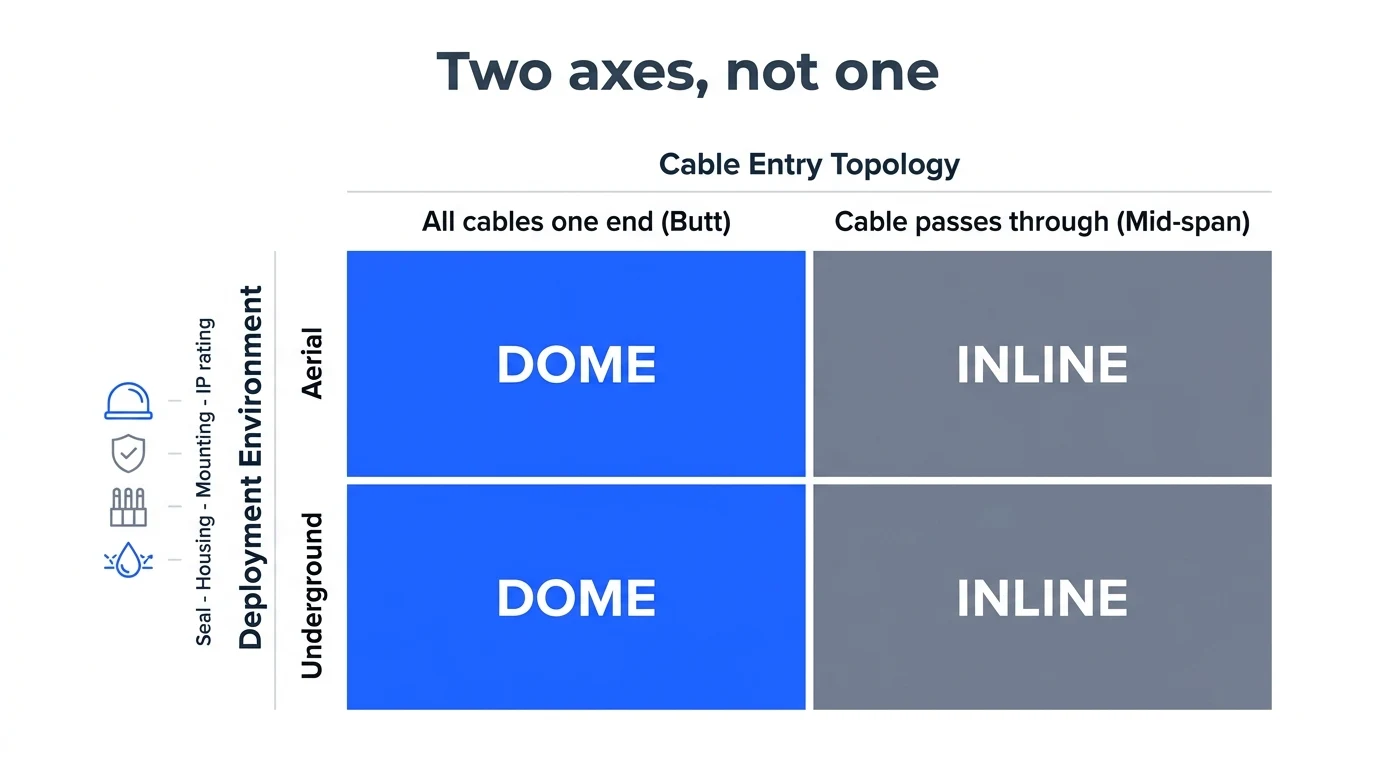
Every closure decision resolves along two orthogonal axes.
Axis 1 — Cable entry topology. How many cables come in, from which directions, and does the through-cable stay intact? This determines dome versus inline. It is a function of your splice plan, not your route.
Axis 2 — Environmental load spectrum. What does the outside world do to this box for the next twenty-five years? This determines sealing method, housing polymer, mounting hardware, grounding, and IP rating. It is a function of your route, and it is where "aerial" and "underground" genuinely diverge.
The reason this matters is economic. Get Axis 1 wrong and you have an awkward splice job and some wasted slack — annoying, recoverable at install time. Get Axis 2 wrong and the closure passes acceptance testing, works for two winters, and then fails in a flooded handhole in February. The first mistake costs an hour. The second costs an emergency crew, an OTDR trace, and an outage SLA.
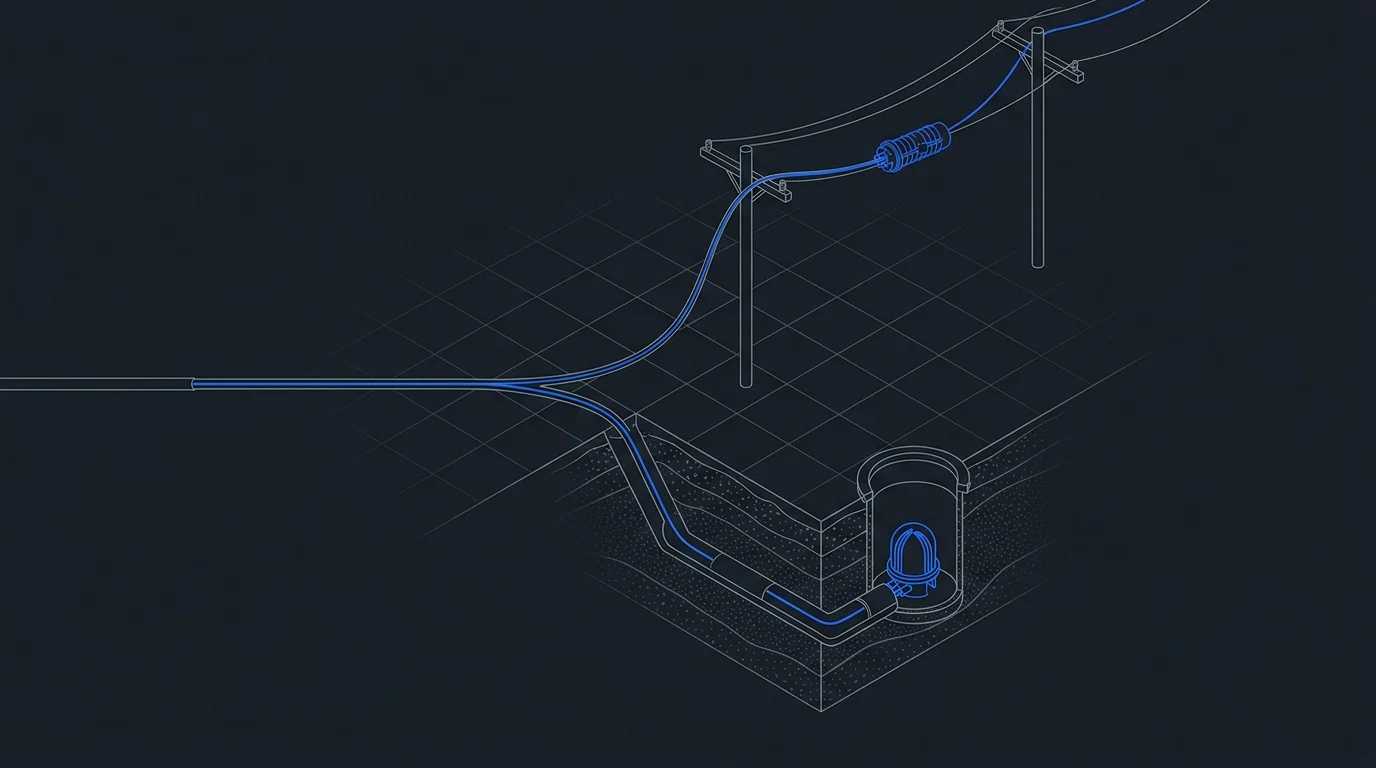
Most selection guides collapse both axes into one rule of thumb because the rule of thumb is usually right. Aerial spans often are butt splices at a pole, which suits a dome. Buried backbone often is a mid-span or straight-through splice, which suits an inline. The correlation is real. But correlation is not causation, and the exceptions are exactly the jobs that go wrong: the mid-span express splice on an aerial ADSS run, the branch closure in a vault feeding four different streets.
Work the axes separately.
Axis 1: Cable entry topology decides dome vs inline
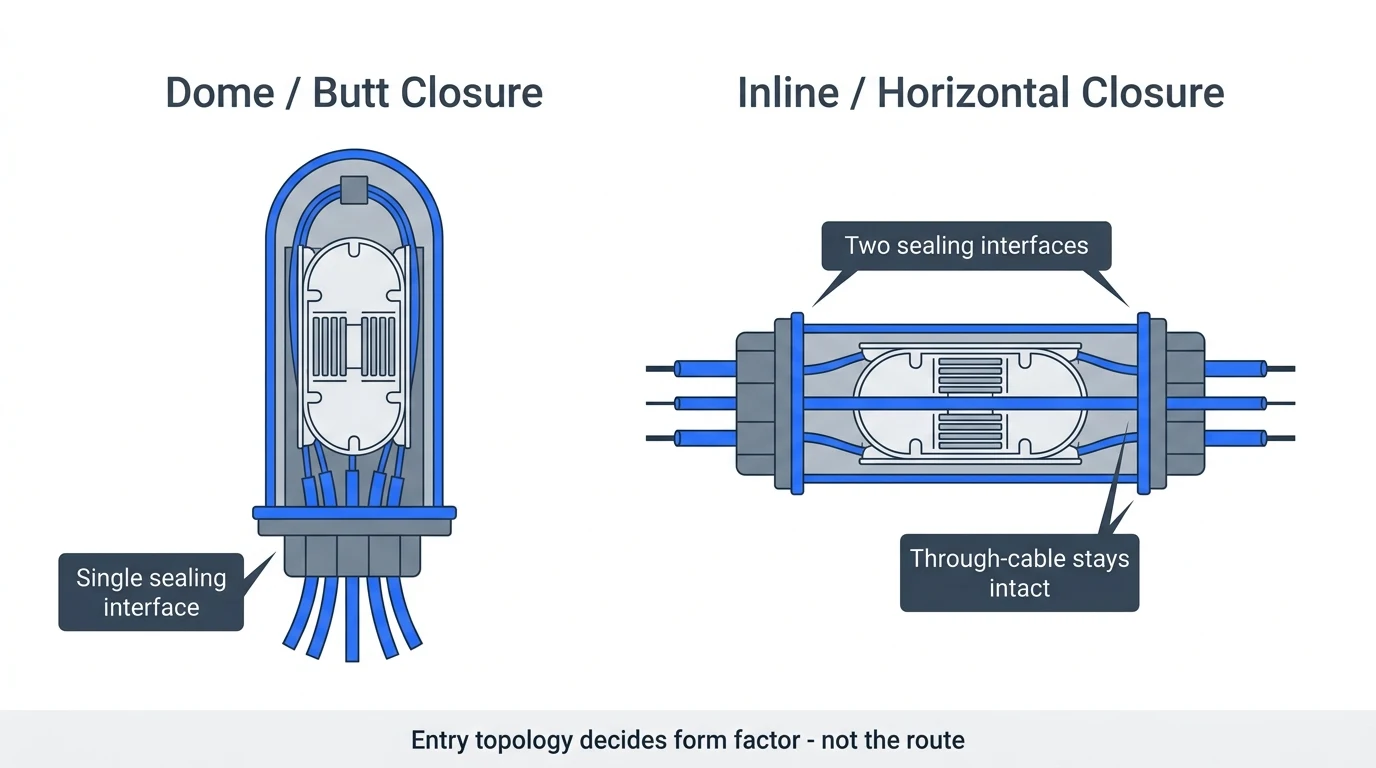
A dome closure (also called a butt closure or vertical closure) takes all cables in through a single base plate. Everything enters from one end; the dome lifts off the base for access.
An inline closure (horizontal closure) has entries at both ends, so a cable can pass straight through the body.
The FOA's account of when each is used is worth quoting because it is refreshingly unromantic: inline closures "are used in applications where two identical cables are spliced and an inline closure saves space or when making repairs to damaged cables," while dome closures "are more popular since they are easier to handle when splicing and storing service loops and the single end seal can be more reliable." (FOA)
Two engineering points hide in that sentence.
Single-end sealing is structurally simpler. A dome has one sealing interface. A classic inline has two, at opposite ends, both of which must hold for the life of the plant. Fewer interfaces, fewer failure modes. This is a large part of why dome closures are so widely used in submerged and buried applications despite the folk rule that says otherwise.
Slack management is easier in a dome. Service loops coil naturally around a vertical dome's tray stack. In a horizontal body, the same slack fights the geometry. When you re-enter a closure three years later to add a branch, the closure that stored its slack cleanly is the one that does not cost you a splice.
The one job that genuinely needs "cable passes through"
There is exactly one topology that imposes a real constraint: mid-span access, where a cable passes through the closure without being cut. You strip the jacket, coil most buffer tubes through untouched, and open only the tubes you need to splice out. The FOA covers the technique in detail (mid-span access).
This is where the folk rule tempts you into a second mistake — "mid-span means inline." It does not. An inline closure is one way to get a through-cable, with entries at both ends. But dome closures with an oval or express port on the base do the same job while keeping a single seal, and in FTTH they are the mainstream way to do mid-span. Corning, PPC, 3M, and most FTTH-focused vendors all ship dome closures specifically for mid-span express splicing. So even within a fixed topology, the form factor is not forced — you choose between a two-end inline and an express-port dome on sealing and slack-management grounds, not on the route.
What the FOA actually says the classic inline is for is narrower still: cases where "two identical cables are spliced and an inline closure saves space or when making repairs to damaged cables." (FOA) That is a space and repair argument, not an aerial-versus-buried one.
And mid-span access happens in both worlds. It happens in a manhole on a buried backbone. It happens on a strand-mounted ADSS run where a branch peels off to serve a village. The route did not decide it. The splice plan did.
The topology lookup
Splice topology | Form factor | Typical fiber count | Notes |
|---|---|---|---|
All cables terminate here (butt splice) | Dome | 24–288 | Single seal interface; best slack storage |
Cable passes through intact (mid-span / express) | Express-port dome or inline | 12–144 | Dome keeps one seal; inline saves space for two identical cables |
One feeder in, two drops out | Mini / dome | 12–24 | Drop-cable splice points, FTTH |
Branch node, several cables terminating | Dome | 96–288 | Multiple ports on one base; can also house a PON/PLC splitter |
Nothing in this table mentions the sky or the soil. That is the point.
Axis 2: What the environment actually does to the closure
This is where aerial and underground stop being interchangeable. The two environments attack a closure through almost entirely different mechanisms, and a closure engineered for one is not automatically fit for the other.
The aerial load spectrum
An aerial closure lives in air, sunlight, and motion.
Ultraviolet degradation is the slow killer. A polymer housing exposed to direct sun for twenty years embrittles, chalks, and eventually cracks at stress concentrations around the seal. This is a materials problem, solved at the compound level — UV-stabilized polypropylene and polycarbonate blends rather than commodity plastic. It is also the specification most vendor datasheets skip entirely.
Mechanical fatigue from wind. Aeolian vibration — low-amplitude, high-frequency oscillation of the span — works on every mounting bracket and cable entry for decades. A closure that is merely strapped tight at install will loosen. Strand-mount hardware exists to move the load path off the closure body and onto the messenger.
Ice and wind loading add static and dynamic weight to the span, transmitted through the closure's mounting. A 1.9 kg closure is trivial; a 1.9 kg closure plus radial ice plus a gust is not.
Thermal cycling is more severe in air than in soil. A closure on a black messenger in direct sun can swing across a range wider than anything a buried closure sees, and every cycle breathes the seal.
Lightning and induced current. Where the cable carries a metallic strength member or armor, the closure is a bonding point, and grounding hardware is not optional.
The underground load spectrum
A buried closure lives in water. Not "sometimes gets wet" — lives in water. Every experienced OSP engineer has opened a handhole expecting damp and found a swimming pool.
Sustained submersion under head pressure is the defining load. This is fundamentally different from rain. A seal that sheds a downpour may still weep under 1.5 meters of standing water for a week, because the driving force is continuous hydrostatic pressure rather than intermittent splash.
Freeze–thaw cycling. Water that has entered a closure — or merely pooled in the vault around it — expands roughly 9% on freezing. Freeze–thaw is what turns a marginal seal into a failed one, and it explains why closures survive their first summer and die in their second winter.
Soil and backfill pressure on direct-buried closures, plus the mechanical shock of backfill going in and, later, of a backhoe that did not call before digging.
Rodent attack. Gophers and rats chew polymer. In direct burial this is a real, documented failure mode, and it is the reason armored cable exists — see our guide to outdoor armored fiber optic cable types.
Near-zero UV and modest thermal swing. The compensations. Below the frost line, a closure sees a narrow, slow temperature band and no sunlight at all.
The comparison your route actually forces
Load / requirement | Aerial | Underground |
|---|---|---|
UV exposure | Severe — primary ageing mechanism | Negligible |
Thermal cycling | Wide and fast (sun on dark messenger) | Narrow and slow |
Water exposure | Intermittent (rain, condensation) | Sustained submersion under head |
Freeze–thaw | Moderate | Severe (standing water in vaults) |
Vibration / fatigue | Continuous (aeolian, wind) | None |
Static load | Ice + wind on span | Soil / backfill pressure |
Rodent attack | Rare | Documented risk (direct burial) |
Grounding requirement | Yes, where metallic members present | Yes, where metallic members present |
Practical IP target | IP65–IP68 | IP68, submersion-rated |
Access cost per re-entry | Bucket truck, traffic control | Vault entry, pumping, confined space |
Two rows deserve emphasis. Water exposure and freeze–thaw are the reason an underground closure cannot be specified on rain resistance alone. And access cost per re-entry is the row that quietly governs your total cost of ownership — which brings us to sealing.
Sealing, IP68, and what that number does not tell you
Every closure datasheet on earth says IP68. Almost none of them say what that means, and the standard is the reason why.
Under IEC 60529, the IP code's second digit describes protection against water. Digits 1 through 7 map to defined tests — dripping, spraying, jetting, temporary immersion. Digit 8 does not. IP68 means continuous immersion under conditions more severe than IP67, and the standard leaves those conditions to be agreed between manufacturer and user (see the ANSI/IEC 60529 scope and contents).
That is not a loophole. It is the standard telling you, in writing, that "IP68" without a depth and a duration is not a specification. It is a marketing string.
So when you evaluate a closure for a flooded handhole, the only number that means anything is the stated test condition — a depth and a duration. Ours, for the record, is 1.5 meters for 24 hours; that is the figure you should be able to get in writing from any serious closure vendor, us included, and check against your worst-case water table. If a supplier's answer to "IP68 to what depth, for how long?" is just "IP68," you have not been given anything you can design against.
Behind the rating sits the sealing method, and this is where the aerial/underground decision has real money in it.
Heat-shrink versus mechanical sealing
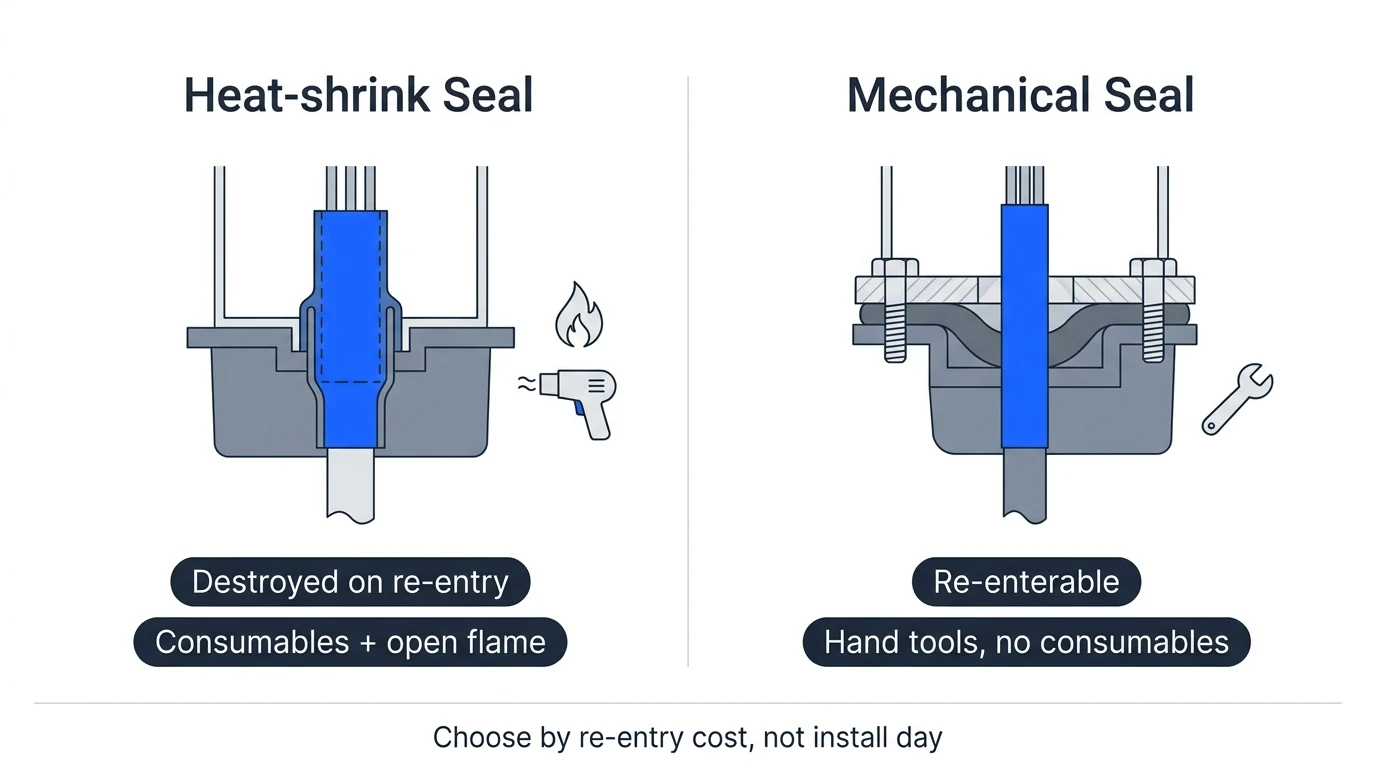
Heat-shrink sealing uses a shrink sleeve, usually adhesive-lined, driven down over the cable entries with a torch. Done well, it is an excellent, conformal, long-life seal — arguably the most forgiving of imperfect cable geometry.
Its cost is on the second visit. Re-entry destroys the sleeve. Every re-entry consumes new consumables, a torch, an open flame in a confined space, and a technician with the skill to reseal correctly under field conditions.
Mechanical sealing uses compressed gaskets and grommets clamped by the closure's own hardware. There is no torch, no consumable, and the seal is designed to be re-established by re-torquing. TTI's mechanical-seal domes are re-enterable and re-sealable without replacing parts.
Now put that against the access-cost row in the table above.
A buried closure in a vault that floods is the worst possible place to run an open flame and the most expensive place to make a second trip. Every network gets re-entered — fiber gets added, a branch gets built, a cut gets repaired. The closure whose seal survives re-entry pays for itself the first time you re-enter it, and underground is where re-entry is dearest.
This is the single most consequential specification on the page, and it is entirely absent from the "dome for aerial, inline for buried" folk rule.
Heat-shrink | Mechanical (gasket) | |
|---|---|---|
Initial seal quality | Excellent, conformal | Excellent when correctly torqued |
Re-entry | Destroys sleeve | Re-sealable, no consumables |
Field tooling | Torch, open flame | Hand tools |
Consumables per re-entry | Sleeve kit | None |
Confined-space suitability | Poor (flame) | Good |
Best fit | Set-and-forget aerial splices | Anything you expect to re-enter |
To see why this is where the money is, put the seal choice against the cost of reaching the closure. The closure hardware itself is a rounding error next to the labor of getting to it — and that labor is exactly what the route changes.
Cost driver, per re-entry | Aerial (pole / strand) | Underground (vault / handhole) |
|---|---|---|
Access | Bucket truck + traffic control | Confined-space entry + pumping |
Heat-shrink re-seal adds | New sleeve kit + torch time | New sleeve kit + torch time in a confined, possibly wet space |
Mechanical re-seal adds | Hand tools, minutes | Hand tools, minutes |
Net effect of a re-enterable seal | Saves a sleeve and torch setup | Saves the sleeve, the flame-in-a-hole hazard, and part of the visit |
The pattern is the same in both environments — a re-enterable seal removes consumables and setup from every future visit — but the size of the saving scales with access cost, and access cost is highest underground. That is the whole case for defaulting to mechanical sealing on anything buried, and it is the closure-level cost story the route-versus-route "which is cheaper to build" guides never tell.
For the failure modes that follow from getting this wrong, our field notes on common outdoor enclosure failure modes cover what water ingress and UV embrittlement actually look like when a crew opens the box.
Specifying an aerial closure
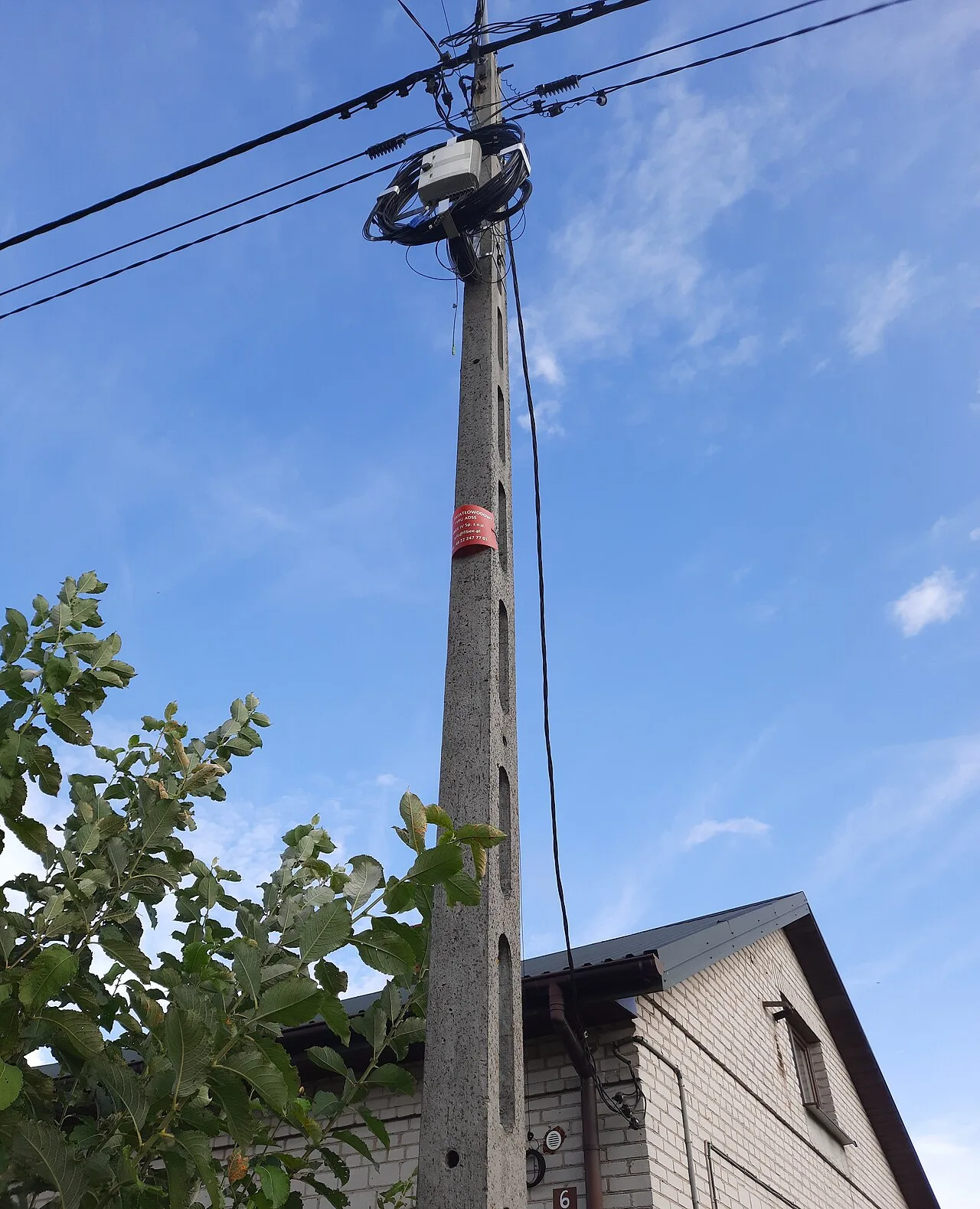
Aerial fiber hardware on an ADSS run: the pole-mounted enclosure and the coiled service loop below it are the details that matter — leave enough slack to lower the closure to a work platform. (Image: public domain / CC0.)
With the axes separated, the aerial specification writes itself.
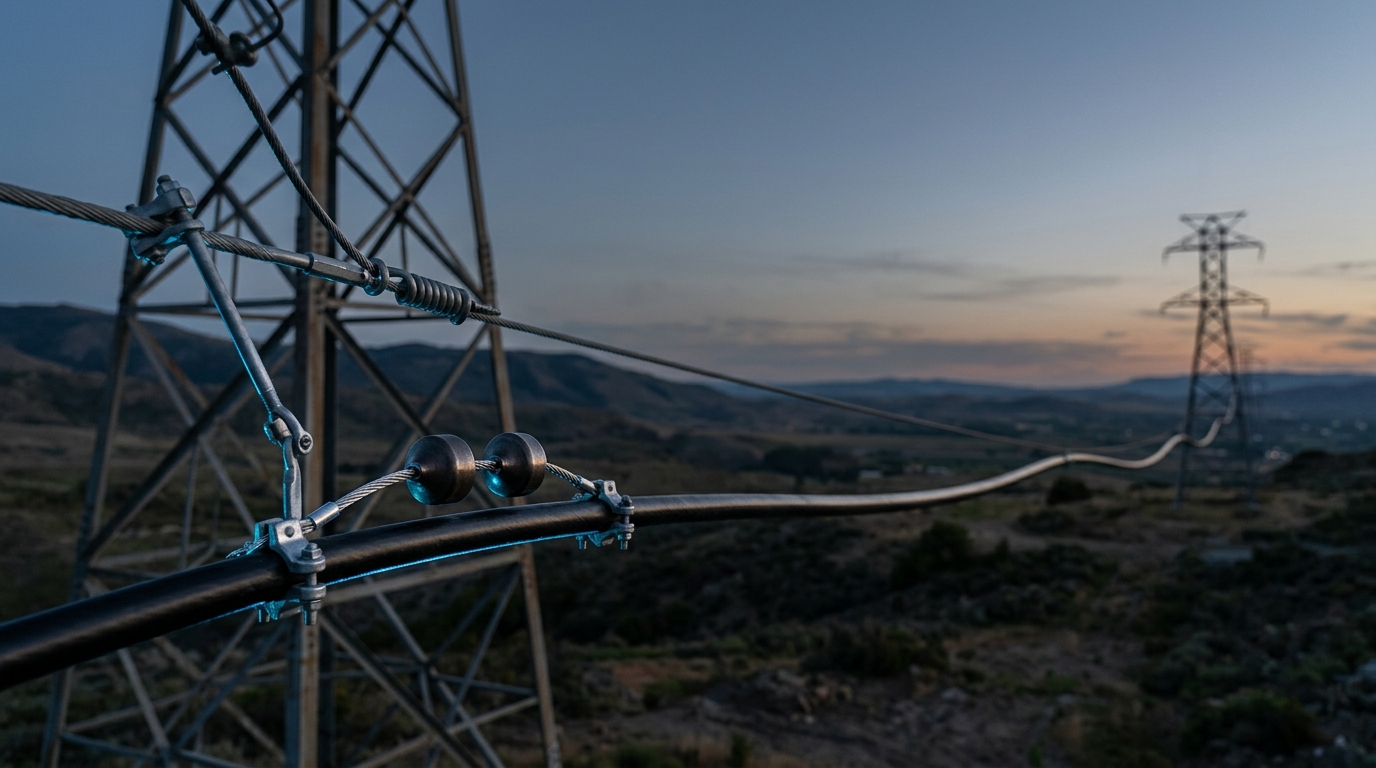
Mounting. Strand-mount brackets clamp to the messenger and carry the load. Pole-mount brackets fix the closure to the pole itself. Either way, the load path must not run through the closure body or its cable entries. Do not improvise with hose clamps.
Housing polymer. UV-stabilized. Ask for the compound, not the color. A PP/PC housing engineered for outdoor exposure behaves very differently at year fifteen from a commodity ABS shell.
Service loop. Leave enough slack, coiled on a snowshoe or in the closure's own storage, to lower the closure to a work platform and re-splice without pulling the span. Crews who skip this pay for it on every subsequent visit.
Grounding and bonding. If the cable has metallic strength members or armor, the closure needs a bond. If you are running all-dielectric self-supporting cable, you have removed this problem at the cable layer — which is one of several reasons ADSS is chosen for power-line corridors. Our comparison of ADSS aerial cable against OPGW covers where each belongs.
Fiber count and form factor. Butt splice at a pole? Dome. Mid-span express splice on a through-run? An express-port dome or an inline — your call on sealing and slack, not the route's. Same rule as everywhere else.
For a typical aerial backbone splice point, a 96-core dome — four cable ports in, four out, four trays of 24, roughly 190 × 310 mm and 1.9 kg — covers most Tier-2 and Tier-3 distribution work without over-buying capacity. Drop-side splice points, where one feeder becomes two subscriber drops, are the domain of the mini closure at 12 to 24 fibers.
Specifying an underground closure
Buried and vault-mounted work inverts the priorities.
Assume the vault floods. Not "might." Specify for continuous submersion and you will never be wrong; specify for splash and you will eventually be very wrong. This means an IP68 rating with a stated depth and duration you have checked against your water table, not a bare IP68 claim.
Choose the seal for re-entry, not for install day. See above. In a confined space that may contain standing water, mechanical sealing is the correct default.
Match the closure to the burial method. Direct-buried closures take soil and backfill load directly and face rodents. Closures in handholes, manholes, and vaults are protected from soil pressure but sit in whatever water the vault collects. Our guide to underground fiber optic cable (direct-buried vs duct) walks through which route method to pick, and how deep to bury the cable covers the depth that determines your frost and load conditions.
Anchor it. A sealed, air-filled closure in a flooded vault is a float. Secure it.
Then, and only then, pick the form factor. Mid-span express splice through a manhole? An inline (12 to 144 fibers) or an express-port dome. Everything terminating at this node? Dome, 24 to 288 depending on count. The vault does not care which.
The one decision the route makes for you: how much a second visit costs. Everything else follows from your splice plan and your load spectrum.
Can one closure serve both aerial and underground?
This is the most-asked question on the topic, and the answer is a qualified yes — which is more interesting than either a flat yes or a flat no.
A closure qualified for sustained submersion (IP68 at a stated depth and duration) already exceeds every water requirement an aerial installation will ever impose. Rain is trivially easier than 1.5 meters of standing water. So the underground water spec dominates the aerial water spec, and a properly submersion-rated closure is water-fit for a pole. This is not a theoretical claim: our own dome and inline product pages list the mounting for each model as aerial, pole, and underground on the same line — one qualified closure, both worlds.
(The one honest exception runs the other way: a purely aerial, never-submerged splice point can use a lighter, free-breathing closure that would fail in a vault. If you know a location will never see standing water, you are not obliged to buy submersion rating for it. The rule that carries is directional — submersion-rated covers aerial, not the reverse.)
What does not carry over automatically:
- UV stability. A buried closure never needed it. Verify the housing compound before you hang it in the sun.
- Mounting hardware. Strand and pole brackets are separate parts. Confirm they exist for the model.
- Thermal range. Aerial swings wider. A closure rated −40 °C to +65 °C covers essentially all terrestrial aerial plant; a narrower band may not.
Which is why the sensible procurement position for a mid-size ISP is not "buy two product lines." It is: buy one submersion-rated, UV-stabilized, mechanically-sealed family across 24 to 288 fibers, and stock the mounting kits separately. One set of crew habits, one training curve, one spares bin, both environments. TTI's dome range runs 24, 96, and 288 fibers on exactly this logic — IP68 (rated to 1.5 m for 24 hours), UV-stabilized PP+PC housing, mechanical or heat-shrink sealing to order, −40 °C to +65 °C.
What the standards actually require
Three documents matter, and the reason so few articles cite them is that none of them are free. Knowing what each governs is still useful when you are reading a datasheet.
IEC 60529 defines the IP code. It is the reason "IP68" alone is not a specification — the standard explicitly leaves the immersion conditions to agreement between manufacturer and user.
IEC 61073 covers fiber optic splice, organizer, and closure requirements at the international level. When a datasheet claims IEC 61073 compliance, it is claiming conformance to defined mechanical, environmental, and optical performance criteria rather than to a marketing adjective.
Telcordia GR-771, Generic Requirements for Fiber Optic Splice Closures, is the North American benchmark and the one your RUS- or BEAD-funded project's engineer is most likely to ask about. It is maintained in the Telcordia generic requirements catalogue (GR-771 document record).
The practical test when reading any datasheet: does the vendor name the standard and the test condition, or only the standard? "IP68" is a claim. "IP68, 1.5 m / 24 h, per IEC 60529, closure per IEC 61073 and Telcordia GR-771" is a specification you can hold someone to.
The selection checklist
Copy this into your design document. Work it top to bottom; the order matters, because each answer constrains the next.
1. What is the splice topology at this node?
- Everything terminates here → dome
- A cable passes through intact (mid-span / express) → inline
- One feeder, two drops → mini
2. What is the fiber count, plus growth?
- 12–24 → mini · 24–96 → dome or inline · 96–288 → dome
- Size for the trays you will need in five years, not today.
3. What is the worst-case water condition at this location?
- Vault, handhole, or direct burial → IP68 with a stated depth and duration, checked against water table
- Aerial → the same closure will over-satisfy this; do not pay twice
4. How often will this closure be re-entered, and what does a visit cost?
- Ever, in a vault or confined space → mechanical seal
- Never, on an accessible pole → heat-shrink acceptable
5. Is the housing UV-stabilized?
- Aerial → mandatory; name the polymer
- Buried → irrelevant, but harmless if you standardise on one family
6. Does the cable carry metallic members?
- Yes → grounding and bonding hardware, both environments
- No (ADSS, all-dielectric) → problem removed at the cable layer
7. Is the mounting hardware specified as a separate line item?
- Strand mount, pole mount, vault rack, direct-burial protection — these are not "included"
8. Does the datasheet name test conditions, not just standards?
- If not, ask. If the answer does not arrive, you have learned something about the supplier.
Where TTI Fiber fits
We manufacture the closures described above, and the framework in this article is the one our own applications engineers use when a customer sends a route map: topology first, environment second, seal method by re-entry economics, mounting hardware as a separate line.
Across the splice closure range — dome at 24, 96, and 288 fibers, inline at 12 to 144, and mini for drop splices — the specifications are stated the way we argue they should be: IP68 at 1.5 m for 24 hours, UV-stabilized PP+PC housing, mechanical or heat-shrink sealing, −40 °C to +65 °C, built to IEC 61073 and Telcordia GR-771. Send us the route conditions and we will tell you which of those numbers actually binds — including when the answer is that a smaller closure is enough.
Frequently asked questions
What is the difference between an aerial and an underground splice closure? Less than most guides claim. The genuine differences are environmental: aerial closures need UV-stabilized housings, strand or pole mounting hardware, and tolerance for wind vibration and wide thermal cycling. Underground closures need sealing qualified for sustained submersion under head pressure and freeze–thaw resistance. The dome-versus-inline form factor is decided by cable entry topology, not by the route — dome closures are used in both environments, and so are inline closures.
Can you use the same splice closure for both aerial and underground? Yes, if it is qualified for the harder of the two water conditions and its housing is UV-stabilized. A closure rated IP68 for sustained immersion already exceeds any aerial water requirement. Confirm the polymer is UV-rated, the thermal range covers aerial swings, and that strand or pole mounting kits exist for the model. Standardising on one family across both environments reduces training, spares, and installation error.
Can you splice fiber underground? Yes — most buried plant is spliced underground, in handholes, manholes, and vaults, or in direct-buried closures. The requirement is a closure sealed for sustained submersion, because the working assumption in outside plant is that any below-grade vault will eventually contain standing water.
Should I use a dome or an inline closure for an underground run? Whichever matches your splice topology. If every cable terminates at that node, use a dome — it has a single sealing interface and better slack management. If a cable must pass through intact for a mid-span or express splice, use an inline. Both are used underground routinely.
What IP rating do I need for a buried splice closure? IP68, with a stated immersion depth and duration. Under IEC 60529 the "8" digit does not correspond to a fixed test — the conditions are agreed between manufacturer and user. A closure advertised as "IP68" with no depth or duration has not told you anything testable. Compare the stated condition against the worst-case water level in your vaults.
How are aerial splice closures sealed against water? By the same methods as buried ones — heat-shrink sleeves or compressed mechanical gaskets — but against a much easier load, since aerial closures face rain and condensation rather than sustained hydrostatic pressure. The sealing decision aerially is driven less by water and more by re-entry cost: heat-shrink must be replaced on every re-entry, while mechanical seals can be re-established with hand tools.
Do I need to ground an aerial splice closure? If the cable contains metallic strength members or armor, yes — the closure is a bonding point and grounding hardware is required. All-dielectric self-supporting (ADSS) cable removes the metallic path at the cable layer, which is a principal reason it is specified in power-line corridors.
Where are splice closures typically located? At every point where cables join: pole-top and mid-span on aerial routes; in handholes, manholes, vaults, pedestals, or direct-buried along underground routes. Location determines the environmental load spectrum and the cost of every future re-entry — which, between them, drive most of the specification.