Fusion vs Mechanical Fiber Splicing Guide
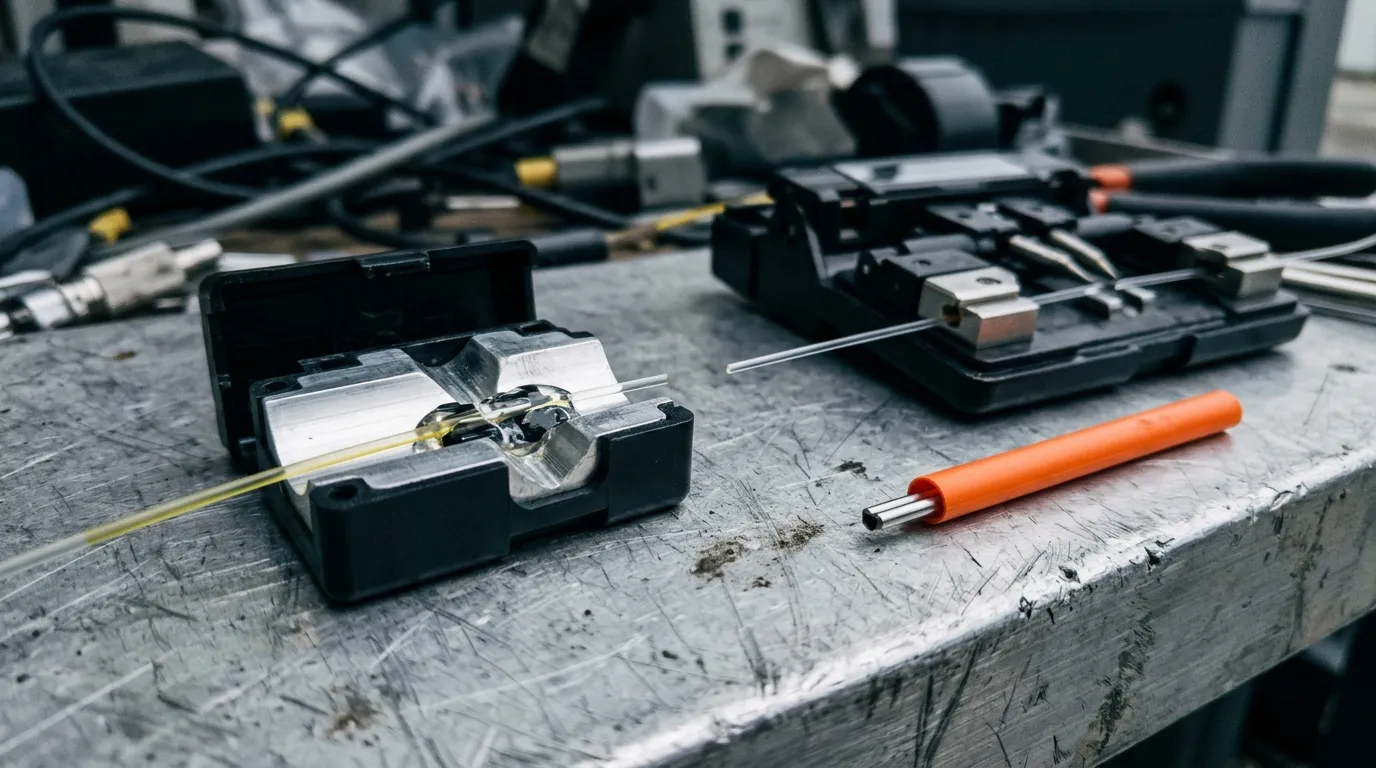
Fiber splicing gives you two ways to join the same 96-fiber cable. One crew books time with a splicer: battery, electrodes, a clean arc chamber, a tray of protectors. The other opens a pouch, cleans two cleaves, and closes a splice body over them with a hand tool. Both joints pass a loss test on the day they are made.
Ten years later, one of them is still a piece of glass.
Choosing between them is the core decision in fiber splicing, and most comparison pages answer it with a loss table: fusion at 0.05 dB, mechanical at 0.3 dB, therefore fusion. That table is wrong in both directions, and it answers a question nobody is actually asking.
Fusion splicing wins wherever the joint must last a decade and the count is above a handful. A mechanical splice wins where there is no power, no room and no time — a restoration at two in the morning, a single repair in a handhole, a joint between the customer's service and the network. The gap between them is not a factor of ten in loss. On the standards, it is zero.
The whole comparison in one table, before the argument for it. Prices are USD list, captured 26 November 2026:
Fusion splice | Mechanical splice | |
|---|---|---|
Insertion loss | 0.15 dB FOA planning value; 0.30 dB is the standard's ceiling for either method | Below 0.2 dB catalogue maximum on a 3M Fibrlok II; 0.2 dB typical on a $4.92 economy body |
Return loss | No polymer in the light path — glass into glass, so the joint is not the reflective element | −35 dB reflectance on the Fibrlok II: 35 dB, past the 26 dB general bar, 20 dB short of the 55 dB analog-video bar |
Cost per joint | Machine capital $3,417.00–$12,739.50, plus a protector sleeve | $4.92 economy body to $20.83 Fibrlok II, single-unit retail |
Power and working envelope | Battery, clean dry arc chamber, level surface, still air | None: one hand, a clean cleave, a dry fiber |
How a bad joint surfaces | On the splicer's screen, before the protector goes on | At acceptance test, after the closure is sealed |
Where it wins | Count, ribbon, 55 dB ORL, anything sealed for a decade | No power, no room, no time — restoration and single repairs |
If you are terminating the end of a drop rather than joining two fibers, that is a different decision, covered in fast connectors versus fusion splicing on the drop. Everything below is about a bare joint: fiber to fiber, no connector anywhere.
What Each Method Physically Does
A fusion splicer strips the coating, cleaves both ends square, aligns the two fibers — by core for singlemode, by cladding in cheaper machines — and strikes an electric arc that melts the glass ends into one continuous fiber. It then measures the splice it just made and reports a loss estimate before you slide a heat-shrink protector over it. On ribbon cable, one arc can join twelve fibers at once.
A mechanical splice does the alignment with a machined element instead of a machine: a V-groove in metal or molded plastic, an index-matching gel to fill the tiny air gap between the two cleaved ends, and a clamp or cap that holds both fibers in place. Nothing melts. One fiber per splice, in 250 µm or 900 µm coating or buffer, in roughly thirty seconds once the cleaves are good.
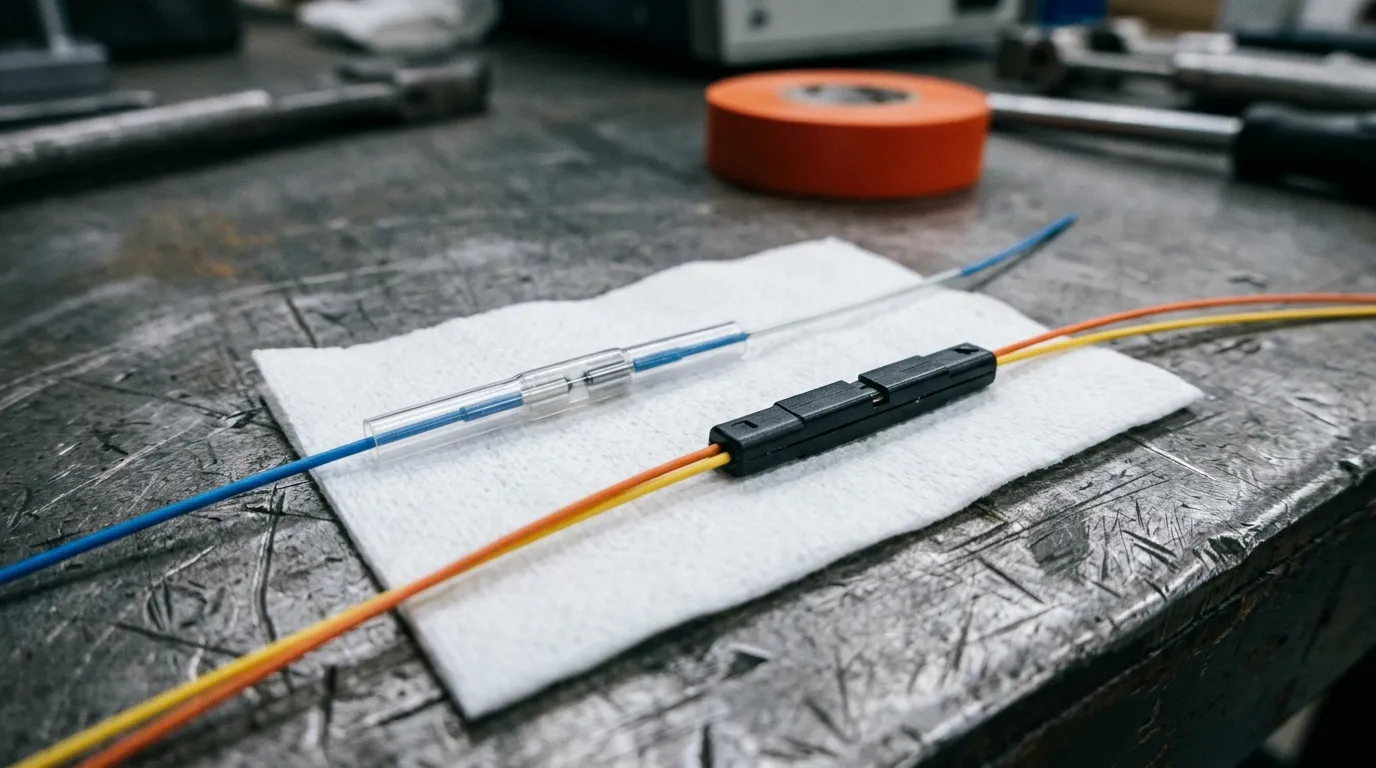
The two objects the decision comes down to: a fusion splice under a protector sleeve, and a mechanical splice body with its gel already inside.
Fusion splice | Mechanical splice | |
|---|---|---|
What holds the light path together | Melted glass, continuous | V-groove alignment, gel, clamp |
Energy needed on site | Electric arc, from the splicer's battery | None |
Fibers joined per operation | One, or twelve on ribbon | One |
Consumable per joint | A protector sleeve | A splice body |
What the joint looks like afterwards | Glass inside a sleeve | Polymer body around glass |
The Fiber Splicing Loss Numbers Don't Mean What They Say
Start with the standard, not a blog post about it. The clause sits in TIA-568-B.3, the fiber-optic annex of the premises-cabling standard, as the Fiber Optic Association reproduces it — and that page notes that the standard's current revision is 568-C. It is blunt: "Fusion or mechanical splices shall not have a loss of more than 0.3 dB for either multimode or singlemode fiber." One limit, both methods, no distinction.
That is not an accident of drafting. It reflects what the committee expected a competent joint to achieve either way — and it is worth reading for what it is, a premises-cabling limit. On outside plant, acceptance is written into the operator's test sheet, and is usually tighter than 0.3 dB per joint. Use this clause as the floor a joint has to clear, not as the target on a feeder route.
The planning values people quote come from a different place. The FOA's loss-budget guidance tells you to figure 0.15 dB for a singlemode fusion splice and 0.3 dB for a multimode mechanical splice — and notice that the 0.3 dB is attached to multimode and to the ceiling, not to the typical singlemode mechanical joint. Product specifications land below that: a current US listing for a 3M Fibrlok II 2529 states an insertion loss below 0.2 dB, with the same part rated for a 250–900 µm coating or buffer range, a retention load above 7.75 lb, and a working range of -40 °C to 80 °C (Fibrlok II 2529 listing).
So the honest picture is a good fusion splice somewhere at or below the 0.15 dB planning value, and a good mechanical splice below 0.2 dB — 0.05 dB apart, a twentieth of a decibel, and that comparison already flatters the mechanical side, because 0.15 is a planning allowance and 0.2 is a catalogue maximum. On a route with four joints those numbers give 0.6 dB against 0.8 dB: a fifth of a decibel across the entire span, inside the uncertainty of the acceptance test, and small beside a splitter. If the two methods were a factor of ten apart, no operator would ever have put a mechanical splice in a network. They did, for decades, and they were not all wrong.
Two cautions on any loss figure you read, including the ones above:
- A quoted splice loss is a measurement, not a property of the joint type. The method is fixed by IEC 61300-3-4, and an OTDR reported loss differs from a light-source-and-power-meter result and from a bidirectional average. The splicer's own estimate is a fourth number again, computed from arc current and camera images, useful for rejecting a bad cleave and useless as a certification value.
- Loss figures from different methods are not interchangeable. A 0.05 dB OTDR event reading on a short span, a 0.15 dB budget allowance and a 0.2 dB catalogue maximum describe three different things. Comparing them is how a page ends up claiming a tenfold difference that no field data supports.
If you need the arithmetic for a whole link, the loss budget walkthrough and the inventory of loss causes carry it. What matters here is that splice loss alone will not choose your method.
Return Loss Is Where the Two Methods Actually Diverge
The TIA clause continues past the loss limit, and this is the sentence most comparison pages never reach: singlemode splices must have a return loss better than 26 dB for general applications, and better than 55 dB for CATV broadband analog video.
Now put the product data beside it. The Fibrlok II 2529 listing quotes a reflectance of -35 dB. In return-loss terms that is 35 dB: comfortably past the 26 dB general requirement, and 20 dB short of what an analog video overlay demands.
That is a real, checkable design distinction, and it is not about loss at all. A mechanical splice works because an index-matching gel fills the gap between two cleaved ends.
Gel is a polymer, and polymer-to-glass is still an interface; it is a much better interface than air, which is why the loss is low, but it reflects and it ages. The fiber optics fundamentals section carries the reflection physics if you want the derivation. A fusion splice has no polymer in the light path — glass continues into glass, and the reflective interfaces in the link are the connectors at each end, not the joint. This is why the polish grade on a connector matters far more than the joint behind it.
Does that rule mechanical splices out? No. It rules them out of some networks:
- RFoG and analog video overlays. 55 dB ORL is the bar. A -35 dB splice in the path does not meet it, and reflections in an analog return path show up as noise on somebody's television.
- High-split and extended-reach PON, where the upstream window is doing more work and back-reflection matters more than it did in a 2.5 Gbps downstream-only design.
- Any link whose budget is already tight. A twentieth of a decibel per joint will not rescue a design that is 3 dB short, but a long span with thirty splices turns that 0.05 dB into 1.5 dB — worth having when nothing else is available.
For ordinary data, business Ethernet and residential GPON without an analog overlay, 35 dB clears the 26 dB requirement with room, and on those links the reflection sits well inside the measurement uncertainty of the test that looks for it.
Qualification is the other half of this. IEC 61753-1 sets out the service-environment categories — C for controlled environments, OP and OP+ for protected outdoor locations, and I for industrial — that any passive component, including a mechanical splice, is tested against before anyone claims it is suitable for a location. Ask for the category, not the adjective: "outdoor rated" is marketing, "category OP+" is a test regime.
Cost per Splice, Not Cost per Tool
Every page on this topic quotes a tool cost. None quotes a joint cost, which is the number a contractor actually budgets.
The machine is the simpler half, and a live catalogue says so. A US distributor's fusion splicer catalogue carried 45 products on 26 November 2026; the twelve on its first page spanned $3,417.00 — a kit with fiber holders and no cleaver — to $12,739.50 for a Sumitomo Q102-CA+ package with its cleaver included. Core alignment with a cleaver, the configuration a crew actually buys, sat at $7,840.00 in the middle of that band. These are USD list prices before tax, and they move. Read the top of the page as the top of the page, not the top of the market: 45 products means there is more above and below it.
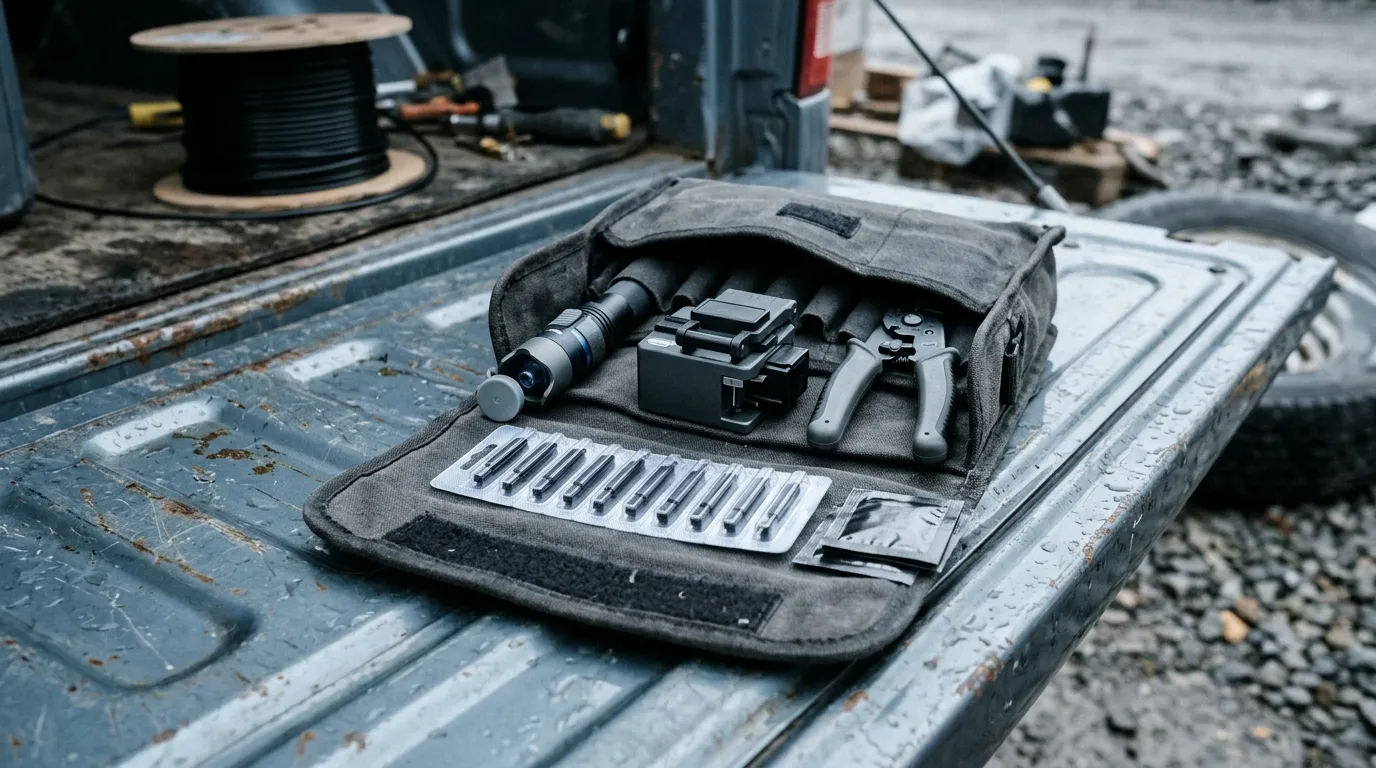
What the mechanical route weighs: no splicer, no battery, no arc chamber. The consumable in the blister strip, not the tool, is where its cost sits.
On the other side, the shelf is wider than the folklore and much wider than the single SKU most comparisons pick. The same day, the same distributor's mechanical splice shelf listed single splices from $4.92 for an economy clamshell to $52.50 for a Corning CamSplice, with a Siemon multimode splice at $12.95, a universal ULTRA splice at $13.25 and the 3M Fibrlok II Angle Splice at $17.95. The Fibrlok II 2529 — the part specified in the section above — appears on that shelf only as a $128.00 six-pack; its own product page prices the single unit at $20.83.
Read that spread for what it is: the money buys what holds the fiber, not merely convenience. The cheap end is a self-gripping clamshell with a 0.2 dB typical loss, singlemode or multimode, sized to drop into a Fibrlok-style tray — and its quoted pull strength of 1.5 lb is the figure with an optional cyanoacrylate adhesive applied (F1-MC125 listing). The 3M part is rated for above 7.75 lb as supplied, seats in about thirty seconds with an assembly tool, and costs four times as much. Below both sits one cheaper tier again: elastomeric lab splices, sold in sixes and twelves at $3.96 and $3.33 each, which are bench parts rather than joints you would seal into a pole closure. So the "$3 to $5 mechanical splice" that circulates on comparison pages is not a myth. It is the bottom of a real shelf, and it buys a part that holds 1.5 lb if you glue it.
The six-pack deserves its own sentence, because it reads like a discount and is not one: the Fibrlok II six-pack lists at $128.00, which is $21.33 a unit — 2.4 % more per splice than buying them singly at $20.83. It is a stocking SKU, not a volume break.
Now the qualifier that belongs on all of it. Every price above is single-unit retail list from a reseller, before tax. A contractor buying splice bodies by the thousand pays less, and buys the machine through a dealer at project pricing, so both sides of any ratio built from these numbers move. Retail list is used here because it is what a reader can check in one click. Treat the arithmetic as an order-of-magnitude test, not a quotation.
With that said, the crossover, and every input labelled. Let C be splicer capital and p the price of a mechanical splice body. Ignoring sleeves, the machine pays for itself after N = C / p joints. At C = $7,840, with p taken from the shelf above:
Body | Price each | Payback, capital only | With $3/joint labor | With $4/joint labor |
|---|---|---|---|---|
3M Fibrlok II 2529 | $20.83 | 376 joints | 440 | 466 |
Fibrlok II Angle Splice | $17.95 | 437 | 524 | 562 |
Universal ULTRA splice | $13.25 | 592 | 765 | 848 |
Economy clamshell | $4.92 | 1,594 | 4,083 | 8,522 |
The labor column is an assumption, not a measurement: a fusion splice takes three to four minutes longer per joint once you count arc, protector and coiling into a tray, priced at $60 per crew-hour, or $1 per crew-minute. That subtracts $3 to $4 from p on every joint, which is where the last two columns come from.
The shape is the finding, and the shape is a band of roughly 440 to 8,500 joints, not a single number. On the premium 3M body the machine pays for itself around the end of the first 400-splice job — 376 joints on capital alone, 440 once labor is counted. On the economy clamshell it effectively never does: the labor difference alone swallows most of the price of the part, and the arithmetic stops discriminating at all. That is not a flaw in the model. It is the model telling you that a $4.92 splice and a $20.83 splice are not the same purchase, even though both are sold as mechanical splices.
Notice how this lands beside the connector argument. A field-installable connector costs a few dollars, and on that arithmetic the connector route can undercut the splicer at almost any volume. A mechanical splice behaves the same way at the bottom of its shelf and the opposite way at the top: at $13–21 the consumable is the expensive half of the joint and the machine pays for itself inside a project or two; at $4.92 the consumable is cheap enough that the machine's capital is the whole cost, and the payback argument evaporates. Two similar-sounding decisions, and the conclusion turns on which part is in the pouch.
Power, Weather and the Handhole at Two in the Morning
No cost model survives the site visit. Access decides the method before the arithmetic above gets a vote, and access does not eliminate the two methods symmetrically.
A fusion splicer needs a charged battery, a surface that is level enough for the fiber holders, and an arc chamber that is clean and dry. Wind blows the arc out or distorts it. Rain on the machine is a fault. Grit in the splicer's holders produces a misalignment that the machine will usually catch — and catching it costs another cleave. None of that is a problem on a bench or in a van. All of it is a problem on a ladder, at the top of a pole, or kneeling in a handhole with water in the bottom.
A mechanical splice needs none of that. It needs a clean cleave and a dry fiber, and it can be closed with one hand while the other holds a torch. That is why it exists, and it is why the method survives despite every disadvantage in this article.
Two corrections to the folklore, though:
- "Mechanical splicing needs no power" is true and slightly beside the point. Most field splicers run on batteries sized for a shift. The real constraint is not electricity, it is the working envelope: flat surface, still air, clean chamber.
- "Mechanical splicing works anywhere" is not true either. The gel interface is the most contamination-sensitive part of the joint. Grit, moisture or fingerprint oil on the cleaved end goes straight into the optical path and stays there, because the body is closed and nothing can be cleaned afterwards. Fusion has the same cleave requirement, but a dirty end usually shows up as a rejected splice on the machine's screen rather than as a 3 dB event discovered next month.
Where the joint lives shapes the choice as much as the weather does. A dome closure on a pole with a 24-fiber tray stack is fusion territory; the comparison of dome, inline and cabinet closures covers the tray capacity and working height that go with it. A wall box at chest height with the drop already glanded in is not.
Ten Years Later: Where Each Joint Fails
The failure mechanics are different in kind, and that difference matters more than either method's starting loss.
A mechanical splice has three things that can move: the gel can migrate or dry, the clamp can relax, and the polymer body expands and contracts with temperature at a different rate from the glass inside it. The listing that quotes the part's optical numbers also quotes its environmental envelope — -40 °C to 80 °C, a retention load above 7.75 lb, and a 250–900 µm coating-or-buffer range — because those are the conditions the moving parts have to survive. That is a serious qualification, and it is why these parts are installed in access networks rather than only in labs.
A fusion splice has none of those mechanisms. Glass does not relax, there is no gel, and the protector sleeve is mechanical protection rather than an optical element. What it has instead is a dependency on the arc: electrode wear, humidity correction, and the cleanliness of the chamber. A splicer that is out of calibration makes joints that pass on the day and drift later, and the failure is invisible without a test.
Then the asymmetry that decides more real projects than any datasheet:
A fusion splicer tells you when it has made a bad splice. A mechanical splice does not.
The splicer estimates loss from the arc and the camera image and stops — or at least warns — when the estimate is out of range; the fix is a re-cleave and one more arc, thirty seconds. A mechanical splice body is opaque. A marginal cleave goes in, the cap closes, and nothing is known until the acceptance test — by which point the closure is sealed, the ladder has gone back on the truck, and the crew is two streets away. The fix is to cut the body out and start again, which also costs fiber length you may not have.
Model the consequence per joint, with illustrative yields rather than survey data. Five joints in a hundred fail first pass at 95 %, ten at 90 %. A joint re-made on site is cheap: one more consumable, one more cleave, one more operation at the tray — a protector or a body, five minutes, and nothing else. Across 400 joints at either yield that is 1.7 to 3.3 crew-hours — small against a job of that size, which is why it rarely appears in the budget. A joint discovered after the enclosure is closed costs the same consumable and then a visit: travel, access, a re-entry, a re-splice and a retest, an hour at best. On 400 joints the two yields produce 20 and 40 of those. The bill is set by who notices the bad joint, and when; the yield only decides how often you pay it. That is also why acceptance testing has to be bidirectional OTDR work rather than a one-way trace: a splice can read as a gain in one direction and a loss in the other.
Training lands differently for the same reason. On paper the two methods demand the same skill — a square cleave, a clean end, the right coating length — and neither forgives a dull blade. In practice a splicer program corrects the operator inside the machine's screen, so a technician who has never been taught cleave angle still ships joints that pass. A mechanical splice program has no such backstop: the skill has to be in the hands, which is why crews that use them tend to have a cleaver discipline written into the method statement rather than assumed.
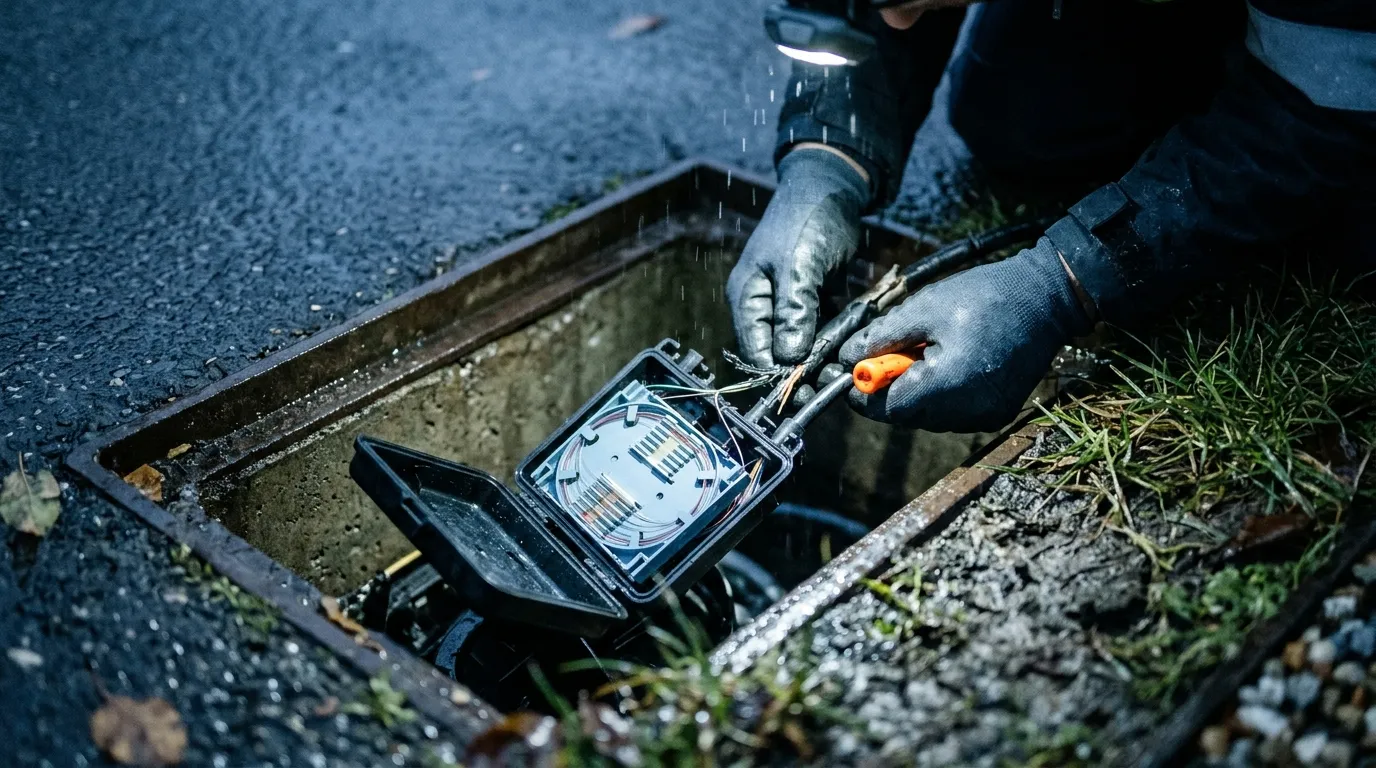
The situation mechanical splices were invented for: no bench, no still air, no second visit available.
The Decision Table
Situation | Method | Why |
|---|---|---|
Trunk or feeder splice in a closure, any count above a handful | Fusion | Density, tray space and per-joint cost all point one way |
Ribbon cable, 12 fibers per operation | Fusion | A mechanical splice joins one fiber at a time |
Analog video overlay, RFoG, 55 dB ORL requirement | Fusion | A -35 dB mechanical splice misses the return-loss bar |
Emergency restoration at night, no power on site | Mechanical | No machine, no battery, one hand free for a torch |
Single repair in a handhole with 300 mm of slack | Mechanical | You cannot stand a splicer over it |
Temporary path while a permanent repair is scheduled | Mechanical | Fast, and it is meant to be replaced |
Drop cable or pigtail in a wall box | Mechanical, or a field-installable connector | No working envelope for a splicer |
Any joint that must be documented and warranted for 20 years | Fusion | The machine measures what it made |
When a mechanical splice is the right answer
Not because it is cheaper at scale — the table above says the opposite from roughly 440 joints on a premium body, and puts the economy body so far out that the payback argument stops applying. Mechanical splicing is the right answer when the constraint is access or time, and the loss penalty fits inside a budget that has room:
- Restoration, where the alternative is a customer offline for another day.
- A joint in a location no splicer can be set up in.
- A single splice where mobilizing a machine costs more than the part.
- A temporary joint whose replacement is already scheduled.
And it is the wrong answer when the design has a return-loss requirement it cannot meet, when the count is high enough that per-joint cost dominates, or when nobody is going to test every joint and the silent-failure mode is the one you can least afford.
When fusion is the only defensible choice
Above a dozen joints in one enclosure, on ribbon, wherever the ORL requirement is 55 dB, and anywhere the joint will be sealed inside a closure and not looked at again for a decade. The splicer's ability to measure its own work is worth more than its loss advantage, because it converts a failure that would surface at acceptance into a failure that surfaces immediately.
Where TTI Fiber Fits
We do not sell either machine, and we do not make the splice bodies — so nothing above depends on which one you buy.
What we make is the enclosure the joint ends up in: dome and inline fiber optic splice closures from 12 to 288 cores, IP68, with 12- and 24-core trays that carry heat-shrink protector slots for fused joints and enough routing depth for either method's bend radius. If you are specifying a closure for a route where the splice method is still being argued, send the fiber count, the cable diameters and the environment, and we will quote the closure and tray configuration that fits either answer.