Optical Network Terminal & ODN Explained
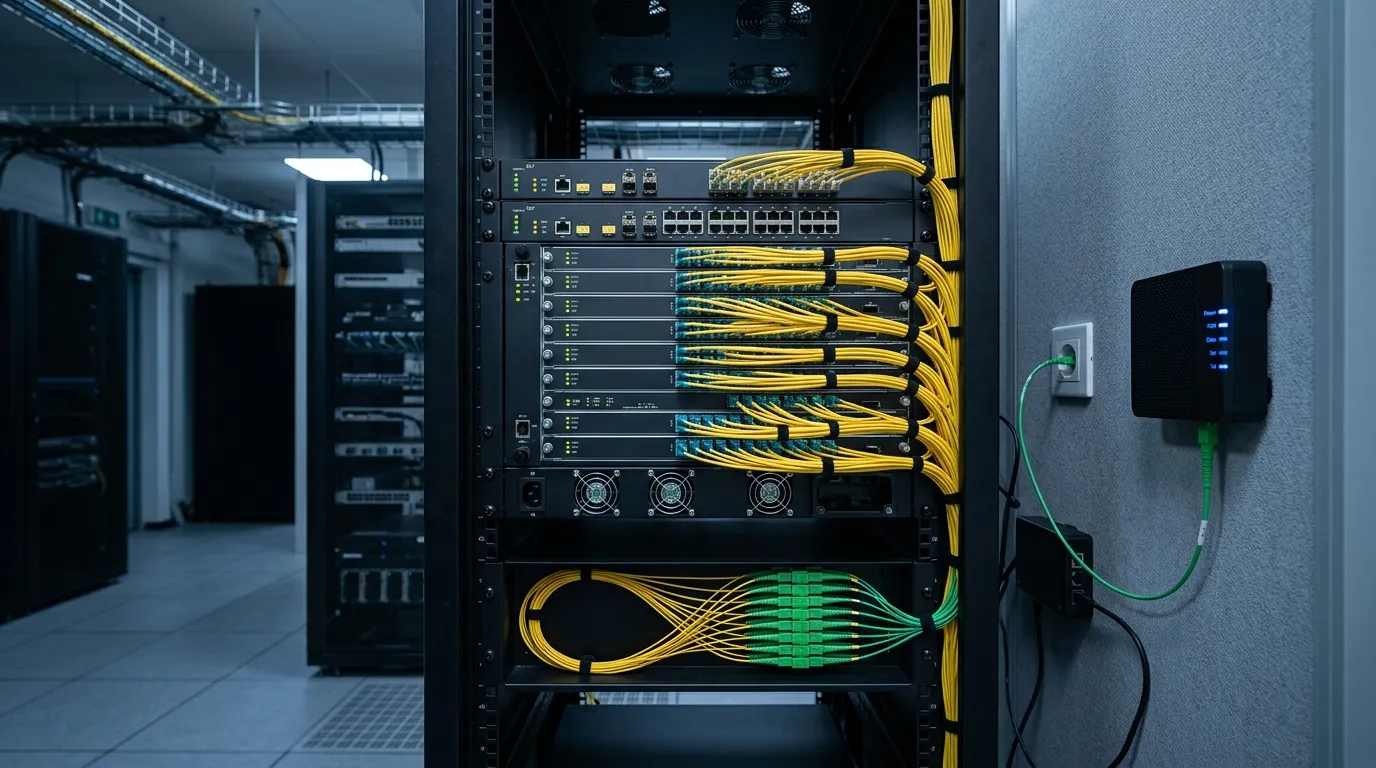
OLT, ONU/ONT and ODN are the core terms used to describe a fiber-to-the-home (FTTH) access network end to end. The OLT is the active head-end device, the ODN is the passive optical plant, and the ONU or ONT is the subscriber-side optical network device. The optical line terminal (OLT) is the provider's active head-end equipment; the optical distribution network (ODN) is the passive fiber plant in between; and the optical network unit (ONU) or optical network terminal (ONT) is the box at the subscriber that turns light back into Ethernet. Read them as one chain rather than four separate parts, and every datasheet, quote and deployment plan starts to make sense. This guide defines each term, shows where it sits, and explains the optical budget that ties all three together — including the FTTH & PON deployment guides this article belongs to.
What Do OLT, ONU, ONT and ODN Actually Mean?
Deployers say the four terms in one breath, but each names a different link in the same chain. The umbrella concept is the passive optical network (PON): a point-to-multipoint fiber architecture in which one provider port serves many subscribers through unpowered splitters.
Term | Full name | Where it sits | Powered? |
|---|---|---|---|
OLT | Optical Line Terminal | Provider's central office or point of presence | Active (powered) |
ODN | Optical Distribution Network | Between the OLT and the subscriber — feeder, distribution and drop segments | Passive (no power) |
ONU | Optical Network Unit | At or near the subscriber premises | Active |
ONT | Optical Network Terminal | Inside the subscriber premises | Active |
A useful mental model: the OLT is the head end that decides who talks when, the ODN is the glass and the splitters that carry the light, and the ONU/ONT is the endpoint that hands the customer a normal Ethernet connection. The OLT and the subscriber-side ONU/ONT are active electronics, while the ODN consists of fiber and passive components. ONU and ONT are commonly used as overlapping terms for the subscriber-side endpoint rather than as two separate active devices.
The OLT: Where the Provider's Network Meets Fiber
The OLT is the aggregation endpoint of a PON. It lives in the provider's central office or point of presence and does four jobs:
- Terminates the PON. Each PON port on the OLT serves a tree of subscribers through one or more splitters — commonly 32, 64 or 128 lines per port.
- Schedules the upstream. Because every ONU shares the same upstream wavelength, the OLT grants each one a time slot so their bursts never collide.
- Provisions and manages endpoints. It authenticates ONUs, pushes configuration and reads alarms over the management channel.
- Uplinks to the core. North-bound, the OLT presents the subscriber traffic to the provider's metro or backbone network over Ethernet or optical uplinks.
An OLT is defined by the PON standard it implements. GPON and XG-PON are specified by the ITU-T in the G.984 series and G.987 series respectively; the older broadband PON (BPON) came first in the G.983 series. Comparing those generations — and the IEEE alternative, EPON — is the difference between GPON vs EPON vs XGS-PON, and choosing between a passive and an active architecture is a separate decision covered in AON vs PON network architecture. What matters for this article is the boundary: the OLT is active equipment, it is vendor-specific, and it is where the subscriber tree begins.

ONU vs ONT: The Optical Network Terminal at the Subscriber End
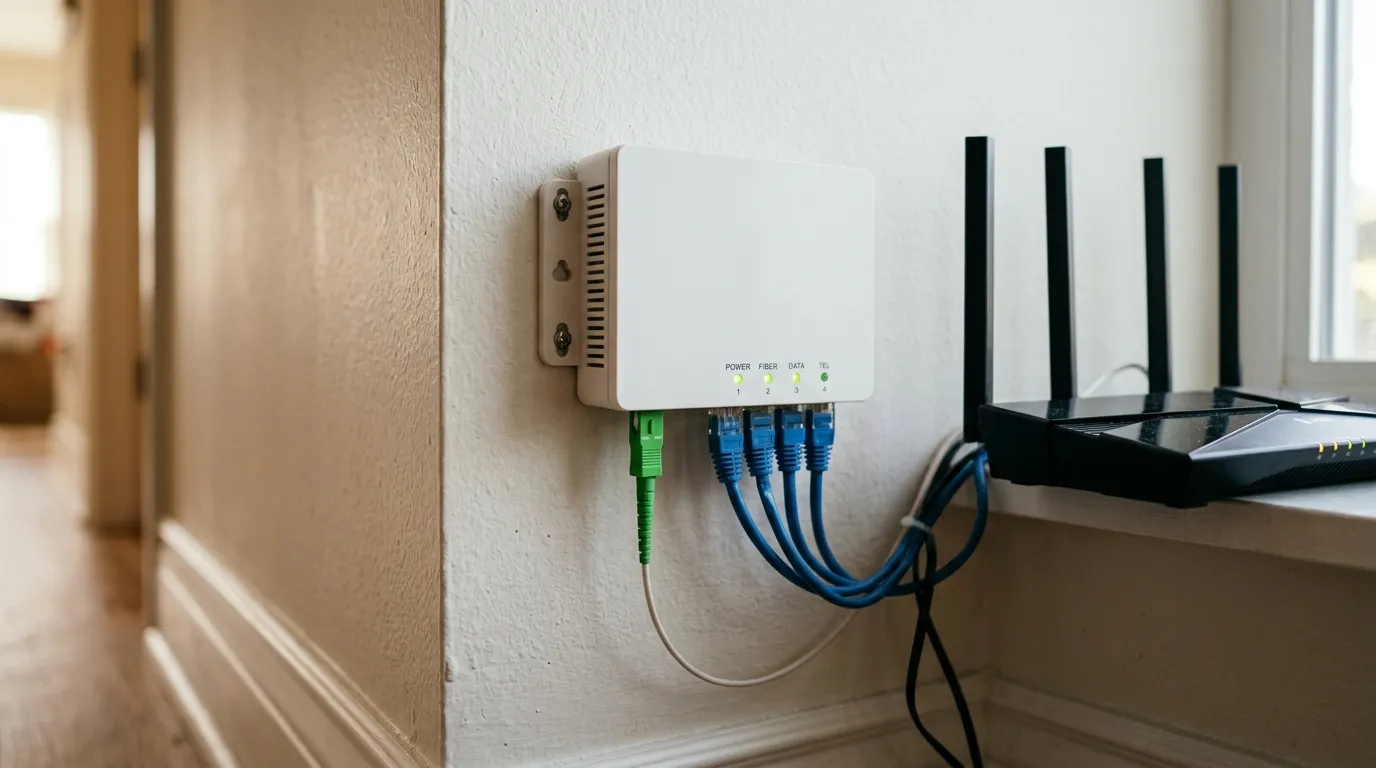
If there is one pair of terms that gets muddled most often, it is ONU and ONT. Both describe the subscriber-side endpoint of a PON — the device that receives the downstream optical signal, recovers the data, and presents it as Ethernet, voice or video to the customer. The ITU-T defines both names in the GPON recommendations, and the IEEE's Ethernet-in-the-first-mile work uses "ONU" for the equivalent device, which is why the Ethernet in the first mile terminology and ITU-T terminology do not line up word for word.
In everyday engineering use, ONU is commonly used as the general term for the subscriber-side optical network unit, while ONT often refers to an ONU or optical termination located at the customer premises. The distinction is architecture- and vendor-dependent, not a universal rule that an ONU serves multiple subscribers or must be located outside the premises.
Inside the enclosure, the function is the same: a photodiode receiver, a burst-mode laser transmitter, the PON MAC, and a set of service ports (Gigabit Ethernet, POTS for voice, sometimes RF video). Because an ONT is active, it needs a power supply and often a small battery so that voice service survives a mains outage. The premise itself — a home versus a building — is the distinction behind the related question of FTTH vs FTTP.
The ODN: The Passive Middle That Does Most of the Work
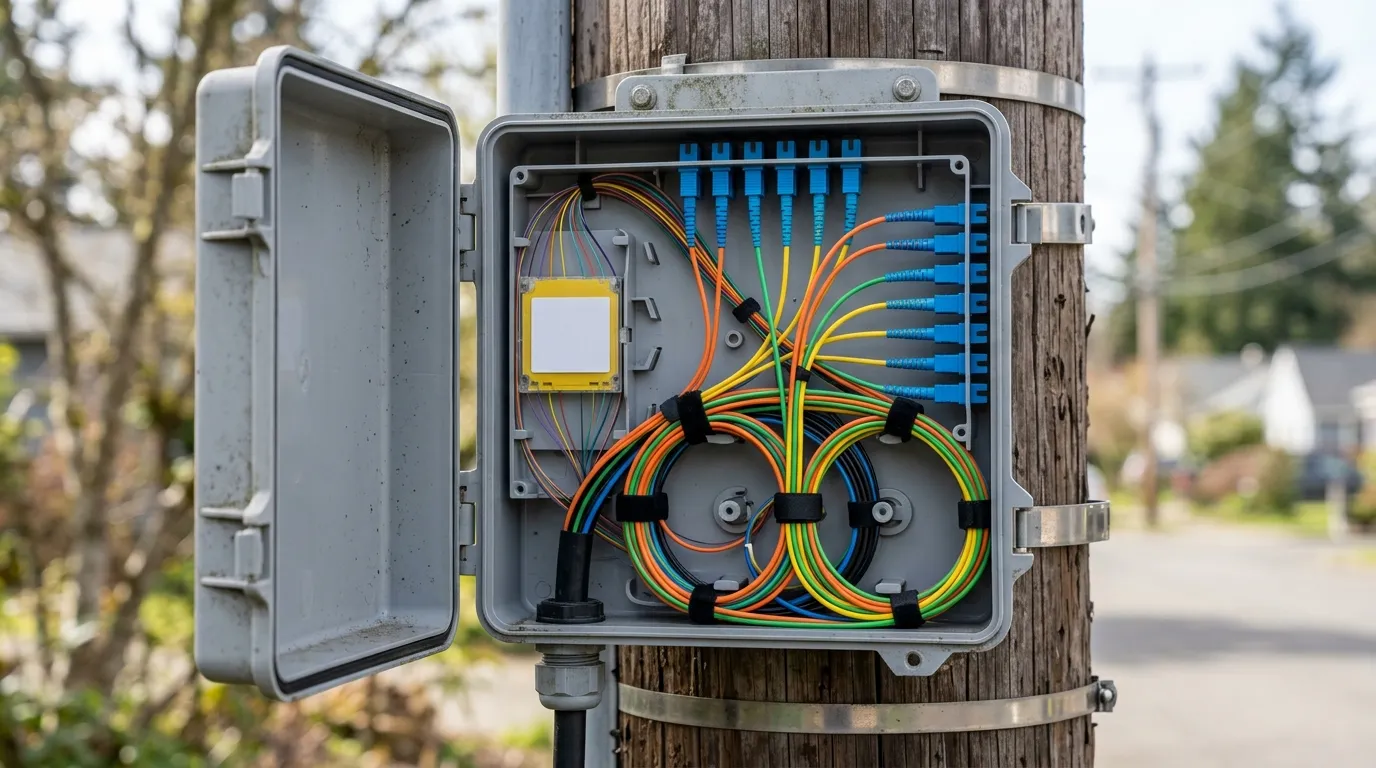
The optical distribution network (ODN) is the part of an FTTH network almost every explainer skips — and it is the part that most of the physical build actually is. The ODN is everything between the OLT's PON port and the ONU/ONT: the fiber and the passive components that carry and split the light. Nothing in it is powered, and that single fact shapes how you design, buy and maintain it.
An ODN is conventionally divided into three segments:
- Feeder — the high-count cable from the central office to the first splitter or distribution point.
- Distribution — the cable from the splitter out to the access points in the streets or building risers.
- Drop — the final cable from the access point to the individual ONT.
The passive components along that path include the optical splitter (a planar lightwave circuit or fused-biconic-taper device that divides one input among many outputs), fiber distribution boxes and access terminals, splice closures, patch panels, connectors and the cable itself. Passive ODN components can often be integrated across vendors when their connector interfaces, wavelength range, insertion-loss limits, environmental ratings, packaging and mechanical requirements match. Passive status alone does not guarantee plug-and-play compatibility or project acceptance; the selected splitter and other components still need to be checked against the ODN design and bill of materials. That differs from the active OLT and ONU/ONT, whose interoperability depends on the PON standard, optical class, registration and authentication method, OMCI or other management profiles, firmware and operator qualification. Compatible equipment may be sourced from different vendors, but cross-vendor operation should be verified rather than assumed. The full menu of splitter choices — centralised versus cascaded, PLC versus FBT, and how each affects loss — is covered in types of optical fiber splitters, and the hardware that terminates those cables in the field is what manufacturers like TTI Fiber build: PLC and FBT splitters and fiber distribution boxes designed for the distribution and drop segments of exactly this network.
Following the Light: How OLT, ODN and ONT Connect End to End
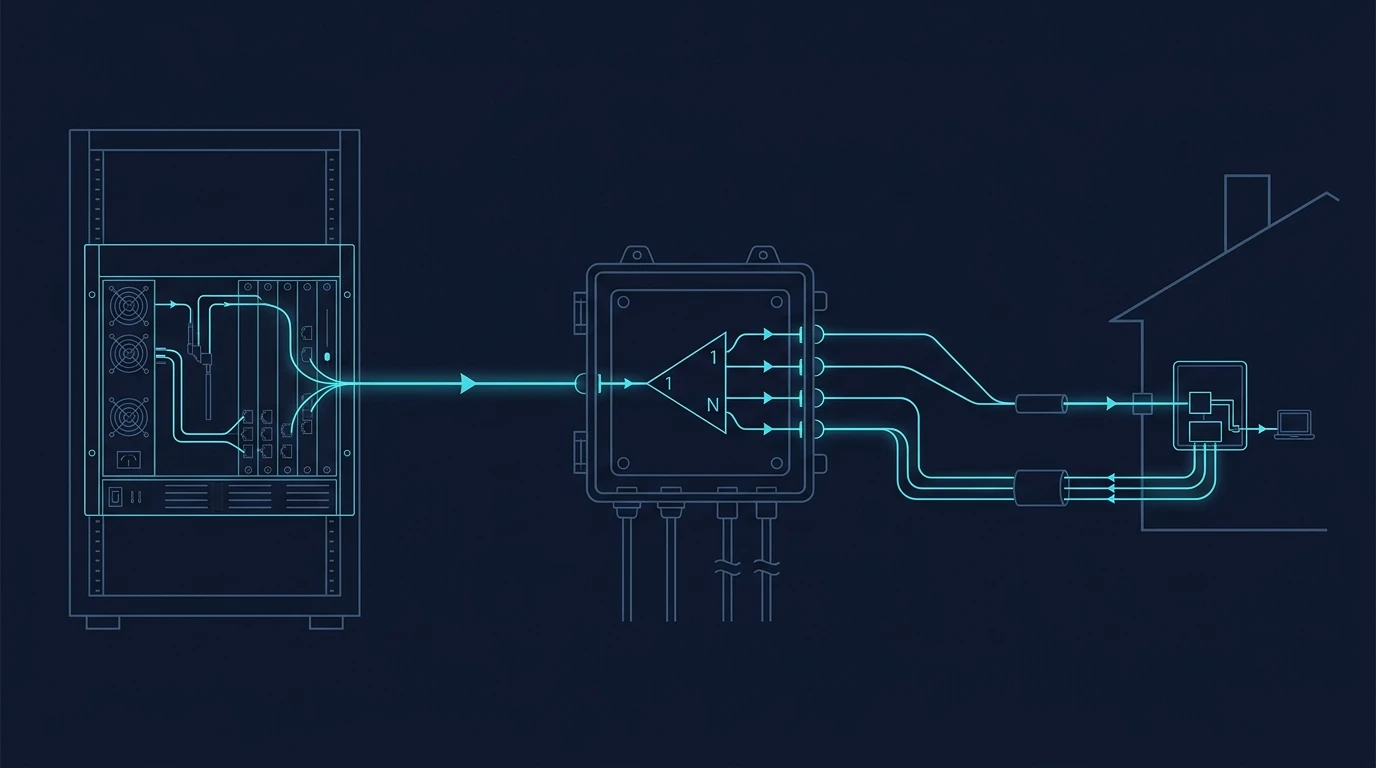
The cleanest way to see the four terms relate is to follow one packet. Downstream, the OLT transmits on the PON's downstream wavelength — around 1490 nm on GPON and 1577 nm on XGS-PON — into the feeder fiber. That single signal reaches the splitter, where its power is divided among the output ports, and continues along the distribution and drop cables to each ONT. Every ONT on the tree receives the same downstream signal and keeps only the frames addressed to it.
Upstream is where the OLT earns its keep. In GPON, the ONT typically transmits around 1310 nm; in XGS-PON, the nominal upstream wavelength is around 1270 nm. In both systems, the subscriber devices share the upstream channel through time-division multiple access, transmitting only when the OLT grants them a time slot so that their bursts do not collide. This time-division multiplexing is invisible to the customer and completely dependent on the head end, which is why you cannot simply swap an OLT for a generic Ethernet switch and expect the network to work.
The ODN is deliberately neutral about direction: fiber and splitters pass light both ways. The passive middle neither knows nor cares which way a packet is going — it only imposes loss. That loss, accumulated from the OLT to the ONT in both directions, is the subject of the next section.
The Optical Budget That Ties the Three Together
Everything in an ODN costs light. The optical budget — also called the link or power budget — is the direction-specific calculation that tells you whether a given OLT and ONU/ONT can operate across a given ODN. The optical budget is direction-specific. For the downstream direction, compare the OLT transmitter power with the ONT receiver sensitivity; for the upstream direction, compare the ONU/ONT transmitter power with the OLT receiver sensitivity. In each direction, the available power budget must cover fiber, splitter, connector, splice, WDM or filter losses and the engineering margin, while also remaining within the receiver-overload limits.
The loss adds up from a surprisingly short list of contributors:
- Fiber attenuation. Single-mode fiber in the access network typically loses roughly 0.35 dB per kilometre at 1310 nm and 0.2–0.25 dB per kilometre at 1490 and 1550 nm. ITU-T G.652 specifies characteristics of the single-mode fiber and cable, while the mechanical construction, environmental performance and applicable cable test methods are determined by the relevant optical-cable standards, product specifications and project requirements.
- Splitter loss. An ideal 1:2 splitter halves the power (about 3 dB); real PLC devices add a small excess loss. In round numbers, 1:2, 1:4, 1:8, 1:16, 1:32 and 1:64 splitters cost roughly 3.5, 7.2, 10.5, 14, 17.5 and 21 dB.
- Connectors and splices. Each mated connector pair adds a few tenths of a decibel and each fusion splice around 0.1 dB — small individually, but they accumulate across a real ODN.
The ITU-T PON recommendations define ODN classes with fixed budgets: GPON's class B+ allots about 28 dB and class C+ about 32 dB, which is why a B+ network often cannot use a 1:64 split and a long reach at the same time. This is the practical reason the ODN, the OLT and the ONT are specified together: change the split ratio or the reach and you change whether the link closes. A splitter choice that looks free on a bill of materials can silently push the network past its budget.
Points People Mix Up: ONT vs Modem, ONT vs Router, ODN vs OSP
A handful of confusions follow these terms around, especially for readers arriving from a home-broadband background.
- ONT vs modem. An ONT does for fiber what a DSL or cable modem does for copper and coax: it terminates the provider's physical medium and hands over an Ethernet connection. It is not a modem in the DOCSIS sense, and it cannot be replaced by one.
- ONT vs router. The ONT terminates the wide-area side. The router does the local work — NAT, DHCP, firewall and Wi-Fi. In some deployments one box does both; in a pure FTTH design they are separate devices, and swapping the router does not disturb the fiber.
- ONU vs ONT. As above: largely naming, with ONT usually reserved for the single-subscriber unit inside the premises.
- ODN vs OSP. The ODN is the logical, functional name for the fiber path between OLT and ONT. "Outside plant" (OSP) is the physical, environmental discipline — ducts, poles, closures, weatherproofing — that implements much of it.
- "Does my ONT need power?" Yes. It is active equipment, which is precisely what separates it from the entirely passive ODN.
What to Look For When You Specify FTTH Hardware
The four terms sort neatly into what you buy and from whom. The OLT and the ONT are active, vendor-managed equipment. Choose them as a pair for the PON standard you intend to run, and treat their firmware and management ecosystem as part of the selection.
The ODN is passive and standards-based. Here the selection is about physical performance and environment, and it rewards a checklist:
- Splitter ratio and type — centralised 1:32 PLC versus cascaded lower-ratio units, based on how the budget closes.
- Connector type — and end-face polish must match the selected OLT, ONU/ONT, splitter and patching interfaces. SC/APC is common in FTTH deployments but is not universal. APC and UPC connectors must not be mated directly; the mismatch can cause excessive reflection, connection loss and possible ferrule damage.
- Port count and IP rating of distribution boxes and closures, matched to aerial, duct or direct-burial placement.
- Cable and component loss figures, so the budget you calculated survives contact with the bill of materials.
Get the passive middle right and the active ends have an easy job. To see how the whole access layer is put together, start from FTTH / FTTx solutions.