What Is Fiber Optics? How It Works and Key Uses
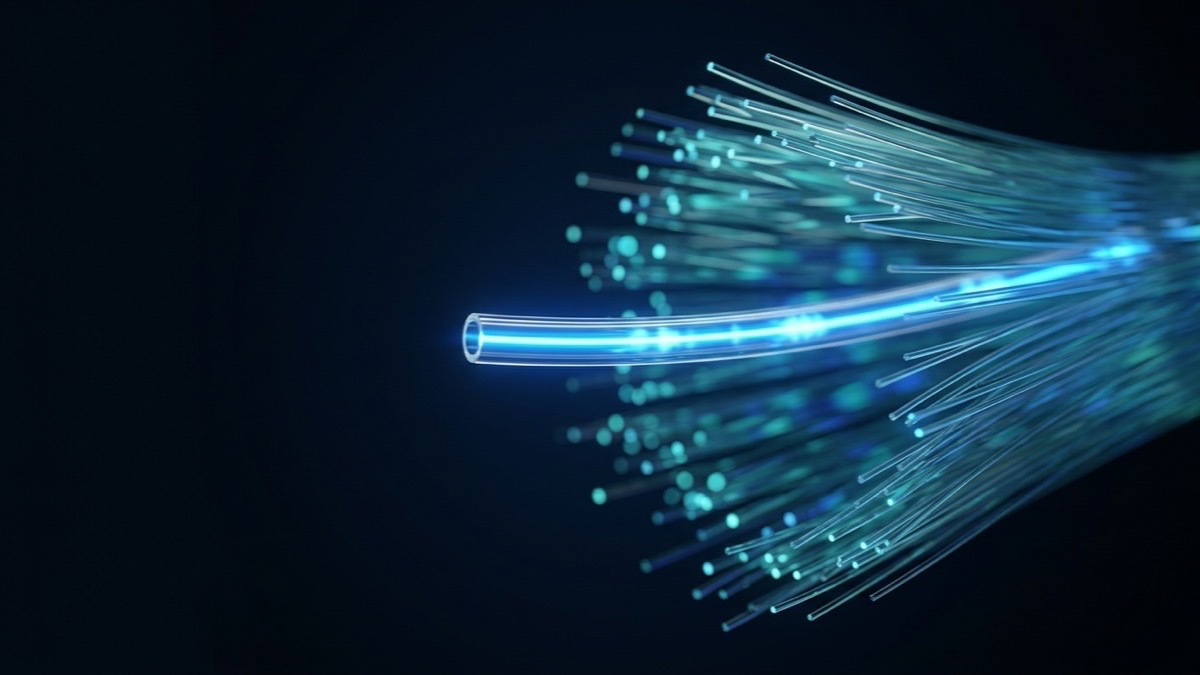
Fiber optics is a technology that transmits information as pulses of light through thin strands of glass or plastic. Instead of pushing electrical signals down a copper wire, a fiber optic system converts data into light and guides that light—by a principle called total internal reflection—along a fiber about the width of a human hair, often for tens of kilometers without a boost.
That single idea now carries almost everything: the video you're streaming, the transaction that just cleared your bank, the message crossing an ocean. This guide walks the whole path—from the physics of a bouncing light beam, to what actually sits inside the cable, to how that cable is built and where it ends up in the real world.
We build outdoor optical cable for a living, so we'll do something most explainers skip: connect the science to the finished product that hangs on a utility pole or runs through a duct. By the end you'll understand not just what fiber optics is, but why it looks the way it does.
What is fiber optics?
Fiber optics is the field of transmitting data as light through an optical fiber—a flexible, transparent strand of ultra-pure glass (silica) or, less commonly, plastic. The term covers the physics, the fibers themselves, and the whole family of components and cables built around them.
It helps to separate two words people often blur together:
- Optical fiber is the raw light-guiding strand of glass. It's the "conductor."
- Fiber optics (or fiber optic communication) is the broader technology and industry that uses those fibers to move information.
A fiber optic link has three basic jobs. A transmitter turns electrical data into light, usually with a laser or an LED. The optical fiber carries that light to the far end. A receiver (a photodetector) turns the light back into an electrical signal a device can read. The fiber is simply the highway; the transmitter and receiver are the on- and off-ramps.
What makes the highway special is capacity. Light has an enormous frequency, which means a single fiber can carry a staggering amount of data—and unlike copper, it doesn't care about electrical interference. Better still, a technique called wavelength-division multiplexing (WDM) sends many separate light signals down the same fiber at once, each on a slightly different wavelength (color). A single modern fiber can carry dozens of wavelengths, each running at 400 to 800 gigabits per second, so one hair-thin strand moves many terabits of data every second. That combination is why fiber became the backbone of modern communication.
How does fiber optics work?
The heart of fiber optics is a piece of physics you can see in a swimming pool: total internal reflection.
When light travels from a denser material into a less dense one (say, from glass into air), it bends. Increase the angle enough—past a threshold called the critical angle—and the light stops passing through the boundary and instead reflects entirely back into the denser material. No light escapes. This is total internal reflection, and it's what keeps light trapped inside a fiber.
An optical fiber is engineered to make this happen thousands of times per meter. The center of the fiber—the core—is made of glass with a slightly higher refractive index than the layer around it, the cladding. Because the core is optically "denser," any light launched into it at a shallow enough angle keeps bouncing off the core–cladding boundary and zig-zags forward instead of leaking out. (If you want the deeper physics, we cover why light stays trapped in the fiber core separately.)
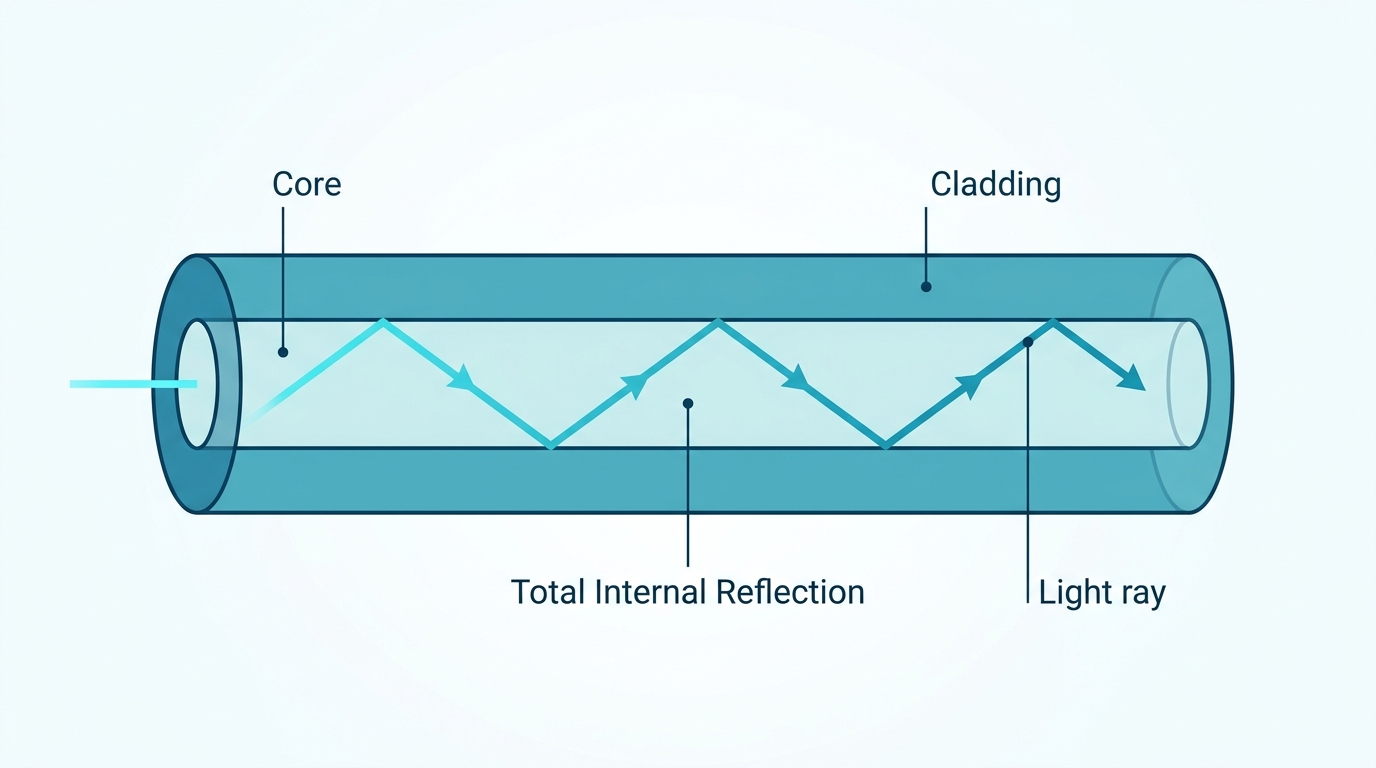
So the working sequence is:
- Encode. The transmitter switches a laser on and off (or shifts its intensity) to represent digital data—billions of pulses per second.
- Guide. Each pulse enters the core and travels forward by total internal reflection, staying inside the glass the whole way.
- Sustain. Because the glass is extraordinarily pure, very little light is absorbed or scattered, so the signal survives long distances.
- Decode. At the far end, a photodetector senses the pulses and rebuilds the original electrical signal.
Two properties decide how far and how fast a fiber can go. Attenuation is how much the signal weakens per kilometer—lower is better, and it's driven largely by the purity of the glass. Bandwidth is how much data the fiber can carry, which is limited by dispersion, the tendency of a pulse to spread out and smear as it travels. Fiber design is largely a fight to keep both numbers low.
Inside an optical fiber: core, cladding, and coating
A bare fiber looks like a fishing line, but it's a precisely layered structure. From the center outward:
- Core — the light-carrying glass at the center. In common single-mode fiber it's only about 9 microns across—far thinner than a human hair, which averages around 70 microns. This is where the signal actually travels.
- Cladding — a glass layer surrounding the core with a lower refractive index. It isn't there to carry light; it's there to reflect it back in. Core and cladding together are typically 125 microns in diameter—roughly the width of a human hair, and an industry-standard number you'll see everywhere.
- Coating (buffer) — a soft polymer layer applied over the cladding to protect the glass from moisture and micro-scratches. Glass fails at scratches, so this coating is what lets a fiber survive being handled at all.
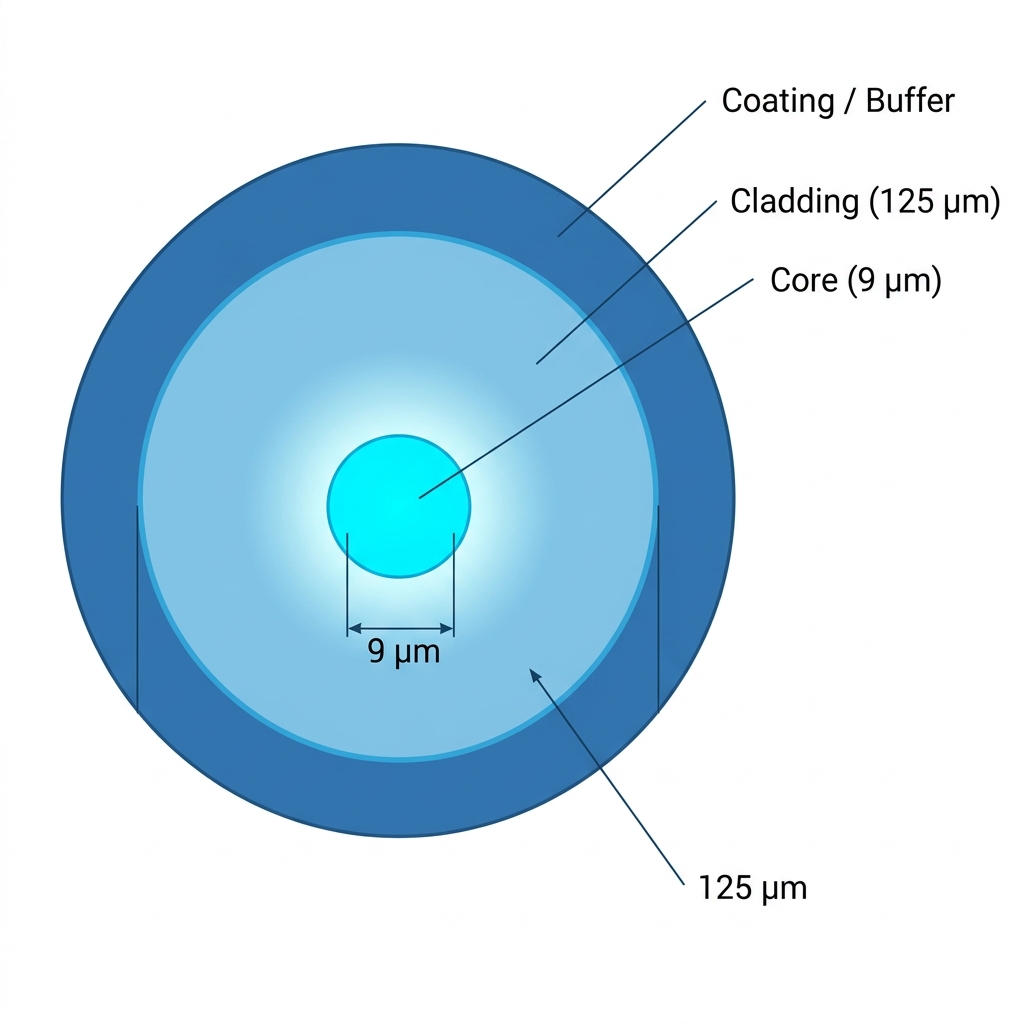
Notice what's not here yet: strength. A coated fiber is still delicate—bend it too sharply or pull on it and it snaps. That's the gap between a fiber and a cable, and it's the next piece of the story.
Optical fiber vs. fiber optic cable
This is the distinction almost every "what is fiber optics" article glosses over, and it matters the moment fiber leaves the lab.
An optical fiber is the glass strand we just described. A fiber optic cable is the finished, deployable product built around one or many fibers so they can survive the real world—being pulled through ducts, buried in the ground, or strung between towers in wind, ice, and heat.
Turning fiber into cable adds layers the glass can't provide on its own:
- Buffer tubes that loosely house the fibers so the cable can bend and stretch without straining the glass—one of several approaches, as our guide to tight-buffered vs. loose-tube construction explains.
- Strength members—aramid yarn (the material in bulletproof vests), fiberglass rods, or steel—that take the pulling load so the fibers never do.
- Water-blocking gel or dry tape to keep moisture out.
- An outer jacket sized for the environment: UV-resistant for outdoor sun, armored against rodents underground, or all-dielectric for hanging near high-voltage power lines.
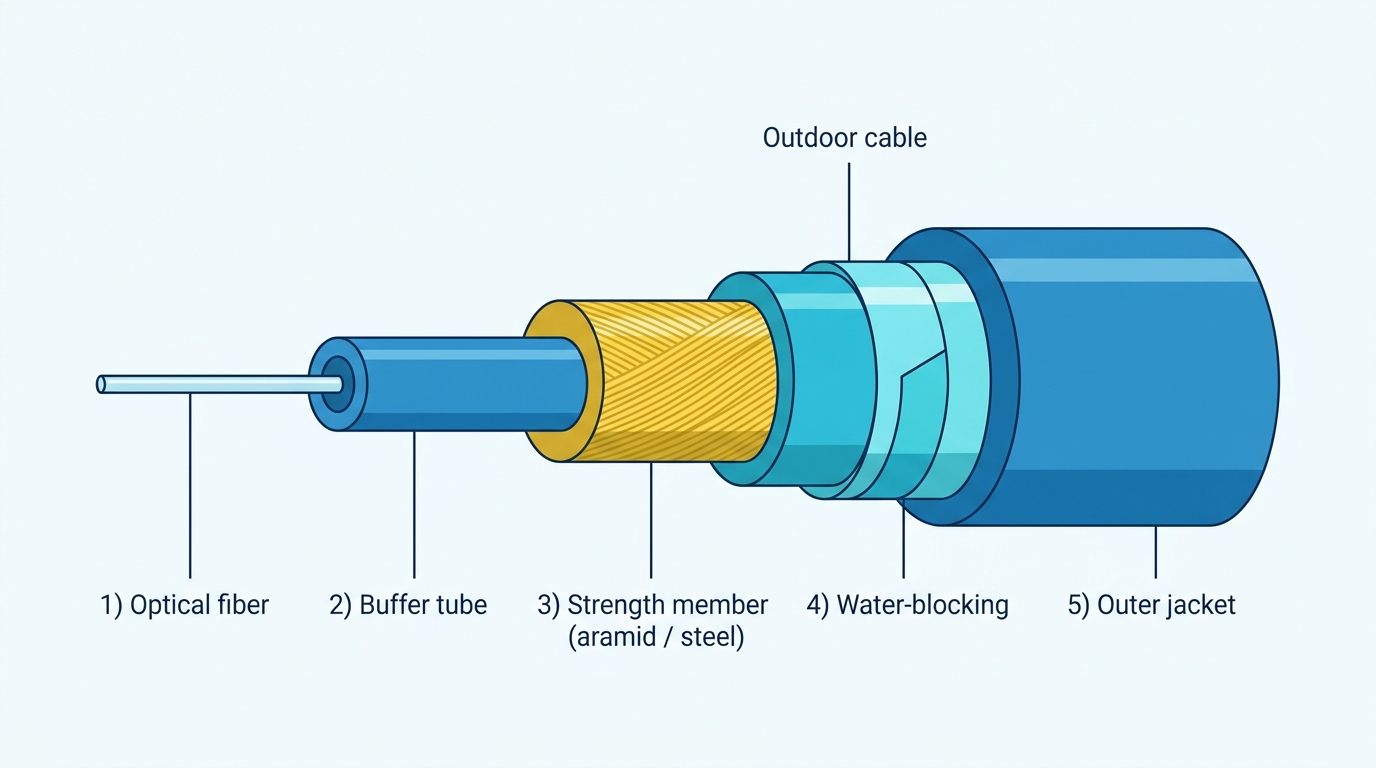
The same glass fiber can end up in a fragile indoor patch cord or a rugged cable rated for a 30-year life on transmission towers. The fiber is the constant; the cable is what makes it fit the job. We'll come back to those outdoor cable types near the end.
Single-mode vs. multimode fiber
Not all optical fibers are the same. The biggest split is between single-mode and multimode, and it comes down to the size of the core.
Single-mode fiber (SMF) has a tiny core—around 9 microns—so narrow that light travels in essentially one straight path, or "mode." With only one path, pulses don't spread much, so single-mode fiber carries signals the farthest: tens to hundreds of kilometers. It's the choice for long-haul telecom, internet backbones, and outdoor networks. It usually runs at wavelengths of 1310 nm and 1550 nm.
Multimode fiber (MMF) has a much wider core—typically 50 or 62.5 microns—so light can take many paths at once. Those paths arrive at slightly different times (a problem called modal dispersion), which limits distance to a few hundred meters. Better multimode fibers use a graded-index core—where the glass gradually changes refractive index—to curb this, rather than the simpler step-index design. But multimode works with cheaper light sources and is easy to terminate, so it dominates short runs inside data centers and buildings. It typically uses 850 nm light. (Within multimode there's a further choice—see 50/125 vs. 62.5/125 core sizes.)
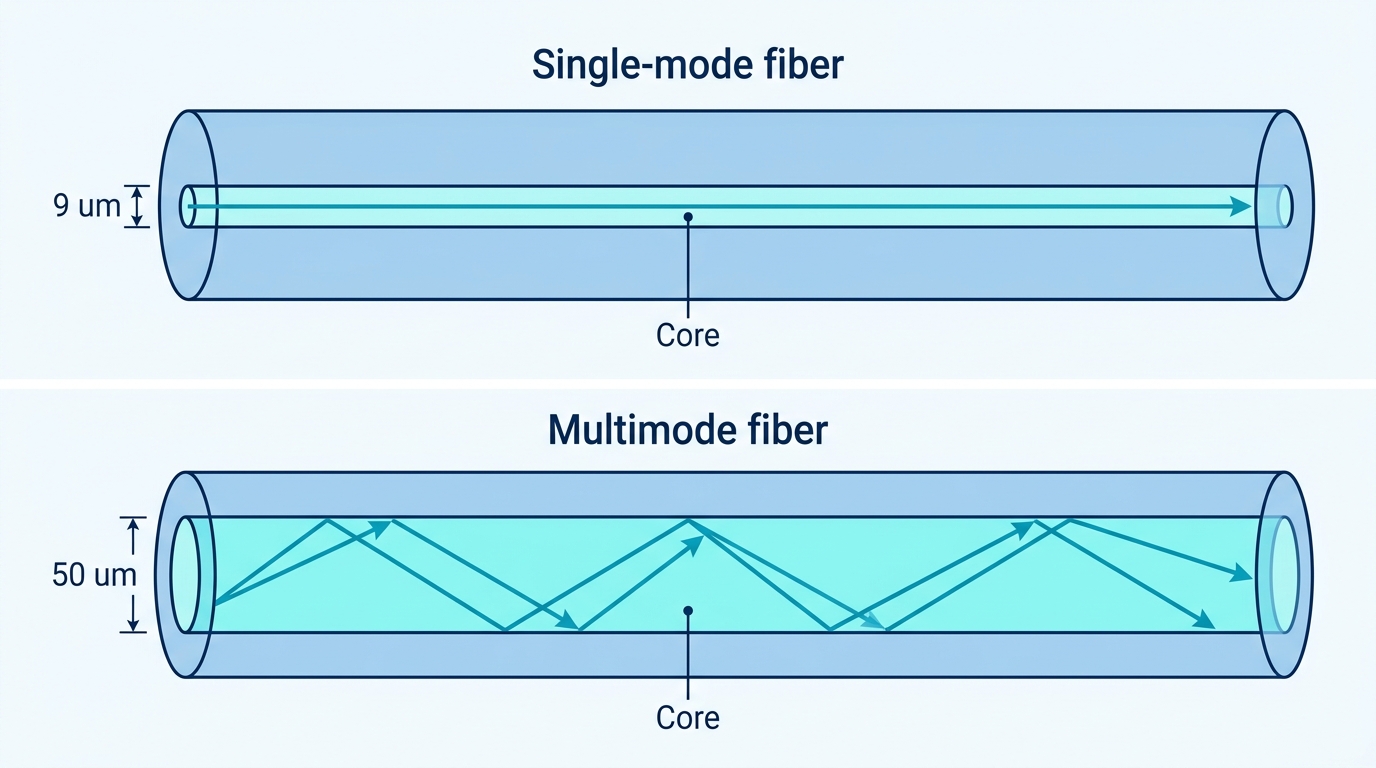
A simple rule of thumb: single-mode for distance, multimode for short reach at lower cost. Outdoor and long-distance cable is almost always single-mode.
How a fiber optic cable is made
Knowing how fiber is manufactured makes every earlier concept click—especially why purity matters so much.
- The preform. It starts as a solid glass rod called a preform, made by depositing ultra-pure silica in vapor form and building up the exact core-and-cladding refractive-index profile layer by layer. The preform is a scaled-up model of the final fiber's cross-section.
- Drawing the fiber. The preform is lowered into a draw tower and heated to around 2,000 °C until the tip softens. Gravity pulls a thread of glass downward, and it's drawn out to a hair-thin 125-micron fiber—kilometers of it from a single preform. The glass keeps the preform's internal proportions the entire way down.
- Coating and testing. As the fiber is drawn, the protective polymer coating is applied and cured in-line, and the fiber's diameter and strength are measured continuously.
- Cabling. Finished fibers are then assembled into buffer tubes, wrapped with strength members and water-blocking, and jacketed—becoming the cable that ships to the field.
The reason glass purity is obsessive here: attenuation is set at the preform stage. Impurities absorb light, so the difference between a signal that reaches 40 km and one that dies at 4 km is decided before the fiber is ever drawn—the full path from raw materials to finished low-loss fiber is worth a closer look. Companies like Corning proved this in 1970 with the first fiber pure enough for practical communication—the breakthrough that made everything since possible.
Fiber optics vs. copper
For a century, communication ran on copper. Fiber replaced it on the routes that matter for concrete reasons:
Fiber optic | Copper | |
|---|---|---|
Signal | Pulses of light | Electrical current |
Bandwidth | Extremely high | Limited |
Distance without a repeater | Tens of km | ~100 m for high-speed data |
Electromagnetic interference | Immune | Susceptible |
Security | Very hard to tap without detection | Easier to tap |
Weight & size | Light, thin | Heavier, bulkier |
The two that changed the game are distance and interference. Because light doesn't weaken the way electrical current does, fiber runs far longer between boosts. And because it carries no electrical signal, it's immune to the electromagnetic noise that corrupts copper near motors, power lines, or radio sources. Copper still wins on short, cheap runs and where devices need power over the same line, but for backbone, long-haul, and high-capacity links, fiber is simply a different class of infrastructure.
What is fiber optics used for?
Fiber quietly underpins most of modern life. Its main uses:
- Internet and telecom backbones. The long-haul links between cities and countries are overwhelmingly fiber.
- Submarine cables. Fiber optic cables on the seabed carry the vast majority of intercontinental data—satellites handle only a sliver by comparison. Industry data puts satellites at well under 1% of international capacity, with submarine cables carrying the rest. You can see the global network on the public submarine cable map, and TeleGeography's cable FAQ explains why fiber beats satellite bit-for-bit.
- Fiber to the home (FTTH/FTTx). The "fiber internet" sold to homes and businesses, bringing gigabit speeds to the doorstep.
- Data centers. Multimode and single-mode fiber link the servers and switches behind every cloud service.
- Medical. Endoscopes use fiber bundles to see inside the body, and lasers delivered by fiber perform surgery.
- Industrial and utility networks. Power grids, railways, and factories use fiber for control signals precisely because it ignores electrical interference.
Advantages and limitations
Fiber's strengths are real, but an honest picture includes the trade-offs—something most guides leave out.
Advantages
- Enormous bandwidth and speed
- Very low signal loss over long distances
- Immunity to electromagnetic interference
- Thin, lightweight, and space-efficient
- Difficult to tap, improving security
- No fire or spark risk (it carries light, not current)
Limitations
- Fragility. Glass breaks if bent too sharply or crushed; installation demands care.
- Skilled installation. Splicing and terminating fiber needs specialized tools (fusion splicers) and trained technicians—you can't just twist two ends together.
- Higher upfront cost for hardware and labor on short runs, even though cost-per-bit is excellent at scale.
- No power delivery. Fiber can't carry electrical power to a device the way copper (Power over Ethernet) can.
For most backbone and long-distance needs these limits are easily worth it. For a short link to a single low-power device, copper can still be the pragmatic choice.
Cable types and deployment: how fiber gets into the field
Once you leave the building, the cable's construction has to match how it's installed. The main outdoor deployment methods:
- Duct / conduit — cable pulled through underground pipes; needs a tough jacket and often water-blocking.
- Direct buried — cable laid straight into a trench; usually armored against moisture and rodents.
- Aerial — cable strung between poles or transmission towers, exposed to wind, ice, sun, and mechanical tension.
Each route asks for a different build; our overview of buried, duct, and aerial install methods breaks down the trade-offs. Aerial routes along power infrastructure are their own specialty, because the cable hangs in a high-voltage electrical environment. Two designs dominate there: OPGW (optical ground wire), which combines fibers with a metal ground wire, and ADSS (All-Dielectric Self-Supporting) cable, which contains no metal at all—we compare how ADSS and OPGW cables differ in detail elsewhere. Because ADSS is fully dielectric, it can be installed on live power lines safely and spans long distances between towers on its own strength—no messenger wire required. It's a clean example of the theme running through this whole guide: the same 125-micron glass fiber, wrapped in a construction designed for one specific, demanding job.
A short history: who invented fiber optics?
The principle of guiding light is old, but practical fiber optic communication has a clear turning point. In 1966, physicist Charles K. Kao showed that if glass could be made pure enough, optical fiber could carry signals over useful distances—identifying impurity, not the concept, as the real obstacle. His insight earned him the 2009 Nobel Prize in Physics and the title "father of fiber optic communications" (Charles K. Kao, Wikipedia). Four years after his 1966 paper, manufacturers produced the first low-loss fiber, and the technology that now wires the planet was born. For more milestones, see the brief history of fiber optic cable.
Frequently asked questions
How does fiber optics work in simple terms? A transmitter turns data into pulses of light, an ultra-pure glass fiber carries that light by bouncing it along its core (total internal reflection), and a receiver at the far end turns the light back into data.
What is the difference between optical fiber and fiber optic cable? Optical fiber is the bare glass strand that carries light. A fiber optic cable is the finished product built around one or more fibers—adding strength members, water-blocking, and a jacket—so it can be deployed in the real world.
What is the difference between single-mode and multimode fiber? Single-mode fiber has a tiny (~9 µm) core and one light path, so it carries signals the farthest—ideal for long-haul and outdoor networks. Multimode fiber has a wider core with many light paths, is cheaper for short runs, and is common inside data centers and buildings.
Is fiber optics better than copper? For bandwidth, distance, and immunity to interference, yes—fiber outperforms copper by a wide margin. Copper still makes sense for short runs and when a cable must also deliver electrical power.
How fast is fiber optics? A single fiber can carry terabits per second, and consumer "fiber internet" commonly delivers gigabit speeds—far beyond typical copper connections.
Who invented fiber optics? Charles K. Kao's 1966 work on light transmission in glass made practical fiber optic communication possible, earning him the 2009 Nobel Prize in Physics.
Fiber optics turns light into the most capable communication medium we have—but the technology only reaches the field as a well-built cable. If you're planning an outdoor or aerial route, our team can help you match the right cable construction, including all-dielectric ADSS cable, to your span and environment.