OM3 vs OM4 Fiber: How to Choose — and Where OM1, OM2 & OM5 Fit

OM3 vs OM4 Fiber: How to Choose — and Where OM1, OM2 & OM5 Fit
Ask ten network engineers to pick between OM3 and OM4 and you'll get one honest answer: "How long is the run, and what speed are you pushing?" Everything else — bandwidth numbers, jacket colors, price per meter — is downstream of those two questions.
Here's the short version, and it's the only sentence most people need:
OM3 and OM4 are both laser-optimized 50/125 µm multimode fibers. OM4 carries roughly 2.3× the modal bandwidth (4700 vs 2000 MHz·km at 850 nm), which lets it run the same Ethernet speeds about 50% farther. Choose OM3 for links under ~100 m to save money; choose OM4 for longer runs, denser 100G/400G links, or upgrade headroom.
That's the decision in one breath. The rest of this guide is for when "it depends" isn't good enough — the full spec table, the 400G fork that trips people up in 2026, the cost math that actually matters, and where the older OM1/OM2 and the newer OM5 fit on the ladder.
The whole ladder: OM1 to OM5 at a glance
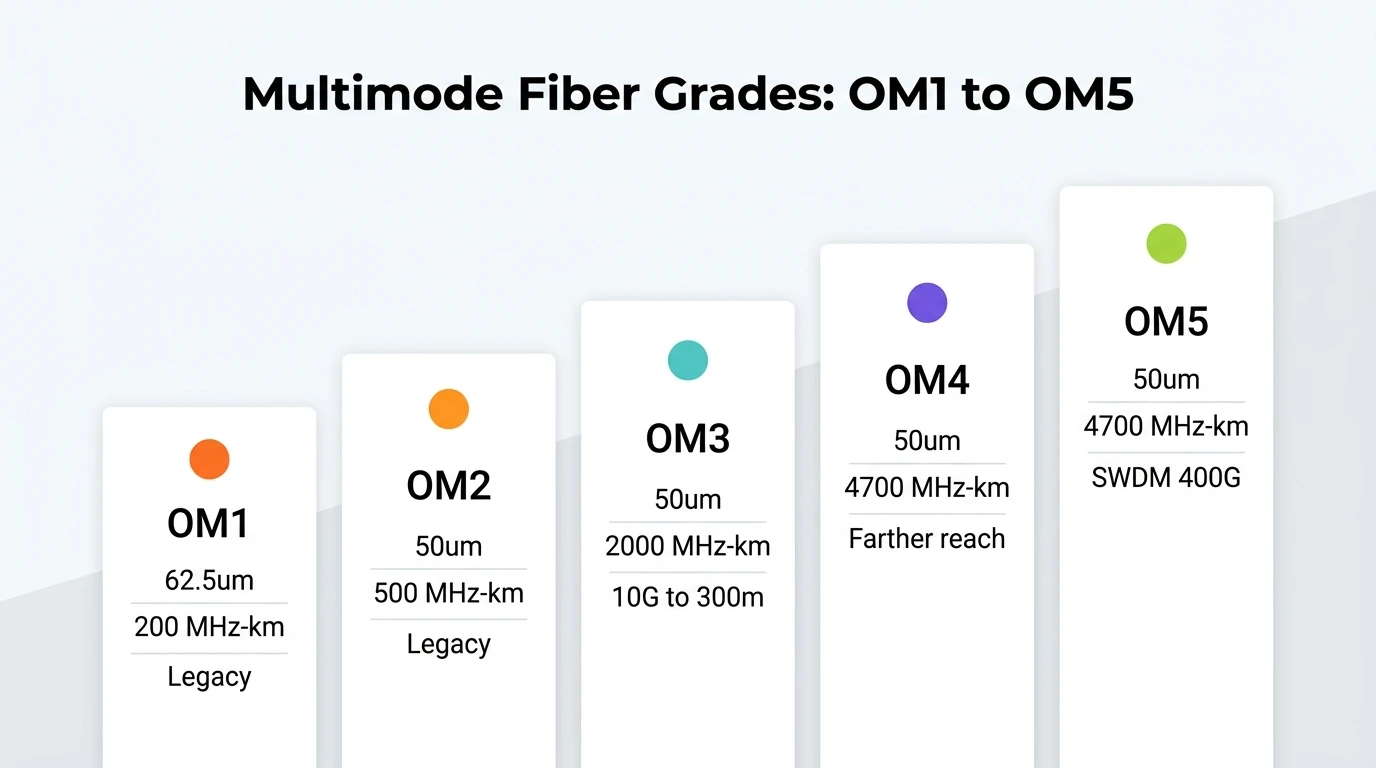
"OM" stands for Optical Multimode — a grading system defined in the ISO/IEC 11801 structured-cabling standard and mirrored in TIA-492. Each grade tells you two things at once: the fiber's core construction and the effective modal bandwidth (EMB) it guarantees. Higher EMB means the fiber holds a clean signal over more distance before the light pulses smear together.
Grade | Core (µm) | Light source | Jacket color | EMB @850 nm | Typical max speed × reach | Status |
|---|---|---|---|---|---|---|
OM1 | 62.5/125 | LED | Orange | 200 MHz·km | 1G @ 275 m, 10G @ 33 m | Legacy |
OM2 | 50/125 | LED | Orange | 500 MHz·km | 1G @ 550 m, 10G @ 82 m | Legacy |
OM3 | 50/125 | Laser (VCSEL) | Aqua | 2000 MHz·km | 10G @ 300 m, 100G @ 70 m | Current |
OM4 | 50/125 | Laser (VCSEL) | Aqua / Erika violet | 4700 MHz·km | 10G @ 400 m, 100G @ 100 m | Current |
OM5 | 50/125 | Laser (VCSEL) | Lime green | 4700 MHz·km (+ 953 nm band) | 100G/400G via SWDM over fewer fibers | Newest |
The dividing line runs right through the middle of the table. OM1 and OM2 are LED-era fiber — fine for 1 Gigabit, but they choke well before 10G over any useful distance, which is why almost nobody specs them for new builds. For a deeper look at those two, see the difference between OM1, OM2, OM3 and OM4, the head-to-head on OM1 vs OM2, and whether OM2 is obsolete.
OM3, OM4 and OM5 are laser-optimized multimode fiber (LOMMF) — engineered for the 850 nm VCSEL transceivers that drive modern 10G–400G data centers. That's why the real 2026 decision is almost always OM3 vs OM4 (with OM5 as a special case we'll get to). So let's put those two head to head.
OM3 vs OM4: the head-to-head spec table
On paper the two fibers are near-twins. Same 50/125 µm glass, same connectors, same 850 nm transceivers, same aqua jacket much of the time. The difference lives in one number — modal bandwidth — and everything the higher number buys you.
Spec | OM3 | OM4 |
|---|---|---|
Core / cladding | 50/125 µm | 50/125 µm |
Fiber class (ISO/IEC 11801) | A1a.2 | A1a.3 |
Effective modal bandwidth @850 nm | 2000 MHz·km | 4700 MHz·km |
Max attenuation @850 nm | ≤ 3.5 dB/km | ≤ 3.5 dB/km (premium ≈ 3.0 dB/km) |
Optimized wavelength | 850 nm | 850 nm |
Standard jacket color | Aqua | Aqua or Erika violet |
10G (10GBASE-SR) reach | 300 m | 400 m |
40G / 100G (SR4) reach | 100 m / 70 m | 150 m / 100 m |
400G (SR8) reach | ~70 m | ~100 m |
Relative cable cost | Baseline | ≈ +$0.10–0.30/m |
Two takeaways matter. First, OM4's edge is entirely about reach, not raw speed — both fibers support the exact same Ethernet standards; OM4 just runs them farther. Second, the attenuation spec is basically identical — the reach advantage comes from bandwidth (dispersion control), not lower loss. That's a distinction most competing articles skip, and it's the key to understanding why OM4 goes farther.
Why OM4 reaches farther (the mechanism)
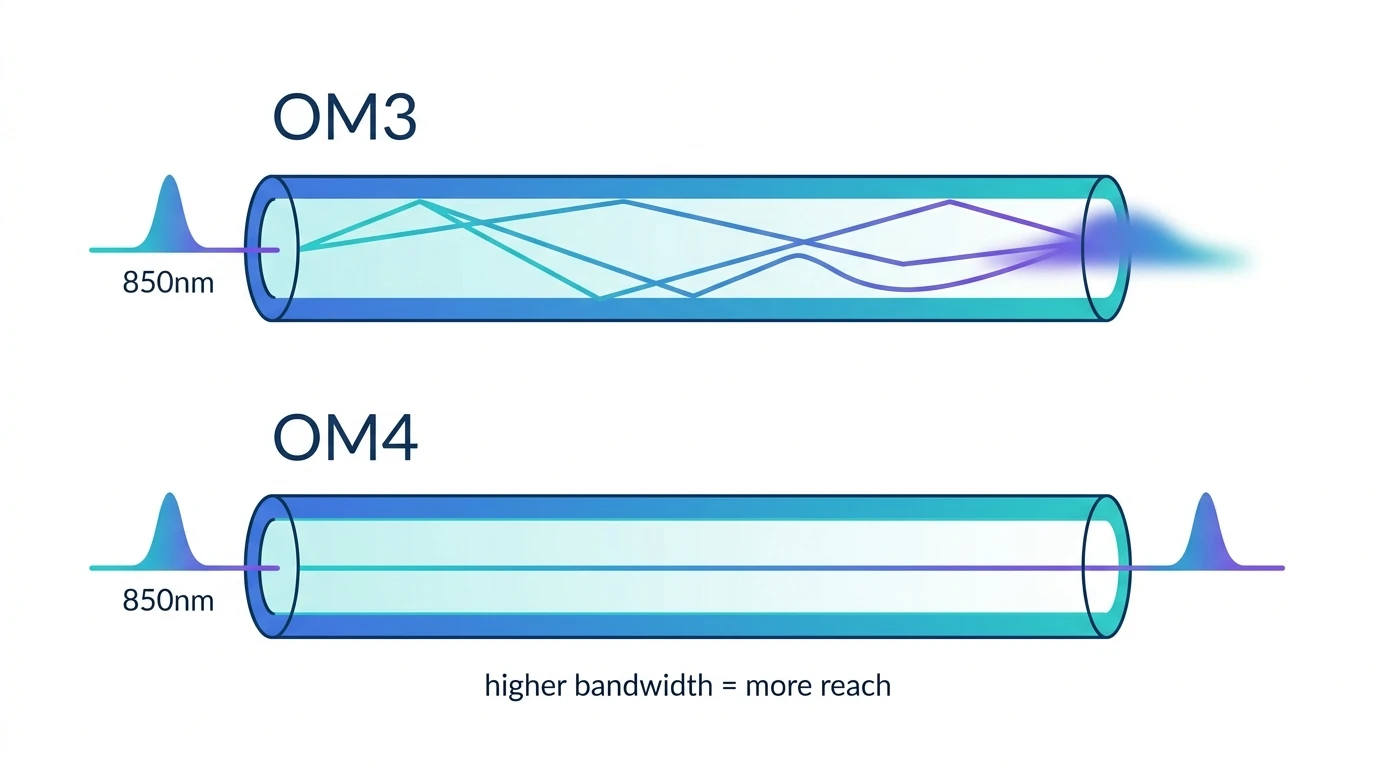
When a VCSEL fires an 850 nm pulse into a multimode core, the light travels along many paths, or modes, at slightly different speeds. Over distance those modes arrive spread out in time — an effect called differential mode delay (DMD). Spread the pulse far enough and the receiver can no longer tell one bit from the next. That's the wall multimode distance runs into.
OM4 pushes the wall back with tighter manufacturing tolerances on the refractive-index profile, which shrinks DMD and raises the effective modal bandwidth to 4700 MHz·km. More bandwidth = a cleaner pulse over more kilometers = more reach at the same speed. Both OM3 and OM4 are already "laser-optimized" (specified with an effective modal bandwidth for VCSEL sources, unlike the LED-era overfilled-launch spec of OM1/OM2) — OM4 simply holds that optimization to a stricter grade.
Distance by speed: the matrix that actually decides it
Bandwidth is abstract; supported distance at your line rate is not. This is the table to bookmark — it's what the r/networking veterans are really arguing about when they trade "330 ft vs 500 ft" war stories.
Ethernet speed | Transceiver | OM3 reach | OM4 reach |
|---|---|---|---|
1G | 1000BASE-SX | 550 m | 550 m |
10G | 10GBASE-SR | 300 m | 400 m |
40G | 40GBASE-SR4 | 100 m | 150 m |
100G | 100GBASE-SR4 | 70 m | 100 m |
400G | 400GBASE-SR8 | ~70 m | ~100 m |
Notice how the gap matters more as speed climbs. At 10G, both fibers clear almost any building — the choice barely registers. At 40G and above, OM3 tops out around 100 m while OM4 buys you 150 m, and that 50 m is exactly the margin that decides whether a spine-leaf or building-to-building link works on multimode at all. For a deep dive on the OM4 ceiling specifically, see how far OM4 multimode fiber can transmit.
A note on the "550 m" you'll see elsewhere: some vendors quote OM4 at 550 m for 10G under ideal, extended-reach conditions. The IEEE 802.3 10GBASE-SR standard guarantees 400 m. We list the standards-based figure — build to that and you won't get surprised.
The 400G fork: where OM5 finally earns its place
Here's the part almost every OM3-vs-OM4 article ignores, and it's the fastest-moving corner of the topic. At 400G, the transceiver you pick splits the road:
- 400GBASE-SR8 uses eight parallel 850 nm lanes and runs on OM3 (~70 m) or OM4 (~100 m) — no new fiber grade required. This is the mainstream 400G path in most AI/cloud data centers today.
- 400GBASE-SR4.2 uses four fibers with two wavelengths each (a form of short-wavelength WDM). That second wavelength is where OM5 matters: OM5 is characterized for bandwidth across the 850–953 nm short-wavelength band rather than at 850 nm alone, which extends SR4.2 reach and lets you carry 400G over half the fiber count.
So the honest positioning: OM5 is not "better OM4" for ordinary links. At a single 850 nm wavelength, OM5 and OM4 perform identically (both 4700 MHz·km). OM5 only pulls ahead when you deploy short-wavelength-division-multiplexing optics. If SWDM isn't on your roadmap, OM4 gives you the same reach for less money. When it is, see where OM4 and OM5 fiber cables earn their keep.
Cost & TCO: the truth about "OM4 is more expensive"
The cable price gap is almost a rounding error. OM4 typically runs $0.10–0.30 more per meter than OM3 — a few dollars across a rack, maybe a couple hundred across a floor. If the cable were the whole cost, you'd just buy OM4 and stop reading.
It isn't. The money in an optical link lives in the transceivers and the labor to pull, terminate, and test fiber — and those are identical whether the glass is OM3 or OM4. A single 100G QSFP28 SR4 module costs more than hundreds of meters of either cable. So the real total-cost-of-ownership question is never "which cable is cheaper?" It's "which cable will I have to rip out and re-pull in three years?"
That reframes the choice:
- Choose OM3 when the runs are short (comfortably under 100 m), the speed ceiling is 10G–40G, and the plant won't outlive its speed tier. You pocket a small saving with zero downside.
- Choose OM4 when runs approach or exceed 100 m, when 100G/400G is live or on the roadmap, or when re-pulling fiber later would cost far more than the cable premium today. For most new data center builds in 2026, OM4 is the default precisely because the re-pull risk dwarfs the price gap.
Compatibility & mixing: answering the questions everyone asks
Are OM3 and OM4 compatible? Yes. They share the same 50/125 µm core geometry, the same connectors, and the same transceivers, so you can interconnect them freely.
But can you mix them in one channel? You can — with one rule: a mixed OM3/OM4 link performs to the OM3 spec. The weakest fiber in the path sets the reach. Splice an OM3 patch cord onto an OM4 trunk and the whole channel behaves like OM3. That's fine for a short jumper on a long OM4 backbone; it's a problem if you're counting on OM4 distance end to end.
Can you put OM3 connectors on OM4 fiber? Yes — connectors (LC, SC, MPO/MTP) are graded by ferrule and polish, not by OM class. An LC connector doesn't care whether the glass behind it is OM3 or OM4. What you do need to keep straight is MPO polarity (Type A/B/C) when you're wiring parallel 40G/100G/400G links — a polarity mismatch will break the channel regardless of fiber grade.
The jacket color myth
You cannot identify fiber grade by jacket color alone — and this trips up more installers than any spec. Here's the reality:
- OM3 is aqua. OM4 is also frequently aqua — the two look identical off the reel.
- Some manufacturers (and many MPO/MTP assemblies) mark OM4 in Erika violet to distinguish it, a convention more common in Europe and among some U.S. vendors.
- OM5 is lime green. OM1/OM2 are orange.
Because aqua covers both OM3 and OM4, always read the cable print legend or the assembly label, never the color. Color is a hint, not a spec.
Connectors, transceivers, and how to actually deploy it
Two connector worlds map onto the two speed tiers:
- LC duplex — two fibers, one transmit, one receive. This is the workhorse for 1G/10G serial links (10GBASE-SR).
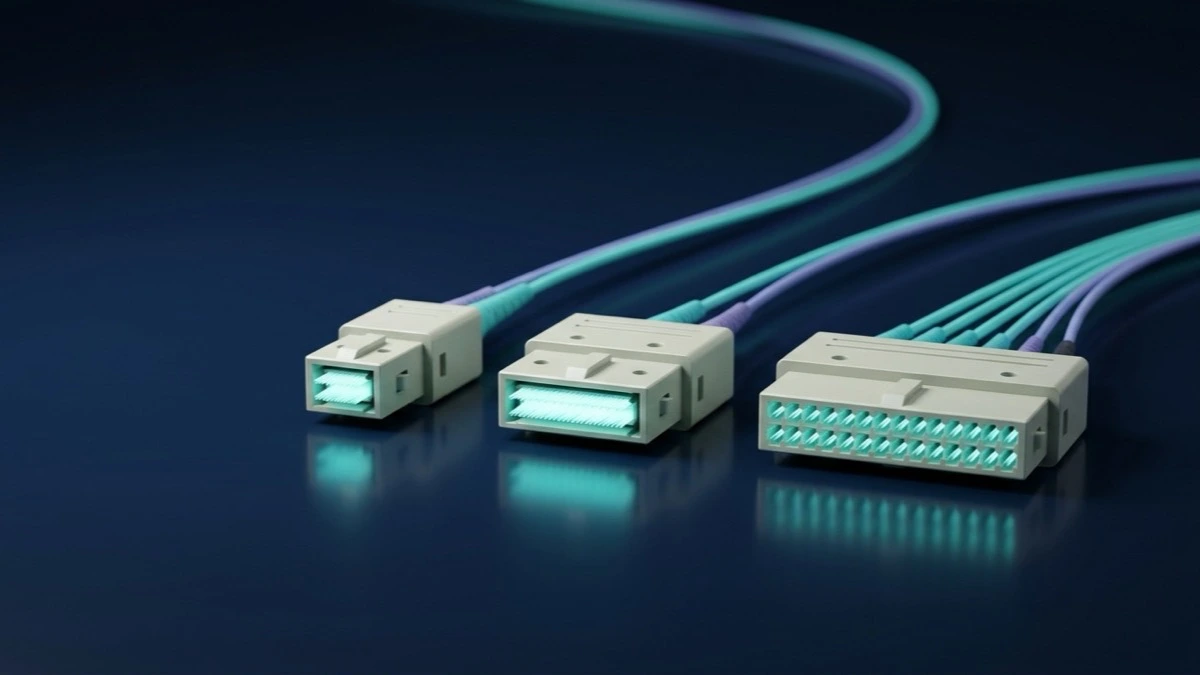
- MPO/MTP — 12- or 24-fiber array connectors that carry the parallel optics behind 40G-SR4, 100G-SR4/SR10, and 400G-SR8. If you're running 40G and up, you're almost certainly running MPO.
This is where the fiber grade meets real hardware. TTI Fiber manufactures both worlds in OM3 and OM4: LC-LC OM3 duplex patch cords for 10G links, and MPO/UPC OM3 and MPO/UPC OM4 patch cords for 40G/100G/400G parallel optics. The OM4 assemblies deliver the full 4700 MHz·km EMB — supporting 100GBASE-SR4 to 100 m — and every cord is 100% factory-tested for insertion and return loss, which is the part that actually determines whether your link closes its power budget.
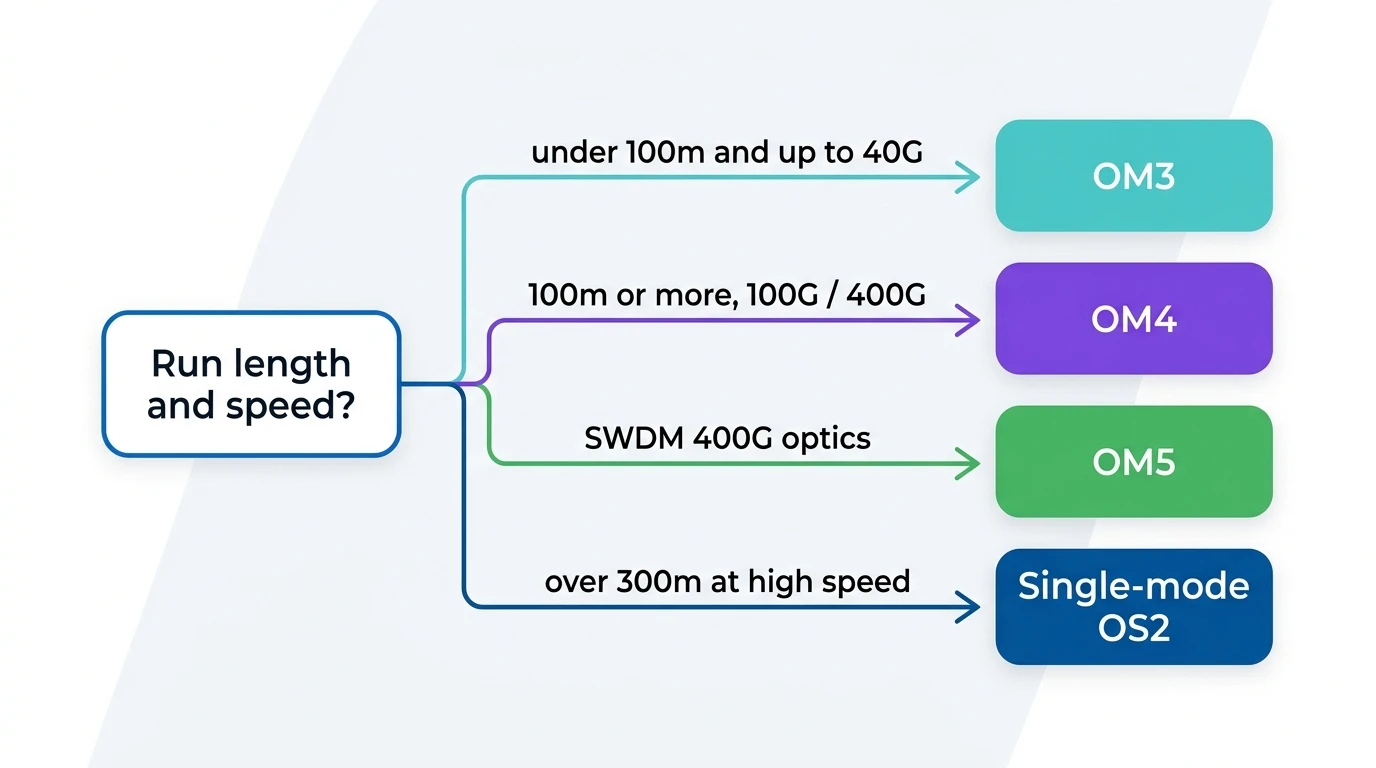
A 20-second decision framework:
- Run length under ~100 m and speed ≤ 40G? OM3 is enough — take the saving.
- Runs near or over 100 m, or 100G/400G now or soon? OM4 — buy the headroom.
- Deploying SWDM (SR4.2) 400G optics? OM5 — otherwise OM4 does the same job cheaper.
- Distances beyond multimode's reach (300 m+ at high speed)? Step up to single-mode OS2 instead.
Frequently asked questions
What is the difference between OM3 and OM4? OM4 has higher effective modal bandwidth (4700 vs 2000 MHz·km at 850 nm), so it runs the same Ethernet speeds about 50% farther — for example 100G to 100 m versus 70 m. Both are laser-optimized 50/125 µm multimode fibers using the same connectors and transceivers.
Are OM4 and OM3 compatible? Yes. They share core geometry, connectors, and transceivers, so they interconnect freely. A mixed OM3/OM4 channel, however, performs to OM3 (the lower grade) distances.
Can you put OM3 connectors on OM4 fiber? Yes. Connectors (LC, SC, MPO) are specified by ferrule and polish, not by OM grade, so any multimode connector works on either fiber.
Which is better, OM3 or OM4? Neither is universally "better." OM4 is the safer pick for runs over ~100 m or 100G/400G links; OM3 is the cost-effective pick for shorter, slower links. The run length and target speed decide it.
Can OM3 and OM4 carry 400G? Yes — 400GBASE-SR8 runs on OM3 (~70 m) and OM4 (~100 m). Only 400GBASE-SR4.2, which uses short-wavelength WDM, benefits from OM5.
The bottom line
OM3 and OM4 are the same fiber family with different distance budgets. Map your longest run against your target speed, remember that the cable premium is trivial next to the cost of re-pulling fiber, and the answer falls out: OM3 to save on short, moderate-speed links; OM4 for reach and 100G/400G headroom; OM5 only when SWDM optics are on the table.
Whichever grade you land on, the fiber only performs if the assembly is built and tested to spec. Explore TTI Fiber's factory-tested OM3 and OM4 MPO and LC patch cords to match the grade you've chosen to a data-center-ready cord.